
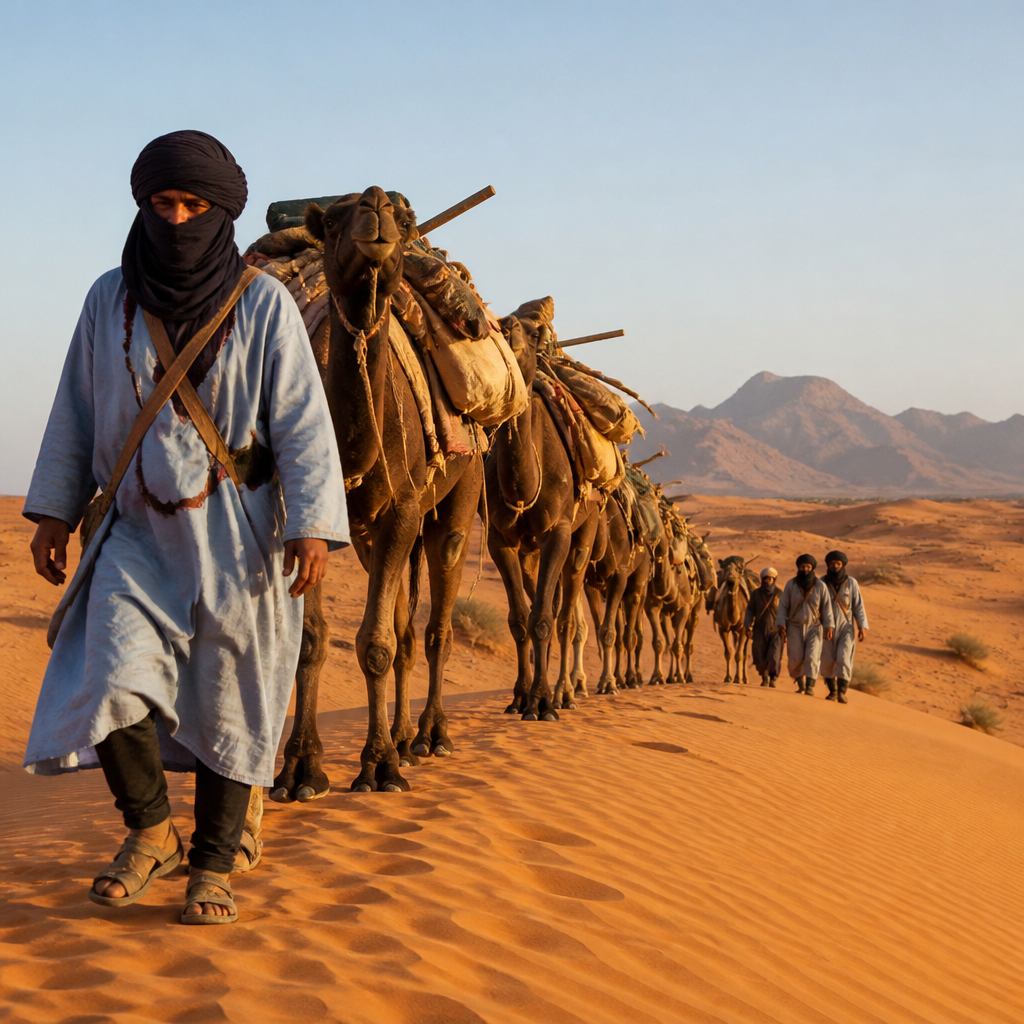
Berber trans-Saharan nomadic caravans linked North Africa and the Sahel for more than a millennium, carrying salt, gold, textiles, books, livestock, and ideas across one of the harshest trade environments on earth. In this context, Berber refers to the Amazigh-speaking peoples of North Africa, while trans-Saharan commerce means the organized movement of goods, people, and knowledge across the Sahara by camel caravan. As a hub within African Empires and Cultural Traditions, this subject matters because it explains how desert mobility helped shape states such as Ghana, Mali, Songhai, and later Saadian Morocco, while also preserving local lifeways among Tuareg, Sanhaja, Zenata, and other caravan communities. I have found that readers often imagine the Sahara as an empty barrier; historically, it was a structured economic corridor with routes, toll points, oasis markets, legal customs, and seasonal rhythms. Understanding these caravans reveals how African history was built not only by kingdoms and courts, but also by nomads, guides, herders, clerics, and merchants who made long-distance exchange possible.
Who the caravan peoples were and why mobility mattered
Berber caravan culture was never a single tribe or a fixed ethnic block. It included confederations and lineages spread from present-day Morocco and Algeria to Libya, Mauritania, Mali, and Niger. The Sanhaja were especially important in western Saharan trade, while Tuareg groups dominated many central Saharan routes. Their power came from environmental expertise. They knew where wells held through the dry season, how far a camel could travel under varying loads, which stars guided night movement, and which oasis settlements could supply fodder, grain, leather goods, and replacement animals. In practical terms, mobility was capital. A family with pack camels, grazing rights, alliances, and route knowledge possessed commercial capacity that settled farmers could not easily replicate.
That mobile capacity helped connect very different ecological zones. From the Maghreb came woven cloth, metalware, horses, glass beads, sugar, dates, and minted coin. From the Sahel and savanna came gold dust, kola nuts, slaves in earlier centuries, ivory, ostrich feathers, leather, and later regional manufactures. Caravans also carried religious scholarship. Manuscripts moved to centers such as Timbuktu, Chinguetti, Walata, and Agadez, strengthening Islamic learning while preserving local legal and linguistic traditions. This is why any serious overview of African Empires and Cultural Traditions must place desert commerce at the center. Empires taxed trade, protected routes, and negotiated with nomadic groups, but nomadic groups controlled the mechanics of movement.
How camel caravans operated across the Sahara
The camel transformed Saharan trade after its widespread adoption in late antiquity and the early Islamic period. Dromedaries could endure heat, carry heavy loads, and travel long distances between water sources. A caravan was a disciplined transport system, not a loose line of animals crossing sand at random. Merchants assembled financing, hired guides, secured guards where necessary, purchased fodder at staging points, and timed departures around temperature and pasture conditions. Loads were carefully balanced. Salt slabs from Taghaza or Taoudenni might travel south on camel back, while gold and other high-value goods moved north in smaller, better-guarded consignments.
In western routes, caravans often linked Sijilmasa in southeastern Morocco with Awdaghust, Oualata, Timbuktu, and Gao. Central Saharan traffic connected Ghadames, Ghat, and Tuat with Air, Kano, and Lake Chad networks. Travel was slow and dangerous. Sandstorms could erase tracks, wells could fail, and raiding remained a constant threat. Yet caravan organization reduced risk through scale and experience. Medieval Arabic geographers including al-Bakri and Ibn Battuta described large caravans numbering hundreds or even thousands of camels. Such numbers were credible on major routes because scale improved security, spread fixed costs, and allowed merchants to move both bulk goods and luxury items in the same expedition.
Major routes, goods, and commercial hubs
Different routes specialized according to geography and politics. Western routes were famous for the gold-salt exchange. Saharan salt was indispensable in the Sahel because it preserved food, supported animal health, and supplied a dietary necessity in hot climates. Gold from Bambuk, Bure, and later Akan-linked zones underwrote North African minting and Mediterranean commerce. In the central Sahara, copper, textiles, dates, and enslaved laborers moved through relay markets, while Hausaland and Kanem-Bornu connected desert trade to manufacturing and regional agriculture. No route existed in isolation; each linked to river transport, local caravans, and urban redistribution.
| Route or Hub | Primary Role | Key Goods | Historical Importance |
|---|---|---|---|
| Sijilmasa | Northern staging market | Textiles, coin, horses, dates | Major gateway from Morocco into western Sahara |
| Taghaza and Taoudenni | Salt extraction centers | Rock salt slabs | Supplied essential bulk commodity to Sahelian markets |
| Oualata and Chinguetti | Oasis entrepots and scholarly towns | Grain, manuscripts, leather, salt | Linked commerce with Islamic education and law |
| Timbuktu | Redistribution and intellectual center | Gold, books, cloth, salt | Connected Niger trade to Saharan and global networks |
| Gao | River-desert junction | Gold, rice, fish, copper | Strategic city for Songhai power and taxation |
| Agadez | Central Saharan caravan crossroads | Livestock, dates, cloth, salt | Key node for Tuareg-led movement toward Hausaland |
These hubs mattered because they concentrated trust. Merchants needed exchange rates, storage, contract witnesses, and authorities able to enforce obligations. Oasis towns supplied all four. In my experience studying caravan economies, this is where readers grasp the system best: a caravan was not only transport but an institutional chain. A salt miner in the desert, a camel owner in an encampment, a jurist in a mosque school, a tax collector at a city gate, and a gold trader on the Niger all depended on one another. The commercial map of the Sahara was therefore social as much as geographic.
Caravans and the rise of African empires
Trans-Saharan commerce strengthened states by creating taxable flows and strategic chokepoints. The Empire of Ghana, centered in the western Sahel before Mali’s rise, prospered by taxing goods entering and leaving its territory. Arabic sources describe rulers drawing revenue from both imported salt and exported gold. Mali expanded this pattern. Under Mansa Musa in the fourteenth century, imperial power rested partly on controlling trade corridors and Niger cities tied to caravan traffic. His famous pilgrimage to Mecca demonstrated immense wealth, but that wealth depended on a broader infrastructure of miners, merchants, caravan leaders, and provincial administrators.
Songhai later deepened this model. By holding Gao, Timbuktu, and stretches of the Niger bend, Songhai connected inland agricultural production, river transport, and desert exchange. Military force mattered, but logistics mattered just as much. States that secured caravan routes could tax commerce more reliably than those that merely raided it. That distinction explains why stable empires usually cultivated relationships with nomadic intermediaries rather than trying to eliminate their autonomy. Similar dynamics appeared farther east in Kanem-Bornu, which linked Saharan routes to Lake Chad commerce. Across the continent, desert trade was not a side story to imperial history; it was a central mechanism of political finance, diplomacy, and urban growth.
Cultural exchange, religion, and everyday life along the routes
Caravans moved beliefs and habits as surely as commodities. Islam spread gradually through merchant contact, scholarly travel, and patronage from rulers who saw value in literate administration and broader diplomatic ties. Yet conversion never erased local culture. Berber, Soninke, Mandé, Songhai, Hausa, Fulani, and Tamasheq traditions adapted Islam to regional conditions, producing distinct legal schools, manuscript cultures, architectural forms, and ceremonial practices. In Saharan towns, mosques often stood beside markets because commerce and scholarship reinforced each other. A trader needed contract law, inheritance rules, and trusted witnesses; clerics and judges helped provide them.
Everyday caravan life was physically demanding. Camps had to be set with attention to wind, animal lines, cooking fuel, and watch rotations. Food was practical: dates, millet, dried meat, clarified butter, tea in later periods, and whatever could be obtained at wells or settlements. Women in nomadic communities often managed tents, household goods, weaving, and aspects of exchange, while men handled long-distance travel more visibly; however, actual labor divisions varied by group and period. Language skills were commercially valuable. A successful broker might move between Arabic, Tamasheq, Songhay, or Hassaniya contexts with ease. These details matter because they show caravan culture as lived reality rather than romantic scenery.
Risk, adaptation, and the long decline of classic desert commerce
Caravan trade was resilient, but it was never permanent in one form. Climate variability altered pasture and water access. Political fragmentation made some routes more dangerous and shifted traffic to competitors. The Moroccan invasion of Songhai in 1591 disrupted established western networks even as trade continued in modified patterns. Atlantic commerce then redirected some gold, slave, and textile flows toward coastal ports. By the nineteenth and twentieth centuries, steam shipping, colonial borders, railways, and later motor transport eroded the comparative advantage of long camel caravans. Salt caravans persisted in places such as Taoudenni far into the modern era, but they served narrower markets.
Decline does not mean disappearance. Many Saharan communities adapted by combining herding, oasis agriculture, guiding, regional trade, and wage labor. Some route knowledge remains economically relevant for tourism, heritage work, and cross-border transport, though modern states now regulate movement far more tightly than precolonial empires did. For anyone exploring World Cultures and Global Heritage, the lasting lesson is clear: Berber trans-Saharan nomadic caravans were not marginal survivals from an isolated desert. They were architects of African connectivity, enabling empires, circulating faith and scholarship, and shaping identities across North and West Africa. To understand African empires and cultural traditions as an interconnected whole, start with the caravan routes, then follow the people, cities, and ideas they bound together across the sand.
Frequently Asked Questions
What were Berber trans-Saharan nomadic caravans, and why were they so important?
Berber trans-Saharan nomadic caravans were organized trading expeditions led largely by Amazigh-speaking peoples of North Africa who specialized in moving goods, people, and information across the Sahara Desert. These caravans connected Mediterranean North Africa with the Sahel and West Africa for well over a thousand years, making them one of the most important commercial systems in premodern Africa. Rather than being random journeys through empty desert, they followed established routes, relied on deep environmental knowledge, and involved careful planning around water sources, seasonal conditions, grazing areas, and political alliances.
Their importance came from the fact that they linked regions with very different resources and markets. Salt from the Sahara and its desert-edge mines was essential in the Sahel, while gold from West Africa was highly valued in North Africa and beyond. Caravans also transported textiles, leather goods, dates, copper, beads, livestock, manuscripts, and other valuable commodities. Just as importantly, they carried religious ideas, legal traditions, languages, artistic influences, and scholarly knowledge. In that sense, trans-Saharan commerce was not only an economic network but also a cultural bridge that helped shape African empires, urban centers, and Islamic intellectual life.
These caravans mattered because they supported the rise and strength of major states such as Ghana, Mali, and Songhai, whose wealth and political influence were closely connected to their ability to tax, protect, and benefit from long-distance trade. Cities at the desert’s edge and beyond, including Sijilmasa, Timbuktu, Gao, and Walata, became important commercial and learning centers because caravans made sustained exchange possible. Without Berber expertise in desert travel and caravan organization, the Sahara would have remained a much stronger barrier. Instead, it became a challenging but navigable zone of connection.
How did Berber caravan traders survive and navigate across the Sahara?
Surviving the Sahara required highly specialized knowledge, and Berber caravan leaders developed techniques refined over generations. The camel was central to this system. Often called the “ship of the desert,” the camel made trans-Saharan trade possible on a large scale because it could carry heavy loads, travel long distances with limited water, and endure the heat and dryness of desert conditions far better than most other pack animals. Caravan organization was also critical. Journeys were not improvised; they were carefully timed and managed, often involving guides, merchants, drovers, guards, and animal handlers.
Navigation depended on intimate familiarity with routes, wells, oases, stars, dunes, rocky plateaus, and seasonal weather patterns. Experienced guides memorized long-distance pathways and knew where reliable water could be found, which was often the difference between success and disaster. Caravans frequently moved in large groups both for safety and for logistical efficiency. A larger caravan could better defend itself, pool resources, and carry enough supplies for long stretches between water sources. Food, fodder, and trade goods all had to be balanced carefully because overloading animals could jeopardize the entire expedition.
The risks were considerable. Sandstorms, extreme temperatures, thirst, disease, animal loss, and banditry were constant threats. Political instability along a route could also disrupt trade. To reduce danger, merchants cultivated alliances with local authorities and nomadic groups who controlled access to stretches of territory or key watering points. In practical terms, survival was a combination of technology, experience, social networks, and discipline. The success of Berber caravans demonstrates not only endurance but also a sophisticated understanding of geography, climate, and long-distance commerce in one of the world’s most demanding environments.
What goods were traded in trans-Saharan caravan commerce?
Trans-Saharan caravan commerce involved a wide variety of goods, but a few commodities became especially famous because they were so valuable and so closely tied to regional needs. Salt was one of the most important. Mined in places such as Taghaza and other Saharan sites, salt was essential for diet, food preservation, and animal health, particularly in warmer regions where human and livestock needs were high. In many areas of the Sahel and West Africa, salt could be exchanged at great value because local supplies were limited. Gold was another major commodity, especially from West African zones connected to powerful empires. North African and Mediterranean markets prized this gold, and it played a major role in broader Afro-Eurasian trade networks.
Other traded goods included textiles, horses, copper, beads, leather goods, weapons, dates, dried foods, and crafted items. Books and manuscripts were also important, especially as centers such as Timbuktu grew into hubs of scholarship and Islamic learning. Caravans therefore moved not only practical goods but also intellectual resources. Livestock could be exchanged or driven along parts of the route, depending on local conditions. In some periods, enslaved people were also tragically part of trans-Saharan commerce, reflecting the harsh realities of historical trade systems and power structures.
What makes this trade especially significant is that the goods were part of larger systems of exchange and social transformation. A load of salt was not just a commodity; it could sustain communities and underpin regional markets. A shipment of books might strengthen religious education, legal scholarship, or literacy in a major town. Fine textiles and imported goods could signal status and political legitimacy for elites. In this way, caravan trade shaped everyday life, state finance, religious practice, and cultural prestige across North Africa and the Sahel.
How did Berber caravans influence African empires and cultural traditions?
Berber caravans played a major role in the development of African empires because they helped create and maintain the commercial arteries that sustained political power. States such as Ghana, Mali, and Songhai benefited from controlling trade routes, taxing caravans, protecting merchants, and managing key trading cities. Wealth generated by this exchange could support armies, courts, religious institutions, and urban development. When rulers secured strategic crossroads or oasis-linked towns, they strengthened their ability to participate in regional and international commerce.
Culturally, the impact was equally profound. These caravans facilitated the spread of Islam across parts of the Sahara and the Sahel, not usually as a single dramatic event but through long-term contact among merchants, scholars, rulers, and local communities. Mosques, schools, legal traditions, and Arabic literacy expanded in many trade-connected towns. At the same time, local cultures did not simply disappear or become passive recipients of outside influence. Instead, African societies adapted, reinterpreted, and integrated new religious and intellectual traditions into existing social frameworks. This produced rich and distinctive cultural landscapes.
The caravan routes also encouraged multilingual exchange, artistic influence, diplomatic contact, and the movement of ideas about law, governance, scholarship, and commerce. Urban centers tied to caravan traffic became meeting points where desert nomads, settled merchants, scholars, rulers, and craftspeople interacted. The result was a dynamic zone of exchange rather than a rigid boundary between North Africa and sub-Saharan Africa. Berber trans-Saharan commerce thus helped shape African empires not only through wealth, but through the circulation of institutions, beliefs, and knowledge that became part of broader African cultural traditions.
Why does the history of trans-Saharan Berber commerce still matter today?
The history of trans-Saharan Berber commerce matters because it challenges outdated ideas that the Sahara was an impassable void separating North Africa from the rest of the continent. In reality, the desert was a difficult but deeply connected space, crossed by traders, scholars, pilgrims, and pastoral communities whose interactions shaped African history in lasting ways. Understanding this network helps explain how economic systems, political power, and cultural traditions developed across a vast region extending from the Maghreb into the Sahel and West Africa.
It also matters because it highlights the agency, expertise, and adaptability of Amazigh-speaking communities and other African peoples who built sophisticated exchange systems under extremely demanding conditions. These caravan networks were not marginal side stories. They were central to the growth of major empires, to the spread of religious and scholarly traditions, and to the circulation of goods that connected African societies to wider Mediterranean and Islamic worlds. Studying them gives a more accurate and more connected picture of African history.
Finally, this history remains relevant because many themes it raises still resonate today: mobility across harsh environments, the relationship between trade and political power, the role of intercultural exchange, and the importance of preserving historical memory. Modern discussions of African heritage, desert societies, regional trade, and cultural identity are enriched by understanding how deeply rooted these connections are. The story of Berber trans-Saharan nomadic caravans is therefore not only about the past. It is also about recognizing Africa’s long-standing networks of knowledge, resilience, and exchange.