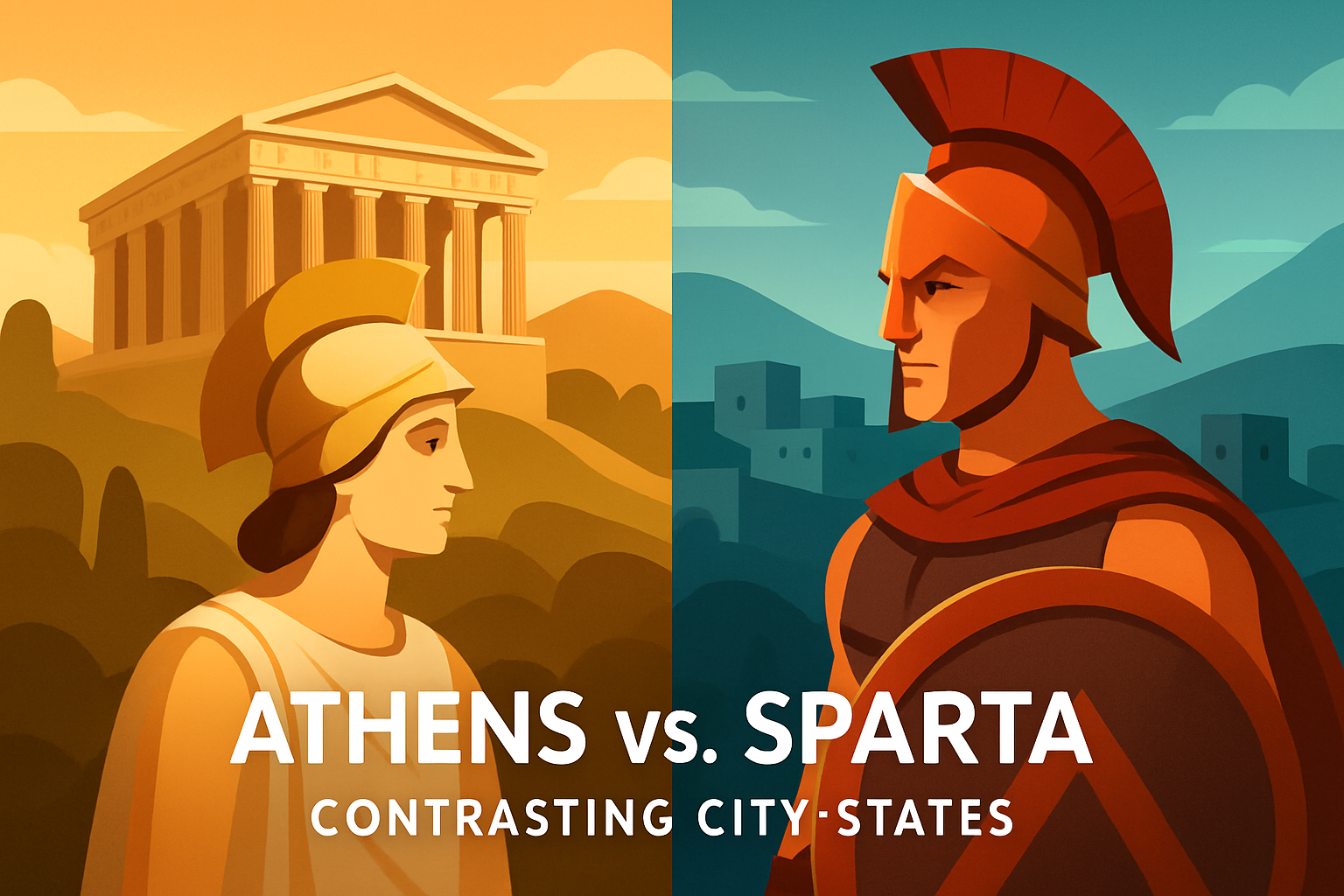
Introduction to Athens and Sparta
Athens and Sparta, two of the most famous city-states in ancient Greece, are often depicted as diametrically opposed entities. Despite being part of the same Hellenic culture, they represent the archetype of divergent Greek political systems, lifestyles, and ideologies. Understanding these differences sheds light on the varying pathways through which societies can develop and thrive. This contextual contrast matters because it allows modern observers to understand the dynamics of political, social, and economic development. While Athens is heralded as the cradle of democracy, celebrated for its intellectual and artistic legacy, Sparta is remembered for its military prowess and disciplined lifestyle. By exploring these differences, one can gain insights into the factors that shape societies, influence cultural achievements, and contribute to a nation’s strengths and weaknesses.
Political Structures and Governance
The political systems in Athens and Sparta sharply diverged, reflecting their contrasting priorities and cultural values. Athens is famously known for being the birthplace of democracy. The Athenian system involved a complex assembly in which all male citizens had the right to vote on important matters, significantly shaping how governance was perceived not only in the ancient world but also in the modern era. This democratic system encouraged open debate, promoted justice, and facilitated the participation of citizens in public life. A real-world example of the Athenian influence can be seen in modern democratic states, where citizen participation remains a democratic ideal.
In contrast, Sparta was governed by a mixed governmental system comprising kings, a council of elders, and an assembly. The dual kingships, held by two hereditary monarchs, focused primarily on military matters. Governance in Sparta emphasized stability and unity, often at the cost of individual freedom and innovation. The priorities of Sparta shaped its structure around maintaining a powerful military force, as can be seen in their stringent social structures and rigorous training programs for male citizens. This aspect of Spartan society has been a subject of admiration and study in military academies and leadership studies worldwide.
Social and Economic Structures
In Athens, society was organized in a more open framework that fostered cultural and economic development. Social mobility was more accessible, underlined by a diverse economy centered on trade, arts, and education. Athenians thrived in various professions ranging from philosophers and artisans to sailors and traders. This diversity spurred progress and intellectual growth, leading to influential contributions in literature, philosophy, and the sciences that echo through history.
Sparta’s social fabric, however, was tightly bound to its military discipline, where life was heavily centered on martial excellence. Spartan society was stratified into distinct classes: the ruling Spartiates, the middle-class Perioeci who conducted trade and crafted goods, and the Helots, who were essentially serfs working the land. This system was aimed at sustaining the Spartan military machine, ensuring Sparta remained an indomitable warrior state. The commitment to austere living and rigorous discipline can be witnessed in modern military academies, where Spartan ideals continue to be revered and emulated.
Cultural Achievements and Lifestyle
Athenian culture was a melting pot of innovation and creativity. Athens is renowned for its monumental architectures such as the Parthenon, its advancement in drama with playwrights like Sophocles, and the philosophical groundwork laid by Socrates, Plato, and Aristotle. These cultural achievements were an integral part of Athenian identity and served as a testament to their emphasis on intellectual pursuits and the arts. Modern educational curricula draw heavily from this wealth of knowledge, with Athenian influence being a cornerstone of liberal arts education.
Conversely, Sparta invested little in cultural development outside of military strategies. Spartan society valued strength, simplicity, and endurance, as embodied in their daily lives and customs. Spartan culture emphasized physical prowess, as epitomized in their agoge—an education and training regimen that shaped their citizens into formidable warriors. Yet, despite this focus, the indirect influence of Spartan culture is visible in modern sports and athletics, where the ideals of discipline and resilience are paramount.
| Aspect | Athens | Sparta |
|---|---|---|
| Government | Democracy | Oligarchy with dual kingship |
| Economy | Trade and arts | Agriculture and conquest |
| Society | Open, vibrant, diverse | Strict, disciplined, class-based |
| Culture | Philosophy, drama, architecture | Military training and discipline |
Educational Systems and Methodologies
The educational pursuits in Athens and Sparta were equally contrasting. Athenian education aimed to create well-rounded citizens knowledgeable in arts, sciences, and public affairs. The educational system was not compulsory, but those who attended learned from some of the finest minds, nurturing thinkers and leaders. This holistic approach laid the foundations for Athens’ remarkable contributions to Western philosophy and science. Evidence of this impact is found throughout modern universities, where Athenian thought still underpins philosophy and ethics.
Spartan education was singularly focused on preparing warriors. From a young age, Spartan males entered the agoge, where they underwent rigorous physical training, learning military tactics, survival skills, and obedience. While this system limited personal freedoms, it developed exemplary soldiers and loyal citizens. The concept of rigorous, specialized training has transcended historical boundaries and can be seen today in specialized military training programs, ensuring that discipline remains a highly valued trait in contemporary defense forces.
Women’s Roles and Rights
In Athens, women played a limited role, largely confined to domestic responsibilities. They had minimal rights and were often excluded from public life, deprived of roles in political discourse or academic pursuits. These gender norms reflected a society that, despite its advancements, held traditional views regarding gender roles. This historical insight allows modern societies to understand and appreciate the progress made toward gender equality and the challenges still faced.
Spartan women, on the other hand, held a relatively elevated status compared to their Athenian counterparts. They were allowed to own property, engage in business, and were expected to maintain physical fitness for producing healthy offspring. Spartan society recognized their contributions not only within domestic spheres but also in broader economic contexts. Modern gender studies frequently reference Spartan women as early examples of female empowerment, illustrating the stark dissimilarities in ancient gender dynamics.
Military Prowess and Approach
Military strategy was a defining trait of both Athens and Sparta, albeit through markedly different approaches. Athenian military power relied heavily on its naval fleet, a reflection of its prowess in trade and exploration. The famous Athenian navy, exemplified by the trireme ships, dominated the Aegean Sea and helped secure commercial routes and military victories, most notably during the Persian Wars. The strategic naval supremacy of Athens has been studied extensively in maritime military history.
Sparta’s military reputation was anchored in its powerful land army. The Spartan hoplites, with their fearsome hoplon shields and phalanx formations, were unparalleled on the battlefield. The success of Spartan military tactics is exemplified by the heroic stand at the Battle of Thermopylae and the overwhelming victories during the Peloponnesian War. The efficient structure, tactics, and discipline of the Spartan army continue to be pivotal subjects of military strategy and leadership studies.
Conclusion: The Legacy of Athens and Sparta
Athens and Sparta represent two distinct but equally impressive examples of ancient Greek civilization. Through this exploration, we can appreciate how their divergent structures, cultural contributions, and societal values have shaped and impacted the world. Athens, with its devotion to democracy, arts, and philosophy, set a precedent for civic engagement and intellectual exploration that remains foundational to modern governance and education.
In contrast, Sparta demonstrated the strength of discipline, unity, and military excellence, embodying values that continue to inspire and instruct those in leadership and military strategy. The legacies of both these city-states teach us about the diverse pathways civilizations can take, each with its own set of values, aspirations, and challenges.
Understanding these legacies offers deeper insights into contemporary society and encourages us to reflect on our values and ambitions. As we continue to study these ancient city-states, let us apply their lessons to foster a world that embraces diversity in governance, culture, and societal organization. Consider exploring more about other ancient civilizations or visiting historical sites to witness firsthand the influences that continue to shape our world today.
Frequently Asked Questions
1. What were the main differences in the political systems of Athens and Sparta?
Athens and Sparta, despite both being prominent city-states in ancient Greece, operated under vastly different political structures that reflected their contrasting ideologies and societal priorities. Athens was known for its progressive and democratic system. It was one of the first societies to experiment with large-scale democracy, a system in which citizens had the power to make decisions about the governance of their city-state. Athenian democracy was characterized by the Assembly, known as the Ecclesia, where citizens could speak their minds and cast votes on various issues. Additionally, the Council of 500, chosen by lot, was responsible for depicting the day-to-day governance and setting the agenda for the Assembly.
In stark contrast, Sparta was known for its rigid oligarchic system. The Spartan government was composed of two kings from separate royal families who shared power and duties. The kings were mainly responsible for military and religious duties, ensuring that Spartans maintained their societal discipline and military prowess. Sparta also had a council known as the Gerousia, composed of 28 elders and the two kings, who were charged with crafting and proposing laws. The Ephorate, a group of five ephors elected annually, held significant power as they were tasked with overseeing the kings and ensuring they adhered to the laws. These differences highlight how Athens valued democratic ideals and civic participation, while Sparta prioritized stability, military strength, and control.
2. How did the educational systems of Athens and Sparta differ?
The education systems in Athens and Sparta were designed to fulfill each city-state’s specific needs and societal goals, resulting in notable differences. Athenian education was broad and humanistic, focusing on producing well-rounded citizens. From a young age, Athenian boys were taught various subjects including philosophy, arts, music, and physical education. This broad curriculum allowed Athenians to cultivate intellectual skills, participate in public life and debates, and appreciate their rich cultural heritage. Education for Athenian girls was minimal, focusing mostly on domestic skills.
In contrast, Sparta’s education system, known as the Agoge, was predominantly centered on physical training and military readiness. Spartan boys entered the Agoge at the age of seven, where they underwent rigorous and often harsh training designed to develop their physical and martial prowess. This system’s goal was to produce disciplined and effective warriors capable of maintaining Sparta’s powerful military legacy. Spartan education downplayed academic learning in favor of physical endurance, battlefield tactics, and survival skills. Unlike Athens, Spartan girls received compulsory physical education to ensure they became healthy and strong mothers of warriors, reflecting Sparta’s emphasis on military and societal stability.
3. What role did women play in the societies of Athens and Sparta?
The roles and status of women in Athens and Sparta were markedly different, reflecting each city-state’s societal values and priorities. In Athens, women had limited rights and were largely excluded from public and political life. They were expected to manage the household and focus on producing legitimate heirs. Athenian women were often confined to their domestic roles, with limited access to education and economic independence. Athenian society emphasized the importance of lineage and family, so women were often married off early to ensure a lineage of legitimate citizens.
In contrast, Spartan women enjoyed relatively more freedom and influence compared to their Athenian counterparts. Given the militaristic nature of Spartan society, women were expected to maintain their families and properties while the men were away at war. They had the right to own property and could inherit wealth, an uncommon privilege in ancient Greece. Spartan women were also encouraged to participate in physical training, reflecting the city-state’s emphasis on health and strength. Their ability to influence household and economic matters gave them a level of power and autonomy not seen in Athens, enabling them to play a supporting, yet crucial role in maintaining Sparta’s societal infrastructure.
4. How did the economies of Athens and Sparta differ?
The economic foundations of Athens and Sparta were shaped by their distinct societal values and geographic realities. Athens boasted a diverse and dynamic economy centered on trade, arts, and agriculture. Its strategic location near the sea facilitated extensive maritime trade, enabling the city-state to become a commercial powerhouse. Athenians were skilled artisans and craftsmen, producing a variety of goods such as pottery, textiles, and weapons. The wealth generated through trade allowed Athens to invest in cultural and infrastructural projects, contributing to its reputation as a center of arts and philosophy.
Sparta, in contrast, had an economy primarily based on agriculture and conquest. The Spartan economy was largely self-sufficient, relying on farming land worked by the helots, a subjugated population who were essentially serfs. The staunch militaristic focus of Sparta meant that commerce and trade were not prioritized, with policies actively discouraging the pursuit of wealth and luxury to maintain social equality and military readiness. While this rigid economic system ensured stability and self-sufficiency, it also limited economic growth and technological advancement when compared to the vibrant trade-based economy of Athens.
5. What were the key military differences between Athens and Sparta?
Athens and Sparta both recognized the importance of a strong military, but their approaches and objectives significantly diverged. Athens built a formidable naval power, which played a critical role in its ability to control trade routes and establish colonies across the Mediterranean. The Athenian navy was equipped with powerful triremes, allowing Athens to project its influence far beyond its city limits. This naval focus was a reflection of Athens’ strategic interest in protecting and expanding its trade networks, providing both economic and military advantages.
On the other hand, Sparta was renowned for its unparalleled land-based military prowess. The Spartan hoplite soldiers, famous for their discipline, strength, and cohesion, were the backbone of Sparta’s military dominance throughout Greece. Spartans trained rigorously from a young age in the Agoge, ensuring a well-drilled and efficient fighting force capable of withstanding and overpowering adversaries. The military was the centerpiece of Spartan society, influencing every aspect of public life and governance. While Athens leveraged its navy for strategic and economic gain, Sparta’s military strength lay in its ability to dominate land battles, underlining the core of its highly organized militaristic society.