
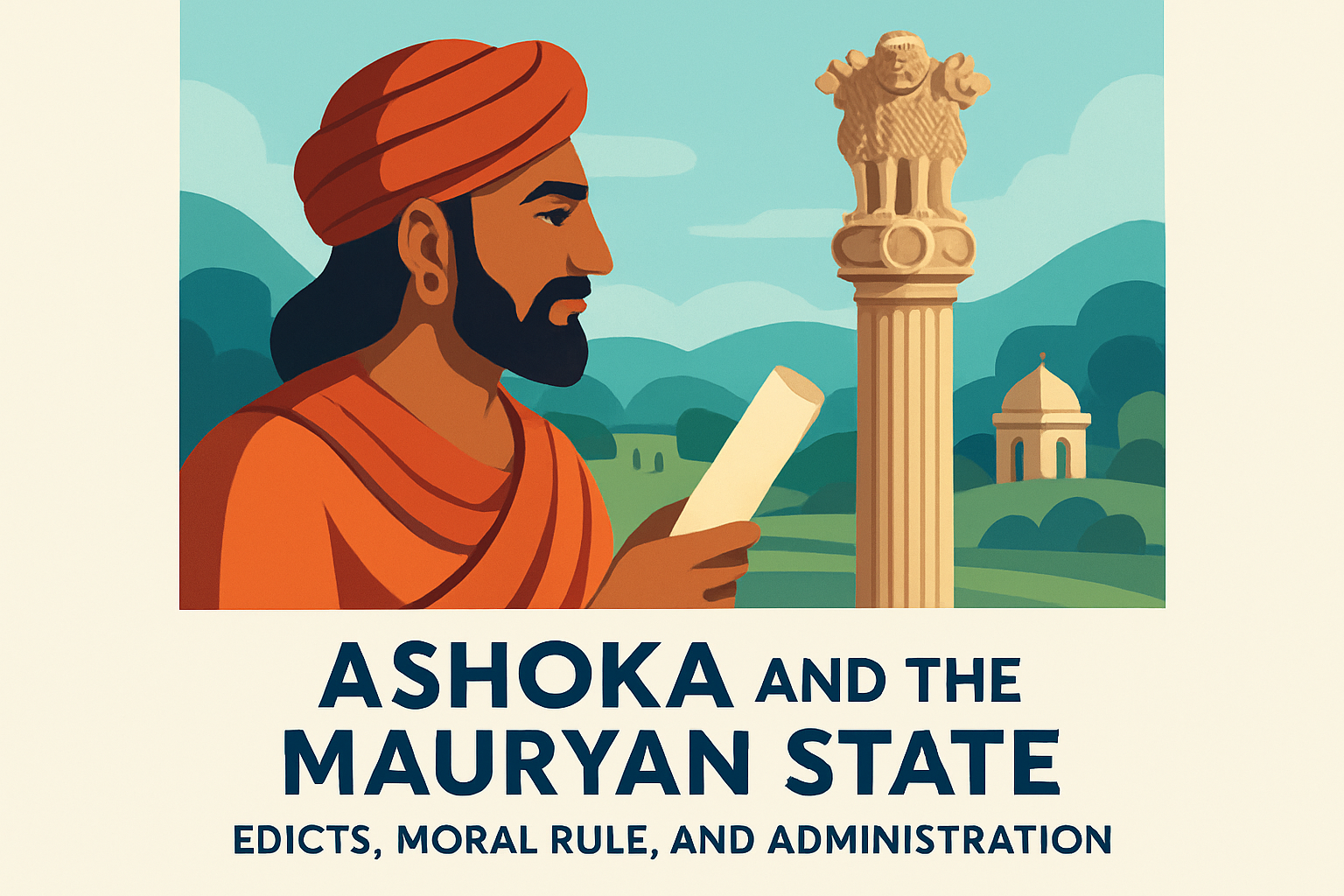
Ashoka, one of India’s most renowned ancient emperors, ruled the Mauryan Empire from around 268 to 232 BCE. His governance is a pivotal example of ancient statecraft that deftly combined political power with moral and ethical leadership principles. The Mauryan Empire itself, founded by Chandragupta Maurya in 321 BCE, was one of the largest empires on the Indian subcontinent, extending over vast regions of South Asia. Understanding Ashoka’s approach to leadership and administration provides insight into historical governance models that prioritize moral and ethical dimensions. The integration of religious philosophy into state policy marked a transformative era in political thought, which has enduring implications even today. This article will delve into Ashoka’s life, his moral edicts, administrative strategies, and their impacts on the Mauryan state and beyond.
Ashoka’s Moral Rule: Edicts and Spiritual Guidance
Ashoka’s reign is perhaps best remembered for his Edicts, a collection of inscriptions carved on rocks and pillars across his empire. These Edicts not only communicated laws and administrative instructions but emphasized moral and ethical teachings, steeped in Buddhist principles. Ashoka’s conversion to Buddhism followed the Kalinga War, a brutal campaign that resulted in massive bloodshed and suffering. Disturbed by this devastation, Ashoka embraced Buddhism, promoting its philosophy of nonviolence and compassion.
Ashoka’s edicts, written in Prakrit and using the Brahmi script, were an innovative approach to governance, as they conveyed the importance of dhamma (moral law) over mere legal enforcement. They reflected a commitment to social and welfare principles aimed at moral reform and promoting goodwill among his people. For instance, one of the renown edicts emphasizes the fair treatment and just administration across different population groups, connecting ethical behavior to societal prosperity.
These edicts had real-world applications, such as outlawing animal sacrifices and encouraging cultural and religious tolerance. Ashoka’s concept of dhamma extended beyond personal piety to include social and ecological responsibilities, promoting practices like planting trees and digging wells to improve public welfare. This approach offered a blueprint for integrating ethical considerations into governance processes, influencing not only those within the Mauryan borders but also neighboring regions.
Impact on the Governance and Administration of the Mauryan Empire
Under Ashoka’s rule, the administration of the Mauryan Empire saw transformations that aligned with his moral philosophy. His governorship was characterized by efforts to establish a centralized and organized administrative structure. The empire was divided into several provinces, each governed by local officials who were instructed to uphold Ashoka’s edicts, ensuring law and order while promoting ethical governance.
The administrative structure reflected Ashoka’s desire to maintain a well-functioning state, with a particular focus on justice and welfare. He established a concept known as ‘Dharma Mahamatras,’ or officers dedicated to the enforcement of moral law, ensuring fair treatment and promoting political stability. These officers served as intermediaries between the ruler and the populace, ensuring that the policies of compassion, equality, and ethical behavior were diligently practiced across the domain.
To facilitate effective governance, Ashoka set up an intricate network of communication that promoted transparency and effective transfer of information. The strategic placement of the edicts on well-frequented routes ensured that the emperor’s message reached a broad audience. This early form of mass communication was highly successful in propagating the king’s moral policies, demonstrating an innovative use of available resources to unify the diverse empire under a central ethical framework.
- Divided empire into provinces for better administration
- Appointed ‘Dharma Mahamatras’ to monitor societal welfare
- Promoted public welfare projects and ethical governance
The Legacy of Ashoka: Influence Beyond Borders
While Ashoka’s policies and administrative measures significantly impacted his own empire, their influence extended far beyond the Mauryan borders. The moral principles and philosophies integrated into his governance model had a profound influence on neighboring regions, particularly in Southeast Asia and Central Asia, where Buddhism began to flourish considerably. Ashoka sent missionaries across Asia to propagate Buddhist teachings, which facilitated cross-cultural exchanges and laid the foundations for the spread of Buddhist cultural influence across the region.
The Buddhist texts ascribed to Ashoka’s efforts mention several emissaries who reached countries as far as Egypt, Syria, and Greece, introducing Buddhist thought to Western civilizations. These missions not only spread religious teachings but also demonstrated the versatility of Buddhist ethics in diverse governance systems, highlighting the adaptability of Ashoka’s principles to different cultural contexts.
This facilitated mutual respect among diverse peoples when it came to cultural exchanges and encouraged cooperation beyond political and ideological alliances. Ashoka’s edicts fostered not just regional stability and unity, but also laid an early foundation for concepts similar to modern diplomatic relations.
| Region | Key Influence |
|---|---|
| India | Buddhist conversion, social justice reforms |
| Southeast Asia | Spread of Buddhism, cultural exchange |
| Central Asia | Missionaries and trade introduced Buddhist thought |
| Western Regions | Early introduction of Eastern philosophies |
The Modern Relevance of Ashoka’s Governance Model
Today, Ashoka’s governance model, emphasizing moral underpinnings and social responsibility, still holds relevance. His integration of ethical considerations into administrative policy underscores the importance of governance centered around human welfare and societal development. Modern governance systems can draw inspiration from Ashoka’s balance of moral leadership and administrative efficiency, a relationship pivotal in navigating today’s complex political landscapes.
In countries worldwide, the principles behind Ashoka’s edicts—justice, care for the environment, and nonviolence—are echoed in various forms. Both historical and contemporary governance models exploring sustainable development and ethical administration acknowledge the relevance of such principles in creating communities that are more equitable and resilient.
As nations today confront escalating challenges, from climate change to social inequality, revisiting Ashoka’s style of leadership offers a perspective on how prioritizing ethical and moral imperatives can lead to more comprehensive and effective solutions to contemporary issues. Ashoka championed an inclusive approach, fostering cohesion and compassion, which are undeniably central to both historical and modern paradigms of governance.
Conclusion: Ashoka’s Everlasting Influence on Governance
In conclusion, Ashoka’s legacy extends far beyond his time as the ruler of the Mauryan Empire. His unique fusion of moral philosophy and political administration offers lessons in ethical leadership that remain relevant today. By leveraging mechanisms such as public edicts and appointing officers dedicated to moral supervision, Ashoka demonstrated an advanced understanding of the role governance plays in ensuring the welfare of all subjects. His efforts to build bridges across cultures and promote ethical governance principles resonate across time, influencing regions beyond the subcontinent.
The study of Ashoka’s reign provides valuable insights into integrating ethical considerations within governance structures, especially relevant as societies today strive for sustainable and humane development. By contextualizing past successes and implementing their teachings, modern-day policymakers are better positioned to create equitable and cohesive communities, just as Ashoka did centuries ago. Acknowledging Ashoka’s contributions encourages broad contemplation of governance approaches, underscoring their significance in the quest for more progressive and balanced societies in the present and future.
Explore Ashoka’s edicts and governance principles that emphasize the necessity of ethical leadership in today’s world. Apply these ancient lessons to drive more substantial policy-making and institutional frameworks that prioritize social welfare and ethical benchmarks.
Frequently Asked Questions
1. Who was Ashoka, and what makes his reign significant?
Ashoka was the third emperor of the Mauryan Dynasty, ruling from approximately 268 to 232 BCE. What sets Ashoka apart is his transformation from a traditional warrior king to a ruler deeply committed to moral governance and ethical leadership. Initially, he expanded his empire through conquest, particularly noted for the bloody Kalinga War, which marked a turning point in his reign. The aftermath of this war led Ashoka to embrace Buddhism and adopt the principles of Dhamma (Buddhist doctrine of natural law), emphasizing non-violence, compassion, and welfare of his subjects.
His reign is significant because it is one of the earliest examples in history of a monarch adopting state policies based on ethical and religious teachings. His edicts, inscribed on pillars and rocks scattered across his empire, highlighted these values, promoting tolerance, understanding, and respect toward all religions and fostering social welfare. This approach not only enhanced the quality of life for his subjects but also marked a significant shift in the way rulers could wield power—through moral persuasion rather than force.
2. What were Ashoka’s edicts, and what do they tell us about his administration?
Ashoka’s edicts are inscriptions carved onto pillars, rocks, and caves throughout the Indian subcontinent, meant to communicate his policies and philosophical beliefs directly to his people. These edicts are a unique historical record that provides insights into Ashoka’s values and his approach to governance. They articulate principles such as religious tolerance, non-violence, truthfulness, compassion, and justice. The edicts reflect Ashoka’s desire to promote a common moral law across his empire, transcending local customs and traditions.
The edicts demonstrate that Ashoka valued communication with his subjects and sought to use moral teachings as a cornerstone of his administration. They are evidence of an administrative system where ethical considerations were foundational. This innovative and principled method of governance contributed to a stable and cohesive empire, where rulers were not just autocrats but also moral guides seeking the welfare of all inhabitants.
3. How did Ashoka’s adoption of Buddhism influence his rule?
Ashoka’s conversion to Buddhism profoundly influenced both his personal beliefs and his policy-making as a ruler. Before his conversion, Ashoka ruled like many of his contemporaries, striving for military success and territorial expansion. However, the brutal outcomes of the Kalinga War instigated a profound transformation in his worldview, leading him to embrace Buddhism with its core tenets of non-violence, compassion, and ethical living.
In his capacity as emperor, Ashoka applied Buddhist principles to governance, heralding an era of what could be termed as ‘Moral Statecraft’. He endorsed a system of governance that sought the spiritual and material betterment of his subjects, encouraging the spread of Buddhism and its ethics both within and beyond his empire. He patronized the construction of stupas and monasteries and sent missionaries across Asia, making Buddhism a significant world religion. His reign showed how spiritual belief systems can effectively integrate with state policies to promote peace, welfare, and social cohesion.
4. What was the structure of the Mauryan administration under Ashoka?
The Mauryan administration, particularly under Ashoka, was highly organized, centralized, and bureaucratic, designed to efficiently manage one of the largest empires of the ancient world. The empire was divided into provinces, each governed by a royal prince or trusted noble representing the emperor, ensuring direct control and loyalty. These provinces were further subdivided into districts and villages, revealing a meticulously tiered structure that facilitated robust administrative oversight and resource management.
Under Ashoka’s reign, the administrative structure witnessed an infusion of moral and ethical regulation. The officers or ‘Rajukas’ became more than mere bureaucratic officials; they were moral counselors and public servants, charged with the responsibility of ensuring justice and welfare, reflective of Ashoka’s dharmic policies. This inclusion of ethical imperatives in governance speaks volumes of Ashoka’s ability to blend traditional administrative rigor with a compassionate socio-political framework, ultimately aligning the machinery of administration with the principles of dharma. This hybrid model was innovative, reflecting a sophisticated approach to governance that went beyond mere rule enforcement to include nurturing societal welfare.
5. In what ways did Ashoka promote social welfare during his reign?
Ashoka’s commitment to social welfare was multi-faceted, focusing on the holistic development of society by implementing measures that went beyond typical state obligations. He emphasized public health, infrastructure improvements, education, and social justice, while simultaneously working to eliminate societal ills like violence, discrimination, and intolerance. One of his significant contributions was the development of infrastructure, including roads, hospitals, rest houses, and water wells, which improved trade and communication within the vast expanse of the Mauryan Empire.
Furthermore, Ashoka promoted education and moral instruction, encouraging literacy and the spread of knowledge. He also made provisions for the welfare of animals, such as establishing veterinary clinics and curbing unnecessary killings, reflecting his dharma of compassion extending to all living beings. Additionally, he was deeply involved in the welfare of the destitute, providing aid without discrimination, showcasing an early model of social justice.
Overall, Ashoka’s administration underlined a leadership ethos that integrated state power with empathy and generosity, pioneering welfare measures that underscored a ruler’s duty to ensure the wellbeing of all subjects, earning him a revered place in history as a monarch who not only conquered territories but won over the hearts of his people. His legacy still inspires leaders worldwide to balance power with compassion in governance.