
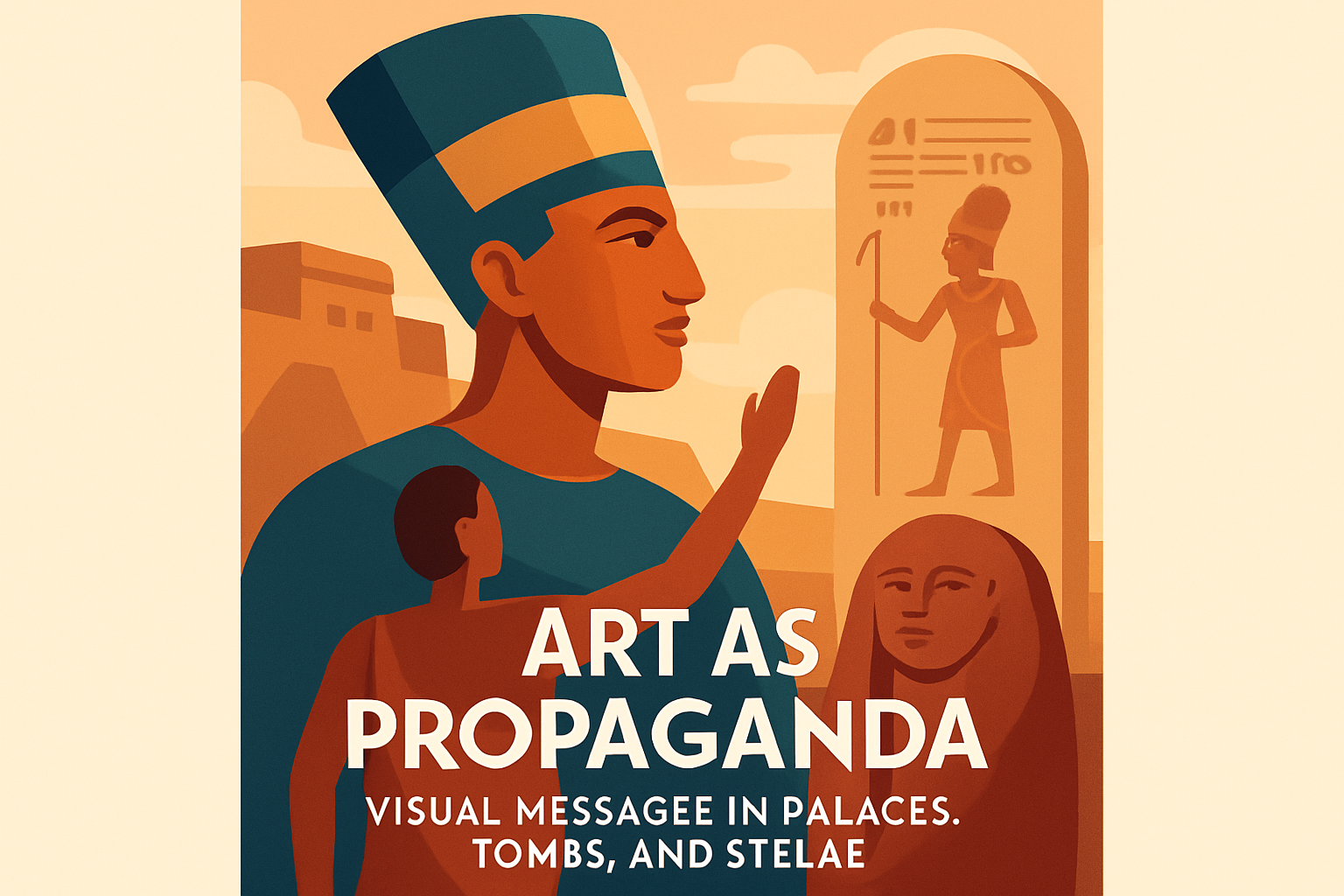
Art has always been a reflection of the society and era from which it emerges, serving as a testament to the visions, aspirations, and narratives of cultures throughout history. Among the many functions that art has served, one of its most potent and enduring roles has been as a medium of propaganda. This term commonly carries a negative connotation, suggesting manipulation or deceit, yet its definition is much broader: art used to promote specific messages, beliefs, or ideologies. In historical contexts, rulers and leaders harnessed art’s power to assert authority, spiritual beliefs, and cultural values. Structures like palaces, tombs, and stelae were not just places or items but were carefully crafted messages meant to influence and inform the public. This article will delve into how, throughout different epochs and societies, these forms of art have been instrumental in shaping public perception and preserving the legacy of those in power.
Understanding the intrinsic role of art as a medium of propaganda is crucial. It allows modern audiences to discern how art was manipulated to assert dominance, reinforce divine right, or preserve cultural heritage. This examination sheds light on history while providing insights into discerning the messages embedded in contemporary art and media. By exploring these structures and relics, we gain a deeper appreciation for how rulers and civilizations articulate their narratives, secure their legacy, and sway their populace through the ages.
The Role of Palaces as Propaganda Tools
Palaces throughout history have been grandiose edifices that exemplify the wealth, power, and aspirations of the ruling class. An excellent example of this is the Palace of Versailles in France. King Louis XIV, the “Sun King,” transformed Versailles from a hunting lodge into an opulent palace. This was more than just a lavish residence; it was a statement. The sprawling gardens, lavish halls, and intricate designs all worked together to convey the king’s absolute power and divine right to rule. Every frescoes and sculpture had a story to tell about his reign, reinforcing his grandeur and political strength.
The power of Versailles as propaganda lay not just in its physical beauty but in its function as a stage for royal authority. It was where artisans, nobles, and diplomats gathered, each visit serving as a reminder of the king’s absolute control. Louis XIV’s clever use of space and art ensured that Versailles remained a lasting symbol of French cultural supremacy and royal hegemony.
Tombs as Eternal Messages of Power
Tombs have played crucial roles in history as shrines that immortalize the legacies and beliefs of those they entomb. In ancient Egypt, the pyramids are supernatural expressions of royal propaganda. The Great Pyramid of Giza, built for Pharaoh Khufu, exemplifies this idea. Its monumental scale and astronomical alignment were architectural feats designed to showcase the divine power and divine favor the Pharaoh possessed.
The construction of such massive structures underscored the society’s organizational power and the divine status of the ruling class. Imagery and inscriptions on these tombs served a propagandistic script, immortalizing the ruler’s victories and religious devotion. These artefacts played a dual role as spiritual guides and as bold statements of imperial might.
Stelae: Stone Tablets as Historical Narratives
Stelae are another form of art closely tied to propaganda. These carved, upright stone slabs have been used across various cultures to convey laws, military victories, or religious decrees. One striking example is the Code of Hammurabi, inscribed on a stele, detailing one of the earliest and most complete written legal codes. This Babylonian relic emphasized not only the king’s role as a just ruler but also reinforced social order and legal authority throughout the kingdom.
Through meticulously crafted narratives and artistic design, such stelae assert the sovereign’s power while ensuring cultural continuity. This public display of law and order serves an integrative function, uniting disparate communities under a shared legal framework and the ruler’s moral aegis, demonstrating the powerful interplay between art, authority, and societal cohesion.
Warrior Stelae: Art as Martial Propaganda
In a martial context, stelae have often been utilized to commemorate military victories, serving as campaigns of visual propaganda. The victory stele of Naram-Sin of Akkad illustrates his triumph over the Lullubi. This artefact portrays the king ascending a mountain under divine auspices. Such iconography proves that art has long been essential in asserting military dominance and divine support, thus solidifying a ruler’s command over both land and minds.
- Naram-Sin’s Stele – Depicts kingship and victory under divine favor.
- Rosetta Stone – Asserts Ptolemaic decree across multilingual inscriptions.
- Code of Hammurabi – Philosophical, legal, and propagandist in essence.
These artefacts show that art as a medium transcends time and civilizations in its ability to convey powerful political and ideological messages subtly and overtly.
Cultural Propaganda in Mesoamerican Temples
The ancient Mesoamerican cultures such as the Maya and Aztec civilization used their temple complexes as a canvas for cultural and religious propaganda. Observatories like El Caracol, at Chichen Itza, were created to align with celestial bodies, reflecting divine support and understanding of the cosmos. These structures stood as testaments to the leaders’ legitimacy and divine mandate to rule.
Murals and carvings in these temples served a dual purpose. They documented historical events, religious myths, and omens, weaving them into an influential propaganda narrative that served theocratic goals while instructing the people in both cultural and religious paradigms.
| Culture | Structure | Purpose |
|---|---|---|
| Egyptian | Pyramids | Royal tombs, divine authority |
| Babylonian | Stele | Legal codes, divine order |
| Mesoamerican | Temples | Religious centers, divine-mythological narratives |
Persian Empire’s Architectural Symbolism
The Achaemenid Empire, particularly under Darius and Xerxes, utilized palatial architecture as an intrinsic form of propaganda. The palaces at Persepolis were majestic and almost theatrical backdrops to court ceremonies, portraying the king’s power over a vast empire rich with diversity. Reliefs depicted tribute-bearers from far reaches of the empire, reinforcing the vastness yet unity under Persian rule.
Through architectural grandeur and intricate detail, the Achaemenid palaces stood as reminders of imperial power and cultural synergy. Such manifestations exemplified how architecture itself became a historical narrative, inviting future generations to witness the remnants of a once great civilization.
Chinese Dynastic Palatial Artworks
Chinese palatial artworks, as seen in the Forbidden City of the Ming and Qing Dynasties, formed another layer of dynastic propaganda. The layout itself was astutely designed to reflect cosmic order and Confucian hierarchy. With its divine symbolism and restricted access, the Forbidden City embodied the emperor’s status as the Sons of Heaven.
Intricate dragons, phoenixes, and symbolic heavens were prevalent, constantly reinforcing the emperor’s role as mediator between heaven and earth. The art within these walls intertwined power with spirituality, further strengthening the ruler’s status and centrality in the sociopolitical order.
In each of these societies and historical epochs, the integration of art as propaganda provides a powerful example of how cultures construct, display, and perpetuate narratives of power and belief. Through understanding how art has historically served this purpose, we gain insights into not only past civilizations but also contemporary uses of art and architecture to influence public opinion.
Conclusion: The Enduring Impact of Art as Propaganda
As we have explored, palaces, tombs, and stelae are not merely remnants of past grandeur, but are integral to understanding how art has functioned as propaganda. They served as mediums through which rulers communicated power, divinity, and order while leaving legacies that would endure for millennia. These structures transcend simple aesthetic pleasure; they are reaffirmations of historical power dynamics and the socio-cultural ethos of their time.
By studying these historical artworks, we are offered a window into the intricate relationship between art and power. This knowledge equips us to understand current and future manifestations of art and propaganda within society. Recognizing the implications of art as a communicative tool highlights its continuing role in shaping public perception.
As an actionable step, we should encourage more in-depth studies of historical contexts and their artworks to better equip ourselves against manipulative uses of modern media and to appreciate the powerful narratives art has to offer. Understanding the historical context empowers us to engage critically with the artistic expressions we encounter in our world today.
Frequently Asked Questions
1. How has art been used as propaganda in ancient palaces, tombs, and stelae?
Art in ancient times was strategically used to convey and enforce power, authority, and religious beliefs. Palaces were often embellished with grand murals and sculptures showcasing the might and divinity of rulers. These art forms elevated the ruler’s status, depicting them as chosen by the gods, thus legitimizing their rule and suppressing dissent. In tombs, art served both a ceremonial purpose and a propagandistic one. Murals and carvings illustrated the deceased’s journey to the afterlife, emphasizing their wealth and status even in death. This created a legacy that reinforced the societal hierarchy for both contemporaries and future generations drawn into these stories. Stelae, often erected in public spaces, carried inscriptions and reliefs that celebrated victories, laws, or decrees, effectively broadcasting a ruler’s achievements and cementing their authority in the cultural consciousness. They served as visual announcements to educate or remind the populace of the ruler’s strength and accomplishments.
2. Are there any prominent examples of art as propaganda from historical periods?
Yes, numerous historical examples demonstrate the role of art as propaganda. One of the most famous is the ancient Egyptian temples and tombs, such as those at Luxor and the Valley of the Kings. These sites are adorned with intricate carvings and paintings that glorified pharaohs as incarnations of gods. Similarly, the ancient Assyrian palaces were decorated with reliefs depicting the king’s military campaigns and divine favor, aiming to impress and intimidate. Another example is the Greek Parthenon, which, through its friezes and sculptures, depicted the might and cultural superiority of Athens. In the Americas, Mayan stelae carved with images of rulers and their divine connections served similar purposes, asserting power and order through visual narratives.
3. What techniques were commonly used in ancient art to convey propaganda?
Artists employed a range of techniques to convey messages effectively. Scale and size were significant, with rulers often depicted larger than life to emphasize their importance. Symbolism was also widely used, where objects, colors, and figures were loaded with meanings—like crowns for royalty, specific animals for divine connections, or certain gods associated with protection or power. Placement and visibility were crucial; art was strategically located in areas with high foot traffic or ceremonial spaces to ensure wide visibility and impact. The narrative technique, portraying scenes of victory, divine endorsement, or harmonious rule, helped embed the intended message within the collective memory. Additionally, repetition was a method to reinforce narratives and ideas; recurring motifs across various artworks ensured that the message was internalized by the populace over time.
4. Did the artists have creative freedom, or were they directed by patrons?
In most historical contexts, artists were commissioned by patrons—often rulers, religious leaders, or the state—who dictated the themes and intended messages. The artists were skilled craftsmen who translated the patron’s visions into visual form. While some artists may have had the freedom to exhibit their unique style or input into the technical execution, the overarching theme and purpose of the art were typically predetermined by the commissioning authority. This ensured that the art served its propagandistic purpose, aligning with the political or religious narratives desired by those in power. However, the precise level of control or freedom likely varied depending on the period, location, and political context.
5. How does understanding art as propaganda help us interpret ancient societies?
Understanding art as propaganda gives us a deeper insight into the values, social hierarchies, political dynamics, and religious beliefs of ancient societies. It reveals the aspirations of rulers and their attempts to shape public perception. By analyzing these artworks, historians and archaeologists can better understand the power structures and cultural priorities of the time. It also allows us to see how societies were influenced and guided by the visual narratives presented to them. Moreover, recognizing these works as propaganda helps modern viewers critically assess the extent to which these artworks reflect actual historical events versus curated narratives to serve specific agendas. It teaches us about the mechanisms of power and communication that are still relevant today.