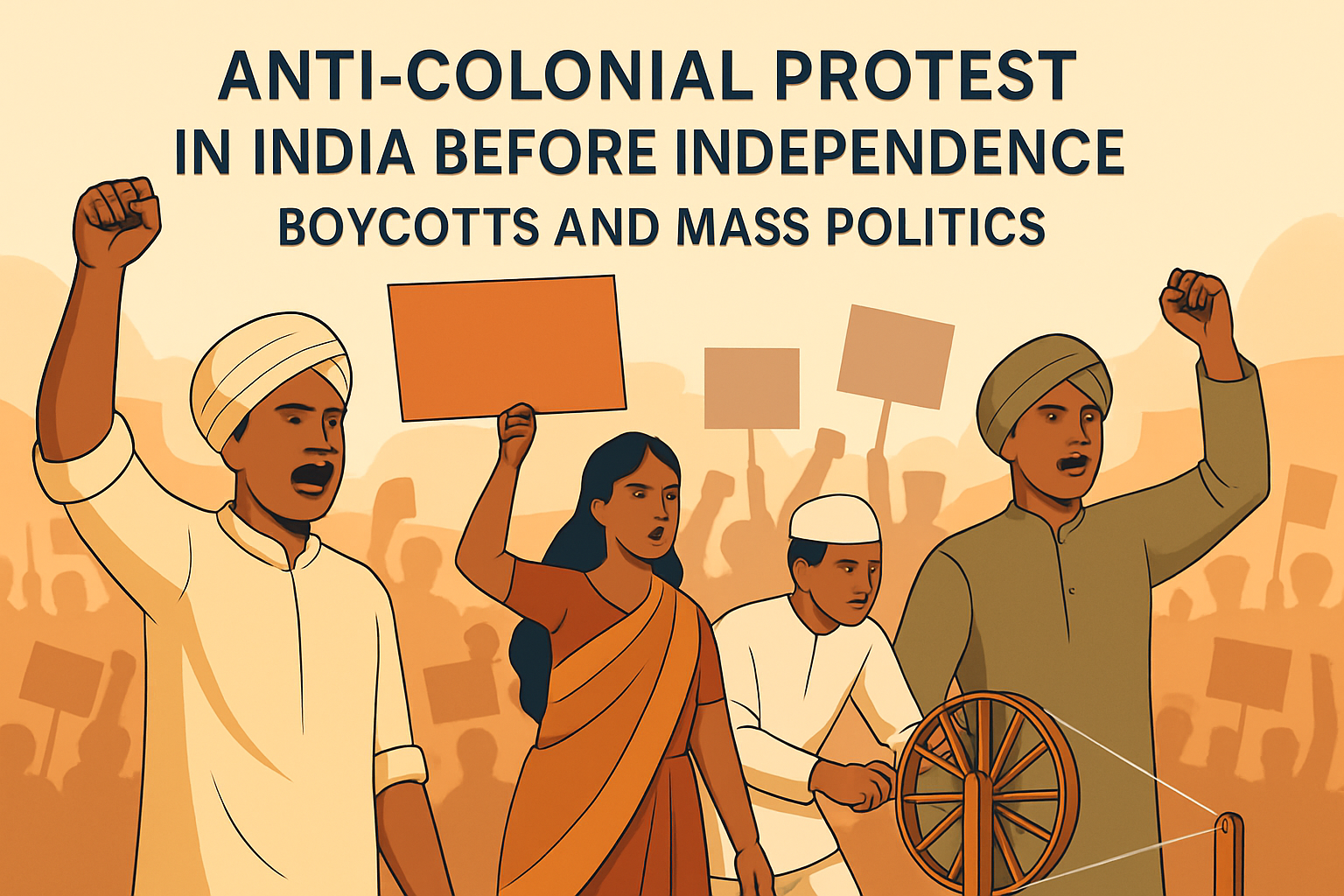
Anti-colonial protest in India before independence transformed scattered grievances into disciplined mass politics through boycotts, public mobilization, and moral confrontation with imperial rule. In Indian history, “anti-colonial protest” refers to organized resistance against British political domination, economic extraction, and racial hierarchy. “Boycott” meant more than refusing foreign goods; it became a political technique that linked household choices, public demonstrations, labor action, and national identity. “Mass politics” describes the shift from elite petitions and constitutional lobbying toward large-scale participation by students, women, workers, peasants, traders, and religious communities. Having worked extensively with archival speeches, Congress resolutions, district reports, and memoirs from the late nineteenth and early twentieth centuries, I have seen how these terms were lived rather than merely theorized. Protest meetings in towns, picketing outside shops, bonfires of cloth, hartals, and volunteer corps created a new political language ordinary people could use. This matters because Indian independence was not secured only through negotiations among leaders. It emerged from repeated campaigns that trained millions in collective action, exposed the limits of colonial legitimacy, and redefined politics as participation rather than deference. To understand modern democratic mobilization in South Asia, and even contemporary boycott movements worldwide, it is essential to study how Indians used consumption, association, and public sacrifice as instruments of anti-colonial struggle.
From Petition to Public Agitation
In the late nineteenth century, the Indian National Congress initially relied on petitions, legislative criticism, and demands for administrative reform. Early leaders such as Dadabhai Naoroji, Surendranath Banerjea, and Gopal Krishna Gokhale were not politically passive, but their methods assumed the British Empire could be persuaded through evidence and constitutional argument. Naoroji’s “drain theory” was especially important because it translated colonial exploitation into measurable economic loss, showing how wealth moved from India to Britain through taxation, salaries, pensions, and trade structures. Yet by the 1890s and early 1900s, famines, plague policies, racial discrimination, and limited political concessions convinced many activists that economic critique needed street-level pressure. Bal Gangadhar Tilak helped popularize a more assertive politics through public festivals, vernacular journalism, and direct appeals to wider audiences. This transition did not replace moderate politics overnight; rather, it widened the field. Protest became performative, visible, and collective. Political claims were increasingly made not only in council chambers but also in bazaars, schools, and neighborhood associations. That was the foundation on which anti-colonial boycotts later grew.
The Swadeshi Movement and the Birth of Boycott Politics
The watershed came with the 1905 partition of Bengal, announced by Lord Curzon. Officially presented as an administrative measure, partition was widely understood as an attempt to weaken Bengali political influence and divide Hindus and Muslims. The response created one of the first truly mass anti-colonial campaigns in India: the Swadeshi movement. “Swadeshi” meant using goods made in one’s own country, while “boycott” targeted British textiles, sugar, salt, and other imported products. What made this powerful was its practical simplicity. A student could refuse foreign cloth, a trader could stop stocking imported goods, a family could spin or purchase local fabric, and neighborhoods could hold public meetings to enforce social pressure. I have found in municipal records and contemporary newspapers that boycott worked because it turned nationalism into routine action. It left marks on markets, education, and social life.
Swadeshi was not merely consumer activism. National schools were established to reduce reliance on colonial education; indigenous enterprise was encouraged; women entered politics through domestic production and ceremonial participation; and songs, pamphlets, and processions spread the message beyond literate elites. Leaders including Bipin Chandra Pal, Aurobindo Ghose, Tilak, and Rabindranath Tagore shaped its language, though they differed in strategy and temperament. The movement also revealed limits. Boycott was harder to sustain in poorer households where imported cloth was cheaper or more available. Regional reach varied, and state repression was real. Still, Swadeshi set the pattern for later anti-colonial politics: combine economic refusal with symbolic action, give ordinary people a role, and turn local practice into national meaning.
How Boycotts Worked in Practice
Boycotts succeeded when they connected moral principle to workable routines. In India before independence, activists learned quickly that calling for sacrifice was not enough; they needed networks, substitutes, and enforcement. Volunteer groups picketed shops selling foreign cloth, students organized meetings, and local committees tracked participation. Merchants who complied could be publicly praised, while those who resisted might face social pressure. Newspapers amplified reputational consequences. This blend of persuasion and discipline made the boycott a political technology rather than a slogan.
| Campaign element | How it functioned | Political effect |
|---|---|---|
| Foreign cloth boycott | Picketing shops, public bonfires, promotion of handspun and Indian mill cloth | Linked everyday consumption to nationalism |
| Hartal | Temporary closure of shops and services during protest days | Displayed collective power in visible form |
| National education | Alternative schools and colleges outside colonial control | Reduced dependence on imperial institutions |
| Volunteer corps | Mobilized crowds, maintained discipline, spread instructions | Turned sentiment into organized action |
| Khadi promotion | Spinning and wearing handspun cloth | Made sacrifice, labor, and identity inseparable |
The most effective boycott campaigns answered a practical question every household asked: what should we do instead? Khadi, indigenous schools, local arbitration courts, and community fundraising were answers to that question. Without alternatives, a boycott remains rhetorical. With alternatives, it becomes a lived movement.
Gandhi and the Expansion of Mass Politics
Mahatma Gandhi transformed boycott from a regional and episodic tactic into a national method of mass politics. His earlier campaigns in Champaran in 1917, Kheda in 1918, and Ahmedabad in 1918 refined tools he later scaled up: disciplined noncooperation, moral framing, local grievances tied to national injustice, and leadership rooted in personal austerity. After the Rowlatt Act of 1919 and the Jallianwala Bagh massacre, confidence in the fairness of British rule collapsed across much of India. Gandhi’s Non-Cooperation Movement of 1920 to 1922 proposed a broad boycott of colonial institutions: law courts, government schools, titles, councils, and imported cloth. This was a major conceptual leap. Earlier nationalism often asked the state for reform. Gandhi asked Indians to withdraw consent.
In my reading of Congress organizational records, the brilliance of Gandhi’s approach lay in its layered entry points. Lawyers could give up practice, students could leave government schools, women could organize spinning and picketing, peasants could join meetings, and urban traders could shift inventories. Noncooperation therefore did not require identical sacrifice from all participants; it required a shared moral direction. Gandhi also insisted on nonviolence not only as ethics but as strategy. A mass movement needed discipline to remain inclusive and politically legitimate. When violence erupted at Chauri Chaura in 1922 and protesters killed policemen, Gandhi suspended the movement. Critics argued he squandered momentum, and that criticism remains historically serious. Yet the episode shows the central tension of mass anti-colonial politics in India: how to mobilize anger at scale without letting it dissolve into uncontrolled violence.
Social Reach: Students, Women, Workers, and Peasants
Mass politics before independence mattered because it expanded who counted as a political actor. Students were often the earliest adopters of boycott, leaving government institutions and spreading messages through volunteer networks. Women, though constrained by region, class, and patriarchy, played crucial roles in picketing liquor and cloth shops, fundraising, spinning khadi, and sustaining the domestic economy of protest. Sarojini Naidu, Basanti Devi, Kamaladevi Chattopadhyay, Kasturba Gandhi, and countless local organizers made nationalist politics visible in spaces colonial officials had underestimated. Their participation was not symbolic decoration. It altered the public culture of protest.
Workers and peasants entered anti-colonial politics unevenly but decisively. In some cities, labor strikes overlapped with nationalist mobilization, though class demands did not always align neatly with Congress priorities. In rural India, peasant participation often depended on whether national campaigns could connect with concrete issues such as rent, revenue, forced cultivation, indebtedness, or forest restrictions. Bardoli in 1928 is a good example. Under Vallabhbhai Patel’s leadership, peasants organized against revenue increases through disciplined refusal and collective solidarity, demonstrating how local grievance could become national politics. Yet historians are right to note that “mass” did not mean socially uniform. Caste hierarchy, landlord influence, religious difference, and local power shaped participation. Anti-colonial protest created broad coalitions, but those coalitions were always negotiated, never automatic.
Civil Disobedience, Salt, and the Power of Symbolic Action
The Civil Disobedience Movement beginning in 1930 showed the extraordinary political power of choosing the right symbol. The salt tax affected rich and poor alike, making it ideal for an anti-colonial campaign. Gandhi’s march from Sabarmati to Dandi turned a basic commodity into a constitutional challenge. By making salt illegally, protesters exposed the absurdity of a regime that taxed necessity and criminalized self-production. The action was simple enough to replicate and dramatic enough to command international attention. That combination is rare in political strategy and helps explain why the Salt March remains one of the most effective acts of protest in modern history.
Boycott remained central during this period. Foreign cloth imports were targeted again, liquor shops were picketed, and local defiance expanded through tax resistance, forest law violations, and resignations from office. British repression was extensive: arrests, beatings, censorship, and ordinances sought to fragment the movement. Yet the campaign demonstrated a core anti-colonial lesson. The legitimacy of imperial authority could be weakened not only by armed challenge or elite negotiation, but by public acts that revealed coercion at the heart of everyday governance. When unarmed protesters accepted arrest for making salt or selling khadi, they turned imperial law into evidence against empire itself.
Limits, Contradictions, and Historical Significance
Anti-colonial boycotts and mass politics were powerful, but they were not universally effective or socially complete. Boycotts could burden the poor if alternatives cost more. Congress leadership often relied on local elites to mobilize rural populations, which could limit radical social change. Muslim political participation intersected with but did not always remain within Congress-led frameworks, especially as constitutional debates deepened in the 1930s and 1940s. Dalit leaders, most notably B.R. Ambedkar, challenged nationalist claims that political freedom alone would resolve entrenched caste oppression. Revolutionary groups also criticized nonviolent mass politics as insufficient against colonial force. These tensions matter because they prevent romantic simplification.
Even so, the historical significance of boycott politics is decisive. It nationalized protest without requiring uniform ideology, taught organizational discipline, legitimized popular participation, and reduced the distance between leader and follower. It also generated a repertoire still recognized globally: consumer boycotts, symbolic marches, civil disobedience, strike action, alternative institutions, and moral witness. India’s freedom struggle did not unfold through one uninterrupted movement, and independence in 1947 came amid partition and immense violence. Yet before independence, boycotts and mass politics had already changed the structure of power. They made empire govern a population that increasingly refused psychological submission. That is their lasting achievement.
Anti-colonial protest in India before independence shows that boycotts were never peripheral gestures; they were central mechanisms for building national consciousness and political capacity. From Swadeshi after the partition of Bengal to Gandhi’s Non-Cooperation and Civil Disobedience campaigns, boycott turned private behavior into public resistance. It offered ordinary people a clear answer to a practical question: how can I participate in the struggle today? By refusing imported cloth, joining a hartal, leaving colonial institutions, spinning khadi, marching for salt, or supporting local committees, Indians converted nationalism from an idea into a daily discipline. That transformation is the real story of mass politics.
The broader lesson is equally important. Successful anti-colonial movements do not rely on emotion alone. They build structures, symbols, alternatives, and moral legitimacy. Indian nationalists learned that public action works best when it is easy to understand, socially repeatable, and tied to material grievances people already feel. They also learned that mass mobilization brings tensions over class, caste, gender, religion, and strategy. Recognizing those tensions does not weaken the history; it makes it more accurate and more useful.
If you want to understand how modern protest movements gain scale, discipline, and legitimacy, study India’s boycott politics closely. It remains one of the clearest examples of how everyday choices, when organized collectively, can challenge an empire.
Frequently Asked Questions
1. What did “anti-colonial protest” mean in India before independence?
Before independence, anti-colonial protest in India referred to organized resistance against British rule in its political, economic, and social forms. It was not limited to anger against foreign government officials; it also challenged the systems of taxation, trade control, legal inequality, and racial privilege that sustained imperial power. Indian nationalists, local activists, students, workers, peasants, merchants, and women all participated in different ways, turning protest into a broad-based movement rather than a series of isolated complaints. What made these protests historically significant was their ability to transform everyday grievances into a shared political struggle with national meaning.
Over time, anti-colonial protest developed from petitions, meetings, and public speeches into a much wider repertoire of action that included boycotts, hartals, processions, picketing, strikes, refusal to cooperate with colonial institutions, and symbolic acts of self-discipline. These methods helped people see British rule not as something distant and permanent, but as a system that depended on Indian compliance. By refusing that compliance, protesters aimed to weaken imperial authority while building a sense of collective political purpose. In this sense, anti-colonial protest was both oppositional and constructive: it fought colonial domination while also creating new habits of civic participation, sacrifice, and national solidarity.
2. Why were boycotts so important in the Indian anti-colonial movement?
Boycotts became one of the most effective tools of anti-colonial protest because they connected politics to daily life. Refusing to buy foreign cloth, imported goods, or products associated with British economic interests allowed ordinary people to participate in resistance from their homes, shops, schools, and marketplaces. This mattered enormously in a colonial economy where British power was tied not only to law and military force, but also to trade, consumption, and the extraction of wealth from India. A boycott challenged that structure by turning purchasing decisions into political acts.
Boycotts also had a powerful moral and symbolic dimension. They expressed the idea that colonial rule survived because Indians were compelled, persuaded, or habituated to support it. To reject foreign goods was therefore to reject dependence itself. During movements such as the Swadeshi movement, boycott campaigns encouraged people to wear Indian-made cloth, support indigenous enterprise, and value local production as part of national regeneration. This gave the boycott a double edge: it was a protest against British economic domination and a positive endorsement of Indian self-reliance. Because of this, boycotts helped create a disciplined political culture in which sacrifice, visibility, and public commitment became central to mass politics.
3. How did anti-colonial protests turn scattered grievances into mass politics?
One of the most important developments in modern Indian history was the conversion of local and specific grievances into a national political movement. Farmers might protest revenue demands, workers might oppose poor labor conditions, students might reject colonial educational control, and urban consumers might resent imported goods undermining local livelihoods. On their own, these struggles could remain separate. Anti-colonial leaders and organizations helped connect them through shared symbols, common slogans, public meetings, newspapers, volunteer networks, and coordinated campaigns. This process gave people a broader framework for understanding their problems as part of a larger system of colonial domination.
Mass politics emerged when protest moved beyond elite discussion and became participatory, visible, and collective. Public demonstrations, processions, bonfires of foreign cloth, picketing of shops, hartals, and village-level mobilization brought politics into streets, bazaars, and neighborhoods. Leaders such as Bal Gangadhar Tilak, Mahatma Gandhi, and many regional organizers recognized that national movements could only succeed if they reached ordinary people in forms they could understand and join. Boycotts were especially important here because they required coordination, public persuasion, and moral commitment rather than specialized political training. In this way, anti-colonial protest created new political communities and taught people how to act together at scale.
4. What role did moral confrontation and non-cooperation play in resisting British rule?
Moral confrontation was central to anti-colonial politics because many Indian leaders argued that British rule depended not just on force, but on claims of legitimacy, civilization, and consent. Protest movements sought to expose the contradiction between those claims and the realities of repression, inequality, and economic exploitation. When Indians marched peacefully, accepted arrest, boycotted institutions, or refused honors and titles, they challenged the moral basis of empire in public view. This made resistance harder to dismiss as mere disorder, because it framed protest as an ethical stand against injustice rather than simply a contest for power.
Non-cooperation extended this principle into practical politics. If colonial rule required Indian clerks, lawyers, teachers, consumers, voters, and local intermediaries to keep its machinery functioning, then withdrawing participation could become a serious political weapon. Refusing to attend certain schools, courts, councils, or official ceremonies signaled that imperial institutions lacked genuine legitimacy. This strategy also demanded discipline. Protesters were often asked to remain nonviolent, accept hardship, and subordinate personal convenience to collective goals. That discipline helped distinguish anti-colonial mass politics from spontaneous unrest. It turned resistance into a sustained campaign capable of mobilizing millions while maintaining a strong moral claim before both Indian and international audiences.
5. What was the wider impact of boycotts and mass protest on India’s struggle for independence?
The wider impact of boycotts and mass protest was profound because these methods changed both the scale and the character of the freedom struggle. They expanded nationalism beyond a small educated elite and made participation possible for traders, women, students, artisans, peasants, and urban workers. Instead of politics being confined to legislative debate or petitions to the colonial state, it became rooted in public action, popular sacrifice, and collective discipline. This reshaped the national movement into something more democratic and socially expansive, even though participation remained uneven across regions and communities.
These tactics also weakened the everyday foundations of colonial power. Even when a boycott did not immediately collapse British trade, it could disrupt markets, generate political awareness, and spread nationalist values through repeated acts of participation. Mass protest created pressure not only through numbers, but through visibility and legitimacy. It demonstrated that British rule faced organized resistance at many levels of society. Just as importantly, it trained people in the habits of modern politics: organizing meetings, distributing pamphlets, raising funds, persuading neighbors, confronting authority, and imagining themselves as members of a nation with a shared political future. In that sense, boycotts and mass politics did more than oppose empire—they helped build the social and political foundations of independent India.