
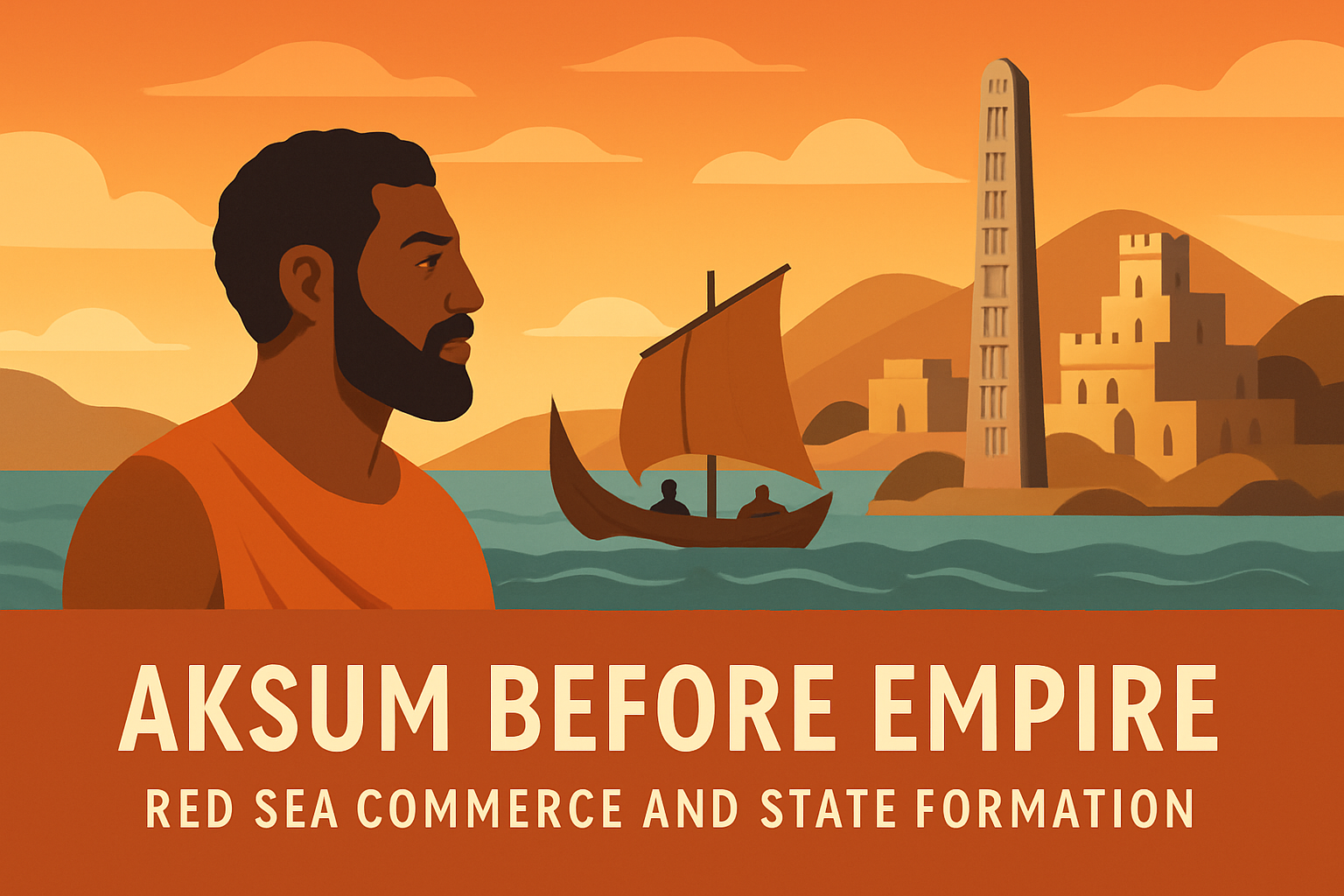
The Kingdom of Aksum, located in the northern regions of present-day Ethiopia and Eritrea, played a crucial role in ancient world history, especially in the high traffic trade networks of the Red Sea. Before it emerged as a centralized empire with large territories and political influence, Aksum was characterized by its participation in regional commerce and the formation of complex state systems. Understanding the pre-empire phase of Aksum, marked by nascent state structures and deep involvement in trade, reveals significant aspects of its later development into a powerful empire. Examining Aksum’s early history is not just an academic exercise; it provides insights into how commerce and geography can drive the development of economic and social systems before imperial consolidation, highlighting broader themes in the study of early complex societies.
Early Trade Networks and Economic Foundations
Aksum’s proximity to the Red Sea was pivotal in its rise as a significant center of trade in northeastern Africa. The location provided access to vital maritime routes connecting the East and West. Initially, Aksum was part of a constellation of smaller polities that engaged in regional trade. These early commercial activities laid the foundation for developing more complex societal structures. Through trading goods such as ivory, gold, and incense, Aksum established connections with merchants from the Arabian Peninsula, India, and the Mediterranean, facilitating cultural and technological exchanges.
For example, the Dean of Coins, one of the earliest banks recorded, emerged due to this economic environment. By facilitating trade, credit, and currency exchange, early financial institutions supported the economic activities necessary for forming a centralized polity. Over time, the accumulation of wealth from trade enabled Aksum’s leaders to consolidate power, invest in public works, and extend political control over neighboring territories.
Aksumite Social Organization and Political Development
The vibrant trade networks provided not only economic wealth but also catalyzed changes in social organization and political development. Initial Aksumite society was tribal, with clan-based structures largely independent from centralized authority. However, the wealth generated from trade allowed certain leaders to gain prominence and influence, spearheading the transition from fragmented tribal systems to organized political entities.
Aksum’s rulers began to adopt elements of monarchical governance seen in neighboring kingdoms. This gradual shift is evident in the archaeological record, with the construction of monumental buildings and evidence of a bureaucracy. The ruling elite leveraged trade wealth to finance these projects, ensuring their legitimacy and the loyalty of their constituents, thus facilitating smoother political transitions and the formation of an early state apparatus.
Cultural Interactions and Technological Developments
Aksum’s engagement with the international trade network was not limited to economic transactions; it also led to significant cultural and technological exchanges. Contacts with diverse cultures introduced new ideas, languages, and technologies, which were instrumental in shaping Aksum’s unique identity. For instance, the adoption of coinage is a standout example of how Aksumite society integrated external influences into its socioeconomic fabric.
Moreover, Aksumite artisans and architects developed distinct styles that blended indigenous influences with foreign elements, evident in the construction of stelae and the introduction of Christianity in later years. These technological and cultural exchanges enriched Aksum’s cultural heritage, fostering a society poised to become an influential player in later historical periods.
Transition from Tribal Confederation to Kingdom
The transition from a tribal confederation to a more centralized kingdom was marked by critical transformations in political organization and expansion of territorial control. Initially, authority within Aksum was decentralized and contingent on clan alliances. However, as Aksum’s trading influence grew, so did the necessity for a more cohesive political structure.
| Change | Tribal Confederation | Centralized Kingdom |
|---|---|---|
| Political Structure | Decentralized, clan-based | Centralized, monarchical |
| Economic System | Regional trade, barter | International trade, currency-based |
| Social Hierarchy | Clan authority | Royal and noble elite |
Strategically, the consolidation meant establishing control over essential trade routes and resources, which required more organized military and administrative systems. This transition allowed for more efficient governance, conflict resolution, and a systematized tax collection necessary for sustaining a more extensive territory.
Role of Religion in State Formation
The role of religion was also significant in the process of state formation in pre-empire Aksum. Initially polytheistic, the region experienced various religious influences due to trade interactions. These included South Arabian and later, Christian influences, which played a vital part in unifying diverse communities under a single political entity.
- South Arabian Influence: Early inscriptions and monuments reveal South Arabian deities, indicating cultural synchronization.
- Judaism and Christianity: Found traces in historical records and were pivotal in later periods, forming a cohesive social and ideological framework that legitimated Aksumite rulers.
Religious structures and places of worship emerged as crucial centers for community gathering, further solidifying political power by projecting divine authority and promoting loyalty to emerging leadership figures. These religious dynamics helped transcend tribal divisions, offering a shared identity and cultural cohesion that were essential for state formation.
Conclusion: The Pre-Empire Lessons of Aksum
In sum, examining Aksum before it became an empire provides critical insights into the ways economic, social, technological, and cultural factors contribute to state formation. In Aksum’s case, it was trade via the Red Sea in particular that proved paramount. By integrating early trade links, leveraging cultural exchanges, and transforming social and political structures, Aksum laid a sturdy foundation upon which its later might and influence as an empire were built.
The reader should note that understanding these processes is not just about historical appraisal but can also yield valuable lessons. These include recognition of the significance of trade routes in economic development, the importance of cohesive political structures in state building, and the role of cultural and religious cohesion in unifying diverse communities. As a next step, one might consider investigating the broader impacts of ancient trade networks beyond Aksum to understand their role across different civilizations.
Frequently Asked Questions
1. What was the geographical significance of Aksum in the context of Red Sea commerce?
The geographical location of Aksum was pivotal in its rise as a significant player in ancient commerce. Situated in the northern parts of what is today Ethiopia and Eritrea, the Kingdom of Aksum was strategically located near the Red Sea, which served as a major connector of trade routes between Africa, Arabia, and the larger Mediterranean world. This positioning allowed Aksum to facilitate and control trade between inland Africa and the coastal regions, acting as a commercial hub. The Red Sea not only provided a maritime trade route but also integrated overland trading paths, enhancing Aksum’s capability to control the flow of goods such as gold, ivory, and frankincense, thereby fostering the economic foundations for its eventual rise as an empire.
2. How did Aksum’s involvement in trade influence its early state formation?
Trade played a critical role in the early state formation of Aksum. By engaging in robust trade activities, the region accumulated wealth and resources, which in turn enabled the emergence of complex social and political structures. The inflow of wealth from trade empowered local leaders to establish administrative and governance frameworks needed to manage the expanding economic activities. Furthermore, trade facilitated cultural exchanges and the adoption of foreign technologies and ideas, which contributed to social and technological advancements within Aksum society. These developments helped lay the groundwork for a more centralized form of governance and organization, eventually leading to the rise of the Aksumite Empire.
3. What types of goods were commonly traded by Aksum before it became an empire?
Before Aksum blossomed into a centralized empire, it was heavily involved in trading a variety of goods that were highly valued across different regions. These goods included gold, ivory, and exotic animal products sourced from the African interior, which were in great demand in the Mediterranean and Arabian markets. Additionally, Aksumites traded frankincense and myrrh, aromatic resins that were essential in religious and cultural rituals. Besides these, textiles, pottery, and glass created from imported raw materials also featured in Aksum’s trade repertoire. This diverse trade not only contributed to the prosperity of the region but also to its cultural and technological development.
4. What were some social and political changes in Aksum as a result of its trading activities?
The involvement of Aksum in extensive trade networks brought about noticeable social and political changes in the region. Socially, trade enriched the local populace and led to more stratified social hierarchies based on wealth and control over resources. This new social structure allowed emerging elite classes to wield more influence, ultimately paving the way for centralized state power. Politically, the control of trade routes necessitated more organized forms of governance, as leaders required systems to levy taxes, protect trade routes, and manage diplomatic relations with other trading partners. This organized governance structure was a precursor to the bureaucracy that would govern the later Aksumite Empire.
5. How did Aksum’s engagement in Red Sea commerce contribute to its cultural development?
Aksum’s active participation in Red Sea commerce significantly influenced its cultural development by encouraging the exchange of ideas, art, and religious practices. The influx of wealth from trade allowed for the patronage of arts and the construction of monumental architecture, which reflected both indigenous and foreign influences. Through trade, Aksum was exposed to diverse cultures and ideologies, which it assimilated while retaining its unique cultural identity. Moreover, commerce facilitated the introduction of Christianity to the region, which eventually became the state religion and reshaped Aksumite culture and society. This blend of local traditions with external influences resulted in a rich, dynamic culture that was both unique to Aksum and reflective of its trade connections with the broader ancient world.