
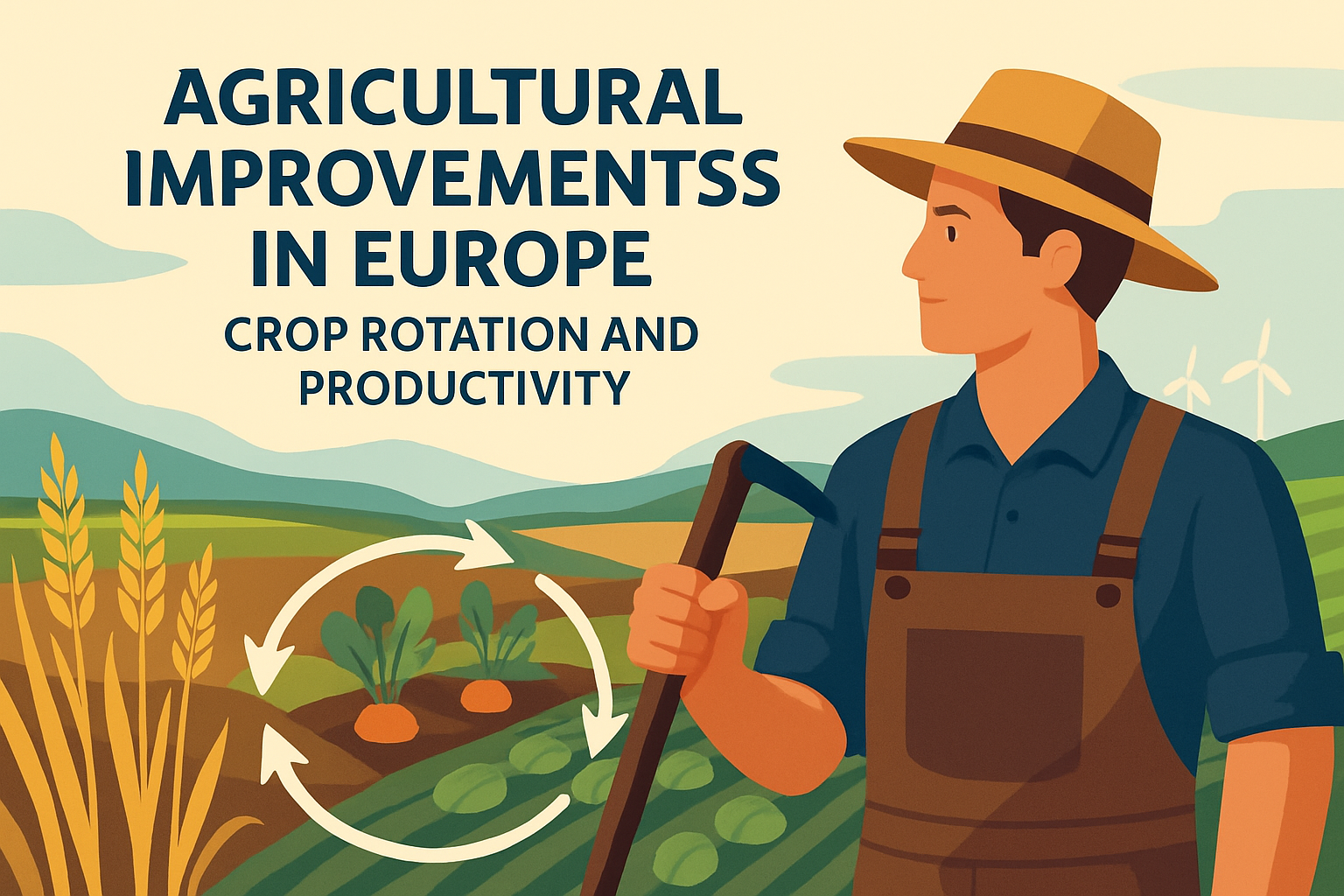
Agricultural improvements in Europe transformed food production, land use, and rural society long before tractors and synthetic fertilizers appeared. Among the most important advances, crop rotation stands out because it raised productivity by changing how farmers managed soil fertility, labor, livestock, and risk. In practical terms, crop rotation means growing different crops on the same field in a planned sequence across several years rather than repeating the same crop continuously. That simple shift reduced nutrient depletion, interrupted pest and weed cycles, and made better use of available land. Across Europe, especially from the early modern period into the eighteenth and nineteenth centuries, improved rotations helped replace low-output systems with more intensive farming that could feed larger populations.
When historians discuss agricultural improvements in Europe, they usually refer to a connected set of changes: enclosure in some regions, better drainage, selective livestock breeding, wider use of fodder crops, improved tools, and more systematic farm management. Yet crop rotation sits near the center of that story because it linked all the others together. I have worked with historical farming records and agronomy case material, and one pattern appears repeatedly: productivity rises most reliably when rotations are designed around the biology of crops and soils, not around habit. European farmers who moved beyond the old two-field and three-field systems gained more than extra grain. They gained manure from larger animal herds, winter feed from turnips and clover, more resilient soils, and steadier output over time.
The traditional medieval three-field system divided arable land into autumn grain, spring grain, and fallow. Fallow land was left uncropped for a season to recover. That method had logic under low-input conditions, but it also imposed a hard ceiling on output because a substantial share of land produced no food crop in a given year. Agricultural improvement began when farmers asked a direct question still relevant today: how can soil recover without idling so much acreage? The answer was not one universal rotation but a family of rotations using legumes, roots, grasses, and cereals in sequence. These systems maintained fertility more actively and kept more land productive each year.
This matters because European productivity growth was not merely a farm story; it shaped demography, urbanization, trade, and industrial development. More reliable harvests reduced famine risk in many areas. Higher yields supported population growth and released labor for nonfarm work. Market-oriented regions could specialize, selling grain, wool, meat, dairy, or seed depending on local conditions. Modern readers searching for the causes of Europe’s agricultural rise often focus on machinery, but in historical sequence, agronomic organization came first. Crop rotation improved productivity because it changed ecological relationships on the farm. Understanding that mechanism explains why these improvements spread unevenly, why some regions advanced faster than others, and why rotation remains a core principle of sustainable agriculture today.
From Open Fields to Planned Rotations
Before improved rotations spread, much of Europe farmed within open-field systems governed by village custom. Strips were scattered, grazing rights were shared, and decisions about sowing and fallow often had to be coordinated collectively. This arrangement limited experimentation. A farmer could not easily introduce turnips or clover on a strip if neighbors expected common grazing after harvest. In England, parts of the Low Countries, and some German and Danish regions, institutional change gradually created room for more deliberate field management. Enclosure is the best-known example in the English case. By consolidating parcels and strengthening control over land use, enclosure made it easier to adopt rotations that required fencing, fodder planning, and tighter integration of crops with livestock.
The famous Norfolk four-course rotation illustrates the principle clearly: wheat, turnips, barley, and clover or grass. It was not the only productive sequence in Europe, and historians sometimes overstate its uniformity, but it became influential because it solved several problems at once. Wheat provided a marketable grain crop. Turnips fed livestock through winter. Barley supplied grain and often supported brewing markets. Clover restored nitrogen through legume biology and created fodder. The key innovation was not simply adding new crops; it was replacing bare fallow with crops that rebuilt the farming system. Farmers who adopted similar rotations often found that every field contributed more consistently to annual output.
Rotations varied according to climate, soil type, market access, and household strategy. In the Low Countries, intensive mixed farming developed with strong links between dairying, manure use, and fodder production. In parts of France, progress was slower and more regionally mixed, though areas near urban markets adopted forage crops and more commercial methods earlier. In central and eastern Europe, large estates sometimes implemented improvements from above, while peasant regions changed more gradually. The point is that crop rotation was not a single invention dropped onto Europe. It was an adaptive framework. Farmers improved productivity when they matched sequences to local constraints rather than copying a model blindly.
One reason improved rotations spread was that they offered visible, cumulative results. A farmer did not need abstract theory to notice that clover supported more animals, that more animals meant more manure, and that manured fields yielded better cereals. Estate managers, agricultural writers, and early improvers documented these effects in manuals and farm accounts. By the eighteenth century, agricultural societies and printed surveys circulated practical knowledge across borders. This diffusion of know-how mattered. Productivity gains rarely came from seed choice alone or field layout alone. They came from coordinated management, and crop rotation provided the organizing logic.
How Crop Rotation Increased Productivity
Crop rotation increased productivity through several mechanisms that modern agronomy can explain precisely. First, different crops draw nutrients from soil in different proportions and at different depths. Continuous cereal cultivation tends to exhaust available nitrogen and weakens soil structure. Introducing legumes such as clover, vetch, peas, or beans helps restore nitrogen through symbiosis with Rhizobium bacteria. Farmers in early modern Europe did not describe the microbiology in those terms, but they observed the effect. After a legume-rich phase, cereal crops often performed better. Second, root crops and forage crops diversify rooting patterns, improve soil tilth, and can suppress some weeds through timing and canopy cover.
Third, rotations reduce biological pressure from pests and diseases. Repeating the same crop invites specialized pathogens and insect populations to build over time. Shifting from wheat to turnips to barley to clover interrupts those cycles. Even when historical farmers lacked modern plant pathology, they recognized that land repeatedly cropped with the same grain became tired and less reliable. Fourth, rotations spread labor demand more evenly across seasons. Sowing, hoeing, harvesting, feeding, and manure application could be sequenced more efficiently, reducing bottlenecks at critical moments. That operational gain is often overlooked, but on real farms it mattered enormously.
Livestock integration was another decisive factor. Fodder crops made it possible to overwinter more animals instead of slaughtering large numbers before winter due to feed shortages. More animals produced more manure, and manure remained the central fertility resource before industrial fertilizer. Better-fed animals also yielded more meat, milk, traction, and wool. In this way, crop rotation multiplied benefits across the entire farm economy. A field of turnips was not just a field of turnips; it was winter feed, which was manure, which was cereal yield, which was market surplus. That chain reaction helps explain why rotations produced structural gains rather than isolated improvements.
| System | Typical Sequence | Main Limitation or Advantage | Productivity Effect |
|---|---|---|---|
| Two-field system | One cropped, one fallow | Simple but half the land rests each cycle | Low land-use intensity |
| Three-field system | Autumn grain, spring grain, fallow | Better than two-field but still leaves one-third idle | Moderate output ceiling |
| Improved mixed rotation | Cereal, root crop, cereal, legume/grass | Requires planning, livestock links, and control over fields | Higher yields and more annual production |
Yield data from early modern Europe are uneven, but the directional evidence is strong. Regions using improved rotations generally achieved more output per acre and often better seed-to-yield ratios than areas tied to extensive fallow. England is frequently cited because by the eighteenth century it showed notable gains in grain output and livestock productivity, though recent scholarship emphasizes regional variation and the role of institutions and markets alongside technique. The Dutch case also matters because intensive land use, drainage, dairying, and fodder systems demonstrated that high productivity could come from tightly managed mixed agriculture. The broader lesson is straightforward: rotations increased productivity not by magic, but by intensifying biological and managerial efficiency on finite land.
Regional Patterns Across Europe
England became the classic example of agricultural improvement, but the European picture was more diverse. In eastern England and the Midlands, farmers benefited from soils and market access that supported commercial grain and livestock systems. Enclosure, though socially disruptive, gave individual occupiers more freedom to organize rotations and invest in drainage or marling. Agricultural writers such as Charles Townshend became associated with turnip husbandry, even if later memory simplified the story. What matters is that English farming increasingly treated fields as parts of an integrated enterprise. The result was rising output per worker and per acre in many districts, especially where rotations, better livestock feeding, and active markets reinforced each other.
The Low Countries offer an equally important model. Dutch and Flemish farmers operated in densely populated, market-oriented economies with advanced drainage, transport, and urban demand. They made intensive use of manure, fodder crops, and meadow management. In effect, they demonstrated that high productivity required careful nutrient cycling and strong links between arable farming and livestock. Their example influenced observers elsewhere in Europe. When British improvers praised continental methods, they were often responding to practices already proven in the Netherlands, including the disciplined management of grass, roots, and manure.
France presents a more uneven case. Some northern and northeastern districts adopted forage crops and commercial rotations relatively early, while many other areas retained traditional structures longer. Fragmented holdings, communal rights, and variable access to capital slowed change in some places. Yet it would be wrong to portray France as static. Progressive estates, scientific societies, and regional experiments expanded throughout the eighteenth and nineteenth centuries. Similar patterns appeared in German states, Denmark, and parts of northern Italy, where reforms in land management and livestock feeding gradually strengthened rotational systems. Denmark later became especially notable for combining improved agriculture with cooperative marketing in the nineteenth century.
Eastern Europe changed under different conditions. Large estates in Prussia, Poland, and the Habsburg lands sometimes adopted innovations through estate administration, but labor systems and market structures shaped outcomes. Where serfdom persisted longer, incentives for peasant-led experimentation could be weaker, though landlords themselves might push selected improvements. Russia had pockets of innovation but vast areas where extensive methods remained dominant. Europe’s agricultural transformation was therefore not a synchronized revolution. It was a long, regionally uneven process in which crop rotation worked best when supported by secure land control, market outlets, animal husbandry, and practical knowledge.
Social and Economic Consequences
Higher productivity changed rural life in ways both positive and contested. The most obvious benefit was greater food supply. More reliable cereal harvests and larger livestock numbers helped support growing populations from the seventeenth century onward, especially in northwestern Europe. Better-fed urban populations could sustain expanding manufacturing and trade. Economists often connect agricultural improvement to industrialization for this reason: farms produced more food with relatively fewer workers, allowing labor and capital to shift into other sectors. This was not a simple one-way cause, but the relationship was real. Productive agriculture widened the economic base of European societies.
At the household level, rotations reduced vulnerability to total failure from a single crop. Mixed systems spread risk across grain, fodder, roots, and animals. If wheat prices fell, dairy or meat could offset the loss. If one field underperformed, others might recover value through feed or manure production. This portfolio effect remains a core principle in farm management today. Rotations also improved diet indirectly. More livestock products and diversified crops meant more calories and, in some areas, better nutrition. Rural living standards did not rise uniformly, but agricultural improvement created conditions under which they could rise.
The tradeoffs were serious. Enclosure and related reforms often undermined customary rights to grazing, fuel, and gleaning. Smallholders and landless laborers could lose access to resources that had sustained them. In some regions, productivity gains concentrated benefits among larger landowners or tenant farmers able to invest in new practices. Historical accuracy requires acknowledging this tension. Agricultural improvements in Europe increased output, but they did not distribute gains evenly. The same rotation that made a farm more productive could also depend on social changes that displaced vulnerable rural people.
Even so, the long-term significance of crop rotation is unmistakable. It converted fertility management from passive recovery to active design. That conceptual shift laid groundwork for modern agronomy, including nutrient budgeting, cover cropping, integrated pest management, and regenerative farming. Today, when advisers recommend rotating cereals with legumes, brassicas, or forage grasses, they are extending principles refined in Europe over centuries. The details differ because modern farms have synthetic fertilizers, mechanization, and improved seed genetics, but the core logic remains the same: soil productivity rises when biological cycles are managed deliberately. That is the enduring legacy of Europe’s agricultural improvements.
A clear takeaway emerges from the historical evidence. Crop rotation raised European agricultural productivity because it kept more land in use, restored fertility without depending solely on fallow, supported larger and better-fed livestock herds, and reduced the risks associated with repetitive monoculture. It worked best where farmers could coordinate land, labor, livestock, and markets into a coherent system. That is why the most successful regions did not rely on one breakthrough. They combined rotations with enclosure or better tenure, drainage, manure management, selective breeding, and access to urban demand. Productivity was the outcome of a system, and rotation was its engine.
The history also shows that agricultural progress is rarely uniform or cost-free. England, the Low Countries, France, German states, and eastern Europe followed different paths shaped by institutions, ecology, and social structure. Some communities benefited early from higher yields and stronger market links. Others faced disruption as traditional rights eroded. A balanced view recognizes both realities. Crop rotation was neither a miracle cure nor a minor adjustment. It was one of the most important practical innovations in European farming because it translated ecological understanding into repeatable gains in output.
For anyone studying economic history, rural development, or sustainable agriculture, this subject remains highly relevant. The same questions European farmers faced still matter now: how do you maintain soil fertility, diversify risk, and produce more from limited land without exhausting the resource base? Crop rotation provided one of history’s best answers. If you want to understand how Europe increased farm productivity before modern industrial inputs, start with rotations, then trace how they connected fields, animals, labor, and markets into a more productive whole.
Frequently Asked Questions
What is crop rotation, and why was it such an important agricultural improvement in Europe?
Crop rotation is the practice of planting different crops on the same piece of land in a planned sequence over time instead of growing the same crop repeatedly year after year. In Europe, this was a major improvement because it helped farmers use the land more efficiently while protecting and rebuilding soil fertility. Different crops draw different nutrients from the soil, and some, especially legumes such as clover and peas, can help restore nitrogen. By alternating cereals, root crops, grasses, and legumes, farmers reduced the exhaustion that came from continuous single-crop farming.
This mattered because pre-industrial agriculture depended heavily on the natural productivity of the soil. Before synthetic fertilizers, farmers had limited ways to replace lost nutrients. Crop rotation offered a practical solution. It reduced the need to leave land fallow, increased the amount of acreage producing useful crops, and created a more reliable supply of food and fodder. As a result, it supported larger harvests, healthier livestock, and a stronger rural economy. In that sense, crop rotation was not just a technical adjustment. It was a foundational change in how European agriculture managed fertility, labor, and long-term productivity.
How did crop rotation increase agricultural productivity before modern machinery and chemical fertilizers?
Crop rotation improved productivity by making every acre work harder and more sustainably. In older systems, especially the traditional three-field system, one portion of the land often had to remain fallow so the soil could recover. Rotational systems reduced or even replaced this unproductive fallow period by introducing crops that restored nutrients or served different agricultural purposes. That meant more land could be under active cultivation in a given year, immediately increasing total output.
It also improved yields indirectly through better soil structure and fertility. Root crops such as turnips helped break up the soil, while fodder crops supported more livestock through the winter. More livestock meant more manure, and more manure meant better fertilization for future grain crops. This created a reinforcing cycle in which crops and animals supported one another. In addition, rotating crops reduced the buildup of pests, weeds, and some plant diseases that often worsen when the same crop is grown repeatedly on the same field. Taken together, these benefits made farming more productive and more resilient, even without tractors, mechanized tools, or industrial inputs.
What kinds of crops were commonly used in European crop rotation systems?
European crop rotation systems varied by region, climate, soil type, and local markets, but several crops became especially important. Cereal grains such as wheat, barley, oats, and rye remained central because they provided bread, porridge, animal feed, and income. What changed was that these grains were increasingly integrated into broader rotations rather than planted continuously. Farmers began pairing them with legumes, grasses, and root crops to balance the demands placed on the land.
Turnips and clover became particularly famous in discussions of agricultural improvement, especially in places like England. Turnips provided winter feed for animals, allowing farmers to keep more livestock alive and healthy throughout the colder months. Clover and other forage crops helped improve soil fertility and also supplied valuable fodder. Legumes such as peas and beans played a similar role, contributing to soil improvement while also adding dietary variety for people and feed for animals. The key point is that rotation was not about one miracle crop. It was about combining crops with different functions so that the land remained productive, livestock were better supported, and harvests became more reliable over time.
How did crop rotation affect livestock, labor, and rural society in Europe?
Crop rotation had effects far beyond the field itself. One of the biggest changes involved livestock. When farmers grew more fodder crops such as clover and turnips, they could maintain larger herds through the winter instead of slaughtering as many animals in the autumn. More animals meant more milk, meat, traction power, and manure. Manure was especially important because it strengthened the link between animal husbandry and arable farming, helping sustain higher crop yields across the farm.
Labor patterns changed as well. A more varied rotation system required planning, knowledge, and careful timing because different crops had different planting, weeding, harvesting, and feeding schedules. This could spread labor more evenly throughout the year and make farm management more complex. In rural society, these changes often contributed to broader economic and social shifts. Higher productivity could support population growth, expand market activity, and increase pressure for land reorganization, including enclosure in some regions. Not every rural household benefited equally, but crop rotation undeniably helped reshape the agricultural landscape by tying soil management, livestock raising, and labor organization into a more integrated and productive system.
Did crop rotation alone cause Europe’s agricultural transformation?
Crop rotation was one of the most important drivers of agricultural improvement, but it did not act alone. Europe’s agricultural transformation resulted from a combination of changes that reinforced one another. These included better drainage, more systematic manuring, selective livestock breeding, enclosure or land consolidation in some areas, improved tools, and stronger connections to local and regional markets. Crop rotation fit into this wider pattern because it made many of these other improvements more effective. For example, more fodder crops supported more animals, and more animals produced more manure, which improved grain cultivation.
It is best understood as a central part of a larger agricultural system rather than a single isolated breakthrough. Its importance lies in the way it linked land use, soil fertility, livestock management, and risk reduction. By diversifying what was planted, farmers became less dependent on a single harvest and better able to withstand poor seasons or shifting conditions. So while crop rotation was not the only reason European agriculture became more productive, it was one of the clearest and most influential innovations in the long transition toward higher output, more intensive land use, and a transformed rural economy.