
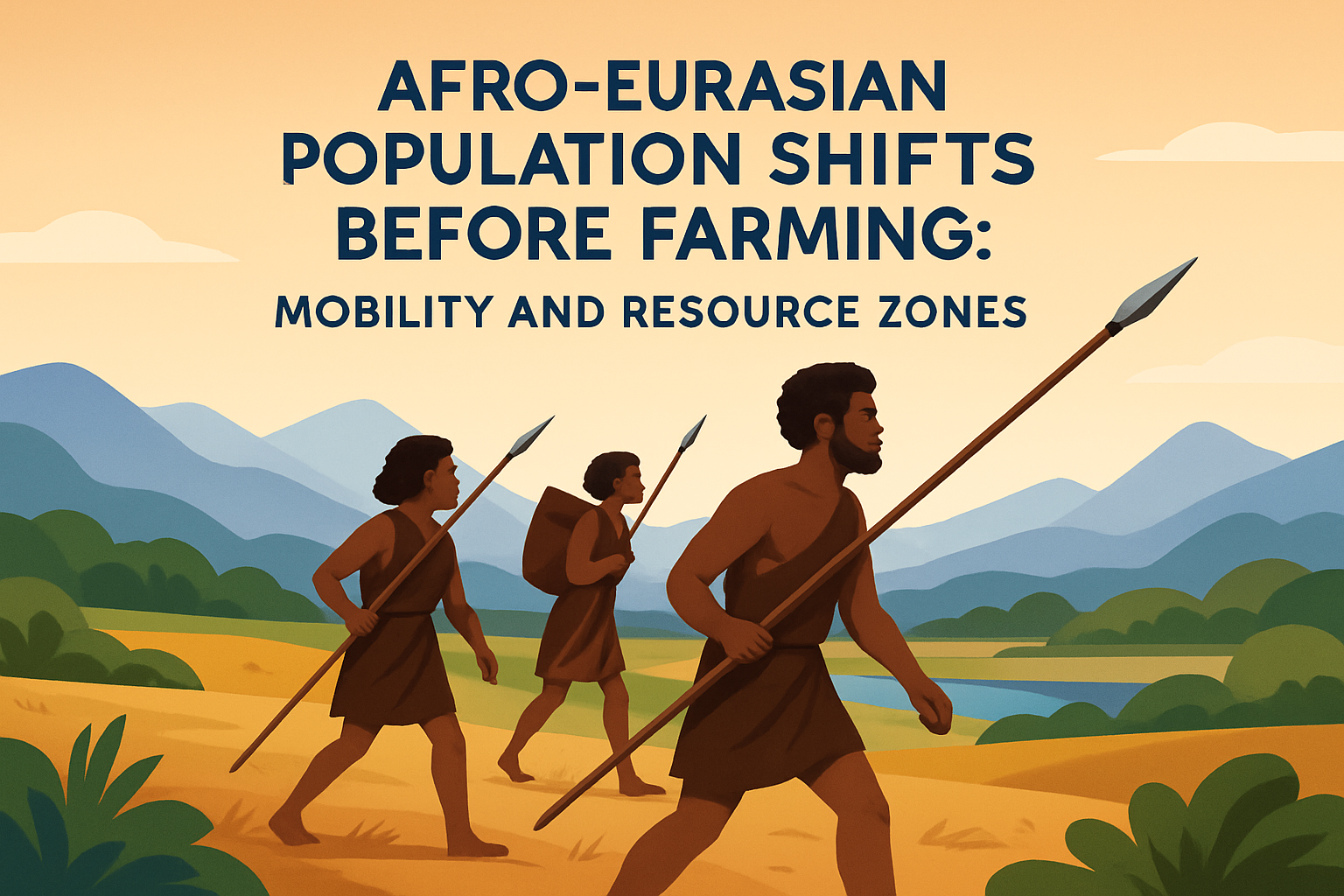
The sweeping landmass of Afro-Eurasia, encompassing Africa, Europe, and Asia, has been a stage for significant population dynamics long before the advent of systematic agriculture. The ebb and flow of human groups across vast terrains were driven by factors like climate changes, resource availability, and evolving social structures. These movements, known as “population shifts,” refer to the migration or relocation of large numbers of people over time. Understanding these shifts is crucial because they shaped the linguistic, cultural, and genetic landscape of modern populations. Additionally, examining the period before the dawn of agriculture provides insights into human ingenuity and adaptability, highlighting how resource zones—designated areas of abundant critical resources such as water, food, and materials—drove the patterns of human habitation and movement. This exploration reveals humanity’s resilient nature while providing analogs for how modern societies might adapt to environmental challenges.
Early Human Migration Patterns
Before farming revolutionized human society, early humans were nomadic, traveling in small bands in search of sustenance. Environmental factors played a central role in directing these migrations. During the Pleistocene era, approximately 2.6 million to 11,700 years ago, ice ages reduced habitable lands, prompting groups to seek refuge in warmer zones.
The cycle of glaciation and interglacial periods necessitated frequent relocations, particularly in Northern Europe, where pervasive ice sheets rendered vast areas uninhabitable. For example, the retreat of glaciers post the last Ice Age opened up new territories. As conditions ameliorated, human bands migrated northeast into the newly accessible European regions. Such migrations illustrate resilience, with communities adapting to ever-changing landscapes, showcasing humanity’s innate drive to explore and colonize favorable environments.
Resource Zones and Population Density
Resource zones are critical in understanding ancient population movements. These areas, rich in vital resources, were hotspots for human activity. In prehistoric times, proximity to water sources, hunting grounds, and raw materials for tool making significantly influenced settlement patterns.
Consider the fertile Nile Valley in Africa. Its consistent floods replenished the soil, making it a prime cradle for human settlement even before organized farming began. This vast and reliable resource zone attracted populations, forming a dense, interconnected web of communities. These interactions set the grounds for complex societal development, including communal cooperation and the eventual rise of cities along the Nile River.
| Resource Zone | Location | Resource Type |
|---|---|---|
| Nile Valley | Africa | Water, Fertile Land |
| Tigris-Euphrates Basin | Asia | Agricultural Land, Water |
| European Steppes | Europe | Grazing Lands, Minerals |
Technological Innovations and Mobility
Mobile lifestyles prompted various technological innovations to improve survival in diverse environments. Stone tool advancements, notably during the Paleolithic period, played a pivotal role in enhancing mobility and resource exploitation. As tools became more specialized and sophisticated, they facilitated the efficient hunting and processing of game, thereby enhancing the ability to occupy a broader range of ecological niches.
The emergence of spear-throwers and bows, for instance, enabled hunters to exploit wide-ranging game herds that roamed expansive areas like the European steppes. These tools influenced migration, promoting more stable inhabited zones that offered both game and raw materials for tool maintenance.
Climatic Influences on Migration
Climate has always been a formidable determinant in guiding human movement. Historical climate fluctuations oscillated between extremes, sometimes creating lush, habitable areas and at other times transforming regions into uninhabitable deserts or frozen wastelands.
The Saharan Pump Theory exemplifies this phenomenon. It posits that periodic wet phases in the Sahara Desert allowed flora and fauna to thrive, thereby supporting human settlements. Conversely, arid periods forced inhabitants to migrate towards more dependable environments like the Nile Valley or the Mediterranean coasts. The theory demonstrates a repeating pattern of expansion and contraction in human settlement driven by climatic changes, emphasizing humanity’s ongoing adaptation to planetary transformations.
Intergroup Interactions and Cultural Exchanges
Contrary to isolated existence, early humans engaged in significant interactions with neighboring groups. The migration of populations created conduits for cultural and technological exchanges. When groups came into contact, they traded not only goods but also ideas and customs, fostering innovation and collective problem-solving.
The Gravettian culture, nurtured across Europe approximately 33,000 to 21,000 years ago, serves as a perfect encapsulation. The people behind this culture spread over vast parts of Europe, interacting with diverse communities. Such interactions likely facilitated the sharing of techniques for crafting better tools, clothing, and constructions. This continuous cultural exchange enriched societies, encouraging cumulative advancements that served as the foundation for more complex sociocultural structures in later epochs.
Genetic Implications of Ancient Migrations
The interactions between distinct populations through migration have also left indelible marks on modern genetic diversity. Gene flow between migrating bands and resident groups introduced genetic variations that shaped the evolutionary pathways of contemporary populations.
An intriguing example is the Denisovan admixture. Genetic studies have revealed that Denisovan genes are present in modern Asian populations, indicating historical interbreeding as migratory ancestors moved through Central and East Asia. Such genetic exchanges highlight how ancient migrations have equipped modern humans with adaptive traits, exemplifying the complexity underpinning our ancestral stories.
Conclusion: Lessons from Ancient Mobility
In dissecting the intricate tapestry of Afro-Eurasian migration patterns before the onset of agriculture, we find compelling evidence of human resilience and adaptability. These ancient population shifts, driven by mobility requirements and resource zones, provide valuable insights into modern challenges.
Key takeaways include the importance of resource mapping for societal sustainability and recognizing intergroup collaboration as a powerful driver of innovation. History repeatedly demonstrated that adaptation to shifting environments and climates was pivotal in human development. Modern society faces its share of environmental challenges—like climate change and resource scarcity—and can harness these historical lessons to foster strategic, long-sighted solutions.
Reflect on this rich history of adaptation and innovation when considering today’s environmental and sociocultural challenges. Let it inspire collective action and informed decision-making as we navigate our interconnected world. Embrace collaboration and harness the available resources wisely to fulfill our legacy of adaptation.
Ready to further explore this topic? Engage with educational materials, participate in discussions on human history, and consider supporting initiatives that preserve and study ancient sites crucial for understanding humanity’s journey.
The story of early human migration is ultimately a tale of courage and adaptability, offering timeless lessons that remain relevant as we progress into an uncertain future. Continue to engage with history, learn from it, and shape a future that honors the perseverance and ingenuity of our ancestors.
Frequently Asked Questions
1. What are the primary reasons behind the population shifts in Afro-Eurasia before the advent of farming?
Before the systematic practice of agriculture took hold, human populations across Afro-Eurasia were driven to move primarily due to several key factors. Climate changes, whether gradual or abrupt, played a significant role in these movements. As the environment changed, so did the availability of resources like water, food from plants and animals, and habitable land. Additionally, the pursuit of resources such as game animals and edible plants was crucial, as these were the primary sustenance for these early communities.
Moreover, social structures and interactions among different groups influenced migration patterns. Groups might relocate to avoid conflict or to establish advantageous trade relationships. The fluidity of borders and the absence of political states meant that resources often dictated movement more than territory ownership. Together, these elements created a dynamic landscape where human populations adapted continually through mobility, allowing them to thrive in diverse environmental zones long before settled farming communities emerged.
2. How did climate changes influence the migration patterns of pre-agricultural Afro-Eurasian populations?
Climate changes greatly influenced the migration patterns of early human populations in Afro-Eurasia. During periods of climate instability, such as ice ages or warming trends, people were often compelled to relocate to areas with more favorable conditions. These shifts in climate could make previously habitable areas unsuitable, turning lush regions into barren landscapes or vice versa.
For instance, during colder periods, populations might move towards equatorial regions where the climate remained milder. Conversely, as conditions warmed, these groups could move back towards higher latitudes. The development of new resource zones, such as fertile river valleys and steppe lands, due to climate change provided new opportunities for habitation and sustenance. Thus, the necessity to find stable environments where water and food sources were reliable was a critical factor in the migration patterns observed during this pre-agricultural era.
3. What resources were early populations seeking during their migrations throughout Afro-Eurasia?
In the pre-agricultural era, the populations of Afro-Eurasia were primarily moving to secure vital resources needed for survival. First and foremost, they sought sustainable sources of food which included wild animals and plants. Depending on the region, this might involve chasing herds of migratory animals such as reindeer or bison or foraging for nuts, berries, and roots.
Water sources also factored heavily into their migration decisions. Rivers, lakes, and wetlands provided not only drinking water but also an abundance of fish and sometimes fertile land that supported a variety of plant and animal life. Additionally, certain minerals and materials needed for tool-making, such as flint for blades or sites for obtaining red ochre for cultural purposes, would influence their paths. Thus, their migrations were closely tied to the search for and management of these critical resources that sustained their communities.
4. How did social structures impact the movement and organization of early Afro-Eurasian societies before farming?
Social structures played a significant role in impacting the movement and organization of early Afro-Eurasian societies. These groups often operated within clan systems or tribe-like units, where the kinship ties and social hierarchies determined decision-making processes. Elders or leaders experienced in understanding environmental cues often influenced group movements.
Conflicts or alliances with neighboring groups also affected mobility. Groups might relocate to avoid hostile encounters or to access new trade routes that facilitated the exchange of goods and information. Additionally, the expansion of a group often depended on its size and resource capacity, with larger, more socially organized groups possibly exerting influence or pressure over smaller ones. Thus, social dynamics were deeply entwined with how these early communities navigated their world, often dictating not only where they moved but also how they interacted with the environments and populations they encountered.
5. Why is understanding pre-agricultural population shifts in Afro-Eurasia crucial for historical studies?
Understanding pre-agricultural population shifts in Afro-Eurasia is crucial because these movements laid the foundational patterns for human settlement and cultural development long before the advent of farming. These migration patterns helped to shape the genetic, linguistic, and cultural diversity that characterizes these regions today. By examining these shifts, historians and archaeologists can better understand how early humans adapted to their environments and the strategic choices they made to enhance their survival and prosperity.
Additionally, knowledge of these movements opens a window into human resilience and adaptability, illustrating how our ancestors responded to challenges with innovation and social cooperation. The information gleaned from studying pre-agricultural shifts offers insights into human behavior, resource management strategies, and interactions with various environments that continue to be relevant for assessing present and future human-environment dynamics. Thus, these studies are integral to reconstructing the broader narrative of human evolution and the development of societies across the Afro-Eurasian landmass.