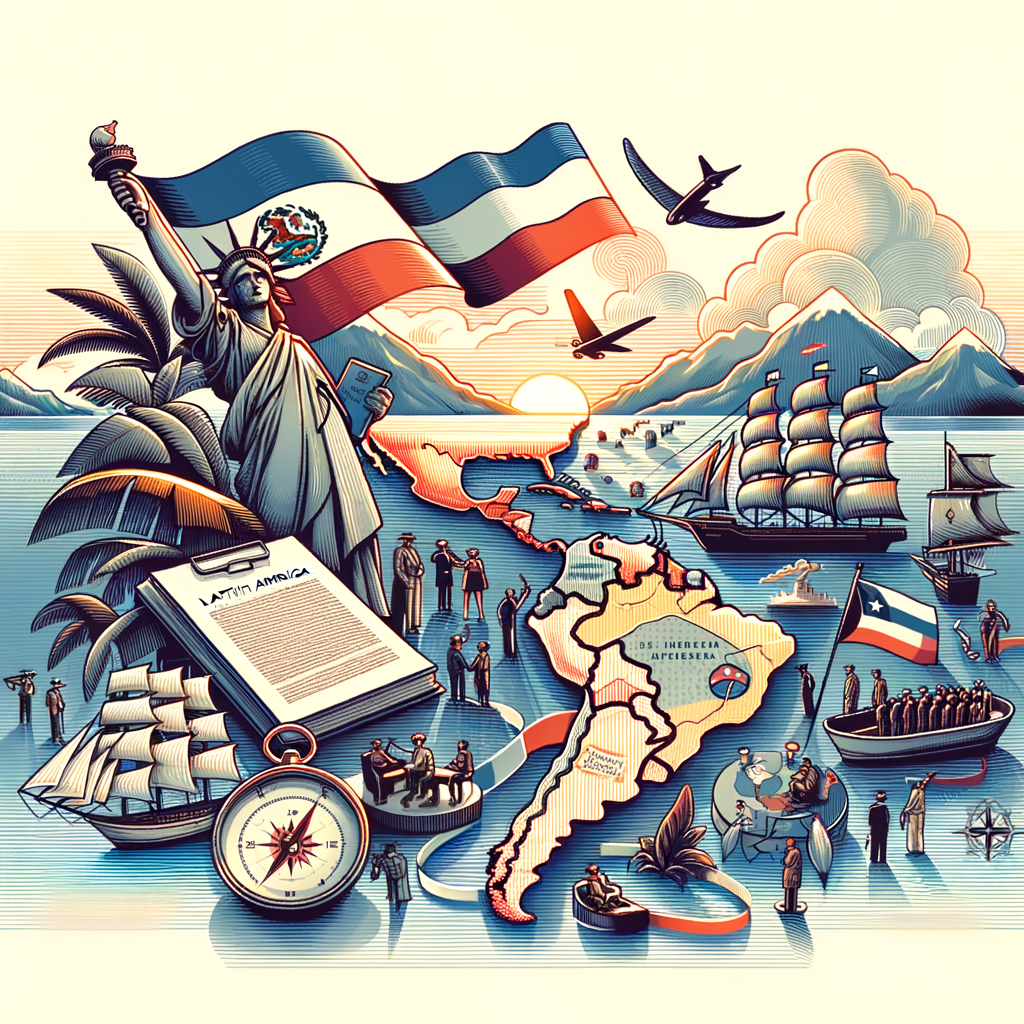
The Monroe Doctrine is a cornerstone of United States foreign policy that has significantly influenced the geopolitical landscape of Latin America for nearly two centuries. Issued by President James Monroe in December 1823, it declared that any further European colonization in the Americas would be viewed as an act of aggression requiring U.S. intervention. This doctrine was ostensibly aimed at protecting the newly independent Latin American states from European interference, promoting an era of hemispheric solidarity under U.S. leadership. However, the application and interpretation of the Monroe Doctrine over time have evoked mixed reactions. Its implementation often extended beyond protecting Latin American nations, sometimes leading to interventions that prioritized U.S. interests. The legacy of the Monroe Doctrine is a tapestry of political alliances, economic influences, and military interventions that continue to shape the present-day relations between the United States and Latin American countries. Exploring the complex legacy of the Monroe Doctrine requires a journey through historical contexts, its varied interpretations, and its ongoing impacts on Latin America.
Origins and Historical Context of the Monroe Doctrine
The early 19th century was a period of significant upheaval and change. The Napoleonic Wars had drastically altered the balance of power in Europe, while Latin American nations began to emerge from Spanish and Portuguese colonial rule. This environment of change set the stage for the articulation of the Monroe Doctrine. As revolutionary movements gained momentum across Latin America, the United States recognized an opportunity to assert its influence. The doctrine was born out of a marriage of idealism and pragmatism, blending a desire to support republicanism while also preventing the Old World powers from regaining a foothold in the Western Hemisphere. Britain’s tacit support of the Monroe Doctrine, due to its own interests in the region, provided an additional layer of security that made the proclamation more effective. Initially, the Doctrine was welcomed by Latin American leaders, who saw it as a supportive gesture from a fellow republic. However, as time passed, its implications began to diverge.
Interpretations and Evolutions Over Time
Throughout the 19th century and into the 20th, the Monroe Doctrine was reinterpreted by successive U.S. administrations to suit their geopolitical objectives. Early on, it was seen as a policy of mutual hemispheric defense. As manifest destiny and expansionism took hold, U.S. interests began to shift towards establishing economic and political dominance. The late 19th century saw the rise of new doctrines and policies derived from the Monroe Doctrine’s principles, such as the Roosevelt Corollary, which posited the U.S.’s right to intervene in cases of “chronic wrongdoing” or financial instability in Latin American nations. This marked a departure from the Doctrine’s original defensive posture, transforming it into a tool for U.S. interventionism. These interventions were frequently justified on the grounds of maintaining stability and order, yet they often prioritized American interests, leading to tensions and resistance within Latin American countries. The “Big Stick” diplomacy under Theodore Roosevelt provided a further extension of U.S. influence, setting the stage for future military interventions and occupations.
20th Century Interventions and Economic Influence
In the early 20th century, the Monroe Doctrine was used to justify a series of interventions in the Caribbean and Central America. The U.S. intervened in Cuba, Puerto Rico, the Dominican Republic, Nicaragua, and Haiti, often to prop up or install governments that would be more amenable to U.S. interests. These countries became subject to U.S. control in various forms, from outright military occupation to economic exploitation through policies such as dollar diplomacy. For instance, the U.S. orchestrated regime changes and financial predicaments to its advantage. The influence of American companies soared, entrenching U.S. economic interests deeply within Latin American economies. The United Fruit Company in Central America is a notable example, where the economic dependencies created for these countries resulted in significant U.S. political leverage. This economic imperialism, often at the expense of local needs and sovereignty, created patterns of dependency and resentment that would spur revolutionary movements throughout the region. The Cold War further expanded the scope of the Doctrine, with U.S. policy focusing on countering Soviet influence by supporting anti-communist regimes, regardless of how repressive they were.
Contemporary Perspectives and Critiques
The legacy of the Monroe Doctrine remains complex and contested in contemporary Latin America. Many view the Doctrine as having facilitated a form of imperialism that contradicted the values of independence and sovereignty it purported to uphold. Instances of U.S. interventionism have left lasting scars, often hindering local development and destabilizing regions long after the interventions ceased. The ideological pretexts used during the Cold War for intervening shaped national politics in ways that continue to affect these countries. Conversely, some U.S. policymakers and historians see the Monroe Doctrine as a visionary policy that aimed to build a strong Western Hemisphere free from European entanglements. Despite this, the narrative and purpose of the Doctrine were often manipulated to fit the hegemonic aspirations of U.S. administrations. In recent years, Latin American countries have increasingly sought to forge their paths, pursuing policies that assert regional autonomy and reduce U.S. influence. This is seen in organizations like UNASUR and CELAC, and through bilateral relations with non-Western countries, diversifying their global partnerships.
The Lasting Impact on U.S.-Latin America Relations
The repercussions of the Monroe Doctrine are evident in current U.S.-Latin American relations. While overt interventions have become less frequent, the power dynamics established by the Doctrine persist. Issues such as immigration, trade agreements, environmental policies, and drug trafficking are modern arenas where the legacy of the Monroe Doctrine can be observed. The North American Free Trade Agreement (NAFTA) and its successor, the United States-Mexico-Canada Agreement (USMCA), show how economic policies continue to be influential on hemispheric relations. The Doctrine’s ideological framework still finds echoes in the way the United States approaches its foreign policy with Latin America, with the U.S. often still seen as taking on a paternalistic role rather than a partnership-based approach. Initiatives under the pretext of security, like the Mérida Initiative with Mexico, underline ongoing collaboration but also dependencies. Meanwhile, Latin American nations are working to address this through greater regional integration and solidarity, which challenges the lingering unilateral influence of the Monroe Doctrine era. The recent geopolitical shifts, including the rise of China and Russia as influential players in Latin America, also serve to undermine its historical grip.
Conclusion
The Monroe Doctrine has undeniably left a profound legacy on Latin America, acting as both a shield and a sword in different epochs. It set the stage for U.S. engagement with its southern neighbors, defining a relationship that has fluctuated between cooperative and coercive. While initially welcomed as a protective measure, it frequently evolved into a tool for asserting U.S. dominance, contributing to economic exploitation and political upheaval in the region. The Doctrine’s influence has extended beyond its original intent, shaping policies and perceptions even now. Modern Latin America strives to redefine its place in a world where multipolarity is becoming more pronounced, yearning to break free from the shadows of its historical dependencies. For the United States, re-evaluating the Monroe Doctrine’s legacy offers an opportunity to foster a new era of cooperation based on respect, mutual benefit, and shared values. Understanding its history, complexities, and consequences is essential for future diplomacy that seeks to rectify past imbalances and build a more amicable hemispheric partnership. The enduring conversation around the Monroe Doctrine reminds us of the continuous need to balance power, sovereignty, and respect in international affairs.
Frequently Asked Questions
1. What was the Monroe Doctrine and why was it issued?
The Monroe Doctrine, proclaimed by President James Monroe in December 1823, was a defining element of United States foreign policy aimed at limiting European interference in the Americas. At its core, the Doctrine declared that any attempts by European powers to colonize or interfere with nations in the Western Hemisphere would be considered acts of aggression warranting U.S. intervention. The primary motivation behind the Monroe Doctrine was to protect the sovereignty of newly independent Latin American countries, many of which had recently gained independence from European colonial rule. At the same time, it asserted a growing U.S. influence and interest in the region, signaling a protective stance over the political and diplomatic affairs of the Americas. The Doctrine’s issuance also aligned with the broader global diplomatic environment of the 19th century, seeking to curb European power plays in the distant Western lands.
2. How did the Monroe Doctrine impact European relations with Latin America?
The Monroe Doctrine fundamentally altered the dynamic between European powers and Latin America by effectively curtailing European colonization ambitions in the Americas. This policy didn’t just serve as a protective measure for Latin American countries; it placed a geopolitical buffer between European influence and the Western Hemisphere. European powers, particularly those with past colonial ties or aspirations, saw themselves limited in their capacity to reclaim or establish influence over the region. Consequently, diplomatic relations with European nations had to be reevaluated; the UK, for instance, welcomed the Doctrine, as it aligned with their interest in preserving Latin American markets open to British trade. However, for other European countries, particularly Spain and its allies, the Doctrine was perceived as an audacious assertion of U.S. power. Over time, the Monroe Doctrine fostered a climate that necessitated respect for U.S. interests and engagements in Latin America by external powers, although it was not always strictly enforced in the early years.
3. What were some of the long-term effects of the Monroe Doctrine in Latin America?
The Monroe Doctrine’s legacy had a profound and enduring impact on Latin America, shaping political strategies and relationships up to the present day. On a positive note, it assured Latin American nations that they were largely free from the threat of reinvasion or re-colonization by European powers. However, the Doctrine also laid the groundwork for increased U.S. intervention in Latin American affairs, often exercised in ways that asserted dominance rather than fostering cooperation. Over time, the Doctrine was used to justify various U.S. actions under the guise of promoting stability or security, ranging from military interventions to covert operations influencing political developments across the region. These actions contributed to a complex relationship characterized by both cooperation and tension, with Latin American perceptions of the Monroe Doctrine evolving between viewing the U.S. as a protector to seeing it as an interventionist power. The policy’s legacy is a tapestry of effects that have woven both protective sentiments and authoritarian undertones into U.S.-Latin American relations.
4. How has the interpretation of the Monroe Doctrine evolved over time?
The interpretation of the Monroe Doctrine has dramatically evolved since its inception, reflecting the shifting priorities and perspectives within U.S. foreign policy and global geopolitics. Initially framed as a policy to deter European colonial ambitions, its interpretation broadened over time, particularly in the 20th century. In the Roosevelt Corollary of 1904, the doctrine was expanded to justify direct U.S. intervention in Latin America under claims of maintaining order and security. This idea rooted in the Doctrine was a precursor to various U.S.-led initiatives and military actions in the region. During the Cold War, the Doctrine underpinned strategies aimed at countering Soviet influence in the Western Hemisphere, framing Latin America as a focal point for U.S. security concerns. In more recent years, while the explicit invocation of the Monroe Doctrine has waned, its essence lingers on in the form of policy frameworks that continue to prioritize U.S. regional interests, with varying degrees of cooperation, partnership, or unilateralism depending on the contemporary political climate.
5. Are there modern equivalents or related policies to the Monroe Doctrine today?
While the Monroe Doctrine as a specific policy may not be directly invoked in today’s political landscape, its principles continue to influence contemporary U.S. policy toward Latin America. Modern equivalents include doctrines and strategies that emphasize hemispheric security and economic cooperation while maintaining a watchful stance against potential encroachments from non-Western powers. For instance, during the Obama administration, there was rhetoric around moving away from the Monroe Doctrine’s interventionist legacy toward a more partnership-based approach, although tensions and interventions persisted in various forms. Under the Trump and Biden administrations, policies have continued to adapt this regional approach, often heightening concerns about non-traditional meddling, such as influence from China and Russia. Thus, the Monroe Doctrine’s foundational impact is still perceptible in policies that assert not just protection but influence over the Western Hemisphere, with particular focus on issues of trade, migration, and geopolitical competition.