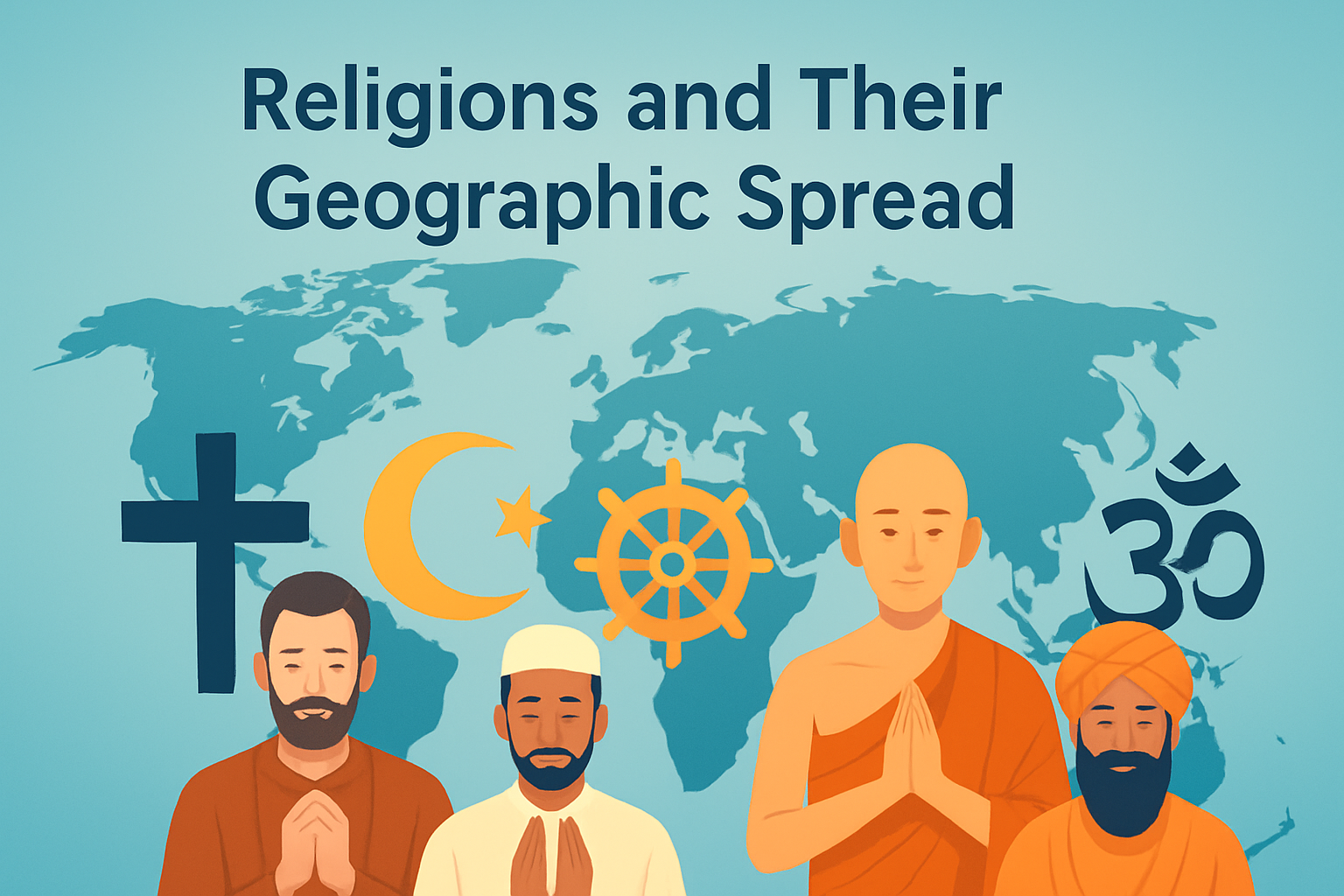
Religion has always been a profound influence in societies across the globe. It shapes cultures, influences politics, and affects the daily lives of its adherents. For the purposes of this article, we define religion as a structured set of beliefs, practices, and systems often centered around spiritual or moral teachings. Understanding the geographic spread of religions is vital because it helps us comprehend cultural diversity, the historical migration of peoples, and the current socio-political environments in different regions. This piece examines the geographic distribution of major world religions, how they spread, and their impact on the regions they touch. By analyzing these patterns, we can gain insights into how interconnected and culturally rich our world is.
The Spread of Christianity
Christianity is known as one of the most widespread religions in the world. Its origins trace back to the Middle East in the 1st century CE with the life and teachings of Jesus Christ. Over the centuries, through a combination of missionary work, colonization, and adaptation to local customs, Christianity has reached almost every corner of the globe.
In Europe, Christianity became the dominant religion in the medieval period, propelled by the Roman Empire’s adoption of the faith as state religion in the 4th century CE. With the Age of Exploration, European powers spread Christianity to the Americas, Africa, and Asia, often intertwining religious conversion with colonial expansion. For example, Spanish and Portuguese colonizers brought Catholicism to much of Latin America, which remains predominantly Catholic to this day.
In the modern era, Christian organizations continue to conduct missionary activities worldwide, often focusing on regions with smaller Christian populations. These efforts have contributed to Christianity’s strength in sub-Saharan Africa and parts of Asia. Understanding Christianity’s spread highlights the relationship between faith, cultural transformation, and geopolitical power.
The Geographic Influence of Islam
Islam is the second-largest religion globally, originating in the Arabian Peninsula in the 7th century CE with the prophet Muhammad. The rapid expansion of Islam was notably facilitated by the political and military strength of early Muslim caliphates.
After its inception, Islam spread swiftly across the Middle East, North Africa, and parts of Europe and Asia. The Islamic Caliphate expanded through conquest and trade routes, playing a significant role in the religion’s geographic reach. For instance, the Ottoman Empire, which lasted until the early 20th century, expanded Islamic influence into Eastern Europe, impacting cultural and societal structures in regions like the Balkans.
Islam’s contemporary geographic distribution shows high concentrations in the Middle East, North Africa, and large parts of Asia, notably Indonesia, which boasts the largest Muslim population in the world. The spread of Islam is not only a story of expansion but also of cultural assimilation and the blending of traditions.
The Reach of Buddhism
Buddhism, founded in the late 6th century BCE in India by Siddhartha Gautama, known as the Buddha, has grown to influence a wide array of cultures across Asia. As Buddhism spread from its birthplace, it splintered into various schools and sects, most notably Theravada, Mahayana, and Vajrayana.
Buddhism initially spread through the Indian subcontinent via missionary efforts and the support of influential leaders such as Emperor Ashoka, who championed the teachings of Buddhism beyond India. As it moved into regions like China, Korea, Japan, and Southeast Asia, Buddhism adapted to local customs and integrated with existing religious practices, such as Confucianism and Shinto.
In contemporary times, Buddhism remains strongest in East and Southeast Asia, with a notable presence in countries like Thailand, Myanmar, and Sri Lanka. Western interest in Buddhism has grown in recent decades, highlighting the religion’s adaptability and the global appeal of its teachings on mindfulness and meditation.
Hinduism and Its Regional Dominance
Hinduism, considered one of the world’s oldest religions, has its roots firmly planted in the Indian subcontinent. Its development spans over 4,000 years, and unlike many other major religions, Hinduism has no single founder but rather is a fusion of various cultural and religious ideas.
Hinduism has largely remained concentrated in South Asia, with India, Nepal, and Bali (Indonesia) having substantial Hindu populations. The religion’s deep establishment in its birthplace underscores a strong cultural and historical connection to its geographic region.
Migration and the Indian diaspora have led to Hindu communities forming around the world, particularly in countries like the United States, Canada, and the United Kingdom. These communities bring aspects of Hindu culture, festivals like Diwali, and traditional practices to new geographic locations, fostering cross-cultural exchange.
The Geographic Spread of Other Major Religions and Movements
Other religions and spiritual movements also possess significant geographic footprints. For example, Sikhism, which originated in the Punjab region of India in the 15th century, has spread globally, with diaspora communities in North America and Europe.
Judaism, one of the earliest monotheistic religions, has a long history of migration and diaspora due to persecution and the search for religious freedom. Significant Jewish populations exist in Israel, North America, and parts of Europe.
New religious movements and modern spiritualities continue to emerge, often blending elements from existing traditions. For instance, the Bahá’í Faith, which began in Persia (modern-day Iran) in the 19th century, emphasizes global unity and peace and has spread to virtually every country, highlighting a modern shift in how spiritual movements propagate.
- Sikhism: Originated in Punjab, spread through diaspora.
- Judaism: Global diaspora, significant presence in Israel and North America.
- Bahá’í Faith: Global reach, emphasizes unity and peace.
The Role of Migration and Trade in Religious Spread
Migration and trade have played significant roles in spreading religions beyond their origins. Throughout history, traders and migrants have carried religious beliefs across borders, integrating with local populations and laying the groundwork for future conversions and cultural exchanges.
Trade routes, such as the Silk Road, facilitated the spread of Buddhism, Christianity, and Islam by connecting distant cultures and promoting the exchange of ideas, beliefs, and practices. Merchants were key transmitters of religious ideologies, often establishing religious centers in trading hubs.
In modern times, global migration continues to spread religions and contribute to multicultural societies, highlighting the ongoing interplay between religion and geographical movement.
Conclusion: Taking Action and Embracing Diversity
The geographic spread of religions sheds light on the interconnectedness of cultures and societies and underscores the importance of understanding and respecting diverse belief systems. By exploring how religions have grown and adapted in different regions, readers gain a deeper appreciation for the complexities of cultural exchange and human history.
The diversity of religions worldwide offers an opportunity for individuals and communities to embrace differences, foster dialogue, and build inclusive societies. As religious adherence continues to shift and change with globalization and cultural integration, a greater awareness and respect for all spiritual traditions can enhance cross-cultural relationships.
To further your understanding, consider engaging with religious communities, visiting cultural centers, and partaking in interfaith dialogues. By actively seeking knowledge and interacting with diverse traditions, you contribute to building a more harmonious and inclusive world.
Frequently Asked Questions
1. What factors have influenced the geographic spread of religions globally?
The geographic spread of religions has been shaped by a myriad of factors, each playing a unique role in how religions have developed and moved across different regions. One of the most critical factors is migration, driven by both voluntary movements and forced displacements. For example, the Jewish diaspora following the destruction of the Second Temple in Jerusalem led to Jewish communities establishing themselves across Europe and the Middle East. Similarly, the spread of Islam in the 7th and 8th centuries was facilitated by the expansion of the Arab Empire, which carried Islamic teachings far and wide. Christian missionaries have historically played a role in spreading Christianity, as seen in the conversion of indigenous peoples in Africa, Asia, and the Americas. Trade routes have served as conduits for religious ideas, with the Silk Road being a notable example where Buddhism spread from India to Central Asia, China, and beyond. Political factors are also significant; when rulers or empires endorse or convert to a particular faith, such as the conversion of the Roman Empire to Christianity, it can lead to rapid religious expansion. Colonialism introduced European religions like Christianity to colonized regions, dramatically altering the religious landscape in places such as the Americas and Africa. All these factors, intertwined with cultural, economic, and social elements, contributed to the complex map of religious distribution we see today.
2. How have religions adapted to new cultural contexts as they spread?
As religions spread geographically, they often adapt to the cultural contexts of new regions in several ways. This adaptation process can be seen in the blending of religious practices, beliefs, and local customs, sometimes resulting in syncretic forms of religion. For example, when Christianity spread to Latin America, it blended with indigenous practices and beliefs, leading to unique expressions of faith still present today, such as the Day of the Dead celebrations in Mexico, which incorporate elements of both pre-Columbian beliefs and Catholic traditions. Similarly, Buddhism, as it spread from India to countries like China, Japan, and Korea, integrated aspects of local philosophies and practices, creating distinct branches such as Zen Buddhism in Japan. Hinduism’s spread to Southeast Asia led it to merge with local animist beliefs, resulting in a diversified religious tapestry across the region. Even within a single religion, different interpretations and practices can emerge based on geographic and cultural variations. Language is another important factor – religious texts and teachings often undergo translation, which can sometimes lead to new interpretations or emphases. Ultimately, religion’s ability to adapt and integrate with local cultures has helped it to survive, thrive, and remain relevant across diverse contexts.
3. Why is the study of the geographic spread of religions important in understanding today’s socio-political climate?
The study of the geographic spread of religions is crucial for understanding today’s socio-political landscape for several reasons. Firstly, it provides insight into the complex cultural and historical factors that shape current global religious demographics. Recognizing how religions spread and establish themselves helps illuminate the underlying cultural, linguistic, and historical ties that bind regions and peoples, contributing to a deeper understanding of global cultural diversity. In many cases, the geographic spread of religions influences modern political boundaries and identities. For instance, the religious makeup of regions like the Middle East, with its historical ties to Abrahamic religions, informs contemporary political and social configurations, affecting everything from alliances to conflicts. Understanding religious geography can also aid in appreciating the causes and resolutions of religious conflicts, as such conflicts often stem from long-standing historical grievances linked to territorial and cultural shifts. Additionally, globalization has led to increased religious and cultural interactions across the globe. By studying how religions have historically moved and adapted, policymakers, educators, and religious leaders can better address the challenges and opportunities that arise from multicultural and multi-faith societies. As religion continues to be a force in global conversations about morality, meaning, and governance, understanding its spread and influence becomes ever more pertinent.
4. Which major religions have experienced significant geographic spread, and what are their key areas of influence today?
Several major religions have experienced significant geographic spread, each with its own areas of influence in today’s world. Christianity is perhaps the most widespread religion, with followers on every continent. Its influence is particularly strong in the Americas, Europe, Sub-Saharan Africa, and parts of Oceania. The religion’s spread is largely a result of colonialism, missionary work, and migration. Islam, originating in the Arabian Peninsula, is another religion with a vast geographic reach. It is the dominant faith in North Africa, the Middle East, and parts of Asia, with significant populations in Indonesia, Pakistan, Bangladesh, and India. Islam’s spread was facilitated by the early Islamic empires’ conquests and trade interactions. Buddhism, which originated in India, spread primarily through Asia, with significant followings in countries like China, Japan, Thailand, Myanmar, and Sri Lanka. Its spread was more through trade and cultural exchange rather than conquest. Hinduism, largely practiced in India and Nepal, has seen smaller geographic movement but has adherents worldwide due to migration. Sikhism, though primarily concentrated in Punjab, India, also has a global presence, especially in countries like the United Kingdom, Canada, and the United States. Judaism, although not having the same geographic spread as some other major religions due to historical persecution and diaspora, has significant populations in Israel and the United States. Each of these religions, through their geographic spread, plays a crucial role in shaping the cultural and social identity of their respective regions.
5. How has globalization impacted the geographic spread of religions in recent times?
Globalization, characterized by the increased interconnectedness of the world through trade, communication, travel, and technology, has significantly impacted the geographic spread of religions in recent times. On one hand, globalization facilitates the rapid dissemination of religious ideas and practices across borders. Through the internet and modern communication, religious teachings, rituals, and communities can expand their reach far beyond traditional geographic confines, creating virtual faith networks that span continents. Population movements, driven by globalized economies and conflicts, result in diverse societies where multiple religious traditions coexist. For example, the rise in immigration from predominantly Muslim countries to Western Europe has led to a growing Muslim population in countries like France and Germany, influencing everything from culinary trends to social policies. Similarly, the spread of Western secular values, often carried through global media and education systems, interacts with traditional beliefs, creating dynamic religious landscapes where adaptation and conflict coexist. Globalization also fosters interfaith dialogue and collaboration, compelling religions to find common ground and respond jointly to global challenges like climate change and social justice. However, it can also lead to tensions as local communities react to perceived threats to their cultural and religious identities. Overall, globalization acts as both a catalyst for the spread and interaction of religions and a challenge as religious communities navigate the complexities of maintaining their identities in an increasingly interconnected world.