
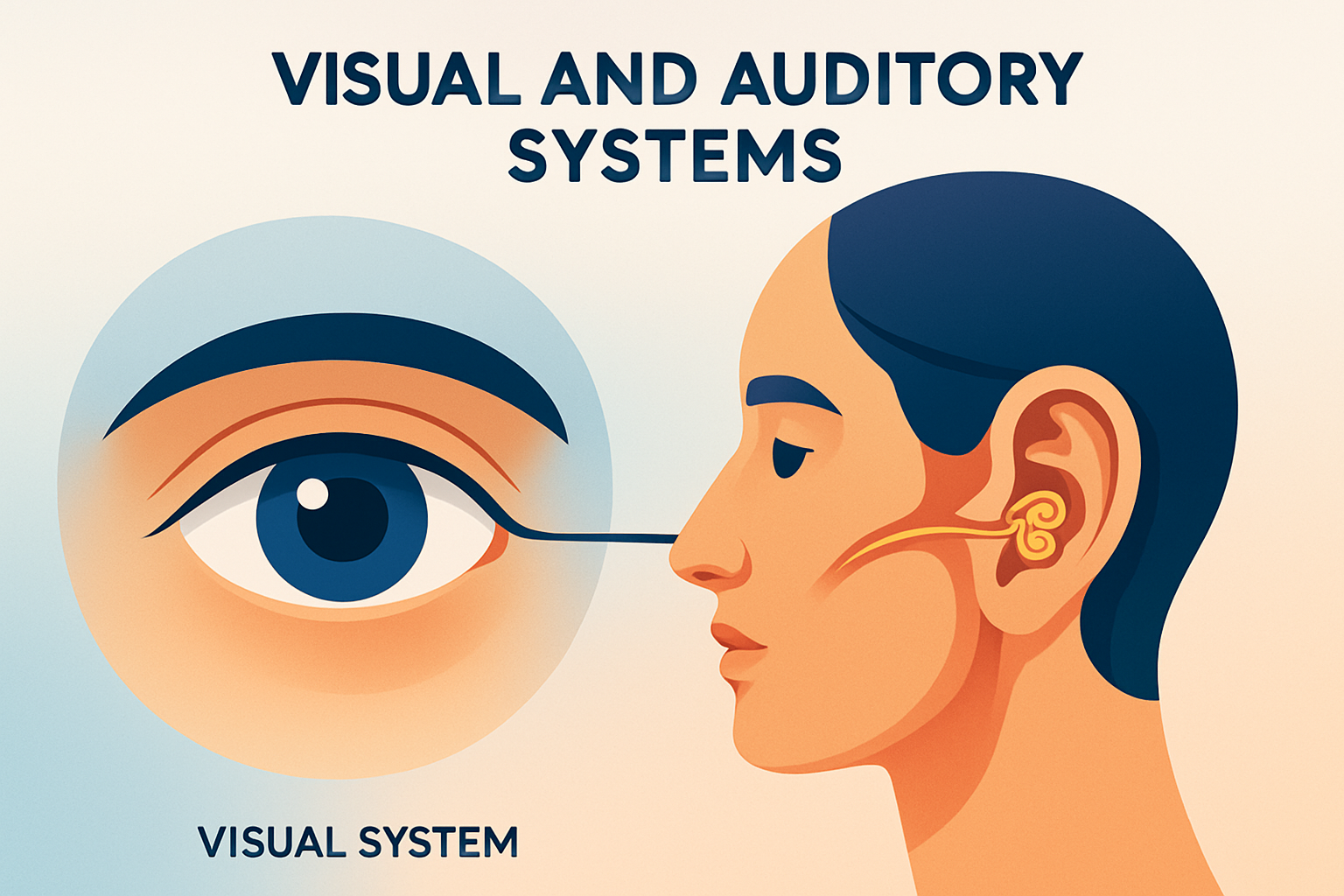
In the intricate tapestry of human physiology, the visual and auditory systems stand out as two fundamental sensory mechanisms. These systems allow us to interact with our environment in a myriad of ways, from appreciating the vibrant hues of a sunset to enjoying the rhythm and melody of music. Comprehending how the visual and auditory systems operate is essential not only for students and professionals in the healthcare and scientific communities but also for anyone interested in understanding the mechanics of human perception. Grasping the foundational elements of these systems can enhance our appreciation for the everyday experiences they make possible, such as reading a beautiful poem or listening to an engrossing lecture.
Anatomy of the Visual System
The visual system primarily comprises the eyes, the optic nerves, and brain regions like the visual cortex. Light enters the eye through the cornea, being bent slightly before it passes through the pupil. The iris, the colored part of the eye, regulates the pupil size and thus controls the amount of light entering. The light then passes through the lens and is focused on the retina, which is at the inner back surface of the eye.
The retina contains photoreceptor cells known as rods and cones. Rods are highly sensitive to light and crucial for night vision. They do not perceive color, which is the role of cones. Cones detect different wavelengths responsible for color vision and require more light to function, making them active primarily in bright conditions. From the retina, the visual information is transmitted via the optic nerve to the brain, particularly the visual cortex, where the information is processed and interpreted.
To understand how vital the visual system is, consider drivers on the road. The ability to perceive traffic signs, distinguish signal lights, and judge distances is directly tied to a functioning visual system. Reaction times and safe navigation depend significantly on ocular health and the brain’s processing capabilities.
Mechanics of the Auditory System
The auditory system encompasses the outer ear, middle ear, inner ear, and the auditory nerves leading to the brain. Sound waves enter through the outer ear and travel down the ear canal, reaching the eardrum and causing it to vibrate. These vibrations move through the ossicles in the middle ear, tiny bones named the malleus, incus, and stapes. The stapes connects to the cochlea in the inner ear, a snail-shaped organ that plays a pivotal role in hearing.
Inside the cochlea, vibrations create waves in the fluid filling the cochlea, moving tiny hair cells. When these hair cells move, they convert mechanical signals into electrical signals transmitted as nerve impulses to the brain, particularly the auditory cortex. It’s here that sounds are interpreted, allowing us to understand speech, enjoy melodies, and sense spatial audio information.
Take, for instance, a classic orchestra concert. The auditory system’s intricate processes enable one to discern the different instrument sounds and appreciate a harmonious blend of melodies. An impairment at any stage of this system can significantly affect how we perceive and enjoy such experiences.
Integration of Visual and Auditory Perception
The integration of visual and auditory information is crucial for navigating daily life experiences. Both senses often work in tandem to provide a complete picture of our surroundings. This multisensory integration occurs primarily in the brain, allowing us to judge events more accurately.
Consider watching a movie in a theater: while visuals display the story, sounds enhance the emotional impact and realism. The audio cues make scenes more engaging, and timely sound effects complement the visual actions, creating a complete cinematic experience.
Furthermore, in social situations such as conversations, the visual sensation of lip movements along with auditory cues aids in better understanding, especially in noisy environments. This synergy illustrates how intertwined perception processes are and their collective importance.
Disorders Affecting Visual and Auditory Systems
Several disorders can impair the visual and auditory systems, ranging from mild inconveniences to significant sensory loss. In the visual domain, conditions like myopia (nearsightedness), hyperopia (farsightedness), and cataracts are prevalent and can often be corrected with lenses or surgery. More severe conditions like retinitis pigmentosa or macular degeneration can lead to substantial vision loss.
Auditory disorders include impairments such as tinnitus, characterized by ringing or buzzing in the ears, and sensorineural hearing loss, which is due to damage to the hair cells in the cochlea. These conditions can result from age, exposure to loud noises, or infections.
Understanding and managing these disorders often involve a combination of medical interventions and adaptive solutions, enabling affected individuals to maintain a high quality of life. For example, hearing aids and cochlear implants can significantly benefit those with hearing impairments, illustrating human ingenuity in addressing sensory deficiencies.
Technological Applications in Enhancing Sensory Experience
Advancements in technology continue to enhance or supplement our visual and auditory experiences. Innovations such as virtual reality (VR) and augmented reality (AR) have transformed how we perceive digital environments, offering immersive experiences that rely heavily on visual and auditory enhancements. These technologies depend on providing rich, synchronized stimuli to create lifelike simulations.
Furthermore, assistive technologies for individuals with sensory impairments have seen significant progress. For instance, screen readers convert text to audio for visually impaired users, while visual alarms enhance safety for those with hearing impairments by using visual signals to prompt action.
- Visual alarms: Use strobe lights or flashing signals to alert individuals with hearing impairments.
- Screen readers: Software that reads digital text aloud, benefitting those with visual impairments.
- Cochlear implants: Electronic devices that provide a sense of sound to those with profound hearing loss.
- Augmented reality apps: Enhance real-world with digital overlays, aiding navigation for visually impaired individuals.
The Future of Visual and Auditory Research
Research in the areas of visual and auditory systems is ongoing and holds promise for future innovations. Scientists are exploring ways to regenerate damaged sensory cells, such as the hair cells in the cochlea, to treat hearing loss. Stem cell therapy and gene editing technologies are presenting new pathways for restoring lost functions.
Moreover, the quest to develop artificial vision systems that can restore sight through direct brain interfaces is gaining momentum. Such developments hint at a future where sensory impairments could be significantly mitigated, if not cured.
Applications of artificial intelligence in sensory devices are also paving new avenues. Machine learning algorithms can learn to interpret complex auditory and visual data, providing insights or aiding device functionalities—such as enhancing speech recognition systems for more nuanced language processing.
Conclusion
In summary, the visual and auditory systems are integral to how humans perceive and interact with the world. They function in remarkable harmony, providing a comprehensive experiential landscape from which we derive understanding and pleasure. While various conditions can impair these systems, technological advancements and ongoing research continue to offer hope for improved treatments and quality of life. For the reader keen on delving deeper, exploring current developments in sensory technology and contributing to these fields can be both enlightening and rewarding. Stay informed, engage with emerging innovations, and consider how these breakthroughs can enhance society at large. A deeper understanding of these systems is a key step toward supporting advancements in healthcare, technology, and education.
If you’re interested in this fascinating intersection of human biology and technology, consider visiting local science museums, attending lectures from experts in the field, or even volunteering for research studies. Exploring practical avenues for real-world application can lead to exciting discoveries and future innovations.
Ultimately, these insights into visual and auditory systems not only enrich our comprehension of human biology but also provide the impetus for further exploration and innovation. As technology evolves, the potential to enhance sensory experiences and address sensory impairments opens new possibilities for improving human experiences globally.
Frequently Asked Questions
1. What are the main components of the visual system, and how do they work together to process visual information?
The visual system is an intricate assembly of structures that work in harmony to provide us with the sense of sight. At its core, this system includes the eyes, the optic nerves, and various brain regions responsible for processing visual information. The journey begins when light enters the eye through the cornea, a clear, dome-shaped surface that helps focus incoming light. This light then passes through the aqueous humor, a fluid-filled chamber, before reaching the iris, which comprises a colorful ring of muscle fibers surrounding the pupil. By adjusting the size of the pupil, the iris controls the amount of light entering the eye, much like the aperture of a camera.
Once light passes through the pupil, it reaches the lens, a flexible, transparent structure that further focuses light onto the retina. The retina, a thin layer of cells at the back of the eyeball, is where the magic happens. It contains millions of photoreceptor cells known as rods and cones. Rods are sensitive to low light conditions and detect black and white shades, while cones are responsible for color vision and operate best under bright light.
These photoreceptor cells convert light into electrical signals that are transmitted through the optic nerve to the brain. At this point, the signals reach the visual cortex in the occipital lobe, where they are processed and interpreted as images. This complex process allows us to perceive details, colors, movements, and shapes. Through coordination between these components, the visual system provides us with a cohesive and comprehensive view of our surroundings.
2. How does the auditory system enable us to hear and interpret sounds?
The auditory system is another critical sensory network that empowers us to process sound. It begins with the external ear, which captures sound waves and channels them through the ear canal toward the middle ear. Here, the sound waves hit the tympanic membrane, commonly known as the eardrum, causing it to vibrate. These vibrations are then transferred to the three tiny bones in the middle ear—known as the ossicles: the malleus, incus, and stapes. These bones amplify the sound vibrations and convey them to the inner ear.
The vibrations enter the cochlea, a fluid-filled, spiral-shaped organ in the inner ear. Inside the cochlea, minuscule hair cells located on the basilar membrane pick up the mechanical energy. These hair cells convert sound vibrations into electrical signals, which are transmitted via the auditory nerve to the brain.
Upon reaching the brain, the signals are relayed to the primary auditory cortex located in the temporal lobe. Here, sound is interpreted through intricate processing, allowing us to recognize different sound aspects such as pitch, loudness, and spatial direction. Moreover, the brain integrates information from both ears to locate sounds and determine their sources, creating a detailed soundscape that helps us engage with our environment fully.
3. What factors can affect the functioning of the visual and auditory systems?
The functioning of the visual and auditory systems can be influenced by a variety of factors, ranging from genetic predispositions and aging to environmental exposures and lifestyle choices. For the visual system, age-related changes such as presbyopia, cataracts, macular degeneration, or glaucoma can impair vision. Genetic factors can also play a role, as in conditions like color blindness or retinitis pigmentosa. Environmental factors, including prolonged exposure to UV radiation and excessive screen time, can contribute to eye strain and visual fatigue.
On the auditory side, repeated exposure to loud noise is one of the most prevalent threats, potentially leading to noise-induced hearing loss. Age-related hearing loss, or presbycusis, is also common and often affects the higher frequency sound range. Additionally, ear infections, genetic conditions like otosclerosis, and certain medications known as ototoxic drugs can impact auditory health.
Preventative measures such as wearing sunglasses and adhering to safe listening practices, as well as regular check-ups with healthcare professionals, can help mitigate these risks and promote the long-term health of these vital sensory systems.
4. What are some common disorders of the visual and auditory systems, and how are they typically treated?
Several disorders can impair the functionalities of the visual and auditory systems, leading to varying degrees of sensory deprivation. In the visual system, common disorders include myopia (nearsightedness), hyperopia (farsightedness), astigmatism, and cataracts. Corrective lenses, such as glasses or contact lenses, are often utilized to treat refractive errors like myopia and hyperopia. Cataracts can be remedied through surgical procedures that replace the clouded lens with a clear artificial one.
Diseases like macular degeneration and glaucoma require different interventions; in many cases, treatments aim to halt progression rather than reversing damage. Successfully managing these conditions depends on early detection and intervention, typically involving medication, laser therapy, or surgery.
In the auditory system, disorders can range from conductive hearing loss due to earwax obstruction or ear infections to sensorineural hearing loss which may stem from damage to the hair cells in the cochlea. The use of hearing aids or cochlear implants can help restore sound perception in some cases. Additionally, behavioral therapies and assistive listening devices can enhance communication for those with hearing impairments.
5. Can lifestyle changes benefit the health of the visual and auditory systems?
Yes, lifestyle changes can significantly impact and enhance the health and functionality of both the visual and auditory systems. Maintaining a balanced diet rich in nutrients like omega-3 fatty acids and vitamins A, C, and E can support visual health. Foods such as fish, leafy greens, and brightly colored fruits often contain these essential nutrients. Protecting eyes from excessive screen exposure and utilizing appropriate lighting can also reduce eye strain and fatigue.
Regarding auditory health, protecting your ears from loud noises by using earplugs or earmuffs is crucial, as is keeping the volume at a safe level when using earbuds or headphones. Regular exercise and maintaining a healthy weight can support blood circulation, which benefits both the eyes and ears. Avoiding tobacco products and moderating alcohol consumption are also key strategies as they lower the risk of conditions that can affect these systems.
Lastly, having regular check-ups with healthcare providers enables timely detection and intervention of potential issues, facilitating ongoing care and management of visual and auditory health. These proactive steps can help preserve these senses’ integrity and functionality throughout one’s life.