
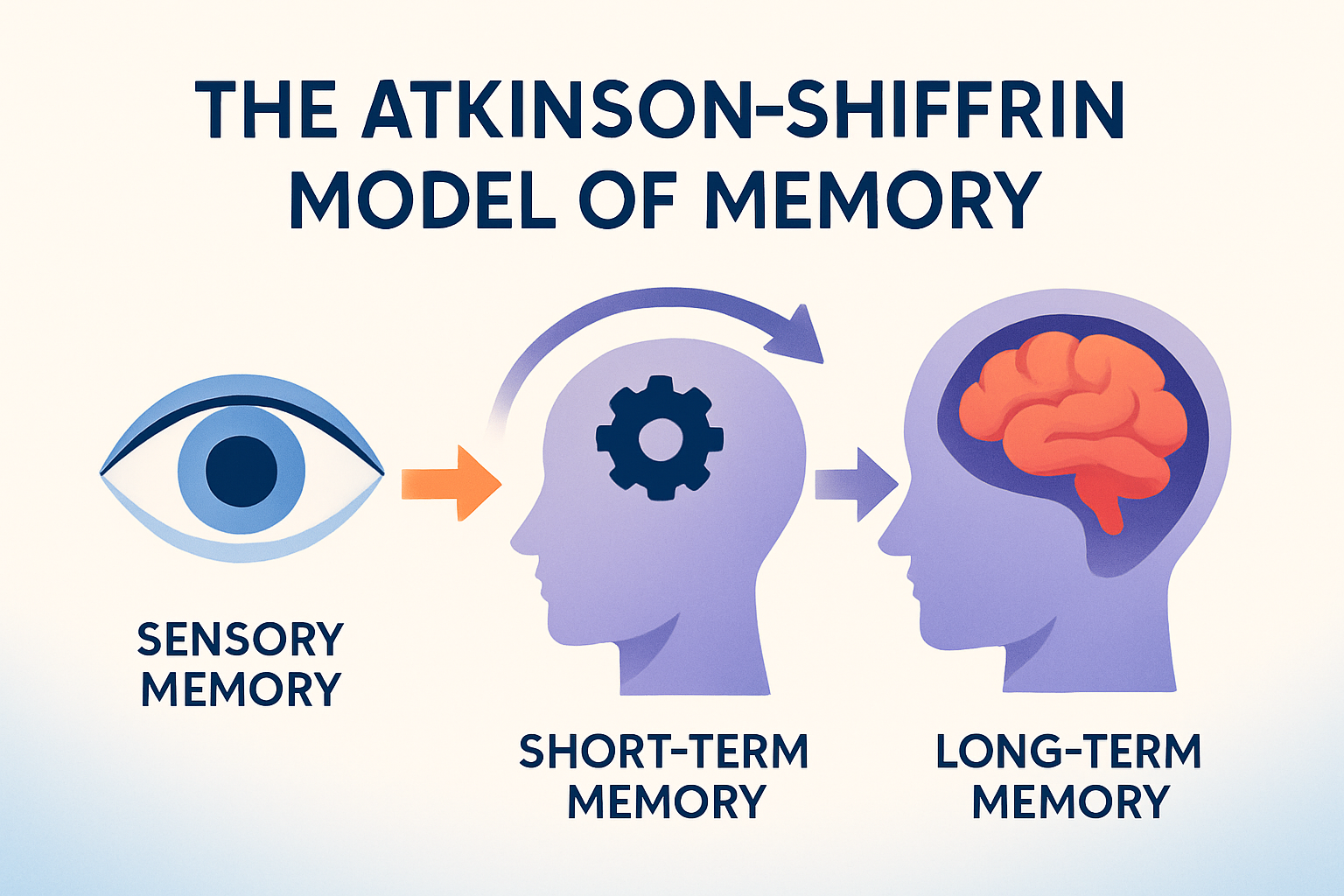
Memory is one of the most critical aspects of our cognitive abilities, allowing us to store and access information from the past. The Atkinson-Shiffrin model, also known as the multi-store model of memory, is a psychological framework that helps us understand how human memory functions. Introduced by Richard Atkinson and Richard Shiffrin in 1968, this model is pivotal for grasping the components and processes of memory storage and retrieval. It divides memory into three distinct stores: sensory register, short-term memory (STM), and long-term memory (LTM). Understanding this model matters because it helps us tackle everyday cognitive challenges, from improving study habits to comprehending memory-related disorders such as amnesia. By aligning educational strategies and cognitive therapies with this model, individuals can enhance learning outcomes and potentially mitigate the effects of memory impairment.
The Sensory Register: Capturing the Moment
The sensory register is the initial stage in the Atkinson-Shiffrin model where sensory information is stored momentarily. This register captures information via the senses, such as visual, auditory, and tactile inputs, almost like a camera snapshot. Although the storage capacity is vast, the information duration is fleeting, lasting a second or less. For instance, when you glance at a sign, the sensory register temporarily holds the image, allowing you to decide whether to focus on it or not.
One real-world example is driving by billboards on a highway. As your eyes capture each one, the visual information hits the sensory register. If something sparks your interest, it moves to the next stage: short-term memory. Otherwise, it fades away quickly. This stage underscores the importance of attention in transferring information further into the memory system.
Short-Term Memory: The Workbench of the Mind
Short-term memory (STM) acts as the workbench of our mental processes, where conscious thought occurs. Information transferred from the sensory register to STM has a limited capacity of about 7±2 items, as suggested by George Miller’s research. This information typically remains in STM for around 20-30 seconds unless actively rehearsed or encoded into long-term memory.
Consider the task of recalling a phone number long enough to dial. Here, the numerical sequence is briefly maintained in STM. This example illustrates STM’s role in executing immediate tasks, such as mental calculations or language comprehension. By actively working with this information through techniques like chunking or rehearsal, individuals can optimize their STM usage and facilitate the transference of information to long-term memory.
Long-Term Memory: The Vast Archive
Long-term memory (LTM) is the final stage, characterized by its potentially limitless capacity and prolonged duration. Information encoded through elaboration and meaningful connections is stored in LTM. This stage encompasses various types of memories, including declarative (explicit) and procedural (implicit) memory.
A practical example is learning to play a musical instrument. Initially, every note and technique requires conscious attention and resides in STM. Over time with practice, these elements are encoded into procedural memory, allowing smooth and automatic performance without conscious effort.
To better understand the distinctions, consider the following breakdown:
- Declarative Memory: Involves facts and events (e.g., recalling the capital of a country).
- Procedural Memory: Involves skills and tasks (e.g., riding a bicycle).
By understanding these subtypes, individuals can improve their learning strategies and consciously apply them to optimize different types of memory storage.
The Process of Encoding and Retrieval
Encoding and retrieval are critical processes that determine how information passes through the memory stages. Encoding is the transformation of sensory input into a format that LTM can utilize. Effective encoding often relies on strategies like mnemonics, visualization, and organization.
Imagine trying to remember your grocery list. By grouping items into categories (e.g., fruits, dairy), you apply organizational strategies that make it easier to encode the list into LTM. This strategy not only facilitates memory retention but also aids in more successful retrieval.
Retrieval is the process of accessing stored information. It involves reconstructing the memory trace created during encoding. For example, during an important exam, recalling learned information hinges on effective retrieval cues linked to the original learning context.
The Role of Attention in Memory Processing
Attention is the spotlight that helps focus on relevant details, enabling deeper encoding and successful transference of information through memory stages. Attention determines whether sensory information gets filtered into STM for further processing.
Imagine attending a lecture in a crowded room. While multiple conversations occur simultaneously, focusing on the speaker allows the information to enter STM. By selectively attending to stimuli, you increase the likelihood of it being encoded into LTM.
Therefore, understanding and improving attention control, such as through mindfulness or learning strategies, can significantly enhance how effectively individuals process and store information.
Implications and Applications of the Atkinson-Shiffrin Model
The Atkinson-Shiffrin model’s understanding transcends theoretical discussions, offering practical applications in daily life, education, and healthcare. In educational settings, recognizing the model aids in designing curriculums that cater to memory reinforcement techniques. For instance, spacing learning sessions and incorporating active recall strategies align well with this model to enhance memory retention.
In healthcare, especially within cognitive therapies, this model aids in addressing memory deficits. Tailoring interventions that consider different memory stages allows for patient-specific strategies that can improve memory functions or compensate for declines.
Visual Representation of the Model
| Memory Store | Duration | Capacity |
|---|---|---|
| Sensory Register | Less than a second | Large |
| Short-Term Memory | 20-30 seconds | 7±2 items |
| Long-Term Memory | Potentially indefinite | Limitless |
Conclusion: Leveraging the Atkinson-Shiffrin Model
The Atkinson-Shiffrin model of memory serves as a foundational explanation for the process and structure of human memory, offering valuable insights applicable across various fields. Highlighting the distinct memory stages—sensory register, short-term memory, and long-term memory—this model illuminates how information is processed, stored, and retrieved.
For readers, understanding this model presents opportunities to optimize personal and academic tasks, enhance cognitive therapies, or provide foundational knowledge for tackling memory impairments. Simple interventions like organizing information, honing attention skills, or strategically revisiting material can significantly improve memory capabilities.
As a call to action, consider how you can apply these principles to your daily activities. Whether you’re aiming to improve study techniques, enhance productivity, or support others facing memory challenges, this model is an invaluable framework. Begin by observing your memory processes—apply effective strategies, monitor outcomes, and adjust approaches as necessary. Remember, the journey of mastering memory begins with mindfulness and intentional practices rooted in the understanding of how memory truly works.
Frequently Asked Questions
1. What is the Atkinson-Shiffrin Model of Memory?
The Atkinson-Shiffrin Model of Memory, sometimes referred to as the multi-store model, is a foundational psychological framework developed by Richard Atkinson and Richard Shiffrin in 1968. This model offers valuable insights into the structure and functioning of human memory, essentially breaking it down into three distinct stores: sensory memory, short-term memory, and long-term memory. Each store represents a different stage of information processing, ranging from the initial moment when we perceive something through our senses (sensory memory), to actively holding and manipulating information (short-term memory), and finally to the long-term storage for future retrieval (long-term memory). This model has been instrumental in influencing our understanding of how memories are formed, stored, and recalled, acting as the groundwork for further research and more advanced theories in cognitive psychology.
2. How does the sensory memory component of the Atkinson-Shiffrin Model work?
Sensory memory is the very first stage of the Atkinson-Shiffrin Model and acts as an initial buffer for stimuli received through the senses. It captures an exact copy of the sensory information you experience, but this information is only held for a very brief duration—typically less than one second. Sensory memory allows us to retain impressions of sensory information after the original stimuli have ended. There are different types of sensory memory corresponding to different senses—iconic memory for visual stimuli and echoic memory for auditory stimuli are the most commonly examined types. Even though the retention time is extremely short, sensory memory plays a critical role in filtering which information catches our attention and might be transferred to short-term memory for more in-depth processing.
3. What is the process of transferring information from short-term memory to long-term memory in the Atkinson-Shiffrin Model?
The transition of information from short-term memory to long-term memory in the Atkinson-Shiffrin model involves several critical processes, primarily encoding and consolidation. Short-term memory, also known as working memory, temporarily holds information in an active and accessible state. However, for this information to be stored more permanently, it needs to be encoded into a form that our memory systems can retrieve later; this is where rehearsal and repetition come into play. The more we process and reiterate the information, the more likely it is that it will move to long-term memory storage. Encoding can involve forming associations, organizing information, or attaching it to existing schemas. Once encoded, the process of consolidation, where changes in the brain stabilize the memory trace, ensures that memories are stored long-term for retrieval. This stage is crucial for retaining vast amounts of knowledge and experiences over a lifetime.
4. What challenges and criticisms has the Atkinson-Shiffrin Model faced over time?
The Atkinson-Shiffrin Model of Memory has faced several challenges and criticisms since its introduction. One significant issue is its seemingly oversimplified view of memory processes, specifically the clear-cut division between short-term and long-term memory. Critics argue that memory processes are more dynamic and interdependent than the model suggests. Additionally, the model does not account for the complexity of the encoding processes in the short-term memory nor does it thoroughly explain how information is forgotten. The discovery of working memory by Baddeley and Hitch in the 1970s further highlighted limitations in the Atkinson-Shiffrin model, suggesting that short-term memory comprises multiple components for different types of tasks rather than being a single store. Therefore, while the Atkinson-Shiffrin model laid crucial groundwork, modern theories have sought to broaden and deepen the understanding of memory systems, incorporating factors like emotional states, attention, and neural networks.
5. How has the Atkinson-Shiffrin Model influenced modern psychology and memory research?
The Atkinson-Shiffrin Model has had an enduring impact on psychology and memory research by providing an initial structured framework for understanding human memory. It set the stage for subsequent models and theories that have expanded upon its basic structure. It has encouraged extensive research into the distinct pathways and structures involved in memory processing, fostering developments in cognitive psychology and neuropsychology. The model spurred exploration into phenomena such as the serial position effect, revealing the ways memory functions across different phases. It has also been pivotal in addressing questions about sensory processing, attention, and rehearsal. Furthermore, as one of the first models to suggest distinct memory stores, it has influenced educational practices and methods for enhancing memory retention, shaping disciplines such as cognitive neuroscience and informing practical approaches to improving memory recall in educational settings.