
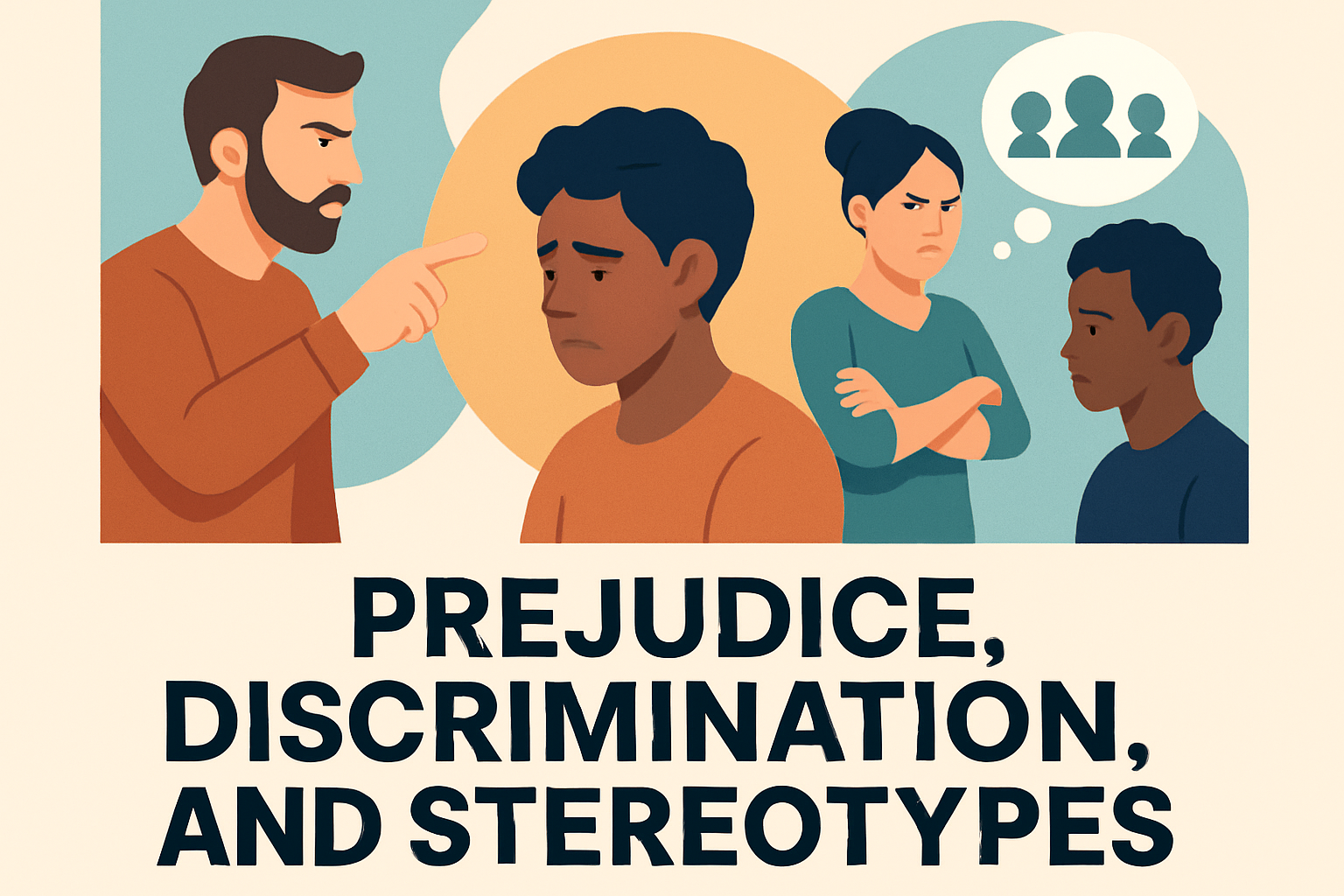
Prejudice, discrimination, and stereotypes are terms that are often interconnected but have distinct meanings. Understanding these concepts is vital as they have a profound impact on society, influencing personal interactions and systemic policies. Prejudice refers to preconceived opinions not based on reason or actual experiences. It’s an attitude or feeling often directed towards people of a particular race, gender, or religion. Discrimination, however, involves actions or behaviors stemming from prejudice that result in unfair treatment. Stereotypes are over-simplified generalizations about a group that often lead to prejudice and discrimination. Ignoring these issues can perpetuate cycles of inequality and social injustice, making it crucial to address and mitigate their effects. By defining these terms and understanding their implications, individuals and societies can work towards creating a more equitable future.
Understanding Prejudice and Its Implications
Prejudice is an unjustified or incorrect attitude (usually negative) towards an individual based solely on the individual’s membership in a social group. Prejudice arises from a person’s upbringing, media exposure, and societal norms. For example, a person might dislike all members of a particular ethnic group based solely on negative portrayals in movies they have seen. This bias affects everyday interactions and can manifest subtly or overtly. In a workplace setting, an employee may disregard a colleague’s input due to prejudices, thus inhibiting cooperation and mutual growth.
The impact of prejudice is not just limited to personal affronts but extends to broader societal damage. It can lead to marginalized communities not receiving equal access to education, healthcare, and employment opportunities. Such exclusion exacerbates socio-economic disparities and stifles diverse perspectives and talents in various spheres. Combating prejudice involves challenging one’s assumptions and adopting an open-minded approach to interpersonal interactions.
The Mechanisms and Effects of Discrimination
Discrimination involves actions that are unjust or prejudicial treatment of different categories of people, particularly on the grounds of race, age, sex, or disability. It is the behavioral aspect of prejudice, where individuals are treated unfairly based on their perceived differences. For instance, in hiring practices, a company may consistently overlook qualified candidates from specific demographic groups due to biased organizational behavior, which is a clear example of discrimination in action.
Discrimination has far-reaching consequences. It denies individuals their rights and opportunities, contributing to long-term psychological and economic harm. Examples include wage gaps where individuals from marginalized groups earn less than their peers despite similar qualifications. Systemic discrimination perpetuates inequality, reinforcing negative stereotypes and maintaining societal hierarchies. Addressing discrimination requires both policy changes and individual shifts in mindset, ensuring equitable treatment becomes integral to societal frameworks.
The Role and Impact of Stereotypes
Stereotypes are oversimplified ideas about groups of people. Common stereotypes relate to race, gender roles, and ethnic identities. For example, the stereotype that women are less competent in science and technology careers can discourage young girls from pursuing these fields. Such stereotypes reduce complex individuals to caricatures and are often used as mental shortcuts for categorizing people, leading to erroneous beliefs and fuels prejudice and discrimination.
The effects of stereotypes are pervasive and damaging. They influence how people interact with one another and can shape individuals’ perceptions of themselves, potentially limiting their ambitions and achievements. Furthermore, stereotypes create and uphold power imbalances in societies by justifying the unfair treatment of certain groups. Overcoming stereotypes involves increasing awareness, promoting diversity, and encouraging critical thinking to dismantle these simplistic views of group identities.
Real-World Examples of Prejudice, Discrimination, and Stereotypes
Examining real-world examples can illustrate the manifestations of prejudice, discrimination, and stereotypes. An illustrative case is the racial profiling of individuals in law enforcement settings. Racial profiling occurs when individuals are targeted or scrutinized based on their race rather than their actions. Various communities, particularly those of African or Hispanic descent in the United States, often report incidents of being stopped and searched without reasonable cause, stemming from stereotypes associating their racial identity with criminal behavior.
Another example includes gender discrimination in the workplace. Women, particularly those of minority backgrounds, may face barriers to career advancement due to stereotypes about their capabilities and commitments. This can be reflected in the “glass ceiling” phenomenon, where qualified women are overlooked for leadership positions due to biases and discriminatory practices.
- Racial Profiling: Disproportionate stops and searches by police based on race.
- Gender Discrimination: Barriers to leadership positions for women.
- Aging Stereotypes: Assumptions that older individuals cannot learn new technologies.
These examples highlight the persistence of prejudices, discrimination, and stereotypes in various sectors. Addressing them requires comprehensive strategies including awareness campaigns, inclusive policies, and education initiatives aimed at debunking stereotypes and promoting diversity.
Strategies for Overcoming Prejudice, Discrimination, and Stereotypes
Overcoming prejudice, discrimination, and stereotypes involves concerted efforts from individuals, communities, and institutions. One effective strategy is education and awareness campaigns that challenge existing social norms and promote understanding among different groups. Educational institutions play a pivotal role by incorporating diversity training and inclusive curricula that foster empathy and critical thinking in students.
On an institutional level, implementing policies that promote diversity and inclusion can create environments where everyone feels valued and respected. This includes setting up affirmative action programs to address systemic inequalities and creating support networks for marginalized groups. For instance, companies can hold workshops to sensitize employees about unconscious biases and develop hiring practices that focus on diverse talent pools.
| Strategy | Description |
|---|---|
| Education & Awareness | Campaigns and curricula that challenge stereotypes. |
| Diversity Policies | Inclusive hiring and affirmative action programs. |
| Community Engagement | Building cross-cultural dialogues and understanding. |
Additionally, open dialogues and community engagement initiatives can bridge the gap between different racial, ethnic, and cultural groups. Encouraging storytelling and shared experiences can cultivate empathy and dismantle harmful stereotypes. Collectively, these strategies can change societal attitudes and repair the injustices caused by prejudice, discrimination, and stereotypes.
Promoting Equality and Understanding
Promoting equality and understanding is paramount in creating a just society. Recognizing prejudice, discrimination, and stereotypes as barriers to cohesion and progress, it is essential to foster an environment where differences are acknowledged and valued. Preference should be for policies and practices that are inclusive, offering equal opportunities and respect for all individuals regardless of their background.
Social media platforms and technological advancement offer opportunities to spread messages of inclusion and connect diverse communities. By advocating for fair representation in media and arts, society can illuminate diverse stories and counteract monolithic stereotypes. Businesses and organizations have a role to play by spearheading corporate social responsibility initiatives that prioritize diversity, equity, and inclusion.
Individuals can contribute to promoting understanding by educating themselves, speaking out against injustice, and supporting marginalized voices. By valuing diversity and fostering mutual respect, we can collectively move towards a world where prejudice, discrimination, and stereotypes no longer dictate the fabric of society.
Conclusion: Taking Action Against Prejudice
In conclusion, understanding and confronting prejudice, discrimination, and stereotypes is integral to fostering a society characterized by equality and mutual respect. Through acknowledging their existence and impact, individuals and communities can take proactive measures to dismantle these barriers. Implementing educational initiatives, policy changes, and community engagement are crucial steps in this journey. Encouraging inclusive dialogues and respecting diversity pave the way towards a more equitable society.
Readers are encouraged to reflect on their biases, challenge stereotypes when encountered, and advocate for inclusive practices in their environments. Engaging in continuous learning and supporting policies that promote justice are powerful means of creating change. As these efforts accumulate, they contribute to a transformed world that thrives on diversity and innovation. Let’s commit to making equality and understanding the foundation of our interactions and relationships.
Frequently Asked Questions
1. What is the difference between prejudice and discrimination?
Great question! It can be a little tricky at first since these terms often get used interchangeably, but they’re not quite the same. Prejudice is like having a preconceived opinion or feeling about someone without any logical basis. It’s an attitude or thought that sometimes stems from stereotypes, which are oversimplified ideas about groups of people based on characteristics such as race, gender, or religion. Prejudice can live inside our minds and hearts without necessarily being acted upon.
Discrimination, on the other hand, is when these prejudices move from inside our heads into our actions. It’s about treating people unfairly or differently because of these preconceived beliefs. While it starts with the attitudes from prejudice, discrimination is all about behavior. To put it simply, prejudice is the attitude or belief, while discrimination is the action based on that attitude. For example, if someone believes that a particular group is less capable, that’s prejudice. But if they deny someone from that group a job opportunity because of that belief, that’s discrimination.
2. How do stereotypes contribute to prejudice and discrimination?
Stereotypes are like these mental shortcuts that we take to categorize and make sense of the people around us. They simplify a complex world, but unfortunately, they often oversimplify to the point of distortion. These preconceived notions about what people are like based on their group membership can lead to unjust assumptions. For instance, assuming that all teenagers are reckless, or that everyone from a certain ethnic group acts a certain way—these are stereotypes.
Once these stereotypes are set in motion, they fuel prejudice by shaping our attitudes and feelings toward individuals who belong to these groups. When you internalize stereotypes, they’re like this silent whisper that guides your emotions and judgments, often without you even realizing it. That’s why two individuals can treat someone with bias yet be completely unaware of the prejudice underlying their behavior.
With discrimination, stereotypes provide a ready-made excuse for unfair treatment. They justify prejudicial attitudes and give a distorted ‘rationale’ for actions. Essentially, they form a vicious cycle where stereotypes lead to prejudice, and prejudice leads to discrimination, reinforcing the stereotypes even further. Breaking this cycle requires awareness and active reflection on these ingrained beliefs.
3. Can prejudice and discrimination occur unintentionally?
Absolutely. It’s entirely possible to hold prejudices without explicitly realizing it, which is what many refer to as implicit bias. Our brains love shortcuts; they take in vast amounts of information daily and subconsciously sort it out using biased cues learned from cultural and societal messages we’ve absorbed over time. This often leads to unintentional assumptions we may make about people based on race, gender, sexual orientation, age, or other factors.
Likewise, discrimination can happen unintentionally through systemic structures or policies that disadvantage certain groups. Sometimes, these systems were put in place long ago and continue to operate under the radar of our awareness. For instance, certain workplace policies might inadvertently exclude some employees based on cultural norms that don’t support diversity as well as they should.
Addressing these unintentional forms of prejudice and discrimination is just as crucial as dealing with their more overt counterparts. The first step is often self-awareness and a willingness to educate ourselves about these biases, followed by active efforts to create fair and inclusive environments in all aspects of society.
4. How can individuals combat stereotypes in their daily lives?
Combating stereotypes takes conscious effort, but it’s absolutely doable with awareness and intention. First, try to approach each individual with an open mind. Like a blank slate. This means giving people the benefit of the doubt and learning about them beyond any labels or assumptions. Ask questions and engage in conversations that help you understand their unique perspectives and experiences. You’ll often find these authentic connections challenge the stereotypes you might have held.
It’s also important to consume diverse media and literature. When people engage with stories and experiences from cultures, communities, or identities different from their own, it broadens perspective and empathy. This can be as simple as watching movies or reading books authored by or about people from varied backgrounds. The main goal is to step beyond one’s comfort zone.
Additionally, calling out stereotypes when you see them is crucial. Whether it’s a joke in poor taste or a generalized statement someone makes, addressing it, even in a gentle manner, can effectively disrupt the cycle of stereotyping. It encourages others to think critically about the stereotypes they uphold or accept as truth.
5. Why is it essential to understand these concepts of prejudice, discrimination, and stereotypes?
Understanding these concepts isn’t just an academic exercise—it’s essential for fostering a more just and equitable society. Prejudice, discrimination, and stereotypes can have profound personal and systemic effects, touching everything from individual relationships to how community policies are shaped.
When we comprehend these dynamics, we’re much better equipped to recognize when they occur, whether in ourselves or in institutions around us. This recognition is the first step toward change. It promotes a more empathetic society where people strive to understand and celebrate differences rather than fear or exploit them. Recognizing these concepts also helps push for systemic change in education, workplace, healthcare, and broader societal policies that perpetuate discrimination.
Moreover, understanding prejudice and stereotypes helps us build bridges over divides, encouraging unity rather than division. Whether it leads to safer environments for dialogue or advocates for equitable resource distribution, this understanding lays the groundwork for progress and inclusion.