
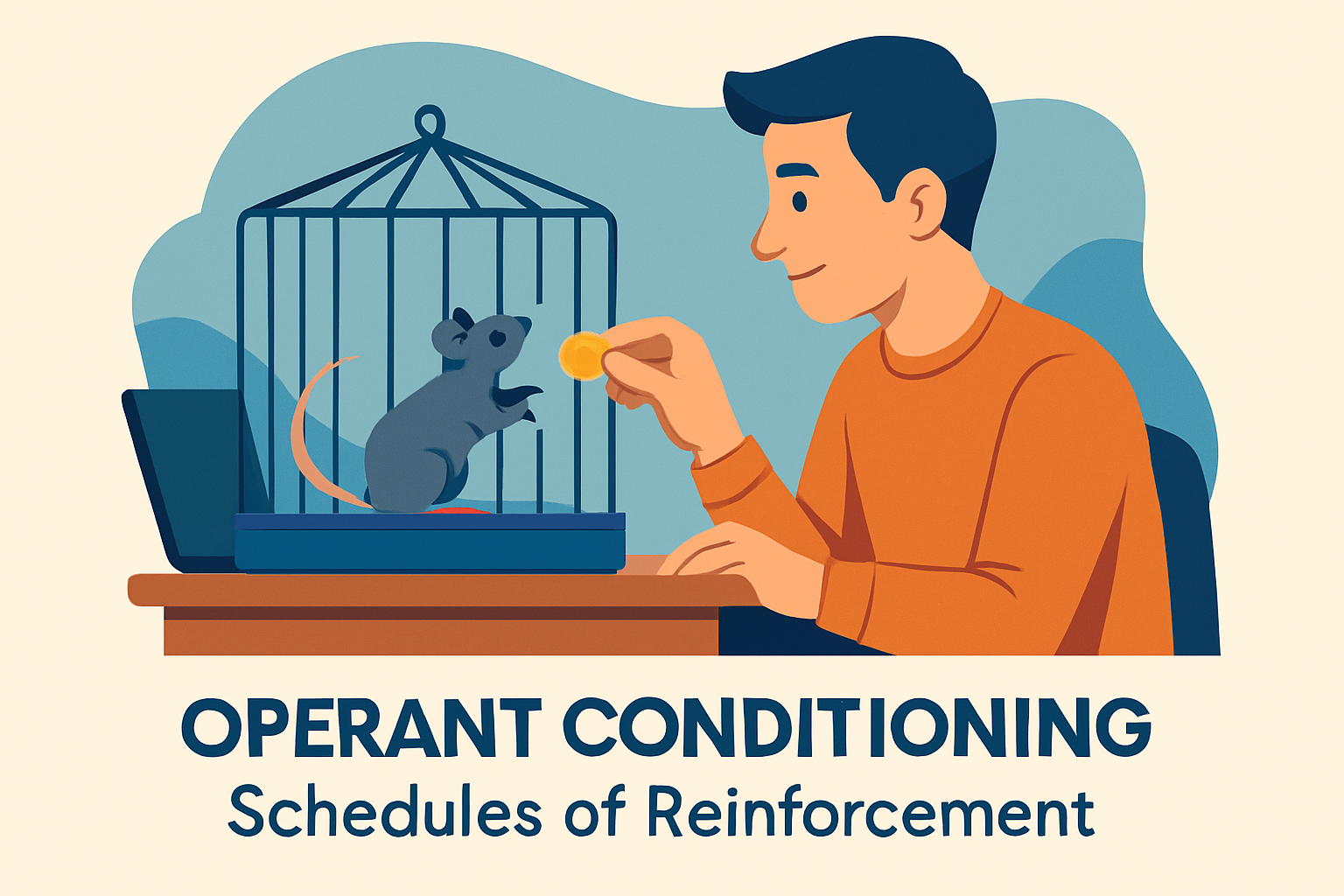
Operant conditioning is a fundamental concept in behavioral psychology that was developed by B.F. Skinner. This technique involves modifying behavior through the use of reinforcement and punishment. In operant conditioning, reinforcement is used to increase a desired behavior, while punishment is used to decrease an undesired behavior. The schedules of reinforcement refer to the rules that dictate how and when reinforcement is given in response to a particular behavior. These schedules are crucial in shaping behavior because they determine the strength and rate at which behavior is exhibited. This topic matters as it helps us understand the dynamics of learning and behavior change, which are applicable in various fields such as education, parenting, animal training, and even workplace management.
Continuous Reinforcement
The first schedule of reinforcement to consider is continuous reinforcement. In this schedule, every instance of the desired behavior is reinforced. Continuous reinforcement is highly effective in establishing new behaviors because it provides consistent feedback to the learner. For example, if you’re training a dog to sit, you might give it a treat every single time it successfully performs the action. This consistency helps the dog quickly associate the action of sitting with receiving a reward, thereby increasing the likelihood of the behavior being repeated in the future.
While effective initially, continuous reinforcement has its downsides. It is often impractical in the long term because it requires sustained effort in delivering the reinforcement. Additionally, behaviors learned under continuous reinforcement can be more susceptible to extinction, which occurs when reinforcement stops, since the subject is accustomed to receiving a reward every time. Therefore, while continuous reinforcement is useful for establishing new behaviors, it is often used in combination with other schedules for maintaining behaviors over time.
Fixed Ratio Schedule
A fixed ratio schedule of reinforcement occurs when reinforcement is provided after a fixed number of correct responses. This type of schedule tends to result in high rates of response followed by short pauses after reinforcement. Consider a scenario where a factory worker is paid for every 10 products they assemble. Here, the reinforcement (payment) is given after a set number of product assemblies, incentivizing the worker to maintain a steady work rate to maximize their earnings.
The main advantage of a fixed ratio schedule is its efficiency in increasing the rate of the targeted behavior. However, if the required number of responses is too high, it may cause fatigue or decreased motivation after each reinforcement, leading to longer breaks or reduced quality of work. It is crucial for those implementing fixed ratio reinforcement to find an optimal balance that maintains motivation without causing burnout.
Variable Ratio Schedule
The variable ratio schedule is highly effective in maintaining high and stable rates of the desired behavior. Unlike fixed ratio schedules, reinforcement is given after an unpredictable number of responses, which makes this approach particularly resistant to extinction. This schedule is often seen in gambling, such as in slot machines, where the player does not know how many lever pulls will result in a win. As a result, the uncertainty keeps them engaged and constantly attempting the behavior in the hope of receiving a reward.
Variable ratio schedules are powerful because they create a scenario where the reward is always perceived as a possibility, keeping the motivation consistently high. This unpredictability also makes it difficult for the behavior to be extinguished quickly because the individual remains hopeful and engaged due to the irregular pattern of reinforcement.
| Schedule | Reinforcement Pattern | Effectiveness |
|---|---|---|
| Continuous | Every response reinforced | Fast learning, quick extinction |
| Fixed Ratio | Reinforcement after set number of responses | High response rate, post-reinforcement pause |
| Variable Ratio | Reinforcement after unpredictable number of responses | High consistent response rate, low extinction |
Fixed Interval Schedule
Under a fixed interval schedule, reinforcement is provided for the first response after a fixed amount of time has passed. This schedule can be seen in educational settings, such as when students receive a grade or feedback on assignments submitted on a regular, predictable basis. Typically, this results in a pattern where responses increase as the anticipated time for reinforcement approaches, a phenomenon often referred to as the “scalloping effect.”
While fixed interval schedules are effective for motivating behavior just before the reinforcement is expected, they can sometimes lead to lower overall response rates at times farther away from the delivery of reinforcement. People tend to increase their engagement mainly as the interval concludes, which can lead to uneven patterns of behavior and learning. This schedule can be beneficial when trying to increase consistency in performance at specific times, but it may not be as effective in situations where continuous high-level performance is desired.
Variable Interval Schedule
Variable interval schedules are similar to fixed interval schedules, but the amount of time that must pass before reinforcement is unpredictable. This schedule results in a slow but steady rate of response since the individual cannot predict when the next reinforcement will occur. An example of a variable interval schedule is receiving emails at unpredictable times of the day. Since the user does not know when the next important email will arrive, they will check their inbox regularly.
This schedule is particularly effective in maintaining behavior over a prolonged period since there is always an element of surprise that sustains interest and encourages steady responses. Unlike fixed interval schedules, there is less of a tendency to ramp up activity just before the expected reinforcement, leading to a more consistent rate of behavior.
Real-World Applications and Implications
Understanding and utilizing the proper schedule of reinforcement is pivotal in many real-world scenarios. In education, for instance, teachers can use variable interval schedules to encourage consistent study habits and engagement by occasionally providing pop quizzes or surprise rewards. In the workplace, managers might implement fixed or variable ratio schedules to boost productivity and motivation, such as offering bonuses based on sales performance.
Moreover, these schedules are instrumental in behavior modification therapies and programs designed to help individuals with various behavioral issues. Therapists might employ specific schedules to reinforce desired behaviors in clients, gradually shaping and encouraging positive habits.
Choosing the Right Schedule
The choice of a reinforcement schedule depends on the specific goals and context within which behavior modification is sought. For quick learning, continuous reinforcement is suitable. However, for long-term maintenance and resilience to extinction, variable interval or variable ratio schedules often prove more effective. Those aiming for high productivity might prefer fixed ratio schedules, whereas variable schedules provide balanced and steady behavioral patterns.
It is important to consider the pros and cons of each schedule and how they align with the objectives of the behavior modification process. Properly implemented, schedules of reinforcement can lead to significant improvements in learning, behavior maintenance, and overall performance.
Conclusion
Schedules of reinforcement are a critical component of operant conditioning and have widespread applications across various disciplines. By understanding how different schedules influence behavior, learners, educators, and professionals can effectively shape and modify behaviors to meet desired outcomes. While each schedule has unique advantages, the choice between them should be made based on long-term goals, the context of the behavior, and the desired pace of learning or behavior change.
Incorporating an appropriate schedule of reinforcement can lead to positive changes and sustained behavior improvements. Whether it be in the classroom, workplace, or in personal growth endeavors, these schedules provide the structure needed to guide and sustain behavioral modifications. Consider exploring these reinforcement strategies further and experimenting with different schedules to determine the most beneficial approach for your specific context or goals.
As a next step, dive deeper into real-world applications of operant conditioning in your area of interest. Whether you are an educator, manager, or someone keen on personal development, understanding and implementing the principles of reinforcement schedules can make a significant impact.
Frequently Asked Questions
1. What is operant conditioning, and how does it relate to schedules of reinforcement?
Operant conditioning is a method of learning that occurs through rewards and punishments for behavior. This concept, developed by B.F. Skinner, posits that behaviors can be influenced by managing the outcomes that follow them. If a behavior is followed by a desirable outcome, it is more likely to be repeated in future situations; conversely, if a behavior is followed by an undesirable outcome, it is less likely to be repeated. This process relies heavily on reinforcement (increasing a behavior) and punishment (decreasing a behavior).
Schedules of reinforcement come into play as the structured plan by which these reinforcements (and sometimes punishments) are administered. They can significantly alter the speed and pattern of the learning process. By using different schedules, we can manipulate the frequency, timing, and predictability of rewards which in turn affects how quickly a behavior is learned and how resistant it is to extinction. This makes understanding and employing the correct schedule crucial when performing experiments in behavioral psychology or when attempting to influence behaviors in applied settings.
2. Could you explain the different types of reinforcement schedules?
Absolutely! There are several types of reinforcement schedules, each having unique characteristics and effects on behavior:
1. Continuous Reinforcement: This schedule involves providing a reinforcement every time a behavior occurs. It’s great for establishing new behaviors quickly, but it’s not particularly sustainable for maintaining those behaviors over time, as continuous reinforcement is impractical in many real-world settings.
2. Fixed-Ratio Schedule: Here, a reinforcement is given after a set number of responses. So, if a schedule has a ratio of one reinforcement per every five responses (FR-5), the subject will receive a reward after every fifth response. This schedule often leads to a high, steady response rate with each “small burst” of responses followed by a short pause.
3. Variable-Ratio Schedule: Unlike fixed-ratio, the number of responses needed for reinforcement varies around some average. For instance, a VR-5 schedule implies that reinforcement will be offered on average every five responses, but not consistently on every fifth response. This creates a high rate of response with little pause or rest in between, similar to the uncertainty found in gambling.
4. Fixed-Interval Schedule: In this case, the first response is reinforced only after a fixed amount of time has passed. A behavior might only be rewarded every ten minutes, no matter how many times it was performed during those intervals. This results in a “scallop-like” pattern of behavior, where responses gradually increase as the time for the next reinforcement draws near.
5. Variable-Interval Schedule: Like the fixed-interval schedule, but here the interval between reinforcements varies. This schedule also leads to steady responding, but with less predictable pauses than the fixed schedule. The behavior is reinforced at variable intervals to encourage consistent performance, much like checking for an email which arrives at irregular times.
3. What effect do different reinforcement schedules have on learning and behavior?
Each reinforcement schedule impacts learning and behavior differently:
Continuous reinforcement is excellent for teaching new behaviors because it provides immediate feedback. However, behaviors learned this way do not persist as well when the reinforcement stops. Thus, while rapid learning is possible, extinction, or the decline of a behavior when it is no longer reinforced, occurs rapidly as well.
Fixed-ratio schedules often lead to high response rates and are useful when we want to encourage productivity. However, a pause or “break and run” pattern often follows reinforcement. This is because the individual knows they won’t receive another reinforcement for a certain number of responses.
Variable-ratio schedules create high and steady rates of response. Since reinforcements are unpredictable, this schedule results in behaviors that are more resistant to extinction—meaning that even when reinforcement ceases, the individual continues the behavior for a time, hopeful of a forthcoming reward.
Fixed-interval schedules lead to slower response rates post-reinforcement and increased responding as the time for the next reinforcement approaches—akin to checking clock-timed factors.
Variable-interval schedules usually prompt a moderate, yet steady response rate since the individual doesn’t know when reinforcement will become available, leading to more consistent behavior over time. These are quite resistant to extinction as well.
4. How do reinforcement schedules apply in real-world scenarios, such as parenting or education?
Reinforcement schedules can be applied in numerous real-world scenarios to modify behavior constructively:
In Education: Teachers often use reinforcement schedules to manage classroom behavior and enhance learning. For instance, they might use a fixed-ratio schedule to reward students after they complete a certain number of problems correctly (e.g., a sticker after every five problems solved). Alternatively, variable schedules (like pop quizzes) keep students on their toes and encourage steady study habits since the timing of reinforcement is unpredictable.
In Parenting: Parents also use these principles, perhaps without realizing. For example, rewarding a toddler with praise or stickers each time they use the potty (initially a continuous reinforcement schedule) can later be shifted to a variable schedule to maintain potty training behavior without requiring constant reinforcement.
Overall, understanding these schedules allows both educators and parents to develop strategies that foster desired behaviors in their students and children, while also reducing reliance on constant reinforcement, which in turn builds independence and resilience in learners and children.
5. How can operant conditioning be used in the workplace to boost productivity and motivation?
In the workplace, operant conditioning strategies, particularly through different reinforcement schedules, can be quite effective in enhancing productivity and motivation:
Fixed-Ratio Schedules: Employees might receive a bonus or an incentive after reaching a certain level of sales or completing a set number of tasks. Such schedules encourage employees to maintain high productivity levels to achieve the reinforcement. However, care should be taken to avoid burnout by ensuring the workload is reasonable.
Variable-Ratio Schedules: Some workplaces implement variable bonuses for particularly high-performing metrics, wherein the reward comes more randomly but as a result of consistent quality or quantity of work. This encourages employees to consistently maintain high levels of performance since the timing of the next reward is unpredictable.
Fixed-Interval Schedules: Regular paychecks or periodic performance reviews can apply here. Though common, this schedule might lead to reduced productivity immediately following the review or reward. Keeping employees engaged between intervals is a challenge that many managers face.
Variable-Interval Schedules: Recognition programs that randomly reward or highlight employee achievements can keep morale high and productivity steady, as employees are consistently engaged, hoping for unexpected recognition.
By thoughtfully applying these principles, managers can effectively boost morale and performance, making the workplace more engaging and productive for everyone involved. It provides employees not just with incentives but also with a sense of a fair and motivating environment.