
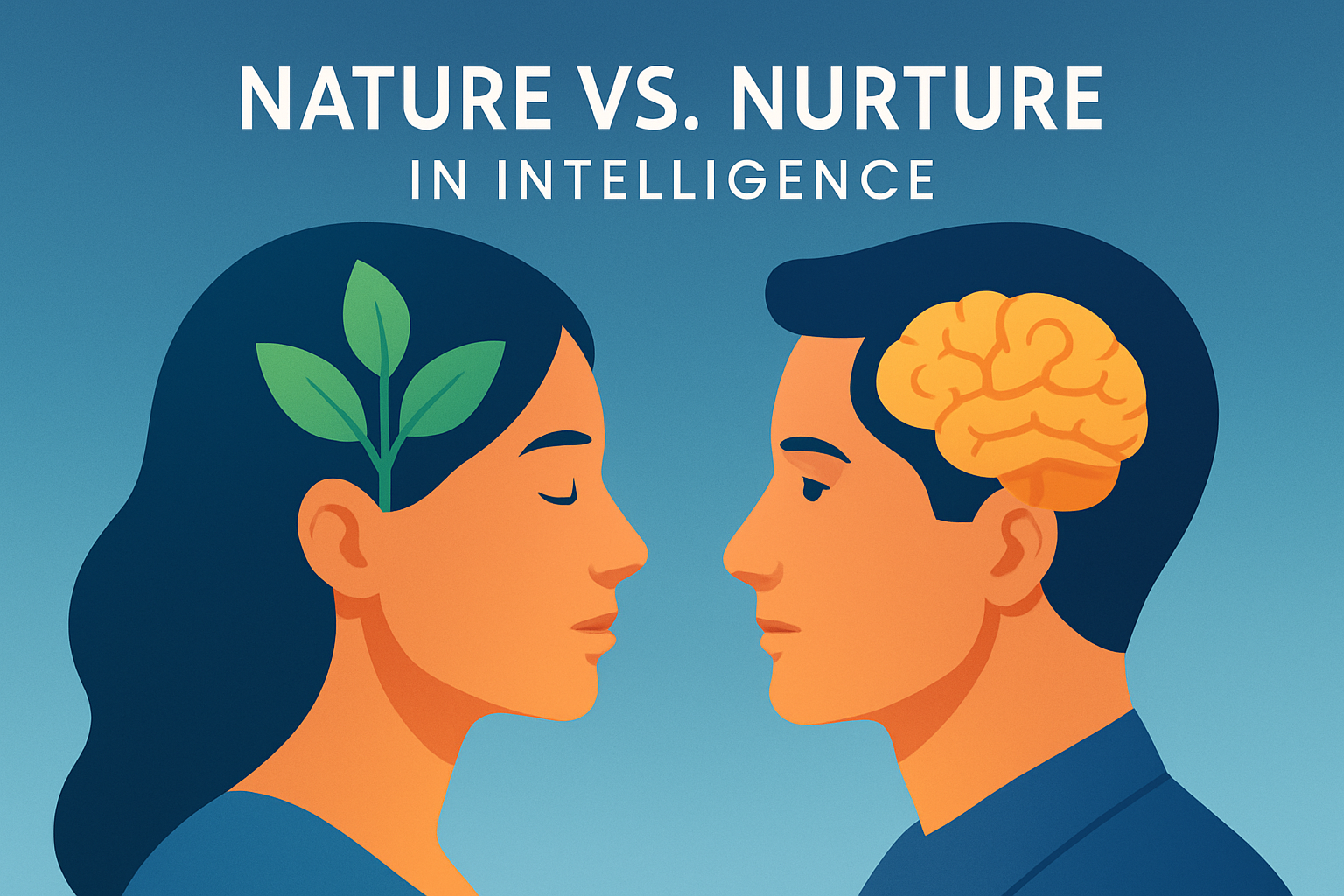
Intelligence has long been a subject of fascination for scientists, psychologists, and educators alike. It serves as a cornerstone in understanding human potential and the capacity to learn, innovate, and adapt to new situations. But what determines intelligence? Is it an inheritance from our genes, a product of our environment, or a mix of both? This debate, often framed as “nature vs. nurture,” poses critical questions about how we come to be who we are intellectually and how various factors influence our intellectual development. Understanding the interplay between nature and nurture in shaping intelligence is crucial because it informs educational strategies, parental approaches, and even public policy. By delving into this topic, we gain insights that could help maximize cognitive potential and offer equitable educational opportunities.
The Genetic Contribution to Intelligence: Nature’s Role
The concept of intelligence being influenced by genetics—nature—is supported by a significant body of scientific research. Genes are powerful determinants, as evidenced by twin studies that reveal that identical twins often have more similar IQ scores than fraternal twins, even when raised apart. These studies suggest that genetics plays a substantial role in determining one’s intellectual capabilities. A specific example can be seen in how certain hereditary conditions, such as Down syndrome or fragile X syndrome, directly impact cognitive abilities, indicating a clear genetic influence.
However, it is crucial to note that while genes set certain potentials or predispositions, they do not determine the entirety of an individual’s intelligence. The Human Genome Project has identified that although many genes are associated with intelligence, the vast majority of them have a tiny effect. Hence, nature provides the building blocks of intelligence, forming the underlying architecture within which environmental factors operate.
Environmental Influences: Nurture’s Impact on Intelligence
Nurture refers to the myriad of environmental factors that affect our cognitive development. Factors such as family environment, education, culture, and personal experiences play significant roles in shaping intelligence. One compelling example is the influence of socio-economic status (SES) on intelligence. Children from higher SES backgrounds typically have access to better educational resources, nutrition, and extra-curricular activities, which can enhance cognitive development.
Another illustrative instance is the “Flynn Effect,” which documents the substantial and long-term increase in IQ scores over generations worldwide. This effect suggests that improvements in education, nutrition, and overall living conditions have contributed to enhanced cognitive abilities over time. In short, the environment not only nurtures but can significantly enhance or inhibit the underlying genetic framework of intelligence.
Early Childhood Development: A Crucial Period for Nurturing Intelligence
Early childhood is a critical phase for cognitive development, during which both nature and nurture have profound influences. During these formative years, neural pathways in the brain are most pliable and can be significantly shaped by experiences. Programs like Head Start in the United States demonstrate the powerful impact of enriching environments. Head Start provides comprehensive early childhood education, health, nutrition, and parent involvement services to low-income families, and studies have shown that participants exhibit long-term improvements in educational outcomes compared to non-participants.
Research reveals that early intervention can help counteract potential genetic disadvantages by providing stimulating and supportive environments. This approach underscores the importance of nurturing during this sensitive period to lay a strong cognitive foundation that genetics alone may not offer.
The Interplay Between Nature and Nurture: A Dual Approach
Rather than viewing nature and nurture as opposing forces, it is most beneficial to consider how they interact. Contemporary research, such as the fields of epigenetics and gene-environment interaction studies, supports the theory that genetic predispositions can be expressed differently depending on environmental influences. This interaction is where the complexity of intelligence truly lies.
For example, consider a child with a genetic disposition for high math ability. If placed in a stimulating educational setting with access to advanced mathematical learning resources, this genetic potential is more likely to manifest. Conversely, a lack of supportive educational experiences might result in this potential going unrealized, illustrating how an enriching environment can catalyze genetic potential.
| Aspect | Nature | Nurture |
|---|---|---|
| Influence on Intelligence | Genetic makeup, hereditary conditions | Family upbringing, educational opportunities |
| Scientific Examples | Twin studies, Human Genome Project findings | Flynn Effect, Head Start Program |
| Potential for Enhancement | Limited without external factors | Significant through enriched environments |
Cultural and Social Considerations in the Nature vs. Nurture Debate
Cultural and social dynamics also influence the expression of intelligence, serving as a potent element of nurture. Education systems, societal values, and cultural expectations can all affect cognitive development. For instance, in some cultures, collective intelligence and community problem-solving are emphasized, while others may value individual critical thinking and innovation.
A real-world example of cultural effects can be observed in how various societies measure intelligence. The Western emphasis on IQ tests contrasts with other cultures that might prioritize social intelligence or practical know-how, showcasing that cultural contexts shape the definitions and perceptions of intelligence. These factors underscore that nurture doesn’t simply mold our biological potentials—it affects how society interprets and values different forms of intelligence.
Real-World Implications and Applications
The nature vs. nurture debate has numerous real-world applications, particularly in educational strategies. Understanding the balance between genetic predispositions and environmental stimuli can aid in creating personalized learning plans to cater to individual needs. For instance, educators equipped with this knowledge can identify innate talents early on and provide the necessary support to nurture these abilities within students.
Furthermore, public policies focused on reducing educational inequalities can leverage the understanding of intelligence as a combined product of nature and nurture. Policies that provide access to quality early childhood programs, improve school systems, and support families in lower socio-economic communities are vital for ensuring that all children, regardless of their genetic background, have the chance to reach their full intellectual potential.
Conclusion: Bridging Nature and Nurture in Understanding Intelligence
The exploration of nature versus nurture in the development of intelligence highlights a crucial takeaway: both elements are inseparably linked in crafting human intellect. Genetics provides the foundation, but it is through nurturing environments that this potential is either realized or stymied. Recognizing this interplay is not merely academic—it has profound implications for personal development, educational strategies, and socio-cultural advancement.
Ultimately, understanding how both nature and nurture contribute to intelligence equips us with a holistic view necessary to foster environments that cultivate every individual’s cognitive potential. Whether you are a parent, educator, policymaker, or simply curious about human development, acknowledging the dual influence of genetics and environment calls us to actively participate in nurturing our own and future generations’ intellectual abilities.
As a next step, consider how you can apply this understanding in your own life or community. Whether through advocating for policies supporting educational equity, fostering a stimulating home environment, or investing in early childhood programs, there are numerous ways to contribute positively. Let’s embrace the dynamic interaction between nature and nurture, striving to unlock human potential in all its diverse forms.
Frequently Asked Questions
1. What is the nature vs. nurture debate in the context of intelligence?
The nature vs. nurture debate in intelligence revolves around whether genetic factors (nature) or environmental factors (nurture) have a more significant impact on a person’s intellectual abilities. For years, this debate has consumed scientists, educators, and psychologists because of its implications on understanding human potential. Those who advocate for the “nature” side argue that intelligence is largely inherited and determined by genetic makeup. In contrast, proponents of “nurture” emphasize the role of external factors, such as socio-economic status, education, upbringing, and cultural influences. The consensus among many in the field is that intelligence results from an intertwined relationship between both genetics and environment. Recent studies and advanced research techniques often reveal that separating these influences completely is nearly impossible as they interact in complex ways throughout an individual’s life.
2. How do genes influence intelligence?
Genes are fundamental in determining various aspects of human intelligence. Genetic factors contribute to establishing a baseline for cognitive abilities, which may include processing speed, memory, reasoning, and problem-solving skills. Studies have employed twin and adoption methodologies to identify these genetic influences, indicating that there can be significant hereditary components to intelligence. For instance, identical twins, who share nearly all their genes, tend to have more similar IQ scores compared to fraternal twins or siblings. Furthermore, researchers have been identifying specific genes and genetic markers – though none solely responsible for intelligence – that may play a role in cognitive development. Nevertheless, it is crucial to remember that while genetic predisposition can provide particular potential ranges for intelligence, the full realization of this potential depends significantly on one’s environmental context.
3. In what ways does the environment affect intelligence?
The environment shapes intelligence in numerous impactful ways, contributing to how genetic potentials are expressed and developed. Key environmental factors include parental involvement, educational opportunities, nutrition, peer influence, and socio-economic status. For example, children raised in stimulating environments with access to quality education and resources tend to develop greater cognitive abilities than those without such advantages. Moreover, nutrition plays a crucial role; adequate nutrients during formative years are essential for optimal brain development. Socio-economic status often dictates access to resources, healthcare, and educational support, directly influencing intellectual growth. Life experiences, culture, and parenting styles also contribute to cognitive development by providing unique challenges, exposure to knowledge, and emotional support. These environmental factors do not merely enhance intelligence; they are sometimes strong enough to negate some genetic predispositions, showing that nurture deeply intertwines with nature in shaping intelligence.
4. Can intelligence change over time, and what factors contribute to this change?
Yes, intelligence can change over time due to various factors relating both to nature and nurture. Although individual intelligence levels can remain relatively stable, particularly after adolescence, they are not fixed and can fluctuate based on diverse life experiences and environmental influences. Cognitive skills can be enhanced by education, ongoing intellectual engagement, and learning new skills or mastering a new language. Moreover, stimulation from social interactions and challenges can also enhance one’s intelligence. That said, negative influences like chronic stress, trauma, and poor health can impede cognitive development or lead to declines in intelligence over time. Similarly, aging can naturally bring about changes in cognitive abilities, though engaging mentally and physically throughout one’s lifetime can mitigate some age-related cognitive decline. Thus, intelligence is dynamic and influenced by a mix of inherent/genetic traits, life decisions, and environmental factors.
5. How has recent research helped in understanding the nature vs. nurture debate in intelligence?
Recent research has advanced our understanding of the nature vs. nurture debate in intelligence by providing more nuanced insights into how these factors interrelate. Advances in genetic research have led to the identification of potential specific genetic components involved in intelligence, though no single “intelligence gene” has been discovered, emphasizing the complexity of genetic influences. Simultaneously, psychological and sociological studies consistently reveal how environmental factors play an immense role in cognitive development. Researchers have employed sophisticated statistical methods and modern imaging technologies to explore how brain structures and cognitive functions correlate with genetic and environmental stimuli. Longitudinal studies have shed light on how early life experiences can have long-lasting impacts on intellectual development, while epigenetics research demonstrates how environmental factors might influence gene expression related to intelligence. These findings underscore the interplay between nature and nurture, suggesting intelligence results from dynamic interactions over a person’s lifetime rather than any single determinant.