
Introduction to Theories of Emotion
Emotion is a fundamental part of the human experience, influencing our behaviors, decisions, and interactions. Among the earliest and most debated theories in psychology are the James-Lange Theory and the Cannon-Bard Theory of emotion. Understanding these theories is crucial, not just for students of psychology, but for anyone interested in the intricacies of human behavior. Why do we feel the way we do? How are emotions initiated and processed within our brains and bodies? The answers to these questions have broad implications, from enhancing therapies in mental health to improving everyday communication.
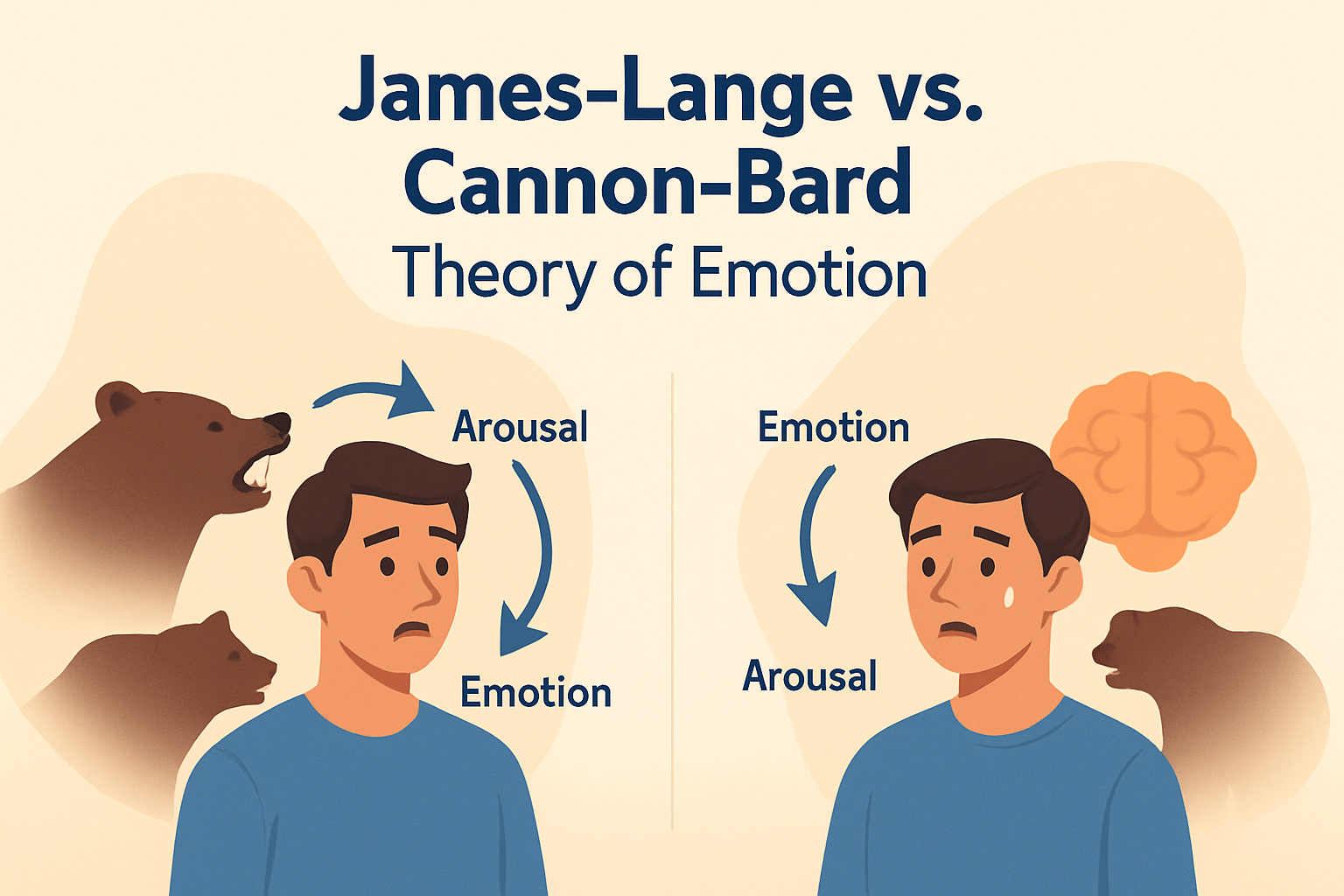
The James-Lange Theory posits that emotions occur as a result of physiological reactions to events. Essentially, this theory suggests that we feel sad because we cry, angry because we strike, and frightened because we tremble. On the other hand, the Cannon-Bard Theory argues that we feel emotions and experience physiological reactions such as sweating, trembling, and muscle tension simultaneously. These differing views have sparked a rich dialogue on the nature of emotion, drawing in insights from biological, psychological, and social perspectives.
In this article, we will delve into both the James-Lange and Cannon-Bard theories, examining the evidence and arguments supporting each. Through exploring real-world examples and relevant studies, we aim to provide a comprehensive understanding of these foundational psychological theories. By the end of this exploration, you’ll gain insight into how these theories manifest in everyday life and the significance of ongoing research in this field. Knowledge of these theories not only deepens our appreciation of human emotion but can also enhance our emotional intelligence and interpersonal skills.
The James-Lange Theory Explained
Developed independently by psychologist William James and physiologist Carl Lange in the late 19th century, the James-Lange Theory suggests a linear progression from stimulus to emotional experience. According to this theory, an external stimulus generates a physiological response, which in turn is interpreted as an emotion. For instance, if you encounter a snarling dog, your body might respond by tensing up, your heart could start pounding, and you might begin to sweat. According to the James-Lange Theory, these physiological changes are interpreted by your brain as fear.
To further clarify, let’s consider a real-world application. Suppose you are preparing to give a public speech. As you anticipate stepping onto the stage, you notice your heart racing and your palms getting sweaty. According to the James-Lange Theory, it is this awareness of the physiological changes in your body that leads to the feeling of nervousness or anxiety. If there were no physiological responses, there would be no ensuing emotional experience.
This theory has prompted extensive studies into the relationship between physiological states and emotions. One of the criticisms of the James-Lange Theory is that it does not account for how different emotions can produce similar physiological responses, such as increased heart rate in both fear and excitement. Nonetheless, it sets the groundwork for examining the role of the autonomic nervous system in emotional perception. Understanding these physiological changes can also aid in developing techniques such as controlled breathing and mindfulness to manage emotional responses effectively.
The Cannon-Bard Theory Unpacked
Walter Cannon and Philip Bard challenged the James-Lange Theory by proposing the Cannon-Bard Theory in the early 20th century. They argued that emotions and physiological responses occur simultaneously and independently. This idea arose from research showing that similar physiological responses could accompany different emotions or no emotion at all, such as the reactions produced by adrenaline. Cannon and Bard suggested that the thalamus, situated in the brain, plays a critical role in this simultaneous emotional and physiological response.
To illustrate, let’s revisit the scenario of public speaking. When you feel nervous before a speech, the Cannon-Bard Theory posits that your brain perceives the situation and simultaneously sends signals to your body and emotional centers, leading to sweating and the feeling of anxiety concurrently. Unlike the James-Lange approach, emotions do not depend on physiological feedback. Instead, both occur as separate but connected processes.
The independence between physiological and emotional responses elucidated by the Cannon-Bard Theory has significant implications in understanding conditions like panic attacks, where emotions seem to occur without a preceding clear cause. This theory highlights the brain’s central role in processing and interpreting emotions, paving the way for therapies that focus on altering thought patterns and expectations to manage emotional experiences.
| Theory | Proposed Mechanism | Key Example |
|---|---|---|
| James-Lange | Stimulus -> Physiological Response -> Emotion | Nervousness felt due to sweating and increased heart rate before giving a speech. |
| Cannon-Bard | Stimulus -> Brain Processing -> Simultaneous Physiological Response & Emotion | Nervousness is felt at the same time as sweating and increased heart rate. |
Bridging the Theories with Modern Insights
While James-Lange and Cannon-Bard provide foundational insights, modern research continues to explore and expand upon these theories. Advancements in neuroscience have revealed that emotions are incredibly complex and involve multiple brain structures and biochemical processes. Studies incorporating functional MRI and other technologies show that emotional experiences correlate with activity in various brain regions, including the amygdala, prefrontal cortex, and hypothalamus, suggesting a more integrative approach.
Take, for example, the modern understanding of the interaction between the amygdala and prefrontal cortex. These two areas play significant roles in emotion regulation and decision-making. While the amygdala processes potential threats rapidly, the prefrontal cortex evaluates these signals to coordinate appropriate responses, reflecting a dynamic blend of conscious thought and instinctual reaction. This supports a nuanced view where both body and brain interactions are vital in shaping our emotional landscapes.
Actually applying this understanding can be beneficial in mental health treatments like Cognitive Behavioral Therapy (CBT), which focuses on altering maladaptive thought patterns. Emphasizing how perceptions can influence emotions and physiological states accords with a more integrated viewpoint of both theories. Such synergy illustrates the evolving nature of psychological science, validating elements from theories while adapting to incorporate new evidence and perspectives.
The Real-World Implications of Understanding Emotion
An understanding of our emotional mechanisms, influenced by theories like James-Lange and Cannon-Bard, can have profound real-world impacts. Recognizing physiological cues as part of our emotional responses can enhance emotional intelligence, empowering us to manage stress and improve our relationships. For instance, being aware of the body’s stress signals can prompt someone to employ stress-reduction techniques proactively, thus preventing potential escalation of distressing emotions.
Moreover, this knowledge extends into artificial intelligence and developing emotionally intelligent systems. Aided by understanding human emotional processes, AI technologies can be designed to respond more naturally and empathetically to human users. Similarly, insights from these theories are invaluable in designing ergonomics that account for emotional impacts on the behavior of users, like using calming colors and layouts in user interfaces to soothe end-users subconsciously.
Overall, these theories demonstrate that understanding emotion is not just an academic pursuit but a practical one with direct links to improving human well-being and enhancing human-computer interactions. Continued research and integration of old and new knowledge promise even more nuanced understanding and application.
Conclusion: Embracing an Integrated View of Emotion
In conclusion, the exploration of the James-Lange and Cannon-Bard theories offers profound insights into how we perceive and process emotions. Both theories propose essential mechanisms—whether linear or simultaneous—by which individuals experience emotions, offering distinct lenses through which to view our emotional world. By integrating these historical theories with contemporary neuroscience, a more comprehensive picture emerges that considers both physiological responses and brain activity as integral components of emotion.
The comprehension of our emotional processes has tangible benefits, enhancing personal emotional intelligence and practical applications such as therapy, AI development, and human-computer interaction design. The key takeaway is that emotional experiences are complex and multi-faceted. They demand a consideration of both bodily states and brain functions, encouraging an integrated therapeutic and technological approach to health and development.
As further research sheds light on this intricate domain, individuals can apply this knowledge to improve emotional resilience and relational dynamics. Whether aiding personal introspection or contributing to innovations in technology and health, the theories of James-Lange and Cannon-Bard continue to illuminate the path toward a deeper understanding of human emotion. Embark on a journey to further explore the abundant insights psychology and neuroscience offer, enhancing both your own life and the wider world around you.
Frequently Asked Questions
1. What is the James-Lange Theory of Emotion?
The James-Lange Theory of Emotion, proposed by psychologists William James and Carl Lange in the late 19th century, suggests that emotions are a result of physiological responses to stimuli. According to this theory, our bodies first experience a physiological change in response to an event, such as an increased heart rate, sweating, or muscle tension, and then we interpret these physical changes as specific emotions. For example, if you encounter a growling dog, your body might start trembling and your heart could race. According to the James-Lange Theory, you perceive these bodily changes and then conclude that you are feeling afraid. This theory emphasizes that our emotional experience depends on our interpretation of physiological states within the body. It’s a fascinating approach because it shifted the perspective from seeing emotions as purely psychological to recognizing the crucial role of the body in emotional processes.
2. How does the Cannon-Bard Theory of Emotion differ from the James-Lange Theory?
The Cannon-Bard Theory of Emotion, introduced by Walter Cannon and Philip Bard as a critique of the James-Lange Theory, proposes that we experience emotions and physiological reactions simultaneously, rather than sequentially. This theory emerged in the early 20th century as researchers questioned some of the assumptions of the James-Lange Theory. According to the Cannon-Bard Theory, when an event occurs, the thalamus in the brain sends signals simultaneously to the cerebral cortex (producing the experience of an emotion) and the autonomic system (resulting in physiological responses). This means you would feel fear and experience a racing heart at the same time when faced with a growling dog; one doesn’t necessarily come before the other. The idea here is that emotional experiences are not strictly dependent on a prior physiological change, emphasizing the role of the brain in processing and experiencing emotions independently of the body’s reactions.
3. What are the primary criticisms of the James-Lange Theory?
One of the main criticisms of the James-Lange Theory is that physiological changes in the body can be similar for different emotions, making it challenging to differentiate emotions based solely on these physical changes. For example, both fear and excitement might cause an increased heart rate or heavy breathing. Critics argue that if our emotional recognition were based solely on these physiological responses, it would be difficult to accurately distinguish between different emotions. Furthermore, some emotions, such as happiness and sadness, might not always present with noticeable physiological changes, which the James-Lange Theory fails to account for. Additionally, those in opposition to the theory point out that some emotional experiences occur faster than the physiological changes that accompany them, suggesting that emotions can arise independently of or prior to physiological responses.
4. How did the Cannon-Bard Theory address limitations of the James-Lange Theory?
The Cannon-Bard Theory was developed partly in response to the shortcomings observed in the James-Lange Theory. It sought to address the issue of identical physiological responses corresponding to different emotions. By proposing that the experience of emotion and physiological responses occur simultaneously, the Cannon-Bard Theory avoids the problem of assuming that each emotion has a distinct physiological blueprint. This simultaneous processing allows for more nuanced emotional experiences even in the presence of similar physiological reactions. Additionally, by emphasizing the role of the brain, particularly the thalamus and cerebral cortex, the Cannon-Bard Theory suggests a more central and direct mechanism for emotional experience, one that acknowledges how our cognitive processes interact with and influence our emotional states, lending a more comprehensive understanding of how emotions can arise rapidly, and independent of the awareness of bodily changes.
5. Why are these theories important in the study of psychology today?
Both the James-Lange and Cannon-Bard theories have significantly influenced how psychologists understand emotions, driving decades of research and debate. These theories laid foundational groundwork that led to modern approaches, including cognitive and neurobiological perspectives on emotion. By examining how these early theories conceptualized the connection between mind, body, and emotion, psychologists have developed more intricate models that consider the roles of cognition, neurobiology, and social context in emotional experiences. Understanding these early theories also helps explain how scientific ideas evolve and refine over time, reflecting how our comprehension of human psychology grows. Additionally, these theories continue to be relevant in educational settings, where they stimulate critical thinking and inspire new hypotheses in the psychology of emotions, ensuring that future research is grounded in a rich historical context.