
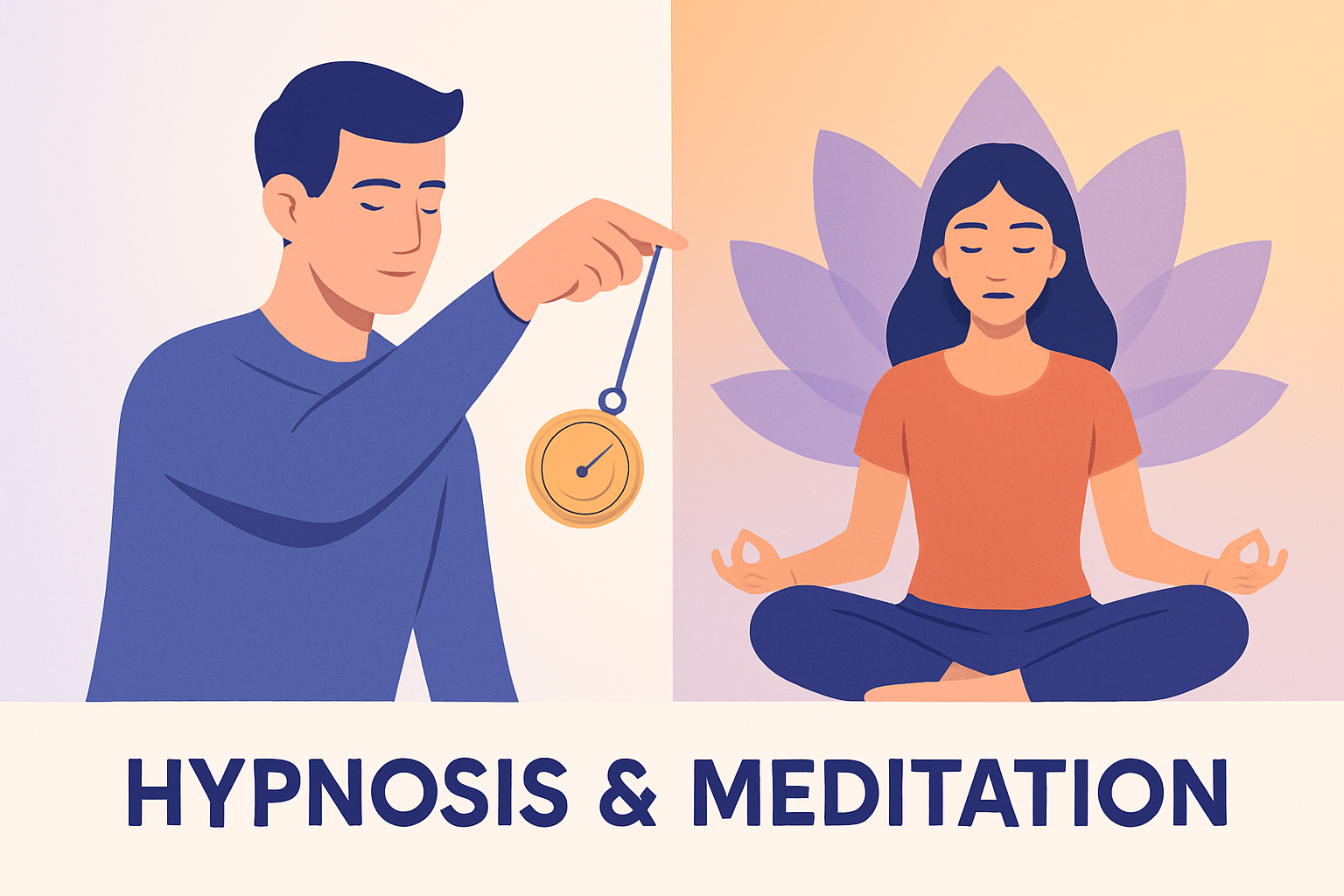
Introduction to Hypnosis and Meditation
In the modern world, where stress and anxiety levels are at an all-time high, individuals are increasingly turning to alternative methods like hypnosis and meditation for relief. These ancient practices have been embraced globally for their ability to promote relaxation, enhance focus, and improve overall well-being. Though both hypnosis and meditation can lead to profound mental, physical, and emotional benefits, they are distinct practices with unique characteristics.
Hypnosis is a trance-like mental state in which individuals undergo heightened focus and concentration. While it is often misunderstood as magical or theatrical, hypnosis is a legitimate psychological tool used for therapeutic purposes. Conversely, meditation is a focused practice that involves deep thinking and reflection to achieve a state of heightened awareness and mental clarity. The fundamental importance of understanding and differentiating between these two practices lies in harnessing their full potential for personal growth and healing.
In the following sections, we will explore various facets of hypnosis and meditation, highlighting their benefits, techniques, and applications in everyday life. We will also provide real-world examples to offer a comprehensive understanding of these practices. Let us delve into the fascinating realm of hypnosis and meditation to discover how they can transform lives.
The Science Behind Hypnosis
The scientific exploration of hypnosis has evolved significantly over the years, demystifying many misconceptions. Hypnosis is often perceived as a form of manipulation, yet it is largely about guided therapy, where a subject accesses deeper cognitive processes. Hypnotic states induce a heightened sense of awareness and are characterized by increased suggestibility and relaxation. This state is facilitated by trained hypnotherapists using verbal prompts and techniques to guide individuals into this trance-like state.
In practice, hypnosis is commonly used to address issues such as phobias, addictions, and chronic pain. Sports psychologists also employ hypnosis to sharpen athletes’ mental focus and performance. A notable real-world example is the use of hypnosis in pain management. A study conducted at Stanford University showcased how patients under hypnosis for dental surgery experienced significantly less pain compared to those without.
Furthermore, scientific studies reveal that hypnosis affects brain activity, particularly in areas related to attention, body awareness, and pain perception. Functional MRI scans of hypnotized individuals illustrate altered states of brain activity, underscoring that hypnosis is not mere imagination but a scientifically measurable state with tangible effects.
Understanding Meditation and Its Varieties
Meditation, an ancient practice rooted in spiritual traditions, is now embraced by millions worldwide for its mental health benefits. Meditation focuses on mindfulness—observing thoughts and emotions without judgment. The practice aims to enhance present-moment awareness and foster a calm, balanced mental state. There are various forms of meditation, including mindfulness meditation, Transcendental Meditation, and loving-kindness meditation, each serving different purposes.
An ordinary meditation session typically features a quiet environment, a comfortable posture, and focused breathing. During mindfulness meditation, individuals concentrate on their breath or a specific thought to cultivate awareness and tranquility. Transcendental Meditation, on the other hand, involves repeating a personal mantra to calm the mind.
A real-world example includes stress reduction programs in corporate settings. Companies like Google and Apple have introduced meditation sessions to improve employees’ mental health and productivity. These programs resulted in decreased stress levels, improved focus, and increased job satisfaction, validating meditation’s effectiveness in real-world contexts.
- Mindfulness Meditation: Focuses on breathing and present moment awareness.
- Transcendental Meditation: Utilizes a mantra for achieving deep relaxation.
- Loving-Kindness Meditation: Cultivates compassion and empathy.
Comparing Hypnosis and Meditation: Similarities and Differences
While hypnosis and meditation share similarities—both promote relaxation and use focused attention—they are distinguished by their methodologies and objectives. Meditation emphasizes individual introspection and awareness, while hypnosis involves guided suggestion to alter perceptions or behavior. Further, meditation is a practice individuals can perform independently, while hypnosis typically requires a trained professional.
A critical difference lies in their applications. Hypnosis is effective for therapeutic interventions, such as quitting smoking or overcoming phobias. In contrast, meditation is widely used for personal growth, stress reduction, and emotional well-being. For instance, a study in the Journal of Consulting and Clinical Psychology demonstrated hypnosis’s efficacy in treating smoking addiction, while Harvard’s research linked meditation with reduced anxiety and depression.
Despite these differences, both practices share a common goal: to enhance overall mental health by harnessing the mind’s power. By understanding these distinctions, individuals can choose the appropriate practice that aligns with their personal needs and goals.
The Applications of Hypnosis in Therapy
Hypnosis is increasingly incorporated into therapeutic settings to address a broad range of psychological and physiological issues. One of the key applications of hypnosis is in cognitive behavioral therapy (CBT), where it complements traditional techniques by helping patients access and reframe cognitive patterns more effectively.
In real-world applications, hypnotherapy has proven effective in treating PTSD (Post-Traumatic Stress Disorder). Veterans and trauma survivors benefit from hypnosis to process traumatic memories and reduce associated stress symptoms. Another pertinent example is the role of hypnosis in managing chronic pain. Studies published in the journal Pain Research and Management illustrated that hypnosis could reduce discomfort and improve life quality for chronic pain sufferers.
| Application | Target Area | Benefits |
|---|---|---|
| Hypnosis for PTSD | Traumatic Stress | Reduces Anxiety and Flashbacks |
| Hypnosis in CBT | Cognitive Patterns | Enhances Cognitive Restructuring |
| Pain Management | Chronic Pain | Decreases Pain Perception |
The Mind-Body Connection in Meditation
The ancient practice of meditation is celebrated for fostering a profound mind-body connection, where mental processes directly influence physical health. Scientific studies underscore meditation’s impact on physiological markers like stress hormones, blood pressure, and immune responses, highlighting its role in promoting holistic health.
A real-world application of this mind-body synergy is apparent among individuals undergoing cancer treatment. Meditation serves as a coping strategy to reduce treatment-related stress, thereby boosting patients’ emotional resilience and improving their overall quality of life. A clinical trial published in the journal Cancer demonstrated that mindfulness-based interventions improved mood and sleep quality among breast cancer patients.
Mind-body practices such as meditation also promote neurological flexibility and enhance cognitive function. Research from the University of Wisconsin-Madison revealed that long-term meditators exhibited higher brain connectivity and improved attention skills compared to non-meditators. By practicing meditation, individuals can harness this mind-body connection to support mental and physical well-being.
Conclusion: Embracing Both Hypnosis and Meditation
In exploring hypnosis and meditation, we uncover two powerful methods that, while distinct, offer complementary benefits for mental and physical health. Both practices enable individuals to access deeper levels of consciousness, promote relaxation, and enhance overall well-being. Incorporating hypnosis and meditation into one’s wellness regimen can lead to transformative personal growth and healing.
The key takeaway for the reader is the understanding that choosing between hypnosis and meditation is not about selecting a superior practice, but rather discovering what aligns with individual needs. Those seeking therapeutic intervention may benefit from hypnosis, while meditation offers a pathway to mindfulness and stress reduction.
As a call to action, consider incorporating either or both of these practices into everyday life. Start with small, manageable sessions to build a consistent habit, and explore professional guidance if needed. Embrace these practices as tools for self-improvement, and unlock the potential for a healthier, more fulfilling life.
Frequently Asked Questions
1. What is the difference between hypnosis and meditation?
While hypnosis and meditation are often mentioned together because of their relaxing and mind-altering effects, they are actually quite distinct practices. Hypnosis is a trance-like state of focused attention and heightened suggestibility with the assistance of a hypnotherapist or through self-hypnosis techniques. It’s often used therapeutically to help individuals change negative behaviors or perceptions. During hypnosis, you are more open to suggestions, allowing you to access the unconscious mind and make deep-seated changes.
On the other hand, meditation is typically a self-directed practice focused on achieving a state of conscious relaxation and awareness. It’s about training attention and awareness to achieve mental clarity, emotional calmness, and stability. Different forms of meditation, such as mindfulness or transcendental meditation, vary in their approach and goals. The processes and outcomes of meditation lean toward personal growth, self-reflection, and mental clarity.
2. Can meditation and hypnosis improve mental health?
Yes, both meditation and hypnosis can contribute significantly to improving mental health. Meditation is renowned for its capacity to relieve stress, reduce anxiety, enhance emotional health, and promote mental clarity. Regular practice can lead to reduced symptoms of depression, improved concentration, and an elevated mood. It encourages mindfulness, allowing individuals to live more fully in the present moment, helping to lessen worries about the past or the future.
Hypnosis, especially when used for therapeutic purposes (hypnotherapy), can aid in addressing various mental health concerns such as phobias, fears, anxiety, and even PTSD. By accessing the unconscious mind, hypnosis can reframe negative thought patterns and implant positive messaging, aiding in behavior change and emotional healing. Clinical hypnosis is often performed by a trained therapist to assist individuals in overcoming mental barriers, facilitating lasting mental health improvements.
3. How long does it take to feel the benefits of meditation and hypnosis?
The time it takes to experience benefits from meditation and hypnosis can vary greatly among individuals, depending on their goals, frequency of practice, and personal dispositions. Some people may feel immediate relief from stress or anxiety after a single session, while for others, it might take several weeks or even months of regular practice to notice significant changes.
Meditation often requires consistency and patience, with many practitioners recommending at least 5-10 minutes of daily practice to begin experiencing subtle shifts in mental and emotional states in as little as a few days. However, profound changes and long-term benefits usually develop over a prolonged period of steady practice.
Similarly, with hypnosis, the number of sessions needed can depend on the depth of the issue being addressed. Some individuals may require multiple sessions to achieve desired results, especially if working on complex or chronic problems. During each session, gradual progress can often be felt, progressively leading to more substantial developments.
4. Are there any risks or side effects associated with hypnosis and meditation?
Both hypnosis and meditation are generally considered safe practices with minimal risks when performed correctly. However, there are essential considerations to keep in mind. With hypnosis, particularly self-hypnosis, it is vital to approach the practice with care, and preferably under the guidance of a trained practitioner for more complex mental health issues. In rare cases, negative responses such as increased anxiety or false memory creation might occur if not handled responsibly.
Meditation is usually safe for most people, but there can be instances where intense forms of meditation lead to discomfort or emotional disturbances. It is essential to choose a meditation style that suits your level of experience and emotional health. Beginners might experience minor physical discomfort, such as restlessness or feeling sleepy during practice, but these typically decrease with time and practice. Always approach both practices with an open mind and sense of self-compassion, aware of personal limits and comfort levels.
5. Can anyone practice hypnosis or meditation, or is it meant for specific people?
Hypnosis and meditation are both incredibly accessible practices suitable for a wide range of individuals, regardless of age, background, or professional status. Both methods have been adapted into various forms to accommodate diverse needs and preferences, ranging from simple relaxation techniques to complex therapeutic applications. Meditation is practiced in many forms around the world, making it adaptable and appropriate for a wide variety of cultural and personal contexts, such as guided meditation, focused breathing, or mindful movement.
Hypnosis is similarly diverse, with applications in fields as wide-ranging as medicine, sports, and personal development. It’s particularly beneficial for individuals seeking behavioral change, such as quitting smoking, managing weight, or alleviating anxiety. Nonetheless, both practices require a willingness and openness to engage with the process and, for therapeutic hypnosis, a professional setting is recommended to ensure safety and efficacy. Ultimately, while meditation can be explored independently, hypnosis should ideally involve a trained practitioner for therapeutic purposes.