
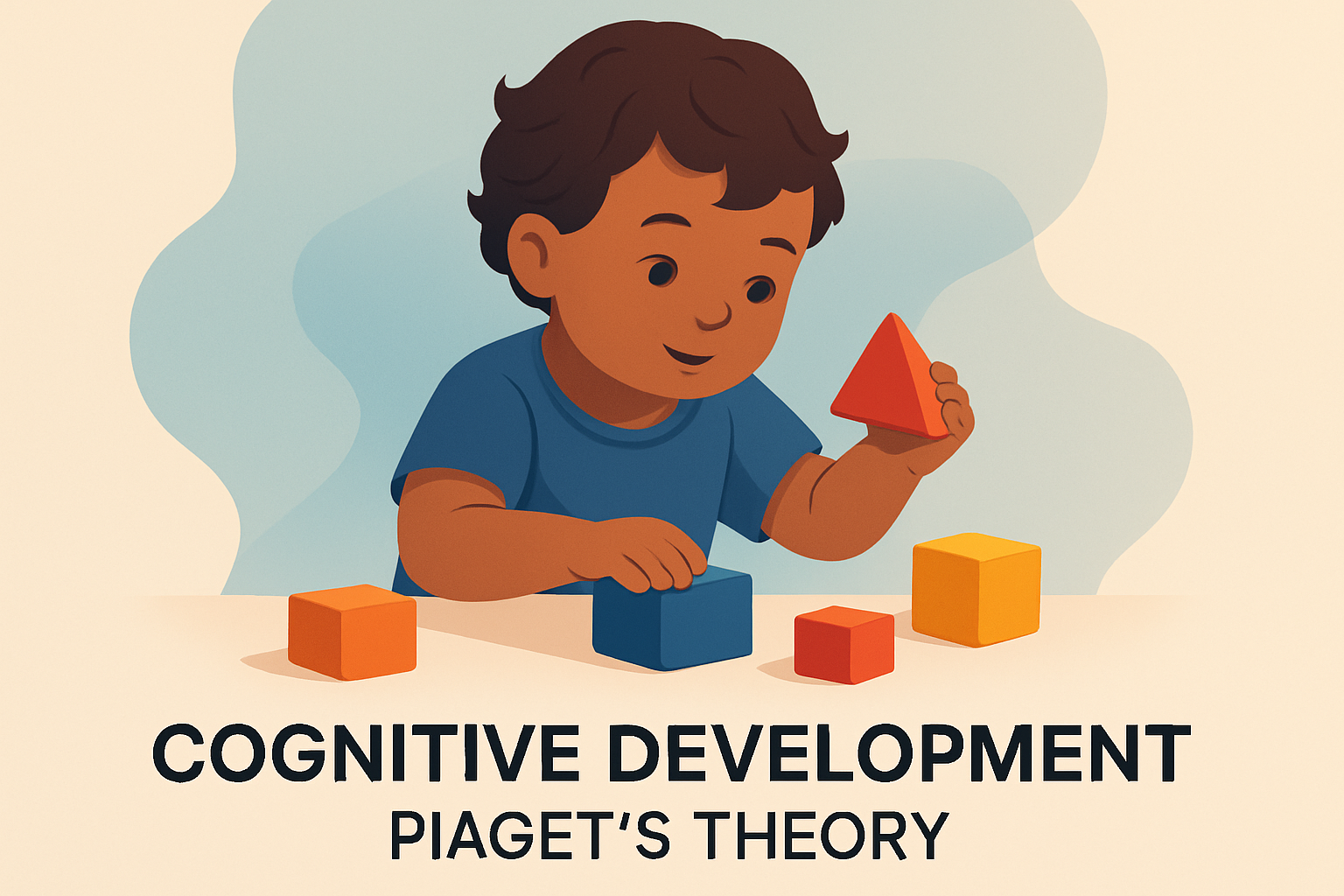
Cognitive development is a central aspect of human growth and understanding it is crucial for parents, educators, and anyone interested in the intricacies of human behavior. One of the most influential figures in the study of cognitive development is Jean Piaget, a Swiss psychologist whose theory has provided invaluable insights into how children progress through different stages of thinking and understanding the world around them. In this article, we delve into Piaget’s Theory of Cognitive Development, exploring its stages, key concepts, and the impact it has on educational practices. Knowing about this theory is essential as it lays the foundation for effective teaching strategies and helps caregivers understand the evolving needs of children across various ages. By understanding Piaget’s stages, we can tailor our interactions and educational approaches to foster a child’s development most effectively.
Understanding the Stages of Cognitive Development
Piaget’s Theory of Cognitive Development is structured around four key stages: the Sensorimotor Stage, the Preoperational Stage, the Concrete Operational Stage, and the Formal Operational Stage. Each stage represents a new level of complexity in how children think and understand their surroundings.
Sensorimotor Stage (Birth to 2 years)
The Sensorimotor Stage is the first stage of cognitive development, occurring from birth until approximately two years of age. During this period, infants primarily learn about the world through their senses and motor activities. This stage is characterized by the development of object permanence—the understanding that objects continue to exist even when they are not seen, heard, or touched.
A real-world example of this is when a baby engages in a game of peek-a-boo. Initially, the infant may believe that the person playing with them truly disappears when covered and returns when uncovered. As object permanence develops, the child begins to understand that the individual is present even when not visible. This cognitive leap is monumental in a child’s understanding of consistency in their environment.
Preoperational Stage (2 to 7 years)
In the Preoperational Stage, children start to use language to explore and understand their worlds. This stage is marked by symbolic thinking and egocentrism, where the child struggles to see things from perspectives other than their own.
Take, for example, a child engaging in pretend play. A child at this stage might use a broomstick as a make-believe horse or a doll as a surrogate baby, demonstrating their burgeoning ability to engage in symbolic play. However, they might also have difficulty accepting that other people may have different views and feelings, illustrated when two young children argue fiercely about something they perceive in contrasting ways.
Key Concepts and Importance
Piaget introduced several key concepts to explain the stages of cognitive development. Some of these include schemas, assimilation, and accommodation.
Schemas
Schemas are mental structures or frameworks that help individuals organize and interpret information. An example of this would be a child’s schema for dogs—initially, they might think of a small, furry animal with four legs.
Assimilation and Accommodation
Assimilation is the process through which new experiences are integrated into existing schemas, while accommodation is the adjustment of schemas to encompass new information. For instance, once a child who knows what a dog is encounters a cat for the first time, they might initially label it a dog because it fits the schema of a four-legged furry animal (assimilation). Over time, they will learn to differentiate and create a new schema for cats (accommodation).
The Concrete Operational Stage (7 to 11 years)
The Concrete Operational Stage is where children begin to think logically about concrete events. They start to understand the concept of conservation—the idea that quantity is unrelated to the arrangement and physical appearance of objects.
| Concept | Description |
|---|---|
| Conservation | Understanding that properties such as mass, volume, and number remain the same despite changes in the forms of objects. |
| Reversibility | Understanding that objects can be changed and then returned back to their original state. |
For example, if you have two glasses of water of the same amount and pour one into a wider glass, a child in this stage will understand that the amount of water is the same in both glasses despite appearances. This development is crucial for mathematical reasoning and problem-solving skills.
The Formal Operational Stage (12 years and up)
The final stage, known as the Formal Operational Stage, is characterized by the ability to think abstractly, reason logically, and plan systematically. Adolescents in this stage develop the capacity to think about concepts and use hypothetical reasoning.
A practical example would be when teenagers tackle problems such as algebraic equations or engage in debates about social or ethical issues. They begin to understand complex scientific theories and can strategize various solutions to a problem. This stage highlights the importance of nurture, as cognitive abilities can be honed and expanded with proper guidance, education, and experience.
Importance of Piaget’s Theory in Education
Piaget’s Theory has significant implications for education, emphasizing the need for teaching strategies that align with a child’s cognitive stage. Educators are encouraged to use hands-on learning and encourage exploration in younger children, while older students benefit from hypothetical and abstract thinking exercises. By understanding these developmental stages, teachers can better assess when a child is ready to learn new concepts and tailor their instructional methods accordingly.
For instance, during the Concrete Operational Stage, children benefit greatly from direct manipulation of materials to understand concepts like conservation or mathematics. As they enter the Formal Operational Stage, incorporating tasks that require high-level reasoning and critical thinking can foster advanced cognitive skills.
Critiques and Evolution of the Theory
Despite its widespread use and foundational place in psychology, some critiques of Piaget’s Theory suggest it underestimates children’s cognitive abilities. Recent research indicates that children may develop some cognitive abilities earlier than Piaget originally proposed.
Nonetheless, Piaget’s contributions remain pivotal, providing valuable frameworks that have been expanded and refined through subsequent research by psychologists like Lev Vygotsky, who emphasized the social aspects of cognitive development, complementing and enhancing Piaget’s work.
Conclusion: Key Takeaways from Piaget’s Theory
Piaget’s Theory of Cognitive Development is a fundamental framework in psychology and education, offering insights into the stages children go through as they develop cognitively. By understanding these stages, parents and educators can better nurture a child’s growth and adapt strategies to their developing needs. Moreover, this knowledge prompts educators to create learning environments that are age-appropriate and conducive to cognitive advancement.
Knowing how children think and learn helps educators chart educational pathways that are not only instructive but also intuitive. As a next step, educators might consider integrating ways to assess individual child development more comprehensively to provide tailored educational experiences. Understanding and applying Piaget’s Theory equips us with the knowledge to support cognitive development in children, encouraging them toward a lifetime of learning and growth.
To enhance your understanding of cognitive development and stay informed about innovative educational strategies, consider exploring further resources, attending workshops, or engaging with professional educational communities.
Frequently Asked Questions
1. What is the basic premise of Piaget’s Theory of Cognitive Development?
Jean Piaget’s Theory of Cognitive Development is a comprehensive theory about the nature and development of human intelligence. It posits that children move through four distinct and universal stages of cognitive development. These stages are characterized by a certain way of thinking and understanding the world. Piaget believed that children are little scientists who actively construct their understanding and knowledge of the world through experiences and interactions. The stages include the Sensorimotor Stage, Preoperational Stage, Concrete Operational Stage, and Formal Operational Stage. Each stage marks a transformation in how a child perceives and engages with the world, laying the foundation for further cognitive growth.
2. What happens during the Sensorimotor Stage?
The Sensorimotor Stage is the first stage in Piaget’s theory, occurring from birth to approximately 2 years of age. During this period, infants learn about the world predominantly through their senses and actions. This is when they develop an understanding of object permanence—the recognition that objects continue to exist even when they are not visible. It’s a crucial period where infants begin to establish a sense of self and other, recognize their ability to affect their environment, and coordinate sensory input with motor actions. Piaget argued that this stage lays the groundwork for more sophisticated cognitive processes by building a foundational understanding of the physical world.
3. Can you explain the characteristics of the Preoperational Stage?
Spanning from approximately ages 2 to 7, the Preoperational Stage is when children start to engage in symbolic play and learn to manipulate symbols, such as words and images. However, their thinking is still non-logical and non-concrete—hence the term “preoperational.” At this stage, children are egocentric, meaning they struggle to see situations from perspectives other than their own. They tend to focus on one aspect of a situation at a time, which Piaget referred to as centration. They’re also prone to animism, attributing life-like qualities to inanimate objects, and struggle with understanding the concept of conservation—the idea that quantity remains the same despite changes in shape or appearance.
4. How does cognitive development evolve during the Concrete Operational Stage?
During the Concrete Operational Stage, which lasts from about 7 to 11 years old, children’s thinking becomes more logical, organized, and flexible. They gain a better understanding of concrete events and concepts, like conservation, classification, and seriation (the ability to order items along a dimension). At this stage, children can perform mental operations and solve problems, but these are strictly concrete and not abstract in nature. Their understanding of the world runs deep in tangible and present realities. They become less egocentric, allowing for improved problem-solving abilities as they can consider multiple viewpoints simultaneously.
5. What developments occur in the Formal Operational Stage?
The Formal Operational Stage begins around age 11 and continues into adulthood. In this final stage of Piaget’s cognitive development theory, individuals develop the ability to think abstractly, logically, and systematically. They can now manipulate ideas in their head, without any dependence on concrete manipulation. This is when hypothetical-deductive reasoning becomes possible; adolescents can think about possible outcomes and systematically test hypotheses. This stage facilitates the exploration of abstract concepts like love, politics, ethics, and free will, offering a more profound engagement with theoretical constructs and philosophical ideas. Piaget believed that reaching this stage enhances an individual’s ability to navigate complex problems and engage in sophisticated thinking, critical for adult learning and decision-making.