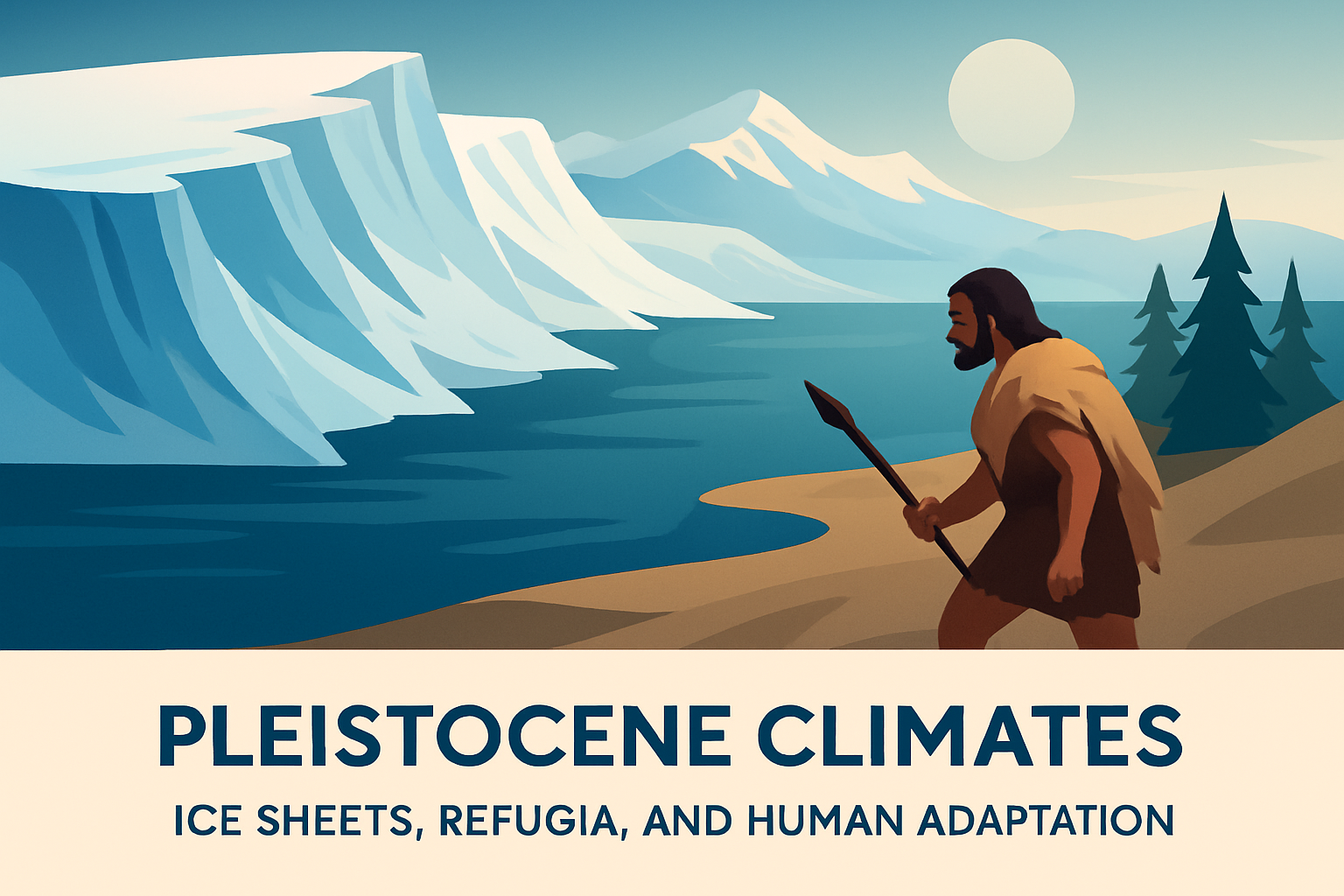
The Pleistocene epoch, spanning approximately 2.58 million to 11,700 years ago, is renowned for its dramatic climatic shifts and extensive glaciations. Characterized by its alternating glacial and interglacial periods, the Pleistocene is crucial for understanding how ecosystems and human populations adapted and evolved in extreme environmental conditions. During this era, vast ice sheets covered significant portions of North America, Europe, and Asia, profoundly influencing global climates and landscapes.
Ice sheets refer to glacier masses that spanned continents, significantly impacting sea levels, weather patterns, and flora and fauna distribution. Refugia, on the other hand, are safe havens where species survived through extreme climate phases. These refugia provided critical sanctuaries for plants, animals, and early humans, preserving biodiversity and enabling post-glacial recolonization. The Pleistocene climate’s effects and the adaptation to them are of paramount importance due to their influence on today’s global biodiversity, climate studies, and understanding human evolution and migration patterns. To comprehend the dynamics of our present and future climate, it’s essential to delve into the Pleistocene climactic narrative.
Ice Sheets and Their Influence on Climate
During the height of the Pleistocene glaciations, ice sheets extended over much of the Northern Hemisphere, with the Laurentide Ice Sheet in North America and the Fennoscandian Ice Sheet covering northern Europe. These monumental ice sheets expanded and retreated in response to climatic changes, reshaping landscapes, influencing ocean currents, and altering planetary albedo, the measure of Earth’s reflectivity. This albedo effect cooled the Earth’s surface, exacerbating glaciation periods and prolonged cold snaps. These substantial ice masses modified global weather patterns by altering jet streams, rainfalls, and seasonal changes, driving climatic oscillations on a mega-regional scale.
The existence of these vast glaciated regions confined ecosystems to limited areas. Glacial maxima reduced habitable territories, confining ecological diversity to smaller zones. Notably, sea levels dropped by approximately 120 meters due to ice formation, exposing continental shelves and creating land bridges. The Bering Land Bridge, a critical link during the last glacial period, connected Siberia to Alaska, facilitating human and animal migration between Asia and North America.
Refugia: Islands of Survival
Amid the severe conditions of the ice ages, refugia were ecological havens that preserved an extraordinary range of biodiversity. These areas, often ice-free and climatically stable, were isolated from ice sheets, providing critical habitat where species survived the drastic temperature shifts. The Iberian Peninsula, the Italian Peninsula, and parts of the Balkans acted as crucial refugia for European flora and fauna. In North America, the Driftless Area, a unique geological region unaffected by glaciers, served a similar function.
Such refugia played a significant role in post-glacial recolonization, acting as seed banks where life could spread once the ice retreated. In Europe, Pleistocene refugia sheltered populations of the brown bear, lynx, and other species, which later repopulated the continent. Botanists studying genetic variance within species, such as the beech tree, have traced population recoveries to these glacial refugia. These genetic legacies provide a blueprint for conserving biodiversity under present-day climatic challenges, ensuring species resilience amidst contemporary environmental shifts.
| Key Refugia | Region | Significance |
|---|---|---|
| Iberian Peninsula | Europe | Preserved Mediterranean flora and fauna |
| Driftless Area | North America | Maintained diverse plant and animal life |
| Bering Land Bridge | Asia/North America | Facilitated human and animal migrations |
Human Adaptations: Survival in Harsh Conditions
The Pleistocene epoch was a period of significant human evolution and adaptation. As hunter-gatherers, humans developed unique strategies to cope with the era’s challenges, such as harsh climates and changing landscapes. The innovations during this period were pivotal for human survival and migration across continents. Among these adaptations, the development of sophisticated tools, clothing, and fire management stood out as crucial survival techniques.
Tool-making advancements included the production of bifacial tools and sophisticated blades, which enabled efficient hunting and processing of food. The invention of clothing from animal hides and plant fibers offered protection against extreme cold, allowing humans to inhabit diverse environments despite harsh climatic conditions. Fire management provided warmth and facilitated cooking, enhancing nutrient absorption and reducing pathogens in food.
Migration and Cultural Developments
Early humans leveraged exposed land bridges to migrate and settle new territories during lower sea levels. The aforementioned Bering Land Bridge allowed humans to cross from Asia into North America, setting the stage for the peopling of the Americas. In Europe, modern Homo sapiens encountered Neanderthals, leading to interbreeding, which contributed genetic variance to contemporary human populations.
Simultaneously, these migrations fostered unique cultural and technological developments. Cave paintings, symbolic art, and complex social structures emerged as humans adapted to their new environments. These cultural expressions not only served as survival strategies but also laid the foundations for subsequent societal advances.
Implications for Today’s Climate and Human Society
By understanding the Pleistocene climate and its influence on migration and adaptation, scientists can draw parallels to contemporary climate challenges. Archaeological evidence of human resilience during the Pleistocene provides valuable insights into sustainable resource management and environmental adaptation. Current climate change mitigation efforts can benefit from such historical data, informing policies related to biodiversity preservation, ecosystem management, and disaster resilience.
The Pleistocene’s cyclic glaciations and interglacial phases also offer critical data for climate scientists modeling future climate scenarios. Studying these natural cycles enhances our comprehension of carbon cycles, ice sheet dynamics, and long-term climate trends, integral to predicting future global changes.
Conclusion: Learning from the Past to Build the Future
The Pleistocene epoch, with its extreme climates and dramatic glaciations, serves as a rich chapter in understanding Earth’s climate history and human resilience. The legacy of ice sheets, refugia, and human adaptation illustrates the intricate interplay between environment and survival, offering timeless lessons relevant to our current climate exigencies.
By examining past adaptations, humans can develop innovative strategies to mitigate the impacts of modern climate change, preserving biodiversity, and strengthening global ecological resilience. It is imperative to harness the wisdom offered by Pleistocene conditions, employing that knowledge to inform proactive environmental policy and sustainable living practices.
Today, as we confront climate changes with a view towards future sustainability, the call to action is to integrate historical climate resilience with scientific advancements, driving impactful ecological stewardship and fostering a harmonious relationship with our planet. Ensuring the preservation of biodiversity, respecting natural cycles, and leveraging past resilience are crucial steps toward a sustainable human future. Our responsibility lies in learning from history to cultivate a world where humanity thrives within the Earth’s resources and limits.
Frequently Asked Questions
1. What were the main climatic characteristics of the Pleistocene epoch?
The Pleistocene epoch was marked by its intense climatic variability, primarily due to the alternation of glacial and interglacial periods. During this time, Earth experienced several major ice ages. Vast ice sheets covered large parts of North America, Europe, and Asia, leading to a drop in global temperatures and significant changes in ecosystems. The thick ice sheets were thousands of feet deep, drastically altering landscapes. However, these glacial periods were interspersed with warmer interglacial phases, where temperatures rose, ice sheets retreated, and ecosystems and human populations adapted to differing climate conditions. The Pleistocene’s climatic oscillations were driven by complex interactions involving Earth’s orbit, solar radiation intensity, and atmospheric greenhouse gas concentrations. These climatic shifts had a profound impact on the evolution of flora, fauna, and human populations.
2. How did ice sheets during the Pleistocene affect the global environment?
The sprawling ice sheets of the Pleistocene had profound and far-reaching effects on global environments. As massive glaciers advanced during glacial periods, they dramatically reshaped landscapes through erosion and deposition, carving out valleys, forming fjords, and creating glacial lakes. As these ice sheets melted during interglacial phases, they had an impact on sea levels, causing them to rise and reshape coastlines and ocean currents. Furthermore, the presence of these ice sheets significantly influenced global weather patterns and climate zones, creating colder and dryer conditions in the regions beneath them. These climatic changes forced numerous plant and animal species to adapt, migrate, or face extinction. Notably, our ancestors, as well as megafauna like woolly mammoths and saber-toothed cats, contended with and adapted to these dynamic environments.
3. What were refugia, and what role did they play during the Pleistocene?
Refugia were critical habitats that served as shelters for biodiversity during the harsher climatic periods of the Pleistocene. These unique environments harbored a variety of flora and fauna and acted as secure zones where species could survive the advancing ice and frigid temperatures. As ice sheets expanded, many species retreated into these more temperate refugia, which were typically located in regions shielded from the direct impact of the ice, such as mountain ranges, peninsulas, and river valleys. These areas provided essential refuges from extreme conditions, contributing to genetic diversity and species resiliency. During interglacial periods, when ice sheets retreated, species spread out from refugia, recolonizing more extensive areas. This dynamic interplay between glaciations and refugia had lasting effects on genetic variation, evolutionary pathways, and the distribution of species that we see today.
4. In what ways did humans adapt to Pleistocene climates?
Our ancestors demonstrated remarkable adaptability and resourcefulness in response to the climatic extremes of the Pleistocene. As the environment around them changed, early humans were able to refine their survival strategies in innovative ways. One significant adaptation was the development and improvement of tools and weapons, helping them to hunt large mammals effectively and process them for food and other materials for survival. Clothing made from animal hides became essential for warmth and protection against the cold. Additionally, humans built shelters using available materials like bones, hides, and wood, creating insulated spaces against harsh weather. Their survival also depended on mobility; by following migratory patterns of prey and favorable climates, humans managed to disperse across vast continents, eventually spreading out of Africa and into Europe, Asia, and beyond. During interglacials, humans adapted further to new environments by developing agriculture and domesticating animals, laying the groundwork for permanent settlements and complex societies.
5. How does the study of Pleistocene climates help us understand current climate issues?
Studying the Pleistocene epoch provides essential insights into Earth’s climate system and the natural processes that have influenced climatic shifts over millions of years. By examining the patterns and drivers of glacial and interglacial cycles, scientists can better understand the mechanisms of climate change, including the roles of greenhouse gases, orbital changes, and ocean currents. These past patterns offer a baseline for natural climate variability, helping us differentiate between climate changes caused by natural factors and those influenced by human activities. In addition, understanding how ecosystems and human societies adapted and endured in extreme conditions sheds light on resilience strategies that may be vital for current and future climate adaptation efforts. This historical perspective allows researchers and policymakers to make informed decisions about how to mitigate current climate challenges and prepare for potential future scenarios, ensuring our ability to sustain life on the planet.