
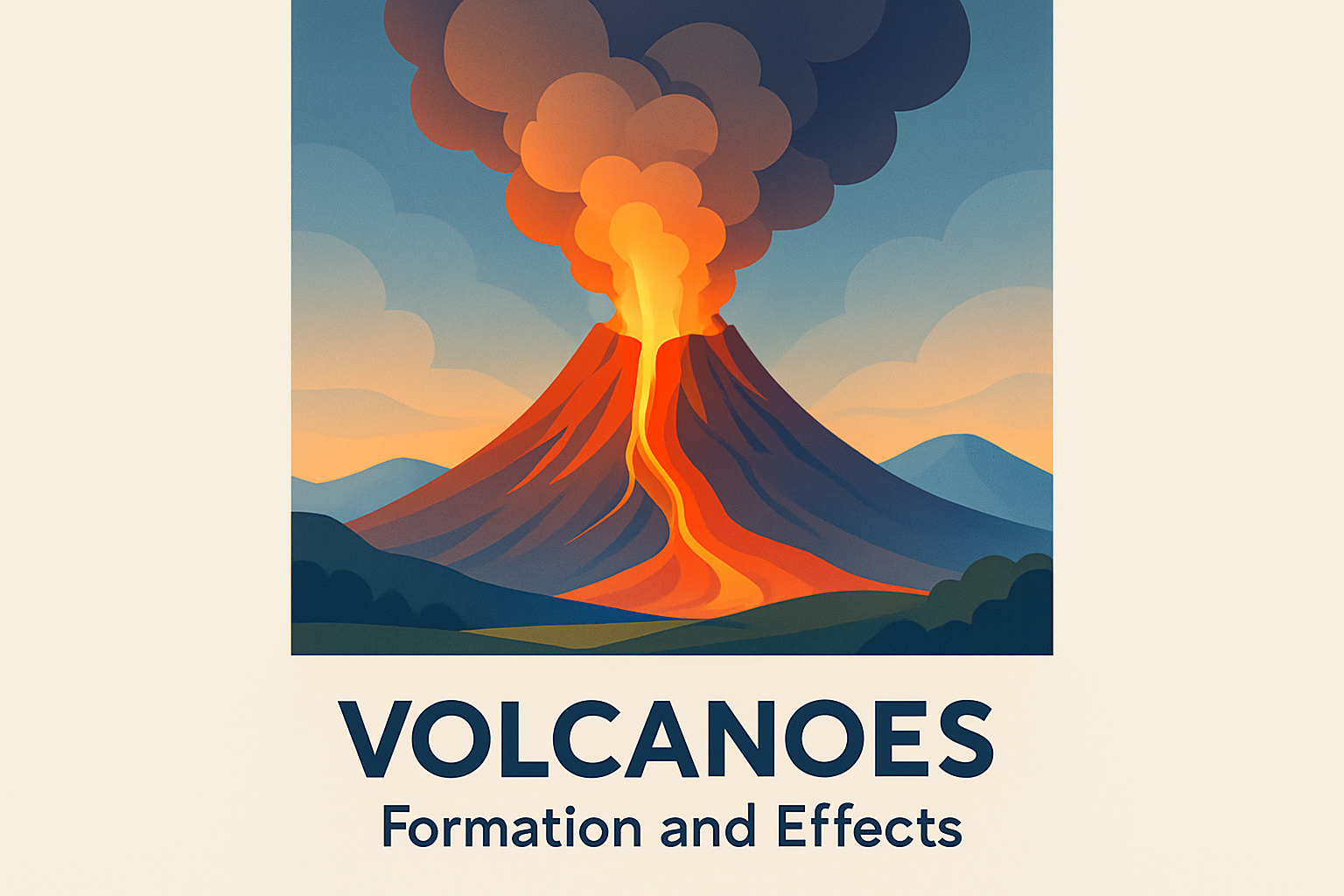
Volcanoes are fascinating natural wonders that have captured the human imagination for centuries. These geological formations result from complex processes occurring deep within the Earth’s crust, leading to the release of magma onto the surface. Understanding the formation and effects of volcanoes is crucial for several reasons, including the safety of populations living near active volcanic regions and the profound impact these natural events have on the global environment.
A volcano forms when there is a rupture in the Earth’s crust through which magma, gases, and ash can escape. This process is driven by the movement of tectonic plates and the intense heat from the Earth’s core. Magma, which is molten rock beneath the Earth’s surface, becomes lava once it erupts. The accumulation of lava, ash, and other volcanic materials can create a variety of volcanic landforms, from towering stratovolcanoes to broad shield volcanoes. The volatile nature of volcanic eruptions can result in a range of effects, from beneficial to catastrophic.
Understanding the dynamics of volcanoes is crucial not only for scientists but also for communities living in their shadow. The ability to predict volcanic eruptions can save lives, while the study of volcanic materials offers insights into Earth’s history and the forces shaping our planet. In this article, we will delve into the formation of volcanoes, explore their diverse types and effects, and highlight the interplay between these magnificent geological features and human society.
Volcano Formation: The Forces at Play
The formation of volcanoes is deeply connected to the movements and interactions of tectonic plates. Tectonic plates are massive slabs of the Earth’s lithosphere that float on the semi-fluid asthenosphere beneath them. The Earth’s lithosphere is broken into several plates, and their interactions at plate boundaries are the primary source of volcanic activity.
The three main types of plate boundaries are divergent, convergent, and transform. Each type plays a unique role in volcanic formation:
- Divergent boundaries: These occur when tectonic plates move apart. As the plates separate, magma rises from the mantle to fill the gap, creating new crust as it cools. This process often occurs along mid-ocean ridges, forming underwater volcanoes.
- Convergent boundaries: These involve plates colliding and one plate being forced beneath the other, a process known as subduction. The subducted plate melts, creating magma that rises to the surface and forms volcanoes. The Pacific Ring of Fire is a prime example of this activity.
- Transform boundaries: At these boundaries, plates slide past one another, causing friction but usually not producing volcanoes. However, complex interactions at these boundaries can contribute to volcanic activity indirectly.
An example of divergent boundary volcanism is the Mid-Atlantic Ridge, where the Eurasian and North American plates are moving apart, leading to volcanic eruptions in Iceland. For convergent boundaries, the Andes Mountains in South America showcase the dramatic results of subduction, where the oceanic Nazca Plate is being subducted beneath the continental South American Plate, leading to the formation of the Andes mountain range and its many volcanoes.
Types of Volcanoes and Their Characteristics
Volcanoes come in various shapes and sizes, and they can be classified into several types based on their morphology and eruption style. The primary volcano types are:
- Stratovolcanoes: Also known as composite volcanoes, these are characterized by steep, conical shapes and are built from alternating layers of lava flows, ash, and volcanic rocks. They are known for their explosive eruptions. An iconic example is Mount St. Helens in the United States.
- Shield volcanoes: These volcanoes have gentle slopes formed by low-viscosity lava that spreads widely. They tend to have effusive eruptions, producing lava flows rather than explosive eruptions. Mauna Loa and Mauna Kea in Hawaii are classic shield volcanoes.
- Cinder cone volcanoes: These are small, steeply sloped volcanoes composed mainly of volcanic ash and tephra. They often form around larger volcanoes. Paricutin in Mexico, which emerged from a farmer’s field without warning in 1943, is a notable example.
The diversity of volcanic forms results from differences in magma composition, eruption style, and tectonic setting. For instance, stratovolcanoes typically arise in subduction zones with explosive eruptions due to high-viscosity magma rich in silica, whereas shield volcanoes with their fluid basaltic lava typically form over hotspots, such as those creating the Hawaiian Islands.
Effects of Volcanic Eruptions
The impact of volcanic eruptions can be both destructive and beneficial, affecting the environment, climate, and human societies in multiple ways. The magnitude of an eruption, its location, and the population density near the volcano all influence the scale and nature of its effects.
Immediate hazards: Volcanic eruptions can pose immediate threats to human life and property. Pyroclastic flows, fast-moving currents of hot gas and volcanic matter, are extremely hazardous and can obliterate everything in their path. The eruption of Mount Vesuvius in 79 AD buried the cities of Pompeii and Herculaneum under ash and pumice, preserving them in time but also providing a grim reminder of the deadly potential of pyroclastic flows.
Long-term environmental impacts: Volcanic eruptions can alter landscapes, create new landforms, and sterilize the soil with lava flows. However, over time, volcanic ash can enrich soil fertility, supporting agriculture. The soils around Mount Pinatubo in the Philippines have benefited from this natural fertilization process since the 1991 eruption.
Climate effects: Volcanic eruptions can influence climate patterns on a global scale, primarily by injecting large quantities of ash and sulfur dioxide into the stratosphere. This can lead to a temporary cooling effect on the Earth’s climate. The eruption of Mount Tambora in 1815 led to the “Year Without a Summer,” causing widespread crop failures and food shortages around the world.
Economic and social impact: Communities living near active volcanoes can face significant economic challenges due to eruption-related disruptions, such as loss of agricultural productivity, damage to infrastructure, and displacement of populations. On the other hand, volcanic regions can become tourist attractions, contributing to local economies. The geothermal features of Yellowstone National Park in the United States draw millions of visitors annually, showcasing the dual nature of volcanoes as both disruptive forces and sources of natural beauty.
Monitoring and Predicting Volcanic Eruptions
Given the significant risks posed by volcanic eruptions, understanding and predicting these events are critical to mitigating their impact. Advances in technology and geoscience have led to the development of sophisticated monitoring systems.
Volcanologists use a range of tools and techniques to monitor volcanoes, including seismographs to detect tremors, satellite imagery to track changes in volcanic terrain, and gas sensors to measure emissions. These data help scientists assess potential eruption scenarios and issue timely warnings.
A prominent example of successful volcanic monitoring is the prediction of the 2010 eruption of Eyjafjallajökull in Iceland. By monitoring seismic activity and measuring ground deformation, scientists were able to provide sufficient warning, minimizing disruptions and ensuring public safety despite the significant impact on air travel across Europe.
In addition to technological advancements, international collaboration plays a crucial role in monitoring volcanoes. Programs like the Global Volcanism Program and the International Association of Volcanology and Chemistry of the Earth’s Interior (IAVCEI) facilitate the sharing of knowledge, data, and best practices among scientists and governments worldwide.
Conclusion
Volcanoes are formidable natural phenomena that remind us of the Earth’s dynamic nature. Through a comprehensive understanding of their formation, types, and effects, humanity can better prepare for and mitigate the risks associated with volcanic activity. This knowledge is invaluable for protecting populations and leveraging the opportunities that volcanic regions offer.
The study of volcanoes not only enhances public safety but also contributes to our broader understanding of the Earth’s processes. Whether through advancements in eruption prediction or the sustainable use of volcanic landscapes, the insights gained from studying these fiery giants hold immense value for society.
As we continue to explore the mysteries of volcanology, readers are encouraged to stay informed about volcanic hazards and support scientific research and conservation efforts. By doing so, we can live more harmoniously with these powerful natural forces and appreciate the beauty and complexity they bring to our world.
Frequently Asked Questions
1. What are the different types of volcanoes, and how do they form?
Volcanoes come in various shapes and sizes, primarily defined by their formation process and eruption style. The main types of volcanoes include shield volcanoes, stratovolcanoes, cinder cone volcanoes, and lava domes. Each type has unique characteristics and forms in distinct geological settings.
Shield Volcanoes: These are large, broad volcanoes with gentle slopes, formed primarily by the eruption of low-viscosity basaltic lava that can travel long distances from the vent. The Hawaiian Islands are classic examples of shield volcanoes. The formation process involves the continuous flow of lava over many eruptions, which eventually builds up a wide, shield-like structure.
Stratovolcanoes: Also known as composite volcanoes, stratovolcanoes are characterized by their steep, conical shape. They form from alternating layers of lava flows, ash, and other volcanic debris. This layered structure results from both explosive and effusive eruptions, which is why stratovolcanoes can be particularly dangerous. Examples include Mount St. Helens and Mount Fuji.
Cinder Cone Volcanoes: These are the simplest type of volcano, built from particles and blobs of congealed lava ejected from a single vent. As the lava is thrown into the air, it breaks into small fragments that cool and fall as cinders around the vent. Cinder cones are usually small, with steep sides, and have a crater at the summit.
Lava Domes: Formed by the slow extrusion of viscous lava, lava domes are small, bulbous masses that often grow within the craters of larger volcanoes. The high viscosity of the lava prevents it from flowing far, causing it to pile up and form a dome. An example of a lava dome is the Novarupta dome in Alaska.
2. What triggers volcanic eruptions?
Volcanic eruptions are triggered by complex processes beneath the Earth’s surface. At the heart of every volcanic eruption is magma, a molten rock stored in magma chambers located several kilometers below the Earth’s crust. Several factors can influence an eruption, making it a highly dynamic process.
Pressure Build-Up: As magma rises from the mantle through cracks in the Earth’s crust, the pressure in the magma chamber increases. This pressure is due to the accumulation of gases and the buoyancy of the magma itself. When the pressure exceeds the strength of the volcanic rock holding it back, an eruption occurs.
Gas Content and Viscosity: The gas content and viscosity of the magma are critical in determining the type of eruption. Magma with high gas content and low viscosity (such as basaltic magma) tends to result in gentle, effusive eruptions, where lava flows steadily from the vent. In contrast, highly viscous magma with a high gas content can lead to explosive eruptions, as the gases are trapped and build up pressure until they violently escape.
External Factors: Sometimes, external factors such as earthquakes, which cause a shift in tectonic plates, can trigger volcanic activity by altering the pressure conditions or opening new pathways for magma to escape.
3. What are some of the environmental impacts of volcanic eruptions?
Volcanic eruptions can have far-reaching impacts on the global environment, influencing climate, ecosystems, and air quality. These impacts can be both beneficial and detrimental, depending on the scale and nature of the eruption.
Climate Change: Large-scale eruptions can inject vast amounts of volcanic gases and particles into the atmosphere, particularly sulfur dioxide, which forms sulfate aerosols. These aerosols reflect sunlight, leading to temporary global cooling. A notable example is the 1991 eruption of Mount Pinatubo, which caused a significant drop in global temperatures.
Impact on Ecosystems: Volcanic eruptions can devastate local ecosystems, destroying habitats with lava flows, ash deposits, and pyroclastic flows. However, volcanic activity also creates new land and provides nutrient-rich soils that support new plant growth and promote biodiversity over time.
Air Quality and Human Health: The release of ash and gases during eruptions can significantly impact air quality, causing respiratory issues for humans and animals. Volcanic ash can also disrupt air travel by damaging aircraft engines and reducing visibility.
4. How can communities near volcanoes prepare for and mitigate eruption risks?
Living near a volcano entails certain risks, but with proper preparation and mitigation strategies, communities can reduce the impact of volcanic eruptions. Here are some measures that can be taken:
Monitoring and Early Warning Systems: Volcanologists use various monitoring techniques, including seismographs, ground deformation measurements, and gas emission analyses, to detect signs of volcanic activity. Establishing early warning systems can alert communities to evacuate or take other protective measures should an eruption be imminent.
Land-Use Planning: Implementing land-use regulations in areas prone to volcanic hazards can minimize risks. This includes restricting development in high-risk zones and designing infrastructure to withstand volcanic events.
Community Education and Preparedness: Educating the public about volcanic risks and emergency procedures enhances community readiness. Regular drills and the distribution of informative materials can help ensure that people know what to do before, during, and after an eruption.
Emergency Response Plans: Developing and maintaining comprehensive emergency response plans tailored to specific volcanic hazards can facilitate a more organized and effective response. These plans should involve coordination between local authorities, disaster response teams, and the community.
5. Why is it important to study and understand volcanoes?
Understanding volcanoes is essential for multiple reasons, ranging from ensuring public safety to advancing scientific knowledge about the Earth. Here, we explore some critical reasons why the study of volcanoes is vital:
Public Safety: Studying volcanoes allows scientists to develop accurate monitoring systems and predictive models that can forecast eruptions, enabling communities to prepare and evacuate if necessary, thereby saving lives and reducing property damage.
Scientific Research: Volcanoes provide a window into the Earth’s internal processes, helping scientists understand geological phenomena, such as plate tectonics and crust formation. This knowledge is invaluable for comprehending the planet’s history and predicting future geological activity.
Environmental Impact Studies: By studying volcanic activity and its effects, researchers can better understand how these natural events influence the climate, biodiversity, and atmospheric conditions, helping to develop strategies to mitigate potential threats.
Sustainable Resource Management: Volcanoes are sources of critical minerals and geothermal energy. Understanding their formation and activity can enhance the sustainable management and extraction of these resources, benefiting local economies and reducing reliance on fossil fuels.