
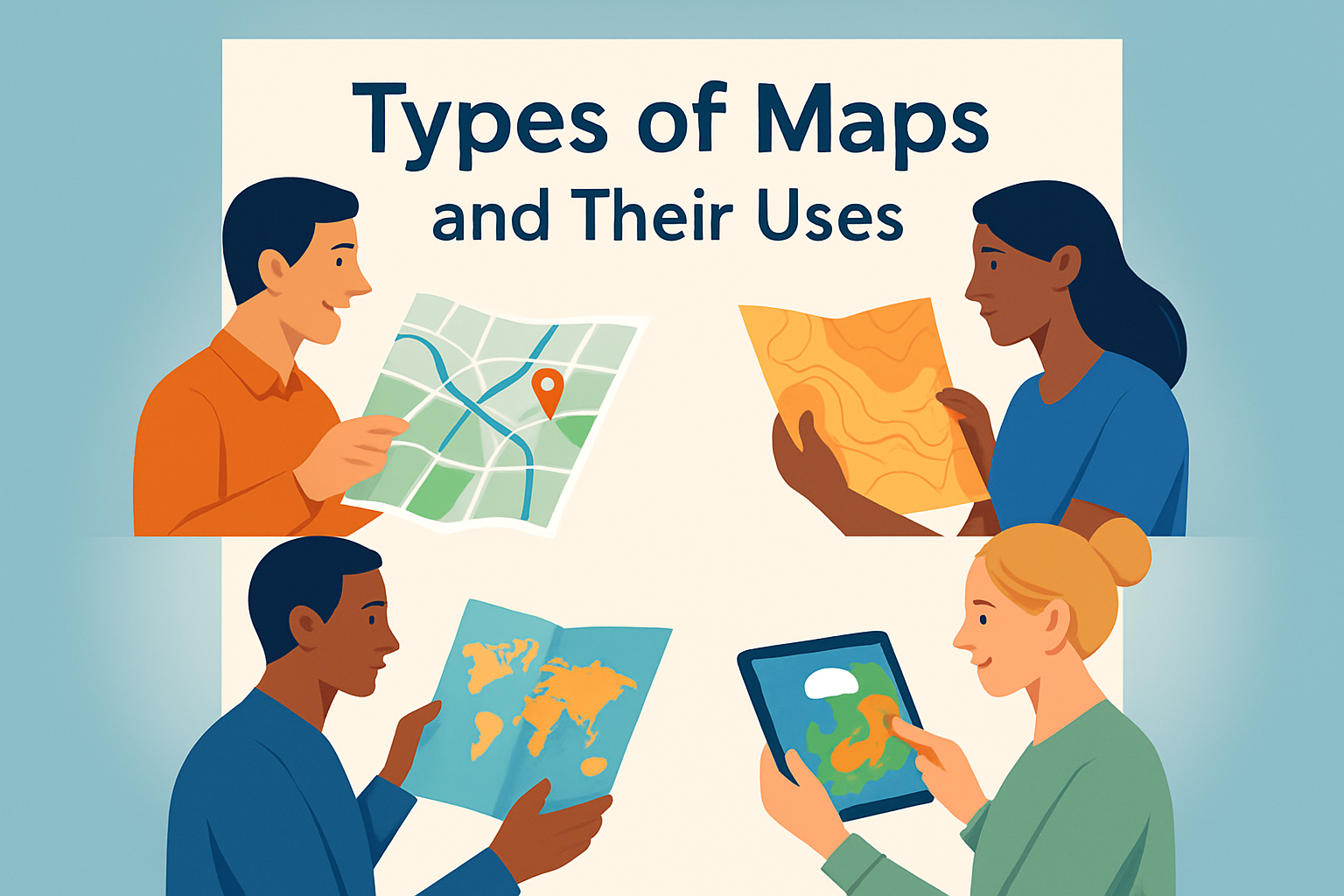
Introduction to Maps and Their Importance
Maps are more than just representatives of the world around us; they are vital tools that help us understand, navigate, and interact with our environment. At their core, maps are graphical representations of geographical features on a two-dimensional surface. The elements depicted on a map can range from physical landscapes, such as mountains and rivers, to constructed elements like roads and city grids.
Understanding different types of maps and their uses is essential for anyone looking to comprehend both large-scale geography and intricate local environments. Maps serve various practical purposes: from aiding daily navigation and planning travel routes to conducting scientific research and assisting in decision-making processes. With the proliferation of digital technology, maps have become more accessible and versatile, offering real-time data and interactive elements. This makes understanding the diverse types of maps available even more crucial.
The significance of maps is evident in fields such as urban planning, environmental conservation, emergency management, and even in our everyday lives through GPS navigation systems. As our world becomes increasingly complex, maps provide clarity, offering a means to visualize and interpret complex data effectively. In this article, we will delve into the various types of maps, exploring their unique features and applications, and ultimately uncovering why maps remain a cornerstone of geographical understanding.
Physical Maps: Depicting Natural Landscapes
Physical maps primarily showcase the physical features of an area. These maps highlight the topography, such as mountains, valleys, plains, and bodies of water. They use color gradients to represent elevation levels, making it easy for users to identify the varying heights of landforms.
For instance, the color green might denote lowlands, while browns and whites are used to signify higher elevations and snow-capped peaks, respectively. An example of a physical map’s application is in education, where students can glean insight into the contours and natural features of continents and countries, providing them a foundation in geography.
Physical maps are essential for hikers and outdoor enthusiasts, as they reveal the terrain’s elevation changes. This assists in planning trails and understanding the physical challenges one might face on a journey. Furthermore, such maps are pivotal in environmental studies for assessing watershed areas and understanding ecological zones.
Political Maps: Highlighting Human Boundaries
Political maps focus on state and national boundaries, emphasizing how humans have divided the world. They delineate countries, states, cities, and other man-made divisions, using different colors to separate distinct areas for better visibility and comprehension.
For example, a political map of the United States differentiates each state with a unique color, marked with the names of state capitals and other significant cities. These maps are crucial for educational purposes, helping students learn about political geography and the organization of human societies.
In terms of practical applications, political maps are valuable for travelers and geopolitics analysts alike. Individuals planning a trip can use political maps to understand the boundaries they would cross, while analysts use them to study geopolitical relations, conflicts, and alliances.
Thematic Maps: Visualizing Specific Data Themes
Thematic maps are specialized maps that focus on a particular theme or subject matter. They utilize various visual indicators, such as colors, symbols, and lines, to represent specific data points. Thematic maps can cover an extensive range of topics, from climate patterns and population density to economic activities and health statistics.
An example of a thematic map is a resource distribution map, which might depict where specific minerals are found globally. This kind of map is crucial for industries like mining, as it enables companies to pinpoint resource-rich locations efficiently. Another example could be epidemiological maps used during health crises, such as the COVID-19 pandemic, which track virus spread patterns and contagion rates.
The true value of thematic maps lies in their ability to simplify complex datasets, making intricate information accessible and understandable to a broader audience. They serve as essential tools for decision-makers in fields such as urban planning, public health, and environmental conservation.
Topographic Maps: Detailed Land Features
Topographic maps are detailed representations of the earth’s surface, capturing the intricacies of geographical and man-made features. Unlike simple maps, topographic maps utilize contour lines to convey elevation and terrain shape. These contour lines are closely spaced in areas of steep elevation and spaced out in flatter regions, providing an articulate depiction of the landscape’s variation.
Topographic maps are often used by geologists, engineers, and land surveyors for activities such as assessing land development and plotting environmental research. For hikers and outdoor adventurers, these maps offer a granular view of paths, trails, and natural obstacles, essential for navigating unfamiliar terrain.
For instance, a topography map of a national park can help park management in planning infrastructure development while minimizing environmental impact. These maps are vital not just for their detail but also for their ability to be layered with other data sets, enhancing their utility in various applications.
Digital Maps: The Modern Fusion of Technology and Geography
With the advent of technology, digital maps have transformed traditional mapping experiences by integrating real-time data and interactive features. Unlike static maps, digital maps are dynamic and can update in real-time, providing users with current information. These maps are accessed through devices like computers, smartphones, and GPS units.
Google Maps exemplifies a popular digital map application, widely used for transportation and navigation. It offers users live traffic updates, alternative routes, and even the ability to view street-level images through Street View. Another practical application of digital mapping is in logistics and delivery services, where companies use digital maps to monitor fleet locations and optimize delivery routes.
Digital maps have also revolutionized urban planning, allowing planners to visualize urban growth, plan developments, and even simulate future cityscapes. The integration of data layers in digital maps means they are utilized in weather forecasting, emergency response, and environmental monitoring, making them indispensable in contemporary society.
Climate Maps: Understanding Weather Patterns
Climate maps focus on representing the different climatic zones and weather patterns across regions. They utilize color codes to denote variations in temperature, precipitation levels, and wind patterns, helping users to understand how climate conditions vary geographically.
An example of a climate map is one showing the average yearly rainfall in South America, which helps farmers in planning crop production based on expected rainfall. Similarly, global climate maps are essential for climatologists studying the broader impact of climate change, offering insights into shifting patterns and emerging environmental challenges.
These maps are not only instrumental in geographical and environmental courses but are also pivotal in policy development, aiding governments in crafting strategies to mitigate climate change effects.
| Type of Map | Main Focus | Primary Users |
|---|---|---|
| Physical Map | Natural landscapes, topographical details | Educators, environmentalists, hikers |
| Political Map | Human-made boundaries and divisions | Students, travelers, analysts |
| Thematic Map | Specific data themes such as economics and health | Researchers, policymakers |
| Topographic Map | Detailed land elevation and feature specifics | Geologists, engineers, adventurers |
| Digital Map | Real-time data and geographical interactivity | General public, businesses, urban planners |
| Climate Map | Weather patterns and climatic zones | Climatologists, farmers, policymakers |
Conclusion and Next Steps
Maps have evolved significantly over the centuries, transforming from simple drawings to complex digital interfaces. Whether you’re a student exploring geography, a policy maker assessing environmental challenges, or simply someone trying to find your way in a new city, maps serve an indispensable function in providing clarity and direction.
Understanding the different types of maps available and their distinct uses empowers individuals and organizations to make informed decisions. From planning eco-friendly urban developments to predicting weather patterns and researching geopolitical shifts, maps are an essential tool in both personal and professional spheres.
As you continue to interact with maps in various capacities, consider how different types can provide alternate perspectives and insights. Whether engaging with digital tools or traditional paper maps, each serves its unique purpose. The next step is to apply this understanding in everyday tasks, appreciating the nuanced details and guides these seemingly simple tools provide. Utilize your newfound knowledge of maps to enhance your navigational and decision-making capabilities, and observe how the world map influences your environment and interactions.
Frequently Asked Questions
1. What are the different types of maps and what are they used for?
Maps come in a wide variety, each serving unique purposes. Some of the most common types include:
1. Physical Maps: These maps focus on the geography of the area and will often have shaded relief to show mountains and valleys. They’re useful for understanding the terrain of a region and preparing for activities like hiking or environmental research.
2. Political Maps: These emphasize state and national boundaries, as well as the locations of cities. They’re essential in educational settings and for understanding geopolitical relationships.
3. Topographic Maps: Showing contour lines to depict elevation changes, these maps help hikers and engineers understand a landscape’s topography. They are crucial in planning construction projects and outdoor adventures.
4. Climatic Maps: These illustrate the climatic zones of an area. They’re vital for agriculture, planning travel, and understanding regional weather patterns.
5. Economic or Resource Maps: Displaying the particular types of economic activities or natural resources present in an area, these maps assist in analyzing economic trends, potential investment locations, and the geographic distribution of resources.
6. Road Maps: Designed primarily for navigation, these show important roads, highways, and routes. They’re indispensable for travelers and delivery services.
Each type of map provides a distinct perspective of the world, tailored to the needs of its users, helping us interpret the vast array of information about our planet efficiently.
2. How do physical maps differ from political maps?
The primary distinction between physical and political maps lies in the type of information each presents. Physical maps focus on the natural features of the earth. They display mountains, rivers, lakes, and valleys, often with varied color schemes or relief shading to highlight differing elevations and terrain types.
On the other hand, political maps are all about boundaries and cities. They emphasize territorial limits such as national and state borders and highlight major cities, capitals, and sometimes even towns. While physical maps might be preferred for planning outdoor activities or for educational purposes to understand geography better, political maps are best suited for understanding the governance and administrative divisions of spaces on the earth’s surface.
3. What are topographic maps, and when are they used?
Topographic maps are absolutely fascinating! They are designed to represent the three-dimensional features of a terrain on a two-dimensional plane. The hallmark of these maps is contour lines, which connect points of equal elevation. The spacing between these lines can tell you how steep or gentle the slopes of the landscape are: close lines mean steep terrain, while widely spaced lines indicate a gentle slope.
Topographic maps serve a variety of purposes. They’re used by hikers to navigate trail systems and by civil engineers planning construction projects that require detailed land assessment. Surveyors use these maps for land planning, and outdoor enthusiasts rely on them to find the best routes for exploring natural landscapes. In essence, they’re critical for any context where a detailed understanding of a region’s physical topography is necessary.
4. Why are economic or resource maps important?
Eliciting insights from economic or resource maps brings us closer to comprehending how wealth and resources are distributed across the globe. These maps are curated to showcase the economic activities predominant in a region or the distribution of natural resources like minerals, forests, and areas suitable for agriculture or fishing.
The impacts of these maps are multiple: they are tools for economists to analyze regional economic strengths and weaknesses. Investors might scrutinize these maps to identify potential sites for business expansion. Meanwhile, governments and agencies use them to plan development strategies or to make decisions regarding resource management. They give us a geographical lens on economies, helping to strategize everything from local to international levels in socio-economic planning.
5. How have digital technologies impacted the use and creation of maps?
The advent of digital technologies has revolutionized the ways we create and use maps. Gone are the days when maps were solely paper-based; now, digital mapping technology allows users to interact with dynamic maps on their devices, offering real-time navigation and up-to-date information. Think Google Maps—a digital revolution in its own right!
Digital maps enable users to access a globe’s worth of geographic data instantly, benefiting industries from logistics (with route optimization) to urban planning (with detailed demographic overlays). Furthermore, Geographic Information Systems (GIS) have broken new ground, offering the ability to layer diverse datasets for comprehensive spatial analysis, environmental monitoring, and decision-making in government and NGO contexts.
In essence, digital technologies have not only enhanced the accuracy and accessibility of geographic information but have also transformed maps into interactive tools that are integral to modern life and industries worldwide.