
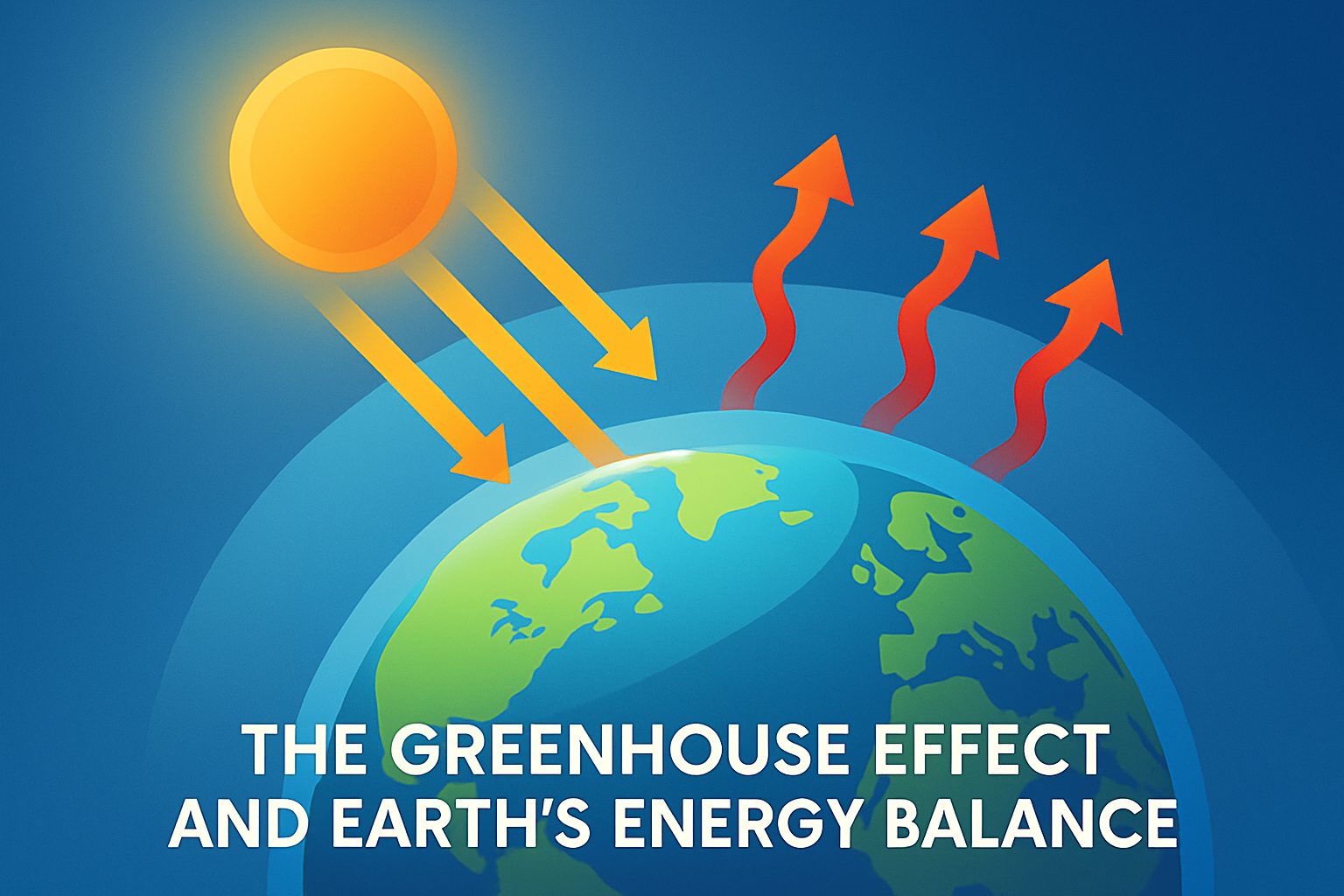
The greenhouse effect is a vital climatic phenomenon that plays a crucial role in sustaining life on Earth. This process involves the trapping of heat in the Earth’s atmosphere, which is essential for maintaining the planet’s energy balance and keeping surface temperatures at a level conducive to life. The Earth’s energy balance is a state of equilibrium between the energy that Earth receives from the sun and the energy it radiates back into space. It is the greenhouse effect that ensures the warmth necessary for life as we know it. When certain gases in the Earth’s atmosphere trap solar energy, it creates a warming effect, akin to the way a greenhouse retains heat. This effect matters significantly as it regulates our planet’s climate, influences weather patterns, and supports diverse ecosystems. As greenhouse gas concentrations change due to human activities, understanding the greenhouse effect and energy balance becomes critical, as it directly impacts climate change, global temperatures, and, ultimately, the survival of numerous species, including humans.
The Mechanism of the Greenhouse Effect
The greenhouse effect begins with solar energy reaching the Earth’s atmosphere. Approximately 30% of this energy is reflected back into space by clouds, atmospheric particles, and bright surfaces like ice and snow. The remaining 70% is absorbed by the Earth’s surface and atmosphere, warming the planet. As Earth’s surface absorbs these rays, it emits energy in the form of infrared radiation. Certain gases in the atmosphere absorb this radiation and re-radiate heat back toward the Earth’s surface, thus warming it.
These gases, known as greenhouse gases, include carbon dioxide (CO2), methane (CH4), nitrous oxide (N2O), and water vapor (H2O). Water vapor is the most abundant greenhouse gas, but its levels are predominantly controlled by natural processes. Carbon dioxide, although present in smaller amounts, is critically important due to human activities that significantly increase its concentration. A real-world example would be the burning of fossil fuels for energy, which releases large quantities of CO2 into the atmosphere. This process leads to increased warming of the climate system, illustrating how anthropogenic actions can amplify the natural greenhouse effect.
Impact of Human Activities on Greenhouse Gases
Over the last couple of centuries, human activities have altered the natural greenhouse effect, contributing to a new phenomenon known as anthropogenic global warming. The Industrial Revolution marked the beginning of significant increases in the atmospheric concentration of greenhouse gases due to the extensive burning of fossil fuels, deforestation, and industrial processes. The alarming rise in greenhouse gas emissions has been a major driver of the rapid changes observed in Earth’s climate.
For instance, industrial processes release CO2, methane emissions arise from agriculture, particularly rice farming and cattle digestion, and nitrous oxide emissions occur through the use of fertilizers in agriculture. According to the Intergovernmental Panel on Climate Change (IPCC), these human activities have contributed to a 1°C increase in global temperatures since pre-industrial levels. Such warming leads to visible impacts such as melting ice caps, rising sea levels, and an increase in extreme weather events.
Greenhouse Gases and Earth’s Energy Balance
The concept of Earth’s energy balance is foundational to comprehending climatic stability. This balance refers to the equilibrium between incoming energy from the sun and outgoing energy from the Earth. When this balance is upset, the Earth’s climate system adjusts in ways that influence global temperatures and weather patterns. Greenhouse gases play an instrumental role in this balance.
The measure of how energy is distributed and re-radiated in the atmosphere is complex and involves multiple feedback mechanisms. For example, as temperatures rise, the capacity of the atmosphere to hold water vapor increases, which can amplify the greenhouse effect since water vapor itself is a potent greenhouse gas. This feedback loop can lead to enhanced warming, which disrupts the energy balance further. An illustration of this concept in real-life can be found in the Arctic region, where warming is occurring at about twice the global average rate due to feedback loops like the melting of ice, reducing surface reflectivity and leading to more heat absorption.
Mitigation and Adaptation Strategies
Recognizing the profound impacts of the greenhouse effect on Earth’s climate system, there are global efforts focused on mitigating these effects and adapting to their consequences. Mitigation strategies center around reducing greenhouse gas emissions and enhancing carbon sinks to temper warming, while adaptation strategies focus on adjusting societal and ecological systems to reduce vulnerability to climatic changes.
For example, transitioning to renewable energy sources such as wind, solar, and hydroelectric power can significantly reduce CO2 emissions. Additionally, reforestation and afforestation projects help in increasing carbon sinks. On the adaptation front, initiatives include building resilient infrastructure, especially in coastal areas prone to sea-level rise, and modifying agricultural practices to maintain food security in changing climates.
| Strategy Type | Examples |
|---|---|
| Mitigation | Renewable energy, reforestation, carbon capture technologies |
| Adaptation | Infrastructure resilience, agricultural adjustments, disaster risk management |
The Role of Policy and International Agreements
The global nature of climate change necessitates international cooperation. Several major agreements and policies guide nations toward sustainable environmental practices. The Paris Agreement, adopted under the United Nations Framework Convention on Climate Change (UNFCCC), is one such pivotal treaty, aiming to limit global warming to well below 2°C above pre-industrial levels.
Policy frameworks, both international and domestic, are crucial in setting targets for emissions reductions and providing a roadmap for countries to achieve sustainability goals. An example of such policy impact can be seen in the European Union, where regulations have resulted in significant reductions in greenhouse gas emissions over the past decades. These frameworks encourage investment in green technologies and promote shifts towards a low-carbon economy.
Consequences of Ignoring the Greenhouse Effect
The failure to address the imbalance caused by enhanced greenhouse effects presents severe consequences. As Earth continues to warm, ecosystems face drastic changes. Coral bleaching, detriments to biodiversity, and threats to food security due to extreme weather conditions are some direct outcomes of increased warming.
If left unchecked, the socioeconomic impacts could be catastrophic. Coastal cities could face unprecedented challenges due to rising sea levels and increased flooding, impacting millions of people. Food and water scarcity could lead to conflict and displacement, highlighting the urgent need for understanding and tackling the greenhouse effect.
Conclusion: The Path Forward
In conclusion, the greenhouse effect, while natural, is a fundamental driver of climate systems crucial for maintaining life on Earth. The intensification of this effect due to human activity challenges the stability of the Earth’s energy balance, leading to global climate disruptions. Understanding the mechanisms that drive the greenhouse effect and implementing strategies towards mitigation and adaptation are vital. By leveraging scientific understanding, technology, and international collaboration, societies can work towards stabilizing climate impacts. The continued exploration of sustainable practices and reduction in greenhouse gas emissions holds the promise of restoring ecological balance. We all have a role to play, whether in influencing policy, adopting sustainable practices, or simply becoming more informed. It begins with understanding the science beyond the greenhouse effect and taking deliberate steps toward a more sustainable, balanced planet.
As we navigate this urgent issue, it is imperative to remain informed and proactive in our approach, advocating for comprehensive policies and practices that promote sustainability and reduce environmental impact. The time to act is now, to ensure a harmonious balance for future generations. Let’s commit to this cause and make informed choices in our daily lives that contribute to a healthier planet.
Take action today: Support initiatives that aim to lower greenhouse gas emissions, engage with local and global climate efforts, and stay educated on the pressing climate issues of our time.
Frequently Asked Questions
1. What is the Greenhouse Effect and why is it important for Earth?
The greenhouse effect is a fundamental and natural climate phenomenon that is crucial for sustaining life on our planet. In essence, it involves the process where certain gases in Earth’s atmosphere trap heat, preventing it from escaping back into space. This trapping of heat helps maintain Earth’s temperature at a level that is comfortable enough for ecosystems to thrive and for human activities to continue productively. Without the greenhouse effect, our planet would be an inhospitably cold place, as the average temperature would drop by about 33 degrees Celsius. Think of it like a thermal blanket surrounding the Earth—without it, the temperatures would plummet dramatically, leading to a frozen world. The most critical gases responsible for the greenhouse effect include water vapor, carbon dioxide, methane, nitrous oxide, and ozone. By absorbing and emitting infrared radiation, these gases help keep the surface warm enough to support forests, oceans, and the diverse life forms we see today. The balance they help maintain is essential for maintaining the Earth’s energy balance, which is a state of equilibrium between the incoming energy from the sun and the outgoing energy radiating back to space.
2. How does Earth’s Energy Balance work in relation to the Greenhouse Effect?
Earth’s energy balance is a finely tuned system representing the equilibrium between the energy Earth receives from the sun and the energy it radiates back into space. To break it down: the sun radiates energy, which travels across the vastness of space and hits the Earth. This incoming solar energy is mostly in the form of shortwave radiation, including visible light. The Earth absorbs some of this energy, which warms the planet, while the rest is reflected back to space. The absorbed energy is eventually released back into the atmosphere as infrared radiation, which is longer-wave than the incoming solar energy. This is where the greenhouse effect steps in. Greenhouse gases like carbon dioxide and methane absorb this infrared radiation, trapping the heat in the atmosphere and warming the planet. It’s a delicate balance—too much trapping of heat can lead to global warming, while too little would result in a severe drop in temperatures. Human activities, such as burning fossil fuels and deforestation, have increased the concentration of greenhouse gases, causing more heat to be trapped and disrupting this energy balance, contributing to climate changes. This highlights the interconnectedness of the Earth’s systems and demonstrates just how sensitive our planet is to variations in atmospheric composition.
3. What are the main gases responsible for the Greenhouse Effect?
The effectiveness of the greenhouse effect hinges on the presence of specific gases, aptly named greenhouse gases, in Earth’s atmosphere. Among the most significant are water vapor, carbon dioxide (CO2), methane (CH4), nitrous oxide (N2O), and ozone (O3). Each of these gases contributes to the greenhouse effect but does so with varying potency. Water vapor is the most abundant greenhouse gas and plays a vital role in the greenhouse effect through its ability to absorb a wide range of wavelengths of infrared radiation. Carbon dioxide, although less potent on a molecule-per-molecule basis compared to other gases like methane, is significant due to the sheer quantity present in the atmosphere and its long lifespan. Methane is far more effective at trapping heat than CO2 but is present in smaller amounts. Nitrous oxide, although found in relatively low concentrations, is notable for its high global warming potential. Ozone in the lower atmosphere also functions as a greenhouse gas. It’s crucial to understand these gases work synergistically to create the conditions necessary for sustaining life by ensuring our planet remains warm enough. Human activities have significantly increased the concentrations of some of these gases, adding to the natural greenhouse effect and impacting the Earth’s energy balance.
4. What role does human activity play in altering the Greenhouse Effect and Earth’s Energy Balance?
Human activities have become a major force in altering the natural greenhouse effect and Earth’s energy balance. While the greenhouse effect itself is a natural process necessary for life, industrial advancements and agricultural practices have magnified its effects. The most prominent activities contributing to this enhancement include burning fossil fuels such as coal, oil, and natural gas for energy and transportation. These actions release large amounts of carbon dioxide and methane into the atmosphere, increasing their concentrations far beyond natural levels. Deforestation also plays a significant role by reducing the number of trees that can absorb CO2, further escalating its presence in the atmosphere. Moreover, industrial processes release nitrous oxide and other pollutants that act as potent greenhouse gases. The result is an accelerated greenhouse effect, leading to more heat being trapped and consequently raising Earth’s average temperatures, a phenomenon known as global warming. This warming disturbs the Earth’s energy balance, disrupting climate patterns and leading to severe environmental impacts such as more intense and frequent extreme weather events, rises in sea levels, and shifts in ecosystems. The evidence is becoming increasingly clear that human influence is the dominant cause of the observed warming since the mid-20th century, calling for urgent action to mitigate these changes.
5. What actions can be taken to mitigate the negative impacts of an enhanced Greenhouse Effect?
Addressing the challenges posed by an enhanced greenhouse effect requires a combination of strategies at individual, community, national, and global levels. The key is to reduce the emission of greenhouse gases and enhance the Earth’s natural ability to sequester carbon. Transitioning to renewable energy sources, such as wind, solar, and hydroelectric power, can significantly reduce the dependence on fossil fuels. Additionally, increasing energy efficiency in homes, buildings, and transportation can lower energy consumption, directly impacting emissions. Reforestation and afforestation efforts can help absorb carbon dioxide from the atmosphere, maintaining the natural balance of gases. Policies that encourage sustainable agricultural practices and industrial processes are also crucial in reducing methane and nitrous oxide emissions. On a personal level, adopting greener lifestyle choices, such as using public transportation, reducing wastage, recycling materials, and supporting sustainable initiatives, can contribute to broader environmental goals. International agreements, like the Paris Agreement, play a pivotal role in unifying countries towards a common objective to limit global temperature rises by setting targets for emission reducers. It’s essential to adopt a holistic approach where science, innovation, policy, and behavior change intersect to create the necessary conditions to stabilize the climate for future generations. Achieving this will require concerted effort across all sectors of society to transform the way energy is produced and consumed, ultimately ensuring a healthier planet for all.