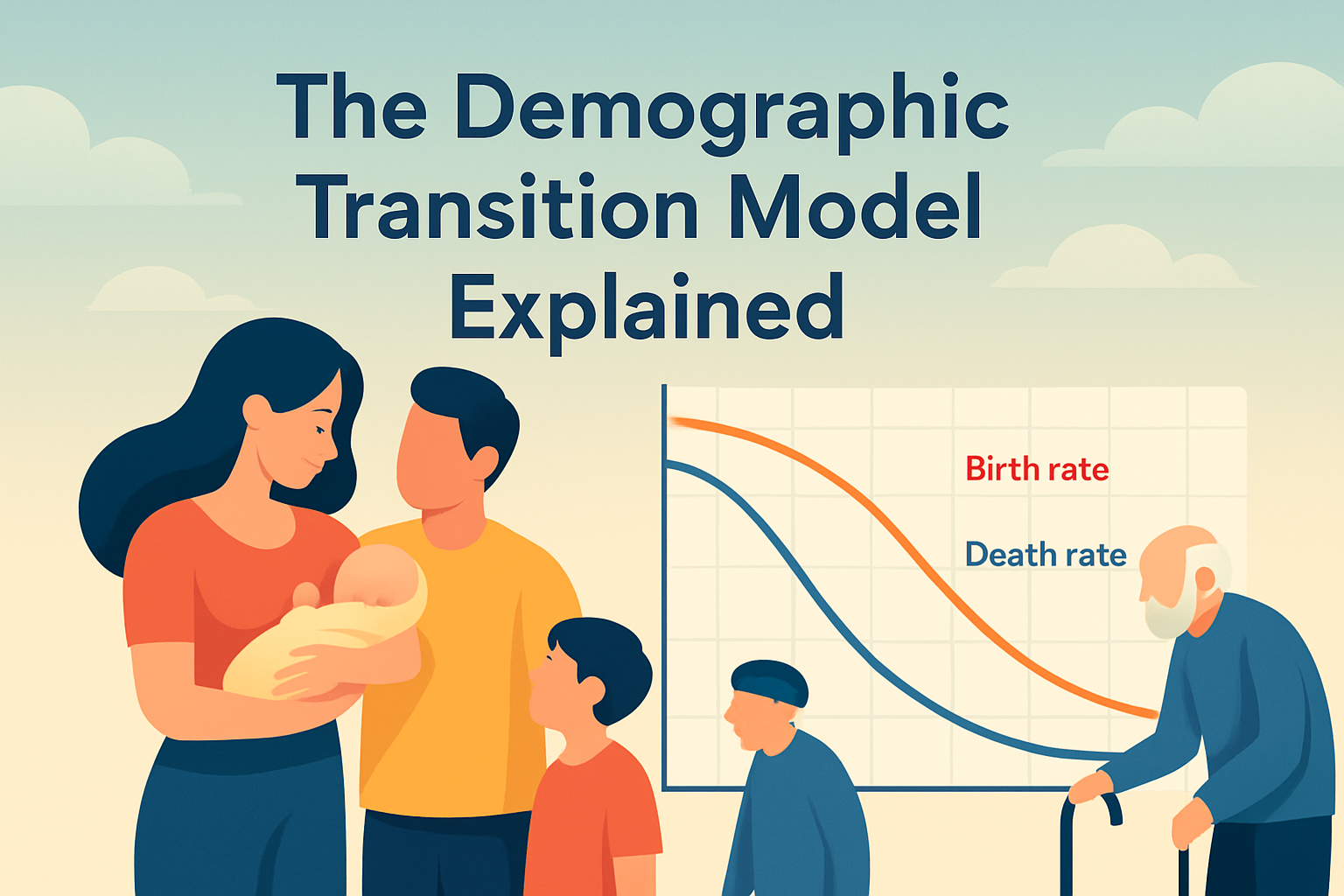
The Demographic Transition Model (DTM) is a cornerstone concept in population studies and geography, illustrating how countries transition through distinct phases as they develop economically and socially. Understanding the DTM is crucial because it potentially forecasts shifts in population growth and helps policymakers, economists, demographers, and environmental scientists plan for and address challenges related to population changes. At its core, DTM is about understanding the correlation between birth and death rates and how these evolve as a nation progresses from a pre-industrial to an industrialized economy.
Introduced in the late 20th century, the model offers a framework to examine historical population trends and predict future changes by categorizing the transition into different stages. Familiarity with DTM aids in addressing global phenomena like urbanization, industrialization, and public health improvements, providing insights into societal transformations. As we delve into this model, you’ll gain a comprehensive understanding of its stages, its relevance, and how it applies to real-world scenarios.
Understanding the Stages of the Demographic Transition Model
The Demographic Transition Model is typically divided into five distinct stages, although some simplified versions might only highlight four. Each stage represents a specific phase in demographic evolution—centered on birth rates, death rates, and overall population growth. Understanding these stages is vital for grasping how societal shifts impact population dynamics over time.
Stage 1: High Fluctuating
In this initial stage, characterized by high birth and death rates, population growth is negligible. This period corresponds to pre-industrial societies where economies are primarily agrarian, public health technologies are rudimentary, and high infant mortality rates are prevalent. Populations remain stable due to a balance between births and deaths.
An example of a society in this phase could be parts of modern-day isolated tribes, far removed from contemporary technological and medical advancements. Such communities rely heavily on subsistence farming and traditional lifestyles, maintaining high birth rates to offset the equally high death rates.
Stage 2: Early Expanding
During stage two, death rates begin to decline significantly due to advances in medical care, sanitation, and food supplies. However, birth rates remain high, resulting in a rapid population increase. This stage is often associated with developing countries experiencing health and technological improvements but still retaining traditional cultural practices that favor large families.
Many countries in sub-Saharan Africa can be categorized within this stage. For instance, countries like Niger have experienced reductions in mortality due to NGOs and governmental organizations support, thus noticing a substantial rise in population. Such changes highlight the impact of improved health infrastructure and food security on population growth.
Stage 3: Late Expanding
In the third stage, birth rates start to decline, following the decrease in death rates. This change is attributed to a societal shift towards urban living, improved education, and employment opportunities, particularly for women, which often lead to later marriages and smaller family sizes. Population growth slows significantly as families have fewer children.
Countries like India and Mexico exemplify this stage as they undergo economic development, resulting in urbanization and shifts in social norms. These changes illustrate the relationship between economic advancement and demographic shifts, paving the way for more diverse and sustainable population structures.
Stage 4: Low Fluctuating
Stage four is marked by both low birth and death rates, culminating in stable population growth. Society during this phase is typically industrialized, boasting advanced healthcare, widespread education, and robust economic structures. Birth rates tend to fluctuate slightly due to economic conditions, but overall growth remains moderate or stagnant.
Countries such as the United States and Canada are prime examples of nations that have reached this stage. These countries have adopted comprehensive public health strategies and policies to manage population growth and ensure socioeconomic stability.
Stage 5: Declining
Finally, the fifth stage, which some demographers debate, involves a scenario where birth rates fall below death rates, leading to a gradual population decline. Factors like aging populations, increased costs of living, and changing cultural attitudes towards family size contribute to this trend.
Japan uniquely illustrates this stage, with its aging population and declining birth rates leading to various challenges, including labor force shortages and increased social security burdens. This stage urges societies to adapt to potential consequences associated with shrinking populations.
Real-World Applications of the DTM
The Demographic Transition Model serves as an analytical tool for understanding population trends across different regions and forecasting future changes. Its application is multi-faceted, influencing policy-making and providing demographic insights that shape global strategies.
For example, in areas confronted by overpopulation challenges, the DTM helps policymakers understand and address socio-economic factors contributing to high birth and mortality rates. In contrast, countries with aging populations can leverage insights from the model to implement policies supporting sustained economic growth and social security provisions.
| Stage | Birth Rate | Death Rate | Population Growth | Example Countries |
|---|---|---|---|---|
| Stage 1 | High | High | Stable/Slow | Remote Tribes |
| Stage 2 | High | Declining | Rapid Growth | Niger, Uganda |
| Stage 3 | Declining | Low | Slow Growth | India, Mexico |
| Stage 4 | Low | Low | Stable | USA, Canada |
| Stage 5 | Very Low | Low | Declining | Japan, Germany |
The Importance of DTM in Addressing Global Issues
The insights derived from the Demographic Transition Model are indispensable in addressing numerous global challenges, including but not limited to economics, healthcare, and environmental sustainability. Understanding the variability of demographic patterns allows nations to implement tailored policies that address their specific needs related to economic growth, healthcare provision, and sustainable development.
In regions facing exponential population growth, managing resources and ensuring sustainable development becomes crucial to avoid overburdening environmental and economic systems. By employing DTM insights, policymakers can craft strategic responses that encompass family planning initiatives, educational programs, and infrastructure development aimed at stabilizing growth rates.
Conversely, countries with shrinking populations benefit from the DTM by gaining awareness about the necessity of sustainable economic models that can adapt to an aging populace. Migration policies, automation, and innovation in healthcare systems become focal strategies in ensuring that declining birth rates don’t adversely impact economic stability.
Criticisms and Limitations of the DTM
While the Demographic Transition Model offers valuable insights, it is not without its criticisms and limitations. One critique revolves around the model’s Eurocentric bias, as it was based on historical data from Western Europe and may not perfectly apply to all regions. The variability in socio-economic conditions across different cultures and geographies might lead to deviations not accounted for by the DTM.
Moreover, the model’s simplicity does not capture all possible demographic dynamics, such as the effects of migration, governmental policies, and unforeseen technological or medical advancements that might alter demographic trajectories. The model’s linear progression from stage one to five suggests inevitability, which may not be applicable given the rapid and varied changes brought by globalization and technology.
Acknowledging these critiques enables researchers and policymakers to use the DTM cautiously, as a framework rather than a dogmatic tool, continually adapting it to new findings and data sets.
Conclusion: Leveraging the Demographic Transition Model for Future Planning
In conclusion, the Demographic Transition Model provides a foundational understanding of the patterns and changes in population dynamics, reflecting a simplified trajectory from high to low birth and death rates associated with socio-economic development. It serves as a vital tool for predicting demographic changes and addressing global challenges related to population growth.
By comprehending the stages of the DTM and its real-world applications, individuals and policymakers alike are better positioned to forecast and navigate the complexities of population shifts. This understanding enables the crafting of innovative strategies to ensure sustainable development, economic stability, and equitable resource distribution.
The call to action for readers interested in demographic studies is to delve deeper into regional variations and emerging trends that may not fit neatly within the traditional stages of the DTM. Encouraged by a comprehensive understanding, stakeholders are better equipped to actively participate in shaping responsive and forward-thinking policies that cater to their unique demographic realities. In pursuing further reading, engagement with demographic and policy experts offers new perspectives and insights into effectively harnessing the DTM for informed decision-making in an ever-changing global landscape.
Frequently Asked Questions
1. What is the Demographic Transition Model (DTM) and why is it important?
The Demographic Transition Model (DTM) is an essential framework in understanding the dynamics behind population changes over time as countries develop. It describes how population growth rates evolve through five distinct phases, each marked by specific trends and characteristics in birth rates, death rates, and overall population size. At its core, the DTM highlights the dramatic shifts that societies experience as they progress from agrarian to industrialized economies. It is important because it provides a valuable tool for economists, policymakers, demographers, and environmental scientists, enabling them to anticipate changes in population growth, forecast demands on resources, and tailor social and economic policies accordingly. By understanding the phases of the DTM, we gain insights into broader socio-economic transformations and can prepare more effectively for future challenges.
2. What are the key stages of the Demographic Transition Model?
The Demographic Transition Model consists of five primary stages:
Stage 1: Pre-Industrial Stage – This initial phase is characterized by high birth and death rates, resulting in relatively stable and low population growth. Societies in this stage are usually agrarian, with limited medical advancements, meaning that families tend to have more children, both to compensate for high infant mortality rates and to ensure more hands on the farm.
Stage 2: Transitional Stage – Here, death rates begin to decline significantly due to improvements in healthcare, sanitation, and food supply, while birth rates remain high, leading to rapid population growth. This stage often coincides with the beginning of a country’s economic expansion and industrialization.
Stage 3: Industrial Stage – In this phase, birth rates start to fall as societies experience improved education, increased urbanization, and access to contraception, which leads to a slower population growth rate. As economic conditions improve, families choose to have fewer children, recognizing the advantages of investing more resources into the well-being and education of each child.
Stage 4: Post-Industrial Stage – Birth and death rates both stabilize at low levels, leading to zero or even negative population growth. Societies in this stage enjoy higher standards of living and longevity, with access to advanced healthcare and a focus on personal fulfilment and economic contributions over large family sizes.
Stage 5: Possibly Decline – Some scholars argue that a fifth stage occurs where birth rates drop below death rates, resulting in a declining population. This can lead to challenges such as workforce shortages and increased dependency ratios, necessitating policy interventions to manage the potential economic impacts.
3. How does the Demographic Transition Model impact a country’s economic development?
The Demographic Transition Model has a profound impact on economic development. As countries transition from one stage to the next, they often move from a reliance on agrarian economies to more industrialized and eventually service-oriented economies. In the early stages (1 and 2), rapid population growth can lead to challenges such as resource depletion, increased demand for healthcare and education, and pressures on housing and infrastructure. However, it can also supply a young labor force that can catalyze industrial growth and drive economic expansion.
Stage 3 sees a shift towards more balanced growth as reduced birth rates allow for increased investments in education and healthcare, fostering a more skilled workforce. This diversification of the economy leads to higher productivity and innovation. Transitioning to Stage 4, as birth and death rates stabilize, the economy often shifts to focus on advanced technologies and services, with a greater emphasis on individual economic contributions and personal well-being.
In countries experiencing Stage 5, economic concerns may arise due to an aging population and shrinking workforce, prompting initiatives to boost labor force participation, such as encouraging immigration or increasing the retirement age. Throughout the transition, understanding the DTM allows governments and businesses to better plan and implement policies that encourage sustainable development and economic resilience.
4. How do social factors influence the stages of the Demographic Transition Model?
Social factors play a critical role in influencing the progression through the stages of the Demographic Transition Model. In Stage 1, high birth rates are largely influenced by cultural norms favoring large families, partly due to high infant mortality rates and the socio-economic necessity of having more individuals to contribute to agricultural work. As countries move into Stage 2, improvements in healthcare, sanitation, and nutrition lead to decreased mortality rates, often without an immediate adjustment in birth rates, resulting in rapid population growth.
Stage 3 is significantly shaped by social changes, including increased access to education, particularly for women, and widespread availability of contraceptives, enabling families to make deliberate choices about family size. Furthermore, economic advances resulting from industrialization encourage urban living conditions where smaller families are more manageable and economically viable.
In Stage 4, societal norms have fully adjusted to lower birth rates, with people prioritizing career development and personal growth over having large numbers of offspring. Social safety nets and pension systems mitigate economic reliance on offspring, further influencing the trend towards smaller families. In proposed Stage 5 scenarios, continued social support systems and a focus on quality of life, alongside economic incentives to address an aging population, become important social factors for maintaining economic stability.
5. Can the Demographic Transition Model be applied universally to all countries?
While the Demographic Transition Model provides a useful framework for understanding population changes, it is not universally applicable to all countries in the same manner. The model was originally developed based on the historical experiences of Western Europe and other industrialized nations, meaning that while it can offer valuable insights into potential trends in population growth, it does not account for several distinct regional and cultural variables affecting population dynamics.
Many developing nations today face unique economic, environmental, and social challenges that may alter or delay the transitions described by the DTM. Factors such as political instability, pandemics, climate change, or sudden economic shifts can disrupt the expected progression through the stages. For instance, countries in Sub-Saharan Africa may experience prolonged periods of Stage 2 due to persistent health and infrastructure challenges, while others might move faster through the stages due to rapid technological advancements and policy initiatives.
Nevertheless, the DTM remains a cornerstone concept in geography and population studies, providing a general framework that allows for the exploration of population dynamics and their implications for planning and policy-making. It is important to consider the DTM as a flexible guide that demands adaptations to accommodate the diverse experiences and trajectories of individual countries and regions.