
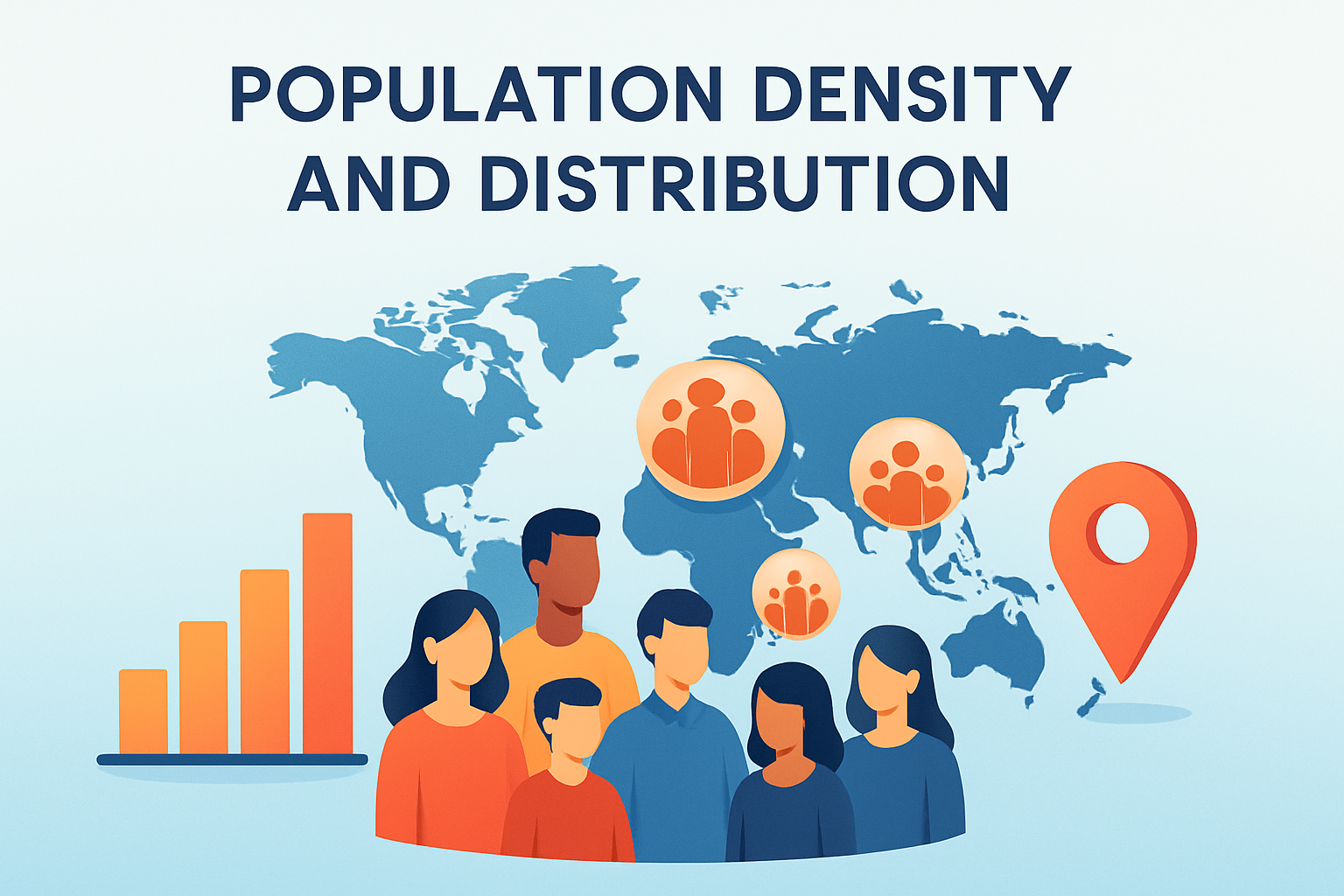
Population density and distribution are critical factors that shape the social, economic, and environmental dynamics of the world. As our global population continues to grow, understanding these concepts becomes increasingly important. Knowing how and where people are spread across the planet helps governments, urban planners, and environmentalists make informed decisions. This article will define key terms, analyze their implications, and illustrate why these concepts are vital for a sustainable future.
Population density refers to the number of people living in a unit area, typically expressed as people per square kilometer or mile. It provides a numerical measure of how crowded or spacious an area may be. On the other hand, population distribution describes the spatial spread of populations across the Earth. While population density gives an average value, population distribution shows the actual arrangement of people, including clusters of high density and sparsely populated areas.
The significance of studying population density and distribution cannot be understated. It influences resource allocation, infrastructure development, urban planning, and environmental protection. Moreover, these concepts help illustrate disparities between wealthy and poorer regions, reveal patterns in housing and land use, and identify areas prone to overpopulation challenges, thus enabling proactive measures to ensure sustainable growth and development.
Factors Influencing Population Density
Population density is influenced by a variety of factors, including geographical, social, economic, and political elements. Favorable geographical conditions, such as fertile land, moderate climate, and access to water, generally attract higher population densities. For example, river valleys like the Nile and Ganges have long supported dense human populations due to their agricultural productivity and water availability.
Socioeconomic factors also play a significant role. Regions with robust economic activities, such as industrial hubs or capital cities, tend to have higher densities as they offer better job opportunities and facilities. Consider New York City, where high population density is driven by financial, commercial, and cultural opportunities.
Political stability and infrastructure, such as transportation and healthcare, further impact population density. Countries with stable governments, such as Japan, and efficient infrastructure see higher densities in urban centers, as people move towards areas offering better living standards.
Patterns of Population Distribution
Population distribution patterns vary worldwide, characterized by clustered, linear, or dispersed arrangements. These patterns result from physical geography as well as historical, economic, and social forces. Clusters often emerge in urban areas where resources and opportunities are concentrated. For instance, the distribution of population in China is highly uneven, with dense populations in cities like Beijing and Shanghai, while regions like Tibet remain sparsely populated.
- Clustered: Seen in cities where resources and infrastructure are centralized. Examples include Los Angeles and Tokyo.
- Linear: Commonly found along transport routes such as roads or rivers, exemplified by settlements along the Nile River.
- Dispersed: Seen in rural or agrarian regions where homes and communities are spread over larger areas, such as rural parts of Australia.
Understanding population distribution aids in addressing urban challenges, like congestion and pollution, while ensuring rural areas aren’t neglected. It shapes public policies on land use, transportation, and economic development.
Impacts of High Population Density
High population density can have significant impacts on an area. It often leads to greater pressure on resources like housing, water, and food. Urban areas with extreme density might face challenges such as housing shortages, increased traffic congestion, and higher environmental pollution. For instance, Mumbai suffers from a high density that strains its housing and sanitation infrastructure.
On the positive side, high density can contribute to economic growth, as it often correlates with increased labor markets and consumer bases, encouraging business investments. A well-known example includes Singapore, where efficient management of a dense population has led to a thriving economy and high standards of living.
Nevertheless, the balance between density and livability is crucial. While density can spur innovation and economic benefits, it demands effective urban planning, social services, and sustainability measures to mitigate possible negative effects.
Challenges of Low Population Density
Areas with low population density face a distinct set of challenges. These regions may struggle with underdeveloped infrastructure, leading to limited access to services like education and healthcare. Economic opportunities can be sparse, resulting in outmigration as residents move to urban areas in search of better prospects.
An example of low population density issues can be seen in parts of Northern Canada, where vast distances and harsh climates make service delivery challenging. Despite rich natural resources, these areas often lack the human resources and infrastructure to fully capitalize on their economic potential.
| Region | Challenge | Strategy |
|---|---|---|
| Northern Canada | Infrastructure development | Government and private sector investments |
| Rural Australia | Outmigration and economic stagnation | Promoting regional tourism and remote work |
Strategies to address low density challenges include government incentives for business investments, improving connectivity through technology, and promoting sectors like tourism to encourage economic diversity and stability.
The Urban-Rural Divide
The urban-rural divide reflects stark differences in population density and distribution, with urban areas facing high density and rural areas experiencing lower density. This divide impacts resource allocation, economic policies, and access to infrastructure and services. Urban centers are characterized by density-driven economies and challenges, while rural areas cope with isolation and limited opportunities.
Brazil offers a clear example of the urban-rural divide. Cities like São Paulo are bustling with economic activity and dense populations, whereas the Amazon basin experiences sparse distribution, with many communities facing challenges in accessibility and service delivery.
Bridging this divide requires comprehensive regional development strategies, investment in rural infrastructure, and policies fostering economic integration between urban and rural areas to ensure balanced growth and reduced disparities.
Conclusion
Understanding population density and distribution is essential in addressing the world’s socio-economic and environmental challenges. These concepts influence urban planning, resource allocation, and the provision of services, playing critical roles in shaping sustainable development strategies. By considering factors like geography, socioeconomics, and infrastructure, we can design more integrated and efficient systems for the future.
The main takeaway is the importance of balancing population density with resource availability and infrastructure capabilities. High density can drive economic vitality but requires careful management to maintain livability, while low density areas need strategic investments to overcome isolation and economic limitations.
As a call to action, individuals, policymakers, and communities must work collaboratively to address the challenges posed by varying population densities and distributions. By investing in education, technology, and sustainable planning, we can ensure equitable growth and enhance the quality of life for all, recognizing that these efforts are crucial for our interconnected world.
Frequently Asked Questions
1. What is Population Density and How is it Measured?
Population density is the measure of the number of people living per unit area, often expressed per square kilometer or mile. It’s a statistical metric that allows us to understand how crowded or sparsely populated an area is. This measure is critical because it helps us assess the strain on resources, infrastructure, and services in any given area.
Technically, population density is calculated by dividing the total population of a place by its land area. For example, if a city has 1,000,000 people living in an area of 500 square kilometers, the population density would be 2,000 people per square kilometer. This number paints a picture of how human activity is distributed and indicates where congestion might occur, where resources might be overtaxed, and where additional services might be necessary. Planners use this data to make decisions about where to build schools, hospitals, roads, and other essential infrastructure. Moreover, geographers and sociologists use density figures to study human migration patterns and urbanization trends.
2. What Factors Affect Population Distribution?
Population distribution refers to the pattern of where people live across the globe. While population density is strictly about numbers, distribution concerns the spread. Numerous factors influence how people are distributed around the planet, and these influences may be natural, economic, or social in nature.
Geographical factors are incredibly significant. Natural resources, climate, and terrain play key roles. Fertile land tends to support more people, while harsh climates like deserts and polar regions have sparse populations. Availability of water is a crucial determinant – rivers like the Nile and the Ganges have historically supported dense populations due to their capability to sustain agriculture.
Economic, historical, and political factors also come into play. Economic opportunities draw people in, resulting in densely populated urban areas. Historical trade routes and colonial activities have, over time, affected distribution patterns. Government policies, like the one-child policy of China or encouraging rural resettlement, also impact where people choose to live.
3. How Does Population Density Affect Urban Planning?
Urban planning is deeply intertwined with population density. As populations grow, urban planners face the challenge of accommodating more residents into cities and towns in sustainable and efficient ways. High-density areas require careful planning to prevent issues like traffic congestion, pollution, overcrowding, and insufficient public services.
In high density areas, planners often focus on vertical expansion, i.e., high-rise apartments and complexes, to maximize the use of limited land. They also emphasize efficient public transportation systems to minimize traffic congestion and reduce carbon footprints. Facilities are strategically located to serve the maximum number of people, and green spaces are carefully integrated to maintain a balance between urban living and the natural environment.
In contrast, low-density areas might face issues like urban sprawl, where the spread of urban developments over large areas results in inefficiencies in transport and service delivery. Here, the challenge lies in maintaining connectivity and ensuring accessibility to essential services across longer distances.
4. Why is Understanding Population Density Important for Environmental Policies?
Population density directly impacts environmental sustainability. High-density populations often lead to increased pollution, waste generation, and resource depletion, posing challenges to environmental management. Understanding density helps formulate policies that mitigate these impacts and promote sustainable practices.
For instance, densely populated cities might push for higher use of public transportation and bicycle lanes to reduce car emissions. Waste management strategies need to be robust, emphasizing recycling and reduction at the source to cope with the large amounts of waste generated. Policymakers rely on density data to prioritize areas that need green initiatives, such as urban forestation programs and green roofs, which help in managing the heat island effect and improving air quality.
In low-density areas, the focus might shift to conservation of natural habitats, preventing deforestation, and protecting water resources from over-exploitation. By aligning population density insights with environmental objectives, sustainable development can be realistically achieved.
5. How is Population Distribution Connected to Economic Development?
The relationship between population distribution and economic development is symbiotic. Economic activities gravitate towards areas with higher population concentrations because they offer a larger labor force and market. Conversely, economic centers promote denser populations as people move towards areas offering better employment opportunities, amenities, and services.
High population density can spur economic growth by facilitating more interactions, ideas exchange, and innovation. Cities usually exemplify this, where diverse industries thrive due to a constant influx of workers and consumers. However, they could also experience inequalities and resource stress if not managed well.
Rural or sparsely populated regions may face economic challenges due to limited workforce and markets. To address this, governments might introduce incentives to attract industries to these areas or develop transport links to connect them with economic hubs. Policies such as improving education and healthcare can help uplift these regions, fostering balanced economic development across different areas.