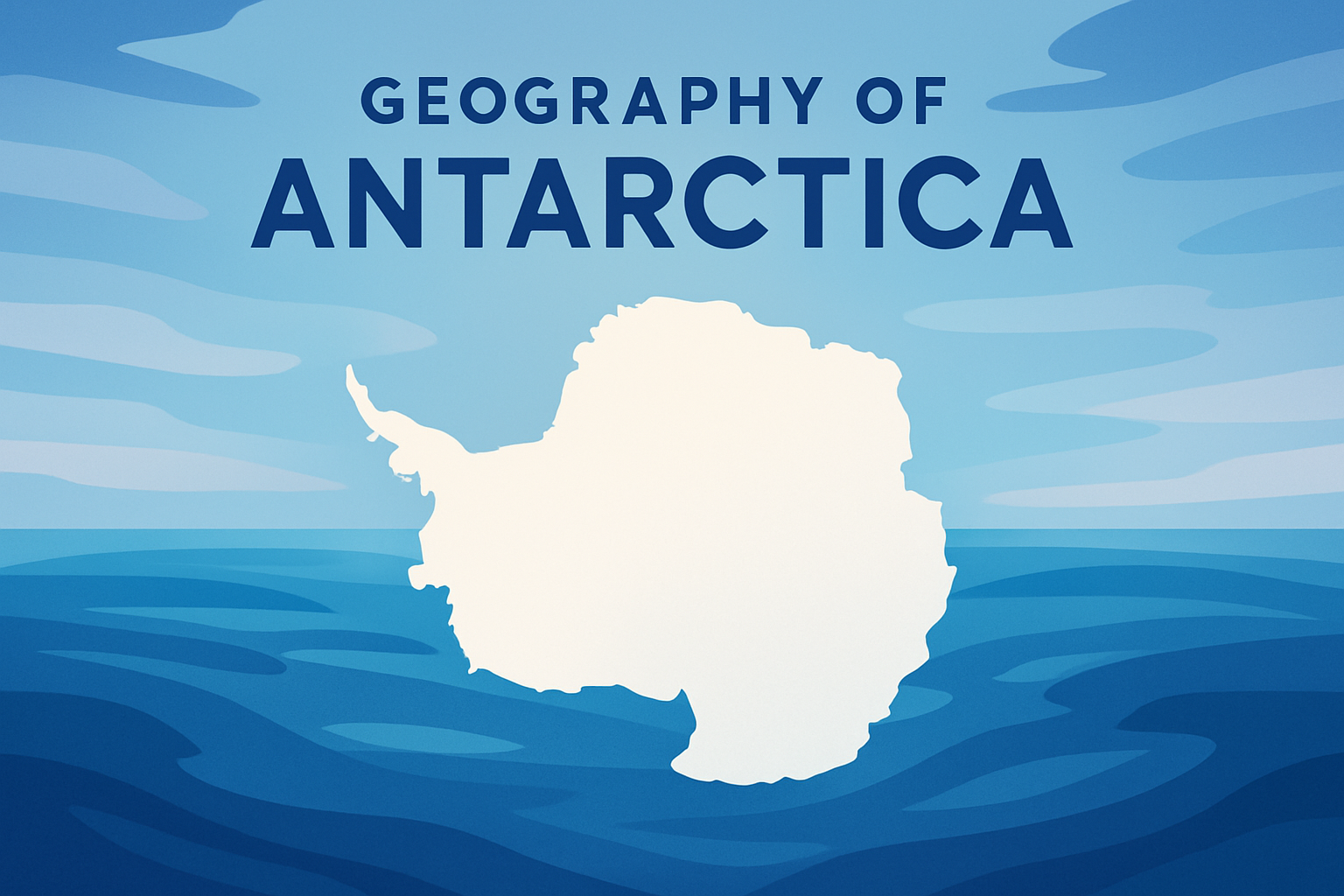
Antarctica, the Earth’s southernmost continent, is an enigmatic and icy realm, comprising a significant portion of the planet’s cold, uninhabitable landmass. Covered nearly entirely by ice, this remote territory is a focal point of climatic and scientific research due to its unique geographical characteristics. The significance of studying Antarctica’s geography is multifaceted, impacting our understanding of global climate patterns, sea-level rise, and the adaptation mechanisms of life in extreme conditions. This article will explore the geographic features of Antarctica, such as its landscape, climate, and unique ecosystems, to highlight why this continent matters globally. Despite its apparent desolation, the geographical study of Antarctica is crucial for comprehending major environmental processes and their implications for life on Earth.
Antarctic Terrain and Landscape
Antarctica, predominantly an ice-covered expanse, is primarily composed of the Antarctic Ice Sheet, the largest single piece of ice on Earth. This ice sheet holds about 60% of the world’s freshwater, making its study pivotal for understanding future water availability. The continent’s landscape features a diverse topography beneath the ice, including mountains, valleys, and plains.
The Transantarctic Mountains, one of the most significant mountain ranges in Antarctica, stretch across the continent, effectively dividing it into Eastern and Western Antarctica. These mountains are a key geographical feature that affects the movement and dynamics of the ice sheets, playing a crucial role in the continent’s glacial activity.
In Western Antarctica, the terrain is more varied and includes the West Antarctic Rift, a geological feature with active volcanic activity. Mount Erebus, located on Ross Island, is the continent’s most active volcano, displaying continuous eruptive activity that provides valuable insights into the geological processes at play beneath the ice.
Climate and Weather Patterns
The climate of Antarctica is classified as polar, characterized by extremely low temperatures, strong winds, and very little precipitation. This harsh climate makes Antarctica the coldest, driest, and windiest continent in the world. The continent’s interior is covered by a vast ice sheet, resulting in temperatures that can plummet to as low as -80 degrees Celsius in the winter.
Despite its harsh climate, the coastal regions of Antarctica experience somewhat milder conditions, influenced by the surrounding Southern Ocean. These areas can have temperatures slightly above freezing during the summer months, allowing for limited melting of ice and snow.
- Wind patterns in Antarctica are primarily driven by the polar vortex, a persistent large-scale cyclonic circulation in the upper atmosphere.
- The katabatic winds, which occur when cold air flows downhill from the high interior ice sheet, are some of the strongest and most consistent winds on the planet.
- Precipitation is extremely low, generally falling as snow, which accumulates over time to form the continent’s massive ice sheet.
Antarctic Ecosystems and Biodiversity
Despite its frigid and inhospitable environment, Antarctica supports a surprising array of life adapted to its extreme conditions. Its ecosystems are mainly centered around the coastline and the Southern Ocean, where higher availability of nutrients supports various species.
Marine life in the surrounding Southern Ocean is rich and diverse, with krill being a crucial component of the Antarctic food web. These tiny crustaceans serve as the primary food source for many marine species, including seals, fish, and large baleen whales.
On land, terrestrial life is limited due to the harsh climate, but some hardy species thrive. These include mosses, lichens, and a few flowering plants, mainly found in ice-free areas. Furthermore, several species of birds, such as the emperor and Adélie penguins, inhabit the continent, relying on the abundant marine life for sustenance.
Human Activity and Scientific Research
Human presence in Antarctica is primarily centered around scientific research stations operated by various countries. The Antarctic Treaty System governs all human activity on the continent, ensuring that it is used for peaceful and scientific purposes only.
Research conducted in Antarctica spans multiple disciplines, including climate science, glaciology, and biology. For instance, the study of ice cores from the Antarctic Ice Sheet provides valuable records of historical climate conditions, aiding in present-day climate modeling and prediction efforts.
Moreover, the pristine environment of Antarctica offers a unique opportunity for astronomical observations, with several observatories located on the continent, taking advantage of the clear, dry air for deep-space studies.
Impact of Antarctic Research on Global Knowledge
The significance of Antarctic research extends far beyond its icy borders, with profound implications for global environmental understanding. As the continent holds a significant portion of Earth’s freshwater in its ice sheets, understanding the dynamics of these ice sheets is key to predicting future sea-level changes.
| Research Area | Global Implications |
|---|---|
| Ice Core Studies | Historical climate data informs climate change models |
| Marine Ecosystem Research | Understanding of ocean biodiversity and food webs |
| Glaciology | Sea-level rise predictions |
| Astronomical Observations | Advancements in space science |
In addition to climate science, Antarctic ecosystems provide insights into how life adapts to extreme environments, which could inform studies on other planets. The research also plays a crucial role in preserving global biodiversity by understanding and protecting unique species that thrive in such harsh conditions.
Future Challenges and Opportunities
Looking forward, the increasing interest in Antarctica poses both challenges and opportunities. Climate change is already affecting the continent, with warming temperatures contributing to the melting of ice shelves and the potential disruption of global ocean currents.
However, these challenges also present opportunities for international collaboration. Joint research efforts can foster a greater global understanding of the Earth’s systems, helping to develop strategies for mitigating the impacts of climate change. Additionally, continued adherence to the principles of the Antarctic Treaty can conserve this pristine environment for future generations.
Conclusion
Antarctica, with its extreme environment and vast ice-covered landscape, is a crucial area for geographical and scientific study. Its unique geographic features, climate, ecosystems, and the impact of human research activities underscore its global importance. By studying Antarctica, we not only enrich our understanding of Earth’s past and present but also equip ourselves with essential knowledge to tackle future environmental challenges. As such, the continued exploration and protection of this icy continent are vital for the wellbeing of our planet.
To gain a deeper understanding of Antarctica’s geography, one can engage with ongoing scientific discourse online, participate in advocacy groups, or support organizations dedicated to Antarctic conservation. By doing so, we can ensure that the insights derived from this remote continent continue to inform global policies and improve the resilience of our environment.
Frequently Asked Questions
1. Why is Antarctica considered a significant focus for scientific research?
Antarctica is not merely a remote and icy landmass at the southernmost point on Earth; it’s a treasure trove of scientific knowledge waiting to be unlocked. Its vast ice sheets serve as a giant natural laboratory for researchers across the globe. This region holds critical clues about past climate conditions through ice cores, which can reveal ancient atmospheric compositions and temperatures. These ice cores help scientists predict future climatic trends based on historical data. Moreover, understanding the ice dynamics and melting patterns in Antarctica is crucial for accurate projections of global sea-level rise. The continent’s unique ecosystems, unlike anywhere else on Earth, allow scientists to study how life adapts and thrives in extreme conditions, offering insights into the biological resilience of various species. By studying Antarctica, we are gathering invaluable data that helps inform global environmental policies and strategies to combat climate change.
2. How do the geographical features of Antarctica contribute to its extreme cold climate?
Antarctica’s geographical layout itself plays a central role in its harsh, frigid conditions. The continent is covered by the Antarctic ice sheet, the largest single mass of ice on Earth, enveloping nearly 98% of the land. This ice reflects a significant amount of solar radiation back into space, a phenomenon known as the albedo effect, which contributes to maintaining the cold temperatures. Additionally, the Antarctic Circumpolar Current, an oceanic current that flows from west to east around Antarctica, acts as a thermal barrier, isolating Antarctica from the warmer waters of the northern oceans. The continent’s elevation, with an average height of about 2,500 meters above sea level, also contributes to its cold climate. Higher elevations typically correspond to lower temperatures. The combination of these geographical factors ensures that Antarctica remains the coldest, driest, and windiest continent on Earth.
3. What impact does Antarctica have on global sea levels?
Antarctica is crucial in regulating the Earth’s sea levels due to its massive ice sheets. It holds about 60% of the world’s freshwater, most of which is locked up in ice. If significant segments of these ice sheets were to melt, it would lead to a noticeable rise in global sea levels. Scientists have been closely monitoring areas like the West Antarctic Ice Sheet and the Antarctic Peninsula, both of which are more susceptible to warming and melting. Any substantial melting from these regions can contribute to rising sea levels, potentially affecting coastal communities worldwide. Furthermore, even moderate increases in temperatures can lead to increased ice discharge into the ocean, accelerating sea-level rise. Continuous research in this area is vital to predict future changes accurately and to prepare mitigation strategies against the repercussions of rising sea levels.
4. How do life forms survive in Antarctica’s extreme environment?
Surviving in Antarctica is a testament to the incredible adaptability of life. Despite its harsh climate, the continent teems with unique life forms that have evolved extraordinary adaptations. Many Antarctic species, especially microorganisms, are psychrophiles, meaning they thrive at very low temperatures. They produce special proteins that prevent ice crystal formation in their cells, allowing them to survive and function in sub-zero climates. Antarctic fish species possess antifreeze proteins in their blood, preventing ice from forming within their bodies. Furthermore, seals and penguins have thick layers of blubber and specialized feathers or fur to insulate against the cold while maintaining flexibility and mobility. Nutrient-rich waters support a vibrant marine ecosystem, feeding whales, seals, penguins, and seabirds. Studying these life forms provides insights into biological resilience and adaptations, potentially offering avenues for scientific and medical advancements elsewhere in the world.
5. What is the importance of the Antarctic Treaty System in preserving the continent?
The Antarctic Treaty System is a landmark in international cooperation and environmental preservation. Initiated in 1959 and entering into force in 1961, this agreement sets aside Antarctica as a scientific preserve, bans military activity on the continent, and promotes peace and cooperation in scientific endeavors. The treaty plays a crucial role in preserving Antarctica’s pristine environment by prohibiting mineral mining, managing bio-resources responsibly, and implementing strict environmental protection protocols that mitigate human impact. All activities in Antarctica, including tourism and research, must undergo thorough environmental assessments to ensure minimal ecological disturbance. The collaborative nature of the treaty fosters international scientific research by facilitating data sharing and logistical cooperation among the participating countries. This systematic approach ensures that Antarctica remains a natural reserve devoted to peace and science, safeguarding it for future generations.