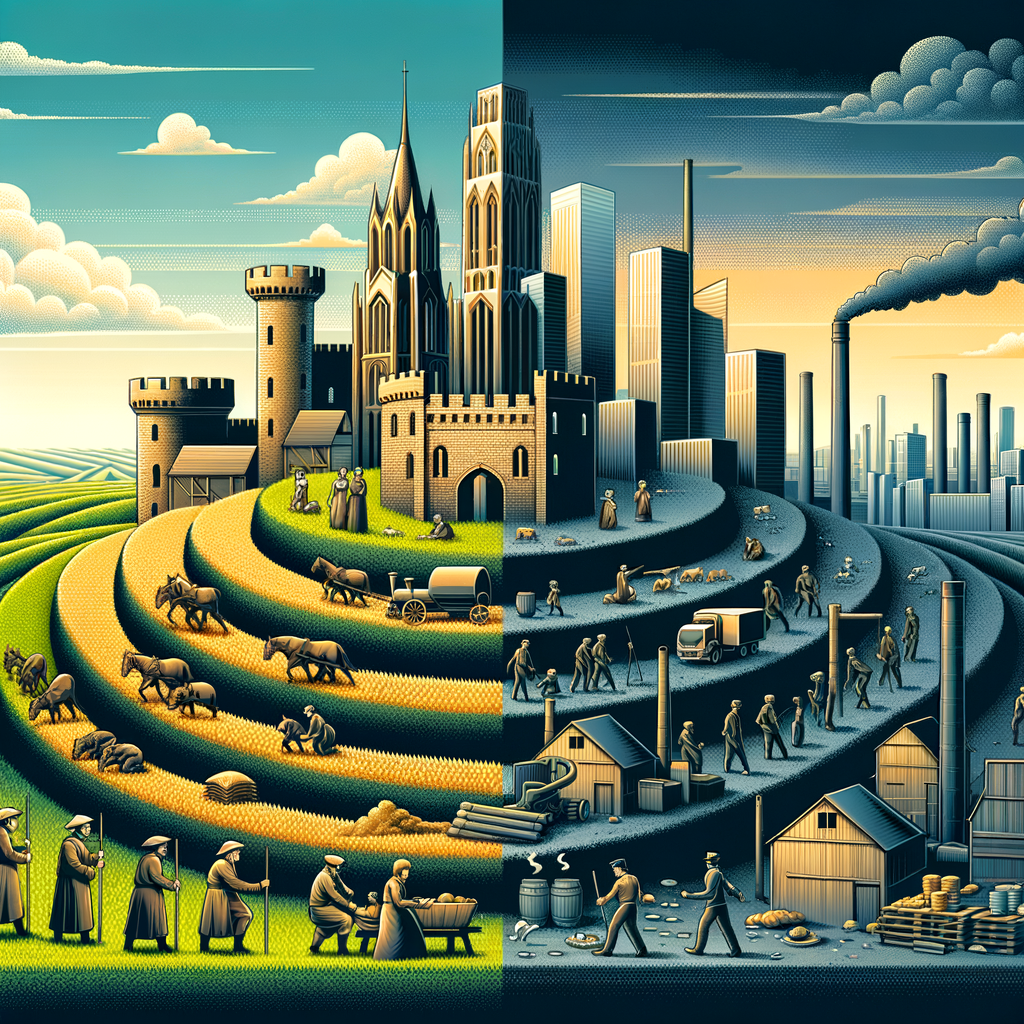
Introduction: Understanding the Transition from Feudalism to Capitalism
The transition from feudalism to capitalism marks one of the most significant transformations in social, economic, and political history. This shift, spanning several centuries, fundamentally altered the ways societies structured themselves, how economies functioned, and the political landscapes that guided them. The roots of feudalism lay in the medieval period, characterized predominantly by a rigid hierarchical structure that revolved around landownership and agrarian economies. Lords owned vast swathes of land, while peasants or serfs worked the land, often without ownership rights, in exchange for protection and sustenance. This system of mutual obligation and protection yielded a stable but innately inflexible framework, which, over time, faced pressures from both internal inefficiencies and external catalysts for change.
Capitalism, in contrast, revolved around the principles of private property, individual enterprise, and market-driven economies. Under capitalism, wealth was generated through trade and industry, rather than agriculture, spurring innovation, competition, and economic growth on an unprecedented scale. The transition was not immediate. Instead, it was a protracted process marked by developments such as the decline of serfdom, the rise of a merchant class, and technological advancements, particularly during the Industrial Revolution. As societies shifted from agrarian economies to those characterized by commercial and industrial activity, political and social structures also evolved. The move towards capitalist economies heralded new ideologies that emphasized individual rights, economic freedoms, and governmental systems shaped by emerging bourgeois classes.
This article will delve into the historical, economic, and social changes that fueled the transition from feudalism to capitalism. We will explore the main factors driving this transformation, the key events and figures involved, and the broader implications for modern societies. The transition was not merely an economic shift but a profound restructuring of societal hierarchies, beliefs, and practices that laid the groundwork for the modern world. Through understanding these processes, we gain insight into the dynamic nature of societal evolution and the historical forces that continue to shape contemporary economic and political frameworks.
The Decline of Feudal Economies and Societal Structures
The decline of feudalism was precipitated by numerous economic, social, and political factors that, over time, eroded the established feudal structures. The transformation was gradual and uneven, varying geographically and influenced by local conditions. A pivotal factor was the decline of the manorial system, essential to the feudal economy. Manorialism hinged on the lord’s control over the land and the peasants working it, but this system became less effective as Europe faced agricultural stagnation and population pressures. The repetitive famines and diseases weakened the population, while technological stagnation and poor yields kept the economy lackluster.
Socially, the rigid hierarchies began to unravel as serfs started gaining more agency. The Black Death, which drastically reduced the European population, heavily impacted labor supply, inadvertently increasing the bargaining power of peasants who sought better conditions and wages. This shift in labor dynamics led some serfs to secure more favorable servitude terms or migrate to burgeoning towns where different economic opportunities beckoned. These shifting labor dynamics marked a pivotal step in the eventual unraveling of feudal structures.
Politically, the consolidation of monarchies and the emergence of centralized states altered the feudal landscape. As kings exerted authority over lords, the dynamic and power balance shifted, leading to increased internal strife and wars. Monarchs, needing resources to wage wars or expand influence, increasingly turned towards merchants and new financial systems that facilitated taxation and resource control. The weakening hold of local lords and the rise of centralized monarchies and nation-states began to dissolve the feudal bonds, paving the way for new administrative approaches that favored commercial interests.
The Rise of Commerce and the Merchant Class
Among the most critical drivers of the transition to capitalism was the burgeoning power of trade and the emergence of a prosperous merchant class. As populations recovered and grew, demand for goods increased, spurring trade across Europe and beyond. This led to the growth of cities and towns as centers of commerce, creating a new social dynamic and competition for the feudal order based around rural agriculture.
The creation of market economies and the establishment of trade routes during the late medieval period heralded changes that aligned more closely with capitalist principles. The revival of long-distance trade brought about the revival of banking and finance, with institutions like the Fugger and Medici banks beginning to shape the economic landscape. This burgeoning commercial activity was captured by the urban-based, emerging bourgeoisie, who profited immensely from the free flow of capital. The development and improvement of banking institutions and the commercial revolution embodied a shift away from traditional feudal economics. As capital accumulated within the merchant class, they wielded greater economic and political influence, challenging and eventually undermining the feudal hierarchy.
The new commercial dynamism stimulated changes in production, with the cottage industries leading to proto-industrialization. The expansion of trade and commerce spurred an early form of capitalism, as merchants and traders organized production for profit and not just subsistence. This period marked the genesis of what would later develop into fully-fledged capitalism. Crucially, the ideals accompanying the burgeoning commercial spirit began to promote ideas of individualism, entrepreneurial initiative, and socioeconomic mobility. These values eventually seeped into the broader societal ethos, clashing incrementally with feudal structures based on birthright and static class positions.
The Impact of Technological and Industrial Advancements
The progression from feudal economies to capitalist systems can hardly be separated from the technological and industrial advancements that became increasingly evident as societies approached the early modern era. Key technologies, including the printing press, dramatically shifted the cultural landscape by democratizing knowledge and facilitating communication. The spread of literacy and new ideas embodied an age of discovery and inquiry that helped to inspire economic and political changes.
Another major ongoing development was that of improved agricultural techniques, the diffusion of new crops, and agricultural innovations like the three-field system. These agricultural improvements increased productivity, freed labor for industrial pursuits, and facilitated the shift towards capitalist production. Inventions like the spinning jenny, steam engine, and water frame during the subsequent Industrial Revolution were catalysts transforming economies. These inventions reduced reliance on agrarian economies and revolutionized production methods, satisfying capitalist market economies’ expanding demands.
The mechanization and adoption of these technologies enabled faster production using machines rather than manual labor. Consequentially, the Industrial Revolution was not just an economic transformation but a social one, reorganizing labor into wage-based systems. The transition moved entire populations from rural work types to industries centered in growing urban centers, creating a clear distinction between feudal and capitalist economies. By creating vast urban workforces and stimulating industries, such as textiles and metal manufacturing, these technological advancements dismantled feudal ties based on agrarian dependency.
Philosophical Shifts Supporting Economic Transformation
The ideological landscape also evolved, supporting the transition from feudal economies to capitalist ones. Intellectual movements such as the Renaissance and Enlightenment ushered in discourses that emphasized reason, individualism, and critical thinking. Philosophers and economists began articulating ideas of property rights, market dynamics, and economic systems that increasingly resonated with capitalist ideals.
Thinkers like John Locke on property and Adam Smith with his seminal “The Wealth of Nations” submitted arguments that promoted ownership and the market’s invisible hand, legitimizing the capitalist paradigm. Intellectual shifts challenged the previously rigid and hierarchical static feudal society, promoting social mobility and economic freedom. As Enlightenment principles reinforced notions of individual rights and democracy, they supported the idea that merit, rather than birthright, should determine one’s economic status.
Philosophical shifts continuing into the age of revolutions provided ideological underpinnings that propelled the political transformations necessary for capitalism’s emergence. Revolutions, such as the French and American, emphasized liberty, democracy, and economic freedoms, driving the decline of noble privileges and facilitating economic environments where capitalist structures could flourish. Ideologies promoting free markets and economic liberalism spiraled throughout societies, dismantling the feudal order and advancing the principles that heralded modern capitalist economies.
The Consequences and Legacy of the Feudal to Capitalist Transition
The momentous transition from feudalism to capitalism carried significant consequences that stretched beyond economic realms into comprehensive societal shifts. Economically, societies experienced unprecedented growth, innovation, and wealth generation, capturing fundamentals of the Industrial Revolution and commercial prowess. New economic models and systems of production based on profit began dictating societal norms, perpetuating growth and consumer culture. Urbanization became a hallmark consequence, as people gravitated to capitalist epicenters famed for flourishing industries and labor opportunities, shaping modern demographic patterns.
Socially, the transition dismantled static social hierarchies, driving changes toward more equitable systems based on market achievements, rather than inherited status. Political landscapes responded with increased democratization, as the interplay between economic and political liberalism emphasized governance systems responsive to economic demands. The integration of ideas of autonomy and individualism reshaped societal outlooks, bolstering frameworks that prioritize enterprise, rights, and participation.
While these transformations fueled expansive advancements, they also spawned challenges synonymous with capitalist systems, including issues around labor rights, class disparities, and the ethical considerations of profit-driven motivation. However, this transition laid critical groundwork for the modern world, fostering dynamic economies integrated globally that continue to evolve. Understanding this transition’s influences offers a lens to appreciate and critique historical and current socioeconomic structures, broadening comprehension of capitalism and its expansive legacy.
Conclusion: Reflecting on the Transition’s Impact and Its Lessons
The transition from feudalism to capitalism remains one of the most transformative phases in human history. It redefined economic systems, social structures, and political frameworks, steering societies towards individualism, innovation, and democracy. Fueled by broadened trade, industrial growth, philosophical shifts, and changing political landscapes, this transition extinguished the existing feudal order and birthed economies responsive to market changes and innovation at its core.
While the positives are evident in prosperity and progress, it also implores assessments of capitalist shortcomings related to inequalities and ethical balance around modern economic practices. As we continue to navigate capitalism’s complexities, the lessons from the past transition encourage capturing progress while addressing enduring challenges within modern capitalist structures. This historical perspective outlines the adaptability and resilience intrinsic to socioeconomic systems, emphasizing evolution reflecting societal norms, demands, and ideologies.
Though centuries past, the impulses igniting this historic transition resonate within current dynamics, inspiring reflections on progress, socioeconomic disparities, and how systems may further adapt as societal imperatives evolve. By understanding both the motivations and ramifications of historical transitions, contemporary societies can prepare for and adapt to ongoing changes, ensuring that economic systems serve broader societal goals, promoting equity, and sustainability alongside innovation and growth.
Frequently Asked Questions
1. What exactly is feudalism, and how did it function?
Feudalism was a social and economic system that dominated medieval Europe. It was centered around a hierarchy of landownership and duties. At the top of the hierarchy was the monarch, who owned vast amounts of land. Below the monarch were powerful lords and nobles, who were granted portions of land in exchange for military service and loyalty. These nobles would in turn allot some of their lands to vassals and knights, who pledged to serve in their armies or provide other services.
The base of the feudal pyramid consisted of peasants or serfs. Unlike slaves, they were not considered property of the landowners, but they were tied to the land and lived in a state of serfdom. They farmed the land and provided goods and services to their lords in exchange for protection and the right to work on the land for their subsistence.
This hierarchical system meant that social mobility was nearly impossible. One was generally born into one’s class, and roles were strictly defined, with little opportunity to change one’s status. This rigid social structure helped maintain order and stability, but it also led to a lack of economic innovation and a very localized economy due to the focus on agrarian production.
2. Why did feudalism decline?
Several factors contributed to the decline of feudalism. One of the key reasons was the growth of trade and commerce, which started to expand primarily during the late Middle Ages. With trade, there was a gradual shift from a purely agrarian economy to one that incorporated more market-based dynamics. This provided a catalyst for people to migrate toward towns and cities in search of better opportunities, which in turn spurred urbanization.
Another significant factor was the Black Death, which dramatically reduced the population of Europe in the mid-14th century. The loss of life led to a shortage of labor, subsequently increasing the bargaining power of serfs and peasants. This newfound leverage allowed many to demand better working conditions and pay or to leave for better economic opportunities.
The Hundred Years’ War and the resulting political unrest also weakened the feudal structures by overburdening the lords with military expenses while their incomes, largely dependent on agricultural outputs, didn’t grow accordingly. The rise of powerful centralized monarchies undermined the autonomy of feudal lords. These monarchies sought to create modern state structures with centralized bureaucracies, which contrasted sharply with the decentralized feudal system.
3. How did capitalism emerge from the remnants of feudalism?
Capitalism emerged as a natural progression from the ashes of the feudal system, catalyzed by several pivotal developments. As trade expanded during the late Middle Ages and Renaissance periods, there was a growing demand for a new organizational structure of production and labor. The decline in feudal obligations and the rise of a money-based economy meant more people engaged in wage labor instead of working as serfs bound to land.
As cities grew, they became melting pots of economic exchange and innovation, fostering environments where ideas and entrepreneurial efforts could flourish. Banking systems developed to manage the increased flow of capital. Economic focus shifted from land ownership and agriculture to manufacturing and mass production, driven by the entrepreneurial class that started to emerge.
The Enlightenment ushered in new ways of thinking, emphasizing rationality, scientific inquiry, and notions of individual rights and economic freedom, further fueling capitalist ideologies. Coupled with colonial expansion, these elements enabled a capitalist system marked by private ownership of the means of production, with a focus on profit and market competition.
4. What impact did the transition have on societal structures?
The transition from feudalism to capitalism brought about profound transformations in social structures. The rigid class distinctions that characterized feudal society began to dissolve with the advent of capitalism. There was an emergence of a new middle class, often referred to as the bourgeoisie, who gained power and influence through commerce and industry rather than landownership.
This newly formed middle class played a pivotal role in advocating for changes that would benefit the capitalist economy, such as legal reforms and property rights, which laid the foundations for modern legal systems. Social mobility, previously unattainable under feudalism, became more achievable, although not equally for everyone, as merit and economic success started to replace noble birth as a marker of status.
The transition also led to a redefinition of the working class. With more people moving to cities to seek employment in manufacturing and services, urban working-class communities began to form. They became important agents of economic production, although often faced with dire working conditions, paving the way for labor movements and eventually the establishment of labor rights and unions.
5. What were the political ramifications of this shift?
The political landscape also experienced significant changes as a result of the transition from feudalism to capitalism. Feudal lords who once wielded considerable power found themselves overshadowed by merchant capitalists and industrialists, who gained political influence through wealth accumulation rather than land control. This marked a shift away from a decentralized political system to more centralized nation-states.
These states began to base their governance on the rule of law rather than feudal allegiances. With the rise of capitalist economies, there was an increased demand for standardized national policies and infrastructures that supported commerce and industry. As monarchies consolidated power, this led to the centralization of governmental functions and a move toward modern governmental institutions.
Furthermore, the weakening of religious strangleholds over politics, as seen during the Enlightenment and the separation of church and state, freed political structures to further embrace rationalism and individualism, encouraging policies that favored economic freedoms. The political changes foreshadowed the rise of democratic ideals and broader participation in governance, embodied by the later revolutions focused on liberty, equality, and fraternity.