
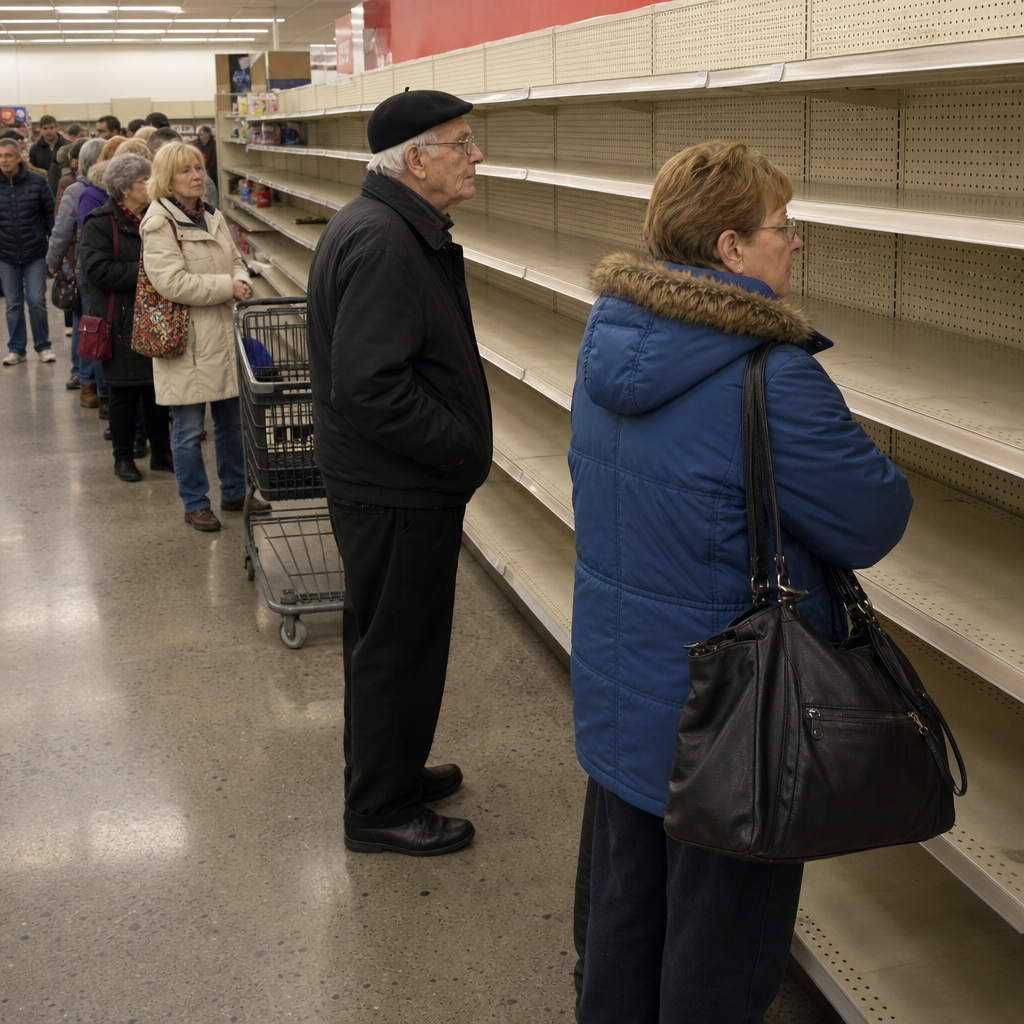
Shortage lines and nonprice rationing in controlled markets arise when official prices are held below market-clearing levels and some method other than price must decide who gets scarce goods. In economics, a price ceiling is a legal maximum price, a controlled market is one shaped directly by administrative rules, and nonprice rationing includes queues, coupons, waiting lists, favoritism, and quality reduction. I have seen these mechanisms explained too neatly in textbooks; in practice they are messy, time-consuming, and often politically charged. They matter because they change not only who buys a product, but also how firms produce, how households plan daily life, and how states manage legitimacy. A low posted price can look compassionate, yet the real cost may reappear as hours spent waiting, informal payments, product scarcity, or unequal access. Understanding shortage lines and nonprice rationing is essential for reading housing policy, energy controls, food subsidies, wartime allocation, and health care shortages. This hub article maps the full terrain, defines the core logic, and shows why controlled markets rarely eliminate scarcity; they mainly redistribute it into new forms.
The Core Mechanism: Why Controlled Prices Create Shortage Lines
A shortage occurs when quantity demanded exceeds quantity supplied at the legal price. If a government sets rent, bread, gasoline, or foreign exchange below the level that would balance buyers and sellers, more people want to buy while fewer suppliers are willing or able to provide the good. The gap does not disappear because the law forbids a higher price. Instead, competition shifts from money prices to nonmoney costs. The classic visible form is the shortage line: people queue because waiting becomes part of the full price. Economists sometimes call this the shadow price of time. The posted price stays low, but the effective price rises once travel, uncertainty, missed work, and inconvenience are included.
This is not merely a diagram on a supply-and-demand graph. During gasoline price controls in the United States in the 1970s, motorists lined up for fuel, stations posted odd-even purchase days, and availability varied sharply by location and time. The nominal price did not fully signal scarcity, so people searched, waited, and filled tanks whenever they could. Similar patterns have appeared in rent-controlled housing markets, where the monetary rent is capped but tenants “pay” through long searches, years on waiting lists, or acceptance of units that do not match their needs. In each case, the control suppresses one signal and amplifies others.
Forms of Nonprice Rationing in Controlled Markets
Nonprice rationing is broader than standing in line. In my work reviewing regulated sectors, I usually group it into five main channels: time costs, administrative allocation, seller discretion, product degradation, and informal side payments. Time costs include queues, repeated store visits, and uncertainty about delivery. Administrative allocation includes licenses, priority categories, point systems, and ration books. Seller discretion appears when clerks, landlords, or officials decide which customer gets access. Product degradation occurs when firms respond to low controlled prices by reducing service quality, shrinking package sizes, or limiting variety. Informal side payments emerge when people pay brokers, bribes, or under-the-table premiums to bypass official rules.
These mechanisms can operate together. A controlled apartment market may feature years-long waiting lists, key money paid illegally to current tenants, and landlords who delay maintenance because regulated rents do not cover modernization. A controlled foreign exchange market may use official quotas, priority access for importers of medicine, and a parallel market where firms pay a much higher implicit rate. A controlled food market may show empty shelves at official stores, favored access for politically connected buyers, and lower-quality substitutes. The important point is that scarcity still rations demand; the rationing method simply changes.
| Rationing method | How it works | Typical example | Main hidden cost |
|---|---|---|---|
| Queues | Customers wait physically for available stock | Fuel lines during energy price controls | Lost time and uncertain access |
| Coupons or ration books | Authorities limit quantity per person | Wartime food distribution | Administrative burden and inflexibility |
| Waiting lists | Access assigned over months or years | Rent-controlled public housing | Delayed consumption and mismatch |
| Seller discretion | Clerks or landlords choose among buyers | Scarce retail goods or apartments | Favoritism and discrimination |
| Informal premiums | Buyers pay extra outside official channels | Black-market tickets or currency | Corruption and legal risk |
Why Queues Are Not Neutral: Hidden Costs and Unequal Burdens
It is tempting to think that first-come, first-served queuing is fair because everyone faces the same posted price. That conclusion fails once time has value. A queue favors people with flexible schedules, proximity to supply points, better information, and lower opportunity cost of time. A salaried office worker, a parent with childcare duties, and an hourly wage laborer face very different queue burdens. If waiting three hours means losing wages or risking job discipline, the low official price is not equally accessible. Economists such as Armen Alchian and William Allen emphasized that full cost includes all resources sacrificed, not just cash paid at the register.
Queues also distort behavior before the purchase happens. People buy more than they immediately need because the next opportunity is uncertain. That is why controlled markets often generate hoarding, stockpiling, and repeated search trips. These responses worsen apparent scarcity even when the initial supply shock was moderate. In retail settings, early arrivals may clear shelves, while later shoppers encounter empty displays and infer a larger shortage. The queue therefore becomes both rationing device and information signal, sometimes triggering panic demand. Policymakers who ignore that feedback loop often underestimate how quickly visible lines can erode public confidence.
Historical and Modern Examples Across Sectors
Wartime rationing is the most defensible and best-organized example of nonprice rationing. In Britain and the United States during World War II, ration books, coupons, and administrative allocation directed scarce food, fuel, rubber, and consumer goods toward military needs while trying to preserve civilian minimum consumption. These systems worked better than ad hoc queues because they matched allocation rules to explicit strategic goals. Even so, black markets emerged, quality varied, and enforcement costs were substantial. The lesson is not that rationing never works; it is that it works only when objectives are clear, supply constraints are real, and administration is credible.
Outside wartime, results are often weaker. Rent control in cities such as New York and Stockholm has historically protected incumbent tenants but also contributed to long search times, low turnover, and insider advantages in access. In health care, price controls or administratively set reimbursements can produce waiting lists for elective procedures, specialist shortages, or regional access gaps if provider participation falls. In agriculture and food retail, controls in countries from Venezuela to Zimbabwe have repeatedly generated empty shelves, informal resale, and substitution toward uncontrolled goods. Foreign exchange controls in Argentina and elsewhere have produced official rates divorced from street rates, with nonprice rationing deciding which firms can import essential inputs. Sector details differ, but the pattern is consistent: when price cannot clear the market, another mechanism does.
Quality Decline, Shrinkage, and the Producer Response
One of the least understood consequences of controlled prices is that suppliers adjust margins through quality, assortment, and maintenance rather than through overt price increases. If a landlord cannot raise rent to reflect rising repair costs, the building may be painted less often, appliances replaced more slowly, or common areas cleaned less regularly. If a food producer cannot charge enough for a controlled staple, the firm may reduce package size, lower ingredient quality, or shift production toward premium uncontrolled lines. The shelf price seems stable, but the consumer receives less value. Economists describe this as quality shading or nonprice adjustment on the supply side.
This matters because statistics can understate the real burden of controls. An official series may record stable prices while missing longer outages, poorer service, fewer varieties, and shorter opening hours. In utility markets, governments sometimes hold tariffs below cost and then confront underinvestment, deferred maintenance, and rolling outages. Consumers are not paying more in cash, but they are paying through unreliability. In pharmaceuticals, strict price ceilings can discourage launches of low-margin drugs or reduce availability of older generics if compliance costs and production expenses rise. The market has not become affordable so much as partially unavailable.
Black Markets, Favoritism, and Rent-Seeking
Wherever official allocation rules leave a large gap between legal and market value, side deals appear. A black market is not an accidental moral failure; it is a predictable response to suppressed price signals. If a kilogram of sugar sells legally for one amount and buyers are willing to pay triple to avoid empty shelves, intermediaries will try to capture that spread. Sometimes this takes the form of straightforward resale. Sometimes it appears as “expediting fees,” broker commissions, tied purchases, or gifts to gatekeepers. The economic issue is rent-seeking: people devote resources to obtaining privileged access rather than creating new supply.
Favoritism is another form of nonprice rationing. When goods are scarce and prices cannot allocate them, personal networks, political status, or bureaucratic discretion often do. That can mean preferred access for party members, long-time customers, relatives, or firms with influence. I have seen controlled systems defended as egalitarian while insiders quietly received the best units, earliest delivery windows, or larger quotas. This is why economists treat transparency and enforceability as central. A control that looks progressive on paper can become regressive in operation if scarce slots are captured by those with connections. Once that happens, trust in both the market and the regulator declines.
When Nonprice Rationing Can Be Justified
Not every use of nonprice rationing is economically unsound. In emergencies, pure willingness to pay may conflict with ethical or strategic goals. During natural disasters, public health crises, or war, governments may ration essentials to prevent panic buying and ensure broad minimum access. Hospitals triage by medical need, not by auction. Water restrictions during droughts may limit quantity per household because unrestricted pricing alone could leave vulnerable users without basic supply. The key test is whether the policy addresses a genuine short-run scarcity while preserving incentives to expand supply over time.
Well-designed rationing has clear eligibility rules, temporary duration, transparent enforcement, and complementary measures on the supply side. Those measures can include subsidies targeted to producers, imports, release of strategic reserves, or investment incentives. Poorly designed rationing tries to deny scarcity rather than manage it. That approach usually fails. If controlled markets are unavoidable, policymakers should measure queue times, service quality, stockout frequency, and black-market premiums, not just official prices. Those indicators reveal the true cost of the policy. For readers exploring related economics topics, this hub connects naturally to price ceilings, shortages, black markets, public choice, welfare analysis, and inflation control.
Shortage lines and nonprice rationing in controlled markets show that banning a higher price does not end scarcity; it changes the form scarcity takes. The visible money price may fall, but the full price often rises through waiting, search, uncertainty, lower quality, favoritism, and informal payments. Queues are therefore not a harmless side effect. They are a rationing technology with distributional consequences, administrative costs, and political risks. Historical evidence from wartime allocation, rent control, fuel controls, exchange controls, utilities, and health care all points to the same principle: whenever quantity demanded exceeds quantity supplied at the legal price, some nonprice mechanism must allocate access.
The practical lesson is balance. Controlled markets can be justified in narrow conditions, especially emergencies or systems where ethical allocation matters more than immediate efficiency. But durable success requires honest recognition of tradeoffs, strong administration, and policies that encourage supply rather than suppress signals indefinitely. If you are building your understanding of economics, use this hub as a starting point and then examine the linked ideas behind shortages, price ceilings, black markets, and government failure. The central benefit of mastering this topic is clarity: you will see past low official prices and ask the more important question—who actually gets the good, at what real cost, and by what rule.
Frequently Asked Questions
1. Why do shortage lines form when prices are controlled below the market-clearing level?
Shortage lines form because a price ceiling keeps the official price below the level that would normally balance how much people want to buy with how much producers are willing to sell. At the lower controlled price, consumers demand more of the good because it appears cheaper, while producers often supply less because the reduced return makes production, transport, storage, or maintenance less worthwhile. The result is a shortage: more people want the item than there are units available. Since the price is not allowed to rise to clear the market, some other mechanism has to decide who gets the scarce supply. One of the most visible mechanisms is the queue.
In that setting, waiting becomes a kind of hidden price. People pay not with more money, but with more time, effort, uncertainty, and inconvenience. Someone who can arrive early, wait longer, return repeatedly, or gather better information may secure the good, while someone with less time or flexibility may go without, even if they value the item highly. This is why textbook diagrams often look tidy, but lived experience is much messier. The official price may be low, yet the true cost to consumers includes standing in line, missing work, arranging transportation, or relying on personal connections. In controlled markets, the shortage line is not an accident on the side of the system; it is often a predictable consequence of suppressing the price adjustment that would otherwise ration limited supply.
2. What is nonprice rationing, and what forms can it take in controlled markets?
Nonprice rationing is any method of allocating scarce goods other than allowing the money price to rise until quantity demanded equals quantity supplied. In controlled markets, this becomes necessary because administrative rules prevent normal market clearing through price. Queues are the classic example, but they are only one form. Governments or sellers may use coupons, stamps, purchase limits, waiting lists, priority categories, registration systems, lotteries, or distribution by workplace or neighborhood. In less formal settings, access may depend on relationships, insider information, discretion by store employees, or favoritism toward repeat customers, friends, or politically connected individuals.
Another important form of nonprice rationing is quality reduction. When sellers cannot legally charge more, they may respond by offering less for the same posted price: smaller package sizes, lower product durability, less reliable service, reduced customer support, shorter opening hours, or fewer product features. That means consumers may appear to be paying the same price, but they are receiving less value. Search costs can also become part of the rationing process. Instead of one trip to one store, buyers may have to visit several locations, monitor delivery schedules, or join multiple waiting lists. In practice, controlled markets often combine several of these mechanisms at once. A good may be officially cheap, require a coupon, involve a long line, be distributed on selected days, and still be available first to people with better connections. That is why economists treat nonprice rationing as broader than simple queuing; it includes the whole set of alternative allocation rules that emerge when price cannot do the job.
3. Are shortage lines and nonprice rationing fairer than allowing prices to rise?
They can appear fairer at first glance because an official low price seems to protect consumers, especially lower-income households, from being priced out. That intuition is one reason price controls are politically attractive. But fairness in controlled markets is more complicated than the posted price alone suggests. When price is prevented from rationing demand, time, information, mobility, and social influence begin to ration instead. A person with a flexible work schedule, nearby transportation, childcare support, or access to insider knowledge may have a major advantage over someone who works fixed hours, has health limitations, or lives farther away. In that sense, queues and waiting lists do not eliminate inequality; they often shift it into less visible forms.
There is also a difference between equal price and equal access. Everyone may face the same official price, but not everyone faces the same opportunity cost of waiting. For a salaried worker, a three-hour line may be frustrating; for an hourly worker, it may mean lost wages. For an elderly person or someone with disabilities, repeated trips to search for goods may be far more burdensome than for others. Favoritism and informal networks can make the system even less fair, because allocation may depend on connections rather than need. That does not mean all price controls are pointless or that every form of nonprice rationing is automatically unjust. In emergencies, wars, or severe disruptions, policymakers may deliberately choose rationing systems to pursue social goals such as minimum access or priority for vulnerable groups. But if the question is whether nonprice rationing is automatically fairer than higher prices, the answer is no. It often replaces one visible allocation method with several hidden and uneven ones.
4. How do controlled markets affect product quality, incentives, and black markets?
Controlled markets can reshape behavior throughout the supply chain, not just at the checkout line. When sellers are prevented from charging a market-clearing price, their incentive to increase output may weaken. Producers may cut back production, delay investment, redirect goods to uncontrolled markets, reduce maintenance, or exit the market entirely if the controlled price does not cover rising costs or reward added effort. Retailers may stock less, shorten hours, limit service, or devote fewer resources to distribution. Over time, these responses can deepen the shortage rather than relieve it.
Quality reduction is a particularly common adaptation. If a seller cannot legally raise the nominal price, they may lower the quality of what is sold instead. That can mean smaller portions, inferior inputs, less reliability, fewer features, worse customer service, or reduced convenience. Economically, this acts like a disguised price increase: the posted money price stays fixed, but the value delivered falls. At the same time, black markets and gray markets often emerge because the gap between the official price and what buyers are actually willing to pay creates an incentive for resale and side payments. Goods acquired through lines, coupons, or privileged access may be resold informally at higher prices. That secondary market reveals that scarcity still exists and that suppressed price signals tend to reappear somewhere else, often with less transparency and fewer protections. So while price controls aim to restrain prices directly, they frequently generate indirect adjustments through lower quality, hidden costs, informal payments, and unofficial trade.
5. Why do real-world shortages under price ceilings look much messier than textbook examples?
Textbooks often isolate the core mechanism: a legal maximum price set below equilibrium creates excess demand, and the gap shows up as a shortage. That simple model is useful, but actual controlled markets operate in a world of institutions, politics, enforcement problems, expectations, strategic behavior, and human improvisation. Different consumers have different information, travel costs, work constraints, and social networks. Different firms have different cost structures, inventory practices, and abilities to evade or adapt to regulation. Officials may enforce rules unevenly, revise them frequently, or add exceptions for certain groups, regions, or uses. All of that makes the outcome far more tangled than a clean graph suggests.
In practice, shortage lines and nonprice rationing are rarely just about one queue outside one store. They can involve uncertainty about delivery timing, hoarding when goods appear, repeated stockouts, multiple overlapping rationing methods, selective enforcement, favoritism, substitution into related goods, and behavioral responses from both buyers and sellers. Consumers may buy more than they currently need because they do not know when the item will return. Sellers may reserve inventory for preferred customers or bundle scarce goods with other purchases. Officials may create coupons to solve one problem but then generate new problems in administration, fraud, and resale. This is why real-world controlled markets often feel chaotic even when the policy design sounds orderly on paper. The underlying logic is simple enough, but the lived system becomes complex because once price is constrained, many other margins of adjustment open up at the same time.