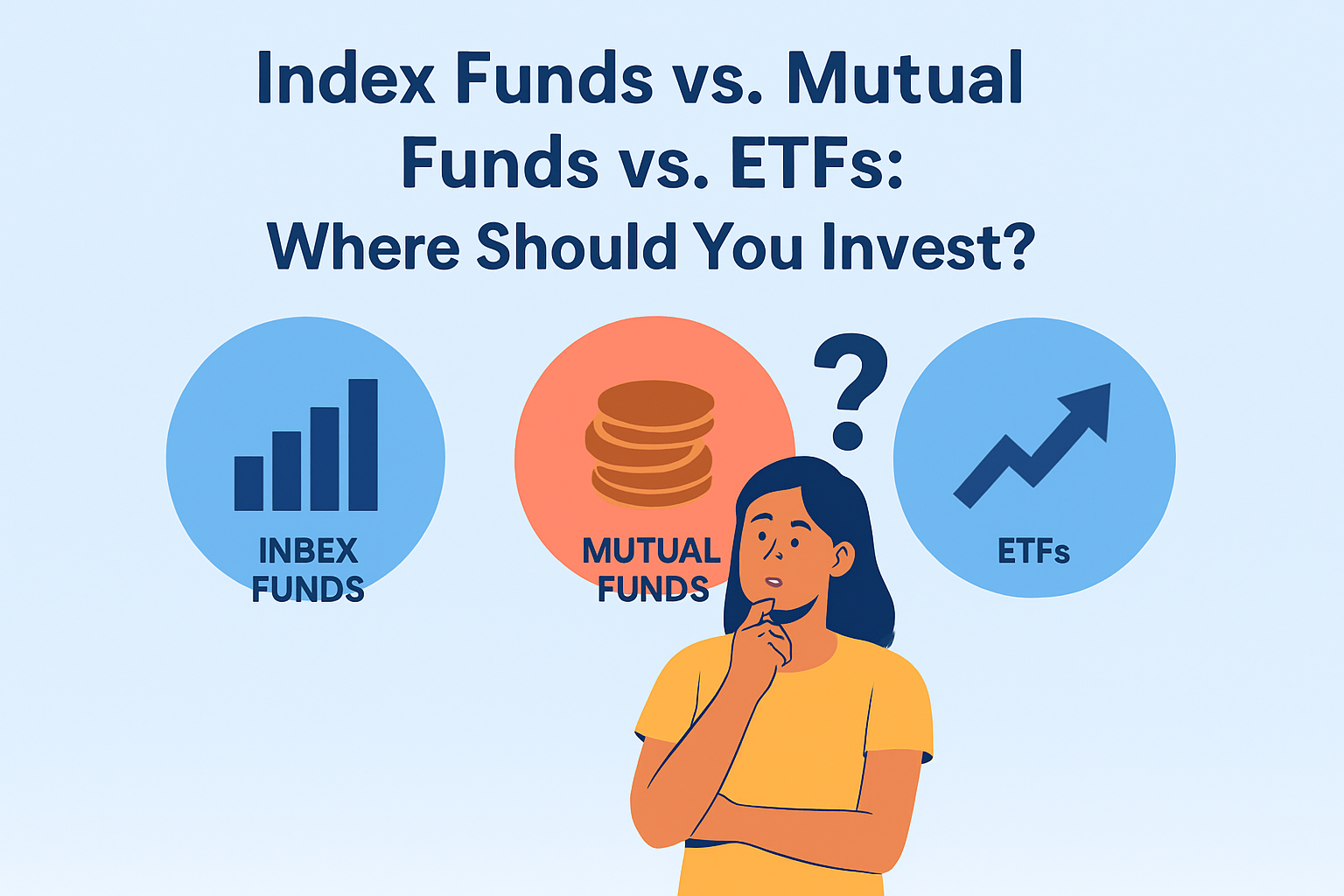
Introduction to Investment Vehicles
Alex, a young professional eager to start his investment journey, faces a common dilemma: “Should I invest in index funds, mutual funds, or ETFs?” This question resonates with many investors, both novice and seasoned, who seek to build wealth and secure their financial future. Understanding these investment vehicles is crucial as they represent popular tools for maximizing returns while managing risks. Grasping their differences can illuminate a pathway toward achieving individual financial goals.
Investment can be daunting, with myriad options and terminologies that often confound even the best of us. Among these options, index funds, mutual funds, and exchange-traded funds (ETFs) stand out due to their accessibility, potential for returns, and ability to diversify portfolios. The orchestration of funds, from pooling money to spreading risk, ensures a smoother ride towards achieving financial targets.
This article endeavors to demystify these funds, comparing them head-to-head and guiding you to make more informed investment decisions. By analyzing their features, tax implications, flexibility, and performance-driving elements, we are better equipped to choose wisely, realizing the benefits each one offers. Understanding their nuances matters for achieving financial freedom, which is increasingly crucial in today’s uncertain economic climate.
Understanding Index Funds
Index funds are portfolios of stocks or bonds designed to mirror the performance of a market index like the S&P 500. Paul, an accountant, opted for index funds due to their straightforward nature and relatively low fees. He found comfort in knowing his investment followed the market trends instead of active management decisions.
One core attraction of index funds lies in their passive management strategy. Since they aim to replicate market performance, fewer resources are directed toward extensive research or forecasting, resulting in substantially lower management fees. The low-cost advantage allows investors to retain more of their returns, enhancing long-term growth.
Index funds offer diversification, spreading investments across various companies or sectors. This broad exposure reduces the impact of individual stock performance, cushioning the overall portfolio. Investors like Paul appreciate the reliability index funds promise, focusing on steady, market-aligned growth rather than speculative or high-risk investments.
Delving into Mutual Funds
Mutual funds, on the other hand, aggregate money from numerous investors to purchase diversified securities such as stocks and bonds. Active management distinguishes them, aiming to outperform the market with strategic investment decisions. Lisa, an experienced investor, prefers mutual funds for their professional management and potential to outpace indices.
Managed by experienced fund managers, mutual funds are constantly adjusted to capitalize on market trends, potential opportunities, and avoid pitfalls. This active management can lead to higher returns compared to passive strategies. However, these benefits come at a higher cost, attributed to management fees and other operational expenses.
One critical advantage of mutual funds is their variety. Investors have access to numerous mutual funds, each catering to specific risk appetites and investment goals. Whether it’s aggressive growth, income generation, or conservative investment, there’s likely a mutual fund strategy to match. Even with their higher fees, the allure of professional expertise guiding investments attracts many like Lisa toward these funds.
Exploring the Dynamics of ETFs
ETFs, or exchange-traded funds, share similarities with both index and mutual funds. They are designed to track indices, commodities, or a basket of assets, but unlike mutual funds, they trade on stock exchanges like individual stocks. Tom, an entrepreneur, enjoys the flexibility and liquidity that ETFs provide, aligning with his dynamic investment strategy.
The prime advantage of ETFs is their tradability. Investors can buy or sell ETFs throughout the trading day, giving them unprecedented control over their investments. Unlike mutual funds that settle once a day, ETFs offer intraday trading, providing opportunities to seize securities market fluctuations.
ETFs are often lauded for their tax-efficiency. Due to their unique creation and redemption process, they typically incur fewer capital gains taxes compared to mutual funds. This efficiency can significantly enhance net returns over time, making ETFs attractive for those mindful of tax burdens.
An additional benefit is the ability to access various asset classes and sectors cheaply and with minimal investment. ETFs cater to those seeking e-commerce exposure, renewable energy, or foreign markets without handling underlying securities directly. Thus, they offer a gateway to diversified portfolios without the complexity of building one from scratch.
- Illustrating practical differences can aid decision-making:
- Index Funds: Low-cost, passive investment replicating indices.
- Mutual Funds: Actively managed, potential for higher returns with higher fees.
- ETFs: Tradable on exchanges, offering flexibility and tax advantages.
Tax Implications of Different Funds
Tax considerations play a critical role in choosing between index funds, mutual funds, and ETFs. Each fund type exhibits distinct tax characteristics, which can influence overall investment returns, especially for those in higher tax brackets. Susan, a teacher focused on preserving her savings, pays particular attention to the tax efficiency of her investments.
Tax efficiency largely favors ETFs due to their structure. By utilizing in-kind transactions during redemptions, ETFs minimize capital gains distributions. Consequently, investors like Susan enjoy lower tax liabilities, maximizing their after-tax returns. Meanwhile, index funds, following a buy-and-hold strategy, also exemplify tax efficiency relative to mutual funds.
Mutual funds tend to distribute capital gains more frequently, potentially realizing higher tax obligations for the investor. These distributions occur regardless of individual investor transactions, meaning investors might incur tax ramifications without initiating fund actions themselves. Understanding these implications is essential in deciding the most suitable fund structure concerning long-term financial planning.
Flexibility and Accessibility in Trading
Trading flexibility differs considerably across these investment vehicles. Debra, a part-time trader, seeks the dexterity to maneuver swiftly within her investment portfolio without restrictions. Here, ETFs outshine both mutual funds and index funds due to their trading nature akin to individual stocks.
The ability to trade ETFs throughout the day allows investors to respond promptly to market shifts, adjust exposure levels, or capitalize on fleeting opportunities. Coupled with features like stop-loss orders and real-time pricing, ETFs cater to active investors desiring precise market entry and exit timing.
Contrarily, mutual funds define themselves by end-of-day pricing, limiting buying or selling decisions to once per day after market closure. This restriction doesn’t sit well with investors wanting agility in response to immediate market information. Although less active, index funds still benefit from similar characteristics, with simplicity and convenience supporting passive investors initially hesitant about market volatility.
Performance Considerations: What Drives Returns?
Understanding performance drivers is an integral aspect of evaluating index funds, mutual funds, and ETFs. Investors inherently seek growth maximization, and knowing what influences returns ensures that desired financial outcomes align with chosen investments.
Index fund performance closely ties to its respective index, gaining when the market rises and declining during downturns. Thus, long-term investors betting on economy-wide growth favor index funds, often accepting occasional lulls for anticipated upwards trends over time.
Comparatively, the success of mutual funds hinges on money managers’ expertise, utilizing market research and strategy to beat benchmark performance. As strategy effectiveness varies widely, performance consistency becomes paramount, driving demand toward fund managers demonstrating proven results.
In the ETF realm, returns correlate with underlying assets, index tracking precision, and market dynamics. Active management in the ETF sphere continues to expand, with emerging funds diverging from passive replication to embrace innovative strategies that promise enhanced returns. Consequently, savvy investors recognize ETF versatility, exploring those promising combinations of growth potential and necessary diversification.
Summary and Next Steps
Choosing between index funds, mutual funds, and ETFs is no mere decision but an evaluative process influenced by personal goals, investment strategies, and financial circumstances. Each offers distinct advantages, from the low fees and simplicity of index funds to the active management and higher potential of mutual funds, and the flexibility and efficiency of ETFs. Recognizing these benefits allows investors like Alex, Lisa, and Tom to cultivate portfolios aligning with their financial aspirations.
While offering security and growth potential, these funds are also pathways toward achieving financial freedom. As you contemplate your investment strategy, consider your risk tolerance, fiscal priorities, and long-term objectives. Should you pursue consistent returns, tax benefits, or the ability to trade on demand? Reflect on your financial journey, recalibrating portfolios as needed, and embracing these instruments to bolster your investment prowess.
Embark on your investment journey today by evaluating your financial aspirations, conducting diligent research, seeking professional advice if necessary, and aligning your choices with a curated strategy befitting your investment style. The world of index funds, mutual funds, and ETFs awaits, promising avenues of opportunity to secure a prosperous financial future.
Invest responsibly and strategically, championing investments that align with your financial goals, and enjoy the rewards of informed financial decision-making.
Frequently Asked Questions
1. What are the main differences between index funds, mutual funds, and ETFs?
When it comes to investing, understanding the distinctions between index funds, mutual funds, and ETFs can help you make informed decisions that align with your financial goals. Let’s break it down:
Index Funds: These are types of mutual funds designed to replicate the performance of a specific index, such as the S&P 500. The main feature of index funds is their passive management, which means they aim to mirror market performance rather than beat it. This approach generally leads to lower fees, given there’s no active manager making selective investments.
Mutual Funds: Mutual funds pool money from many investors to purchase a diversified portfolio of stocks, bonds, or other securities. They are actively managed, meaning fund managers make decisions on which securities to buy or sell based on research and market conditions. As a result, mutual funds often carry higher fees compared to index funds, but they offer the potential for higher returns if managed successfully.
ETFs (Exchange-Traded Funds): ETFs combine characteristics of both index funds and stocks. Like index funds, they typically aim to track specific indexes, but like stocks, they are traded on an exchange throughout the day. This means ETF prices fluctuate like individual stocks and can be bought or sold whenever the market is open. ETFs often have lower expense ratios and offer more trading flexibility than mutual funds.
2. Which investment vehicle is more cost-effective: index funds, mutual funds, or ETFs?
Cost-effectiveness is a crucial consideration when evaluating index funds, mutual funds, and ETFs. Here’s a closer look at the cost dynamics of each investment type:
Index Funds: These funds are generally considered cost-effective due to their passive management. The reduced need for professional fund managers results in lower expense ratios. Investors benefit from minimal costs, which can significantly boost their net returns over time.
Mutual Funds: Depending on whether the fund is actively managed, mutual funds can be expensive. Active management involves higher administrative costs, leading to higher expense ratios than index funds or ETFs. Additionally, mutual funds may have sales charges (loads) or redemption fees, adding to their costs.
ETFs: Often viewed as cost-efficient, ETFs tend to have lower expense ratios compared to mutual funds. Since ETFs are traded like stocks on exchanges, investors might incur brokerage fees if they frequently trade ETFs. However, for long-term holders, the minimal expenses make ETFs a competitive choice for cost-conscious investors.
3. How do tax considerations vary between these investment vehicles?
Tax efficiency is an important aspect when comparing index funds, mutual funds, and ETFs. Let’s delve into the specifics:
Index Funds: Index funds, thanks to their low turnover, generally generate fewer capital gains compared to actively managed mutual funds. This passive nature means there are fewer taxable events, which may lead to better tax efficiency.
Mutual Funds: Typically, actively managed mutual funds have higher turnover rates than index funds, resulting in the realization of more capital gains. These gains are distributed to investors, who are liable for taxes on them. As such, active mutual fund investors may face a higher tax burden.
ETFs: ETFs are often considered the most tax-efficient of the three, largely because of their unique “in-kind” creation and redemption process. This structure enables ETFs to minimize taxable capital gains to investors. Although this efficiency enhances after-tax returns, it’s essential for investors to remain aware of any dividends paid, as these are still taxable.
4. Which investment option offers greater liquidity: index funds, mutual funds, or ETFs?
Liquidity can play a major role in deciding where to place your investments. This refers to how quickly and easily you can convert your investments to cash. Here’s how each type stacks up:
Index Funds: As a subset of mutual funds, index funds can be bought or sold at the end of the trading day at the net asset value (NAV). While this provides a predictable transaction process, it lacks the immediate liquidity some investors might desire, as trades don’t occur during market hours.
Mutual Funds: Similar to index funds, mutual fund transactions are executed based on the end-of-day NAV. Investors seeking immediacy won’t find it here, as they need to wait until the market closes to complete transactions.
ETFs: ETFs stand out for their superior liquidity because they are traded like individual stocks on exchanges during market hours. This means investors have the flexibility to trade ETFs at any point during the trading day, capitalizing on real-time pricing, which provides a level of liquidity unmatched by mutual or index funds.
5. How do you decide which investment vehicle aligns best with your financial goals?
Choosing between index funds, mutual funds, and ETFs requires a thorough understanding of your financial objectives, risk tolerance, and timeline. Here are considerations to help guide your decision:
Identify Your Investment Goals: Whether you’re saving for retirement, a house, or simply building wealth, your goals will shape your choice. Index funds are excellent for long-term stability, while ETFs can provide flexibility and immediate access to funds when needed.
Evaluate Your Risk Tolerance: If you prefer a hands-off approach with lower risk and minimal fees, index funds or ETFs may be suitable. Conversely, if you’re comfortable with risk and seek potentially higher returns, an actively managed mutual fund might fit your profile.
Consider Your Investment Horizon: The period over which you plan to invest matters. For short-term trading, ETFs provide liquidity and quick accessibility. Long-term investors may benefit from the stability and cost-efficient growth offered by index funds.
Review Tax Implications: Understanding tax liability is crucial. If minimizing taxes is a priority, ETFs generally offer more significant advantages due to their tax-efficient structure compared to mutual funds.
Ultimately, the best starting point is to consider meeting with a financial advisor who can assess your unique circumstances and preferences to recommend a tailored investment strategy.