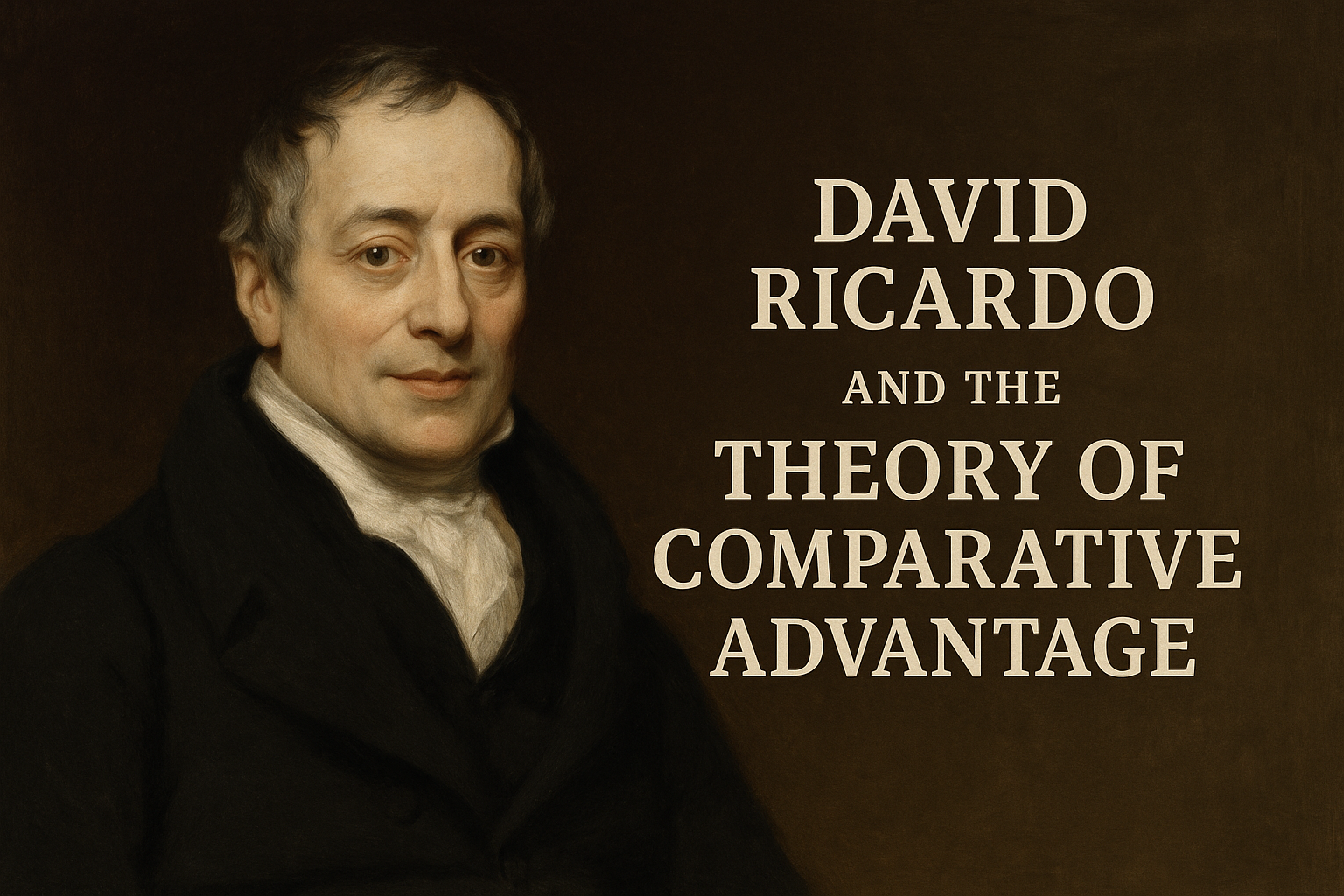
David Ricardo was a British political economist renowned for formulating the Theory of Comparative Advantage. This theory, introduced in the early 19th century, remains a fundamental concept in international trade economics. Ricardo’s innovative ideas challenged existing economic thought and provided a compelling rationale for why nations engage in trade and how they benefit from it even when one country is more efficient in producing all goods than its trading partners. By focusing on comparative rather than absolute advantage, Ricardo’s theory shifted the perspective from individual nation productivity to the efficiency and relative opportunity costs of producing different goods. Understanding the origins and implications of Ricardo’s theory offers insight into global trade dynamics, making it a critical study in the field. This article delves into the nuances of comparative advantage, examining its historical context, theoretical foundations, practical implications, and enduring relevance in today’s complex global marketplace. Through this in-depth exploration, we aim to clarify how Ricardo’s theory influences contemporary economic strategies and decisions and the broader economic landscape, offering insights into the mechanics of international trade and the economic interdependence of nations.
Historical Context of Ricardo’s Theory
In the early 1800s, the economic landscape was primarily influenced by mercantilist views, which suggested that national prosperity was achieved by maximizing exports and minimizing imports to accumulate precious metals. Challenging these beliefs were views from emerging classical economists, including Adam Smith, who proposed that free trade maximizes a nation’s wealth. David Ricardo introduced a new perspective that advanced these ideas. Drawing inspiration from Smith’s Theory of Absolute Advantage, Ricardo offered an explanation emphasizing how and why countries benefit from trade based not solely on productivity but on relative efficiency and opportunity cost differences between nations.
Ricardo’s theories arose in a period marked by Britain’s rise as a dominant global power, experiencing rapid technological advancements and expanding global trade routes. The industrial revolution further fueled the need to understand trade dynamics, as British industries, hungry for raw materials and new markets, asserted the imperative for free trade policies. This historical backdrop served as a ripe environment for Ricardo’s formulation, demonstrating the profound desire for logical explanations of why nations benefit from open markets and cross-border exchange.
Theoretical Foundations of Comparative Advantage
The Theory of Comparative Advantage is premised on the idea that it is beneficial for nations to trade even if one nation holds an absolute advantage in producing all products compared to another nation. It hinges on the concept of opportunity cost—the cost of forgoing the next best alternative when making a decision. In Ricardo’s model, if a country can produce a good at a lower opportunity cost than another, it has a comparative advantage in producing that good.
To illustrate, consider two countries—England and Portugal—with two products: cloth and wine. If England is relatively less efficient at producing wine than cloth compared to Portugal, and Portugal is relatively less efficient at producing cloth than wine compared to England, Ricardo’s theory would suggest that England should specialize in producing cloth and Portugal in producing wine. The two countries should then trade these goods. Specialization and trade, according to comparative advantage, optimize the total economic output and benefit both countries, allowing them to consume beyond their production possibilities.
This emphasis on opportunity cost differentiated Ricardo’s theory significantly from Smith’s absolute advantage. Absolute advantage looks at the straightforward ability to produce more of a good with the same resources, while comparative advantage illustrates more nuanced incentives for trade based on relative efficiencies, broadening the understanding of how nations benefit from engaging in global markets.
Mathematical Representation and Analysis
Ricardo’s comparative advantage can be conveyed through mathematics, using productivity ratios to determine the most efficient allocation of resources. Suppose England takes one day to produce a unit of cloth and two days per unit of wine, while Portugal takes three days for cloth and one for wine. Although England has an absolute advantage in both goods because it uses fewer days, the comparative advantage for England lies in cloth (lower opportunity cost). At the same time, Portugal’s comparative advantage is in wine.
By allocating resources according to comparative advantage, England and Portugal enhance overall productivity. Engaging in trade, they can enjoy a greater quantity of both goods than if each attempted to produce both goods in isolation, demonstrating an economic principle that markets benefit from specialization and exchange based on comparative rather than absolute metrics.
Economic Implications of Comparative Advantage in International Trade
The implications of the Theory of Comparative Advantage have had a profound impact on shaping modern economic policies, emphasizing the importance of specialization and global trade networks. Through trade liberalization and the reduction of trade barriers, nations can exploit natural and acquired efficiencies, a central principle underpinning free trade agreements and international economic cooperation.
Comparative advantage explains why countries focus on industries where they hold relative efficiency, promoting economic interdependence. For instance, many developed nations concentrate on technology and capital-intensive sectors, while developing countries may emphasize labor-intensive industries. This specialization drives economic growth, innovation, and technological advancement, contributing to improved global welfare, raising living standards, and increasing opportunities for innovation.
Contemporary Relevance and Critiques
Despite its intellectual allure and practical application, the Theory of Comparative Advantage faces contemporary scrutiny in an ever-evolving economic environment. Critics argue that the theory oversimplifies complex international trade dynamics by assuming constant returns to scale and ignoring transportation costs, trade barriers, and the diversification benefits of a broad industry concentration.
Moreover, the global economy has shifted towards more advanced services and digital technologies, challenging traditional assertions of comparative advantage. The increased integration of markets, alongside shifts in geopolitical power dynamics and protectionist trends, has raised questions regarding the sustainability and fairness of comparative advantage-based trade. Issues such as inequality, environmental concerns, and labor rights further complicate the oversimplified focus on trade efficiencies.
Nonetheless, the Theory of Comparative Advantage remains a cornerstone of economic analysis. It provides a vital framework for understanding trade relationships, forming the foundation of economic models that anticipate the long-term impacts of trade policies, highlighting both the benefits and potential constraints of interconnected economies.
Conclusion
The Theory of Comparative Advantage, as formulated by David Ricardo, remains integral to the discourse on international trade. By shifting focus from absolute advantages in production to comparative efficiencies across industries, Ricardo revolutionized economic thought, explaining why mutually beneficial trade can occur even between nations with disparate technological capabilities.
The historical context of Ricardo’s era, marked by the industrial revolution and a growing acknowledgment of the benefits of trade liberalization, underscored the theory’s relevance. Despite criticisms due to its assumptions not entirely reflecting present economic complexities, the theory’s foundational precepts sustain its utility in examining global trade patterns. By emphasizing opportunity costs and specialization, comparative advantage highlights the principle of generating the most significant overall benefit through resource allocation and specialization. David Ricardo’s pioneering idea, emphasizing relative efficiency and trade benefits, continues to resonate in modern economic discussions, illustrating the profound and lasting impact of his theory.
Ultimately, Ricardo’s theory underscores the interdependencies and shared efficiencies that shape today’s global marketplace. While evolving economic conditions necessitate adaptations and nuanced policies, comparative advantage remains an enduring lens through which international trade is evaluated, fostering a deeper understanding of the pivotal mechanisms driving economic integration and growth.
Frequently Asked Questions
1. Who was David Ricardo and what is the Theory of Comparative Advantage?
David Ricardo was a prominent British political economist in the early 19th century, celebrated for his significant contributions to economic thought. Among these contributions, the Theory of Comparative Advantage stands out as a cornerstone in the field of international trade economics. This theory proposes that even if a nation is less efficient at producing all goods compared to another country, it can still engage in beneficial trade by focusing on the production of goods where it has a relative efficiency advantage. Essentially, it suggests that countries should specialize in the production of goods that they can produce most efficiently relative to others, and then trade with other nations to obtain goods that might be produced less efficiently within their borders.
2. How does the Theory of Comparative Advantage differ from Absolute Advantage?
The Theory of Comparative Advantage is often compared to the concept of Absolute Advantage, but they are distinct ideas in economic theory. Absolute Advantage refers to a country’s ability to produce more of a good using the same amount of resources than another country. In contrast, Comparative Advantage doesn’t focus on the overall capability to produce more but rather on the relative efficiency or cost of producing goods. While Absolute Advantage can lead to beneficial trade, the magic in Ricardo’s theory is that it shows how trade can be beneficial even when one country holds an absolute advantage in producing all goods. Through Comparative Advantage, each country specializes and trades based on not absolute efficiency, but in producing goods with the lowest opportunity cost, leading to better allocation of global resources and increased overall welfare.
3. Why is the Theory of Comparative Advantage still relevant today?
Despite being introduced in the early 19th century, the Theory of Comparative Advantage is still remarkably relevant in today’s global economy. Modern international trade often shows countries engaging in exchange not because one country cannot make a product, but because the economics of comparative efficiency dictate that it’s more advantageous for countries to focus on industries where they hold comparative efficiencies. This theory underpins many of today’s trade policies, agreements, and economic strategies, offering the rationale for global trade—even in sectors within which all participating countries are competent. It supports diverse economic partnerships and helps nations leverage their unique strengths, resulting in mutual economic benefits and global economic integration.
4. Can you give a simple example to illustrate Comparative Advantage?
Sure! Consider two countries: Country A and Country B. Country A can produce both wine and cheese, but it does so very efficiently. Country B also makes wine and cheese, but it’s more efficient at making cheese than wine. Despite Country A being better at making both products, according to the Theory of Comparative Advantage, Country A should specialize in producing wine, where it holds the most relative efficiency or lowest opportunity cost. Meanwhile, Country B should focus on producing cheese. After production, they can trade: Country A sells wine to Country B, and Country B sells cheese to Country A. This arrangement ensures each country is making the best use of their resources, increasing overall consumption possibilities compared to if each country tried to produce both goods self-sufficiently.
5. What criticisms are often directed at the Theory of Comparative Advantage?
While the Theory of Comparative Advantage is a foundational element of international trade theory, it is not without its criticisms. Critics often point out that it relies on assumptions that may not hold true in the real world, such as the absence of transportation costs, perfect mobility of factors of production, and constant returns to scale. Additionally, the theory assumes that trade patterns are solely determined by comparative costs and efficiency, neglecting other important factors such as technology, economies of scale, and complex global value chains that also influence trade dynamics. Furthermore, critics argue that the theory doesn’t account for the potential negative impacts of trade, such as job losses in industries where a country no longer competes. Despite these criticisms, the fundamental insights of comparative advantage continue to play a crucial role in shaping modern trade policies.