
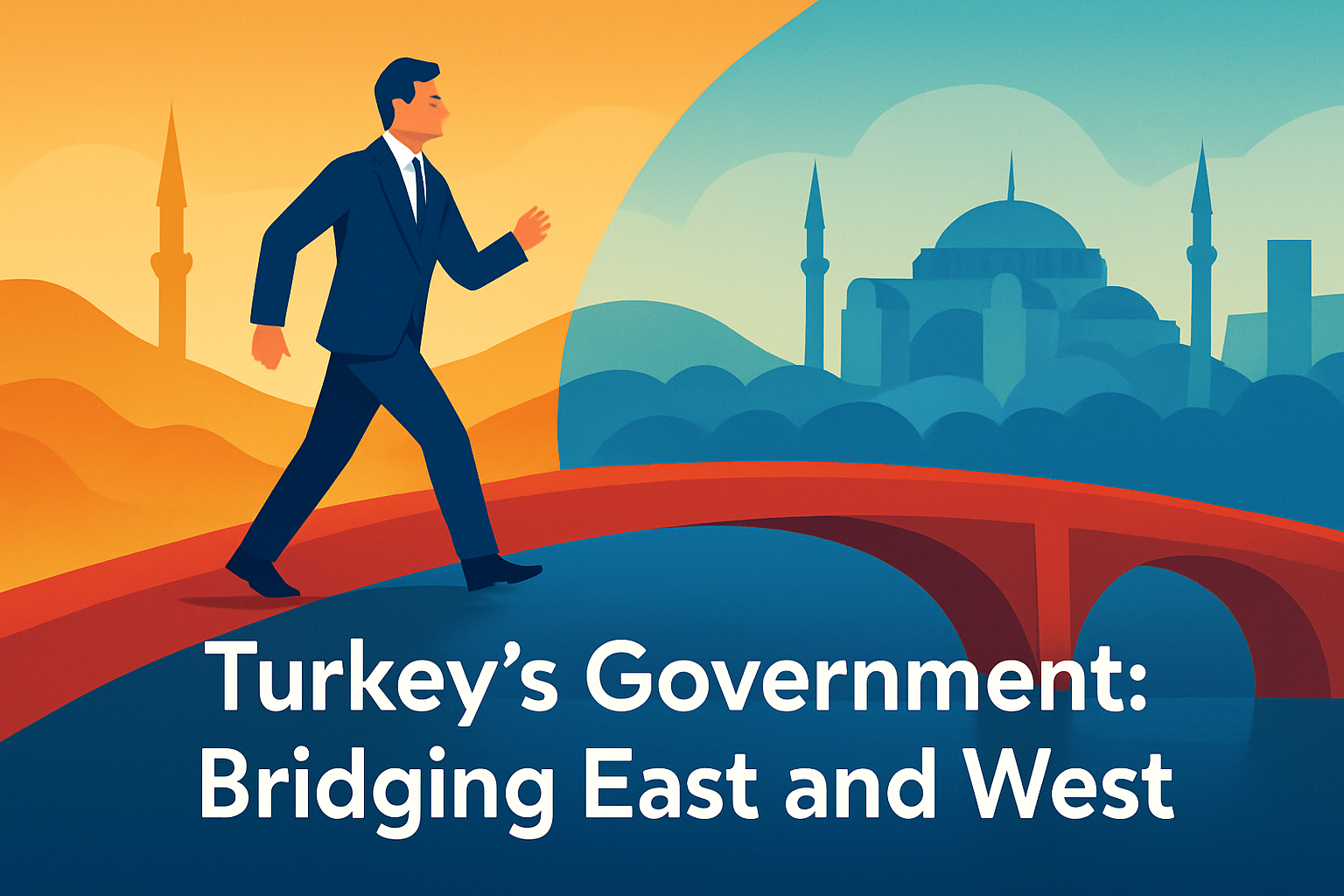
Introduction: The Significance of Turkey’s Government
Turkey, a nation that lies at the crossroads of Europe and Asia, holds a unique place on the global stage. This geographical positioning impacts not only its culture and society but also significantly influences its political landscape and international relations. Understanding Turkey’s government is crucial because it acts as a pivotal link bridging eastern and western political ideologies and economic strategies, impacting global diplomacy.
The government of Turkey operates under a presidential system, having transitioned from a parliamentary system in 2018. This change was marked by a constitutional referendum aimed at bolstering executive powers. Key terms like ‘presidential system’, ‘geopolitical significance’, and ‘cultural mediation’ are essential to comprehending Turkey’s role as a mediator between various interests globally.
Exploring the governmental framework of Turkey reveals insights into how it maneuvers political, cultural, and economic challenges, engaging both eastern and western political paradigms. This understanding not only clarifies Turkey’s internal mechanisms but also highlights its role as a strategic player in international affairs.
The Evolution of Turkey’s Political System
In recent years, Turkey’s government has undergone significant evolution. Historically operating under a parliamentary system, the 2017 constitutional referendum marked a significant transition. Spearheaded by the ruling Justice and Development Party (AKP), the referendum proposed various amendments, transitioning the government into a presidential system.
Before this transition, the Turkish political system was characterized by a Prime Minister-led government, with power shared between the executive and legislative branches. The new system consolidates the head of state and government roles, providing the President with substantial executive authority previously reserved for legislative bodies.
This shift aimed at creating a more streamlined decision-making process to respond swiftly and effectively to both domestic issues and international diplomacy challenges. It’s useful to compare Turkey’s system to that of other nations that have undergone similar transformations, reflecting the broader trend of evolving governmental frameworks across Europe and Asia.
Turkey as a Geopolitical Player
Turkey’s strategic location makes it a crucial geopolitical player. It shares borders with countries like Greece, Syria, and Iran, directly affecting regional stability in both Europe and the Middle East. The government’s policies often reflect a blend of eastern and western ideologies, showcasing a unique diplomatic balance.
This is particularly evident in Turkey’s involvement with NATO. As a member since 1952, Turkey plays a critical role in regional defense strategies and alliances. However, its strategic partnerships also extend eastward, maintaining robust energy and economic agreements with Russia and China. This dual orientation helps illustrate Turkey’s ability to mediate between differing geopolitical interests, serving as a bridge in international negotiations.
Economic Policies and Cross-Continental Trade
Economically, Turkey has leveraged its position to enhance trade relations across continents. The government implements policies that facilitate cross-border trade, promoting Turkey as a key trade hub between Europe and Asia.
A practical example is the Belt and Road Initiative, where Turkey plays a pivotal transit role. By participating actively, the government boosts infrastructure development, enhancing trade routes that connect Asia with Europe. This involvement positions Turkey as a significant player in decisions shaping global economic trends.
- Economic integration with the European Union
- Partnerships in technology advancements
- Cultural and educational exchanges enhancing trade relations
Turkey’s Domestic Politico-Cultural Dynamics
Domestically, Turkey’s government continuously navigates a complex tapestry of cultural diversity. This diversity informs its internal policies, balancing secular ideologies with Islamic influences, a reflection of its historical and cultural heritage.
The government’s approach often involves promoting inclusive policies that accommodate various ethnic groups while upholding Turkey’s secular framework established under founding leader Mustafa Kemal Atatürk. This balancing act is crucial for maintaining national unity amid diverse cultural and religious climates.
Cultural Mediation between East and West
A unique role of Turkey’s government is its cultural mediation, aiding in diplomatic relations and soft power strategy. As a nation with deep-rooted historical ties to both Europe and Asia, Turkey effectively communicates between diverse cultural viewpoints.
This cultural diplomacy is evident in international forums and collaborations where Turkey contributes insights derived from both eastern and western paradigms. By bolstering mutual understanding, Turkey enhances its geopolitical narrative, furthering its influence on the world stage.
Conclusion: The Balanced Path Forward
Turkey’s government, with its nuanced blend of political strategy and cultural integration, plays an ever-essential role in linking east and west. The government’s evolutionary political structure reflects its ambition to operate dynamically within an ever-shifting global landscape.
As Turkey continues to advance its economic policies and strengthen international alliances, it remains a powerful influence in the orchestration of global diplomacy. For those interested in harnessing Turkey’s strategic insights, exploring collaborative opportunities in technology, defense, and economic initiatives could pave the way for impactful partnerships.
Frequently Asked Questions
1. What role does Turkey’s government play in bridging Eastern and Western political ideologies?
Turkey’s government is uniquely positioned due to its geographical location that straddles both Europe and Asia. This positioning enables it to be a critical player in bridging Eastern and Western political ideologies. Historically rooted in a tapestry of diverse cultures, Turkey’s governance reflects a blend of Eastern and Western influences. Through its membership in international organizations such as NATO (a predominantly Western alliance) and its aspirations to join the European Union, Turkey seeks to harmonize western democratic principles with its Eastern traditions. The government plays a diplomat’s role, standing as a mediator on issues that transcend these spheres, from regional conflicts to trade negotiations. This diplomatic balancing act allows Turkey to act as a facilitator for dialogue, offering platforms and mediating peace talks in contentious areas. By doing so, Turkey’s government exemplifies a model of governance that can adapt and integrate the complexities of different political ideologies, fostering cooperation and understanding in a global context.
2. How does Turkey’s government impact the economic strategies between Europe and Asia?
Turkey’s government wields significant influence over economic strategies between Europe and Asia due to its strategic location and rapidly growing economy. Acting as a gateway for trade between the continents, Turkey’s economic policies, infrastructure investments, and trade agreements are pivotal in facilitating the movement of goods and capital. The government supports initiatives to enhance transport connectivity such as the development of rail projects like the Marmaray rail tunnel under the Bosphorus, which connects Asia and Europe. Furthermore, the government’s policies often aim to attract investments from both sides, balancing relationships to ensure mutually beneficial economic outcomes. Turkey’s participation in various trade and economic councils with European and Asian nations also illustrates its commitment to maximizing its pivotal position. Export strategies and free trade agreements designed by the government demonstrate its role in maintaining robust trade ties and enhancing Turkey’s standing as a central juncture of economic exchange. Thus, through these concerted efforts, Turkey’s government significantly contributes to shaping a cohesive and interconnected economic landscape bridging Europe and Asia.
3. In what ways does Turkey’s government influence global diplomatic relations?
At the heart of global diplomacy, Turkey’s government is adept at influencing international relations by leveraging its geographic and cultural position. As a nation where cultures and continents converge, Turkey is often at the forefront of diplomatic initiatives aimed at conflict resolution and international dialogue. The government actively participates in international bodies such as the United Nations and the Organization of Islamic Cooperation, promoting peace and cooperation across divides. Turkish diplomacy is particularly noted for attempting neutrality in conflicts and fostering dialogue between diverse political entities. This makes Turkey an appealing mediator for international disputes, as evidenced by its involvement in the Syrian conflict and dialogues concerning the Eastern Mediterranean tensions. Furthermore, Turkey’s government regularly hosts international summits and conferences, reinforcing its crucial role in fostering collaborative diplomatic exchanges. By prioritizing these facets, the Turkish government indeed serves as a bridge in global diplomacy, advancing its agenda of connectivity and multilateral understanding on the world stage.
4. How does Turkey’s position influence its cultural and societal dynamics?
Turkey’s role as a bridge between East and West immensely influences its cultural and societal dynamics, creating a rich tapestry of diversity. Geographically, Turkey encompasses elements of both Europe and Asia, a factor that is mirrored in its vibrant blend of cultural traditions, languages, and societal norms. This cultural amalgamation is a cornerstone in the Turkish government’s policies that foster inclusivity and multiculturalism. The government supports cultural initiatives and educational programs that promote understanding of different traditions and histories, ensuring that both Eastern and Western cultural heritages are celebrated and preserved. This is evident in Turkey’s bustling cities like Istanbul, where one can witness the seamless integration of ancient traditions with modern advancements, an embodiment of its geographical duality. Consequently, Turkey serves not only as a geographical bridge but also as a beacon of cultural solidarity and societal innovation. By nurturing these multifaceted dynamics, Turkey’s government plays a pivotal role in the cultivation and celebration of a culture that thrives on diversity and inclusion.
5. What challenges does Turkey’s government face in its position as a bridge between East and West?
While Turkey’s role as a juncture between East and West comes with numerous advantages, it also presents various challenges for the government. Politically, Turkey is tasked with harmonizing vastly different alliances and interests, which sometimes results in geopolitical tensions. Balancing its role in NATO with its neighboring relations in the East often requires diplomatic dexterity, with the government frequently navigating conflicting foreign policy priorities and responses to regional instability. Economically, this bridge role sometimes places Turkey at the center of competing trade policies and regulatory standards from both Europe and Asia. Besides, managing cultural diversity also presents internal challenges. The government must maintain social cohesion and manage ethnic and sectarian differences within its borders while promoting wider integration. These challenges necessitate a stable and strategic governance approach, aiming to leverage Turkey’s unique position for long-term national and regional stability. In essence, Turkey’s government faces the ongoing task of negotiating these intricacies while reaffirming its commitment to being a pivotal and constructive actor on the global stage.