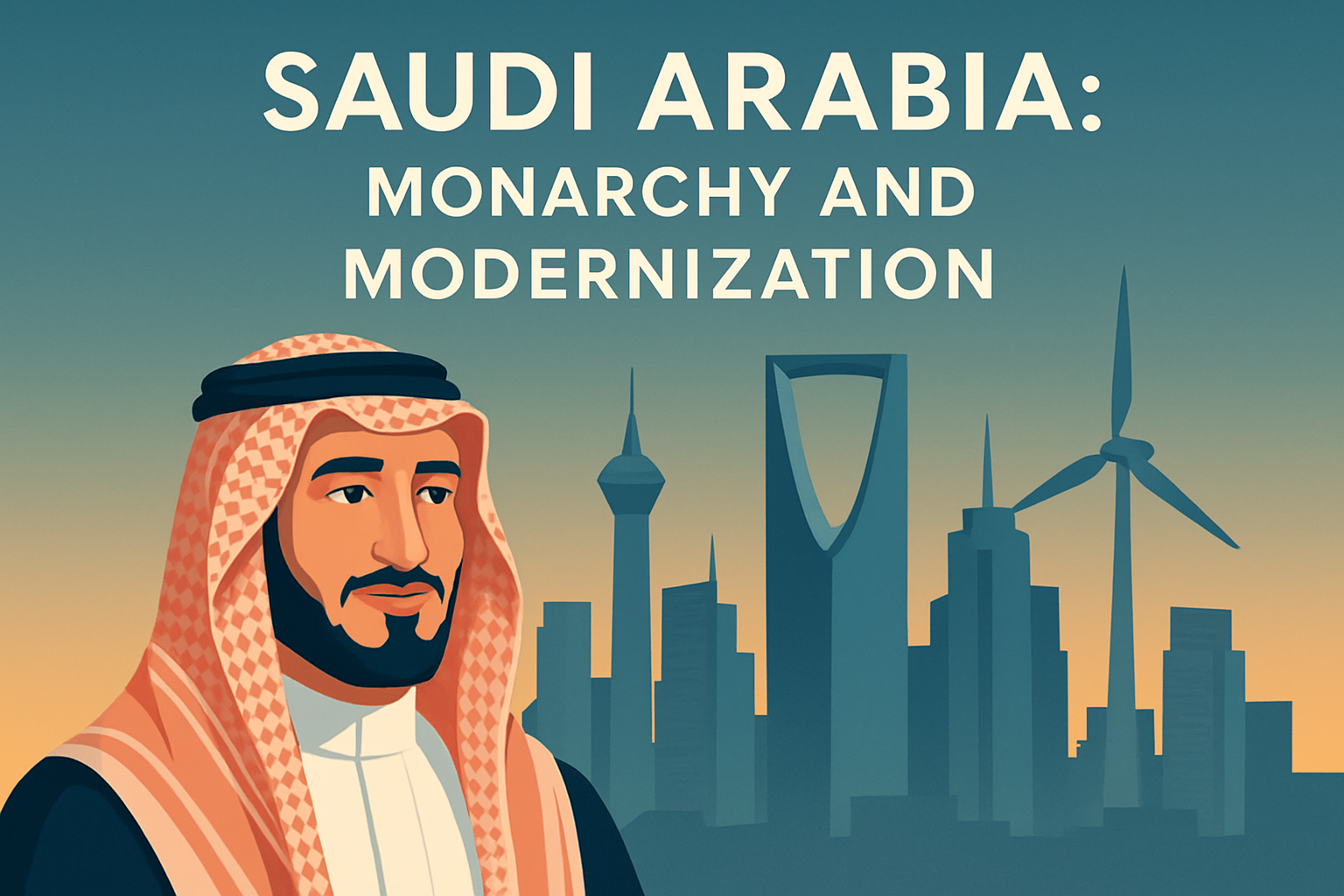
Introduction to Saudi Arabia: Monarchy and Modernization
Saudi Arabia, a nation deeply rooted in its monarchical structure, is also in the midst of an ambitious modernization campaign. Understanding Saudi Arabia involves recognizing its dual identity: a traditional monarchy that serves as a custodian of Islam’s holiest sites, and a rapidly modernizing state seeking to diversify its economy and expand its international influence. This dual identity is not only fascinating for scholars and observers alike, but crucial for businesses, policymakers, and global citizens aiming to engage in the broader Middle Eastern arena. As the kingdom transitions from an oil-dependent economy to one more diversified and sustainable, it occupies a pivotal role in shaping regional geopolitics and global economic trends.
The Monarchical System: A Bedrock of Saudi Governance
At the heart of Saudi Arabia’s political system is its monarchy, a hereditary rule under the al-Saud family, extended to multiple generations. King Salman bin Abdulaziz Al Saud reigns as the head of this monarchy, representing a model where political power is centralized and consolidated within royal structures. Decisions emanating from this system affect not only domestic policies but reverberate throughout the Gulf region and beyond. Compared to its Gulf neighbors, Saudi Arabia’s monarchical system is distinguished by its scale and its role as the leader of the Organization of the Petroleum Exporting Countries (OPEC), significantly influencing global oil markets.
For instance, the accession of Crown Prince Mohammed bin Salman (MBS) marked a transformative phase in Saudi politics. His Vision 2030 initiative seeks to modernize the Saudi economy and reduce its dependency on oil by fostering new sectors such as tourism, entertainment, and technology. This has included significant reforms, such as allowing women to drive and opening the country to international tourism, showcasing the monarchy’s adaptive capabilities.
Economic Modernization: From Oil Dependency to Diversification
The Vision 2030 initiative is Saudi Arabia’s blueprint for economic diversification. At its core lies the intention to shift from an oil-centric economy to a more varied one, integrating renewable energy, logistics, and digital technology sectors. This ambitious undertaking is spearheaded by the Public Investment Fund, which aims to elevate the kingdom’s status as a global investment powerhouse.
An example of this modernization effort is the NEOM project, a planned cross-border city in the Tabuk Province, powered entirely by renewable energy. NEOM is envisioned to become a hub for innovation, leveraging cutting-edge technologies to enhance living standards and bolster economic growth. This highlights a paradigm shift where Saudi Arabia seeks to transform its economic landscape by aligning with global sustainable development goals.
Social Reforms: Aligning Tradition with Progress
Under the leadership of Crown Prince Mohammed bin Salman, Saudi Arabia has embarked on significant social reforms, striving to balance traditional Islamic values with the demands of modernization. These reforms are critical for fostering a more inclusive society that promotes the role of women and embraces cultural openness.
A notable reform is the lifting of the ban on women driving, a policy change that symbolizes broader efforts to empower women in Saudi society. Additionally, the introduction of cinemas and entertainment complexes marks a shift towards a more vibrant cultural landscape, inviting international artists and encouraging cultural exchanges.
Cultural Renaissance: Envisioning a New Era
Saudi Arabia’s cultural renaissance is a vital element of its modernization strategy, embracing both Arab heritage and global cultural influences. By hosting global events such as the Dakar Rally and the MDL Beast music festival, the kingdom aims to position itself as a cultural and entertainment hub in the region.
This renaissance is evident in the development of the King Abdulaziz Center for World Culture, known as Ithra. This state-of-the-art institution serves as a beacon of cultural exchange, featuring exhibitions, workshops, and performances that celebrate both regional and international art forms.
- Hosting international film festivals
- Investing in art and cultural museums
- Building local creative industries
Geopolitical Influence: A Regional Powerhouse
Saudi Arabia’s modernization efforts also entail a heightened geopolitical role, asserting its influence in Middle Eastern affairs and beyond. As a major oil producer and a key player in the Islamic world, the kingdom’s foreign policy maneuvers carry significant weight.
For instance, Saudi Arabia’s role in mediating regional conflicts and fostering alliances underscores its growing diplomatic presence. The kingdom’s efforts to normalize relations with Israel and its leadership in the Gulf Cooperation Council represent deliberate strategies to bolster its geopolitical clout.
Challenges and Controversies: Navigating a Complex Transition
Modernization in Saudi Arabia is not without its challenges and controversies. The kingdom faces the delicate task of balancing rapid reform initiatives with traditional values and addressing human rights concerns raised by international observers.
Critics point to ongoing restrictions on freedom of expression and political dissent as areas needing attention. Nonetheless, the government’s commitment to unprecedented economic and social changes reflects a broader effort to redefine Saudi Arabia’s identity on the global stage.
Conclusion: Embracing the Future with Strategic Insight
Saudi Arabia’s journey towards modernization, while rooted in its enduring monarchical legacy, exemplifies a transformative vision aimed at redefining its economic and social paradigms. The kingdom’s leadership recognizes the necessity of adapting to global trends while preserving core values, ensuring that Saudi Arabia remains a pivotal player in the international community.
For individuals and businesses interested in navigating this dynamic landscape, understanding Saudi Arabia’s modernization is crucial. By embracing strategic partnerships and recognizing the kingdom’s evolving role, stakeholders can effectively engage with one of the most influential nations in the Middle East.
As Saudi Arabia continues to evolve, the synergy between tradition and modernity offers a unique lens through which to view its remarkable transformation journey.
Frequently Asked Questions
1. What is the structure of the monarchy in Saudi Arabia?
The structure of the monarchy in Saudi Arabia is a traditional and absolute system, deeply intertwined with the Islamic faith. The country is ruled by the Al Saud family, with the King acting as both the head of state and government. This hereditary system means that the throne typically passes down within the family, although it is not strictly linear; instead, it often involves selection from among eligible males within the royal family. The King wields substantial power over both political and religious matters and appoints the Crown Prince, who is often viewed as the heir apparent.
In Saudi Arabia, the monarchy functions under Sharia law, which influences both the legal and social landscape of the country. This intertwining of religion and governance further centralizes power. Recent years have seen significant initiatives to modernize and diversify governance structures, including the introduction of councils and advisory committees that aim to streamline decision-making processes while still maintaining the monarchy’s absolute power.
2. How is Saudi Arabia managing its modernization while staying true to its traditional roots?
Saudi Arabia’s ambitious modernization efforts, spearheaded by Vision 2030, aim to diversify the economy beyond oil and embrace technological advancements and societal reforms. At the same time, the kingdom is committed to preserving its cultural and religious heritage. This balance is maintained through a series of strategic initiatives that align with both Islamic principles and modern socio-economic aspirations.
Education and employment opportunities are being expanded, especially for women, reflecting a modern, inclusive approach while maintaining respect for Saudi customs. Technological innovation is encouraged, with substantial investments in digital infrastructure, yet developments are closely aligned with cultural sensitivities. Cultural reforms, such as allowing entertainment venues and broader social freedoms, are carefully managed to respect traditional values. By creating an economic and social blueprint through comprehensive plans like the National Transformation Program, the kingdom aspires to create an environment where tradition and modernity coexist harmoniously.
3. How does Saudi Arabia’s role as a custodian of Islam influence its modernization initiatives?
Saudi Arabia’s role as a custodian of Islam’s holiest sites—Mecca and Medina—profoundly influences its internal and external policies. The country holds significant religious authority, which it aims to preserve even amid accelerating modernization efforts. This religious responsibility often requires maintaining alignment with traditional values while implementing reforms.
Modernization initiatives are therefore pursued with a deep awareness of religious context. Economic diversification, such as through tourism, includes developing religious tourism, providing sophisticated amenities for pilgrims while protecting religious sanctity. Educational reforms incorporate Islamic teachings while promoting skills relevant to a modern economy. Furthermore, Saudi Arabia actively invests in religious and cultural diplomacy, signaling its ongoing commitment to religious leadership, even as it becomes a global economic contender.
4. What are the main economic diversification strategies of Saudi Arabia?
Saudi Arabia is focusing on several key strategies to diversify its economy away from oil dependency, outlined in its Vision 2030 plan. One of the major goals is to develop the country into a global investment powerhouse, which involves establishing a vibrant financial sector and increasing foreign investment through streamlined regulations and various economic incentives.
The tourism and entertainment sectors are seeing significant investment, aiming to attract international visitors while providing opportunities for domestic tourism. The country is also expanding its industrial base by investing in sectors like renewable energy, technology, and manufacturing, aiming to create jobs and sustain growth in a post-oil era. Furthermore, the integration of advanced digital solutions and innovation-driven industries forms the crux of Saudi Arabia’s strategy to foster a knowledge-based economy, balancing economic expansion with employment growth and skills development.
5. How is Saudi Arabia’s international influence affected by its modernization efforts?
Saudi Arabia’s modernization efforts are reshaping its role on the global stage, enhancing its international influence through proactive economic and diplomatic strategies. These initiatives signal to the world that Saudi Arabia is moving towards a more open and progressive economy, potentially attracting increased foreign investment and partnerships.
The country is leveraging its strategic geopolitical positioning, acting as a cultural and religious leader in the Muslim world, while simultaneously broadening its alliances through participation in global economic forums such as the G20. Hosting international events, like the Future Investment Initiative, further showcases Saudi Arabia’s commitment to transforming its economy through global collaboration. Balancing modernization with maintaining cultural identity enhances its soft power, allowing Saudi Arabia to project a modern image that respects traditional values, thereby expanding its international influence.
Moreover, engaging in these modernization efforts not only strengthens its economic sovereignty but also fortifies its geopolitical standing, enabling Saudi Arabia to wield greater influence in regional and global affairs.