
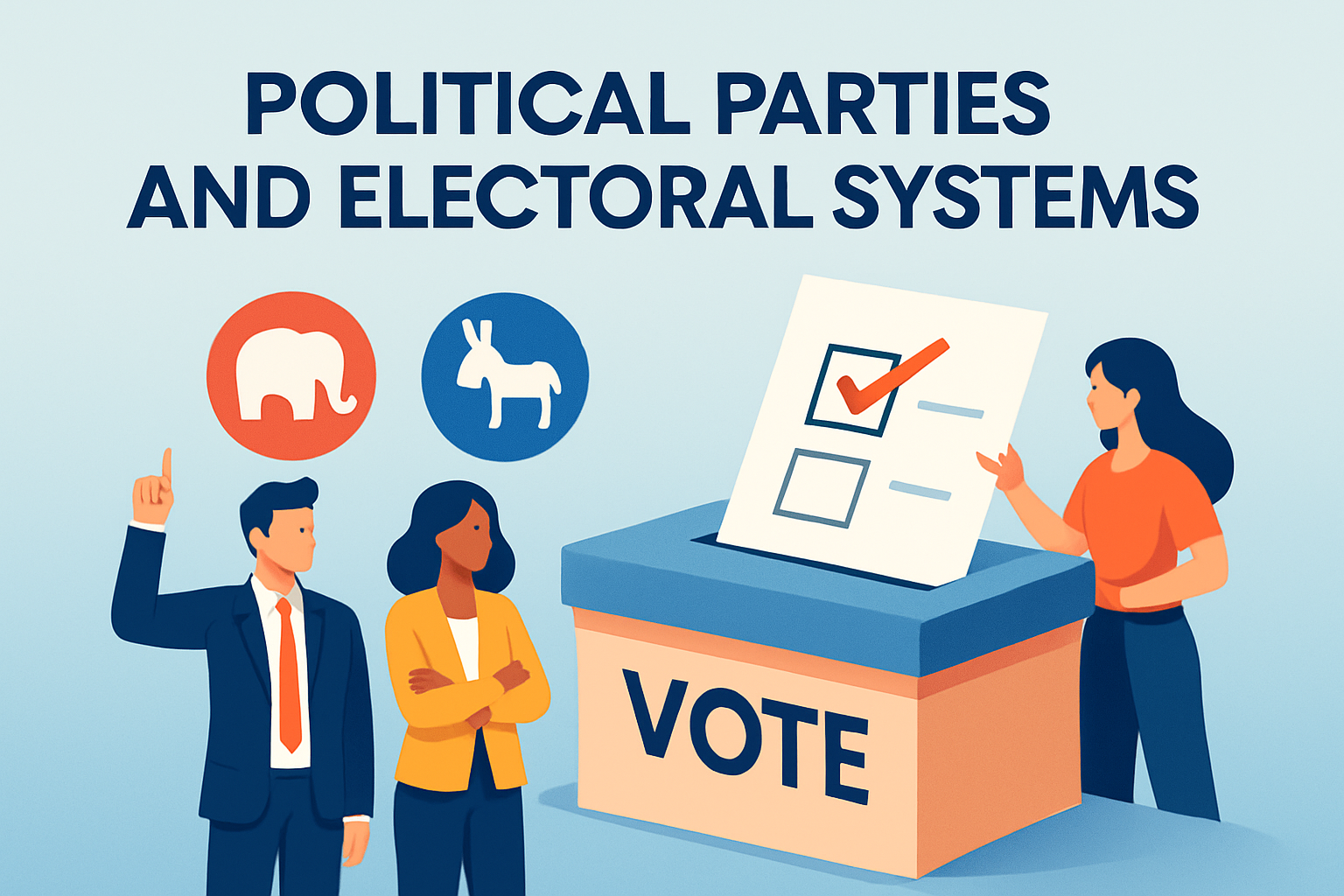
Politics is a fundamental aspect of human society, shaping governance, policies, and the distribution of power. At the core of political processes are political parties and electoral systems, both of which significantly affect how societies are structured and governed. Political parties are groups organized to gain and wield political power, whereas electoral systems dictate how votes are translated into seats in legislative bodies. Understanding these concepts is essential as they determine the democratic health and political stability of nations. This article explores the interplay between political parties and electoral systems, demonstrating their importance in shaping the political landscape.
Understanding Political Parties
Political parties are the backbone of democratic systems, serving as platforms for various political ideas and ideologies. These parties organize and simplify complex political landscapes for voters by presenting distinct choices during elections. Political parties can vary widely in terms of their structure, ideology, and goals, greatly influencing how they interact with electoral systems and the resulting governance.
A prime example of the role of political parties is evident in the United States, where the Democratic and Republican parties dominate. Both parties offer different platforms and policy proposals, reflecting divergent views on governance, economy, healthcare, and more. These parties help structure political debates, mobilize voters, and influence legislative agendas. Understanding their influence is critical for analyzing policy outcomes and government actions.
Different Electoral Systems
Electoral systems determine how votes cast by the electorate are converted into seats for candidates and political parties. There are several types of electoral systems, each with distinct mechanisms and implications for political representation.
The most common electoral systems include:
- First-Past-the-Post (FPTP): A candidate with the most votes wins. This system is prevalent in countries like the United States, United Kingdom, and Canada.
- Proportional Representation (PR): Seats are allocated based on the percentage of votes each party receives. Countries like Germany and Sweden use this system.
- Mixed-Member Proportional (MMP): Combines elements of FPTP and PR, offering a balance between individual representation and party proportionality. New Zealand is known for using this system.
Each system has its strengths and weaknesses, impacting party dynamics and political representation. For instance, FPTP often leads to a two-party system, while PR encourages multi-party systems with more diverse representation.
Impact of Electoral Systems on Political Parties
Electoral systems significantly shape political landscapes by influencing how political parties function and are organized. The choice of electoral system has implications on the number of viable political parties, the type of campaigns conducted, and ultimately, the legislative efficiency in governance.
Proportional Representation tends to support multiple political parties, as seen in the multiparty coalitions of Germany’s Bundestag. This system enables smaller parties to gain seats, contributing to a broader spectrum of political representation. However, it can also lead to fragmented parliaments, requiring coalition governments that often necessitate compromise and negotiation.
In contrast, the First-Past-the-Post system commonly results in two-major-party dominance, as with the Democratic and Republican parties in the United States. This system simplifies decision-making but may reduce representation for smaller or regional parties, limiting policy diversity.
Real-World Example: The United Kingdom
The United Kingdom presents an intriguing case study of how electoral systems affect political parties. The UK employs a First-Past-the-Post electoral system for its general elections. This system has led to the dominance of two main parties, the Conservative Party and the Labour Party, which have historically alternated in power.
| Political Party | Seats Won in 2019 Election | Percent of Total Vote |
|---|---|---|
| Conservative Party | 365 | 43.6% |
| Labour Party | 203 | 32.2% |
| Liberal Democrats | 11 | 11.5% |
The FPTP system in the UK has resulted in a substantial discrepancy between the percentage of votes and the number of seats won, particularly impacting smaller parties like the Liberal Democrats. Though they secured a significant portion of votes, their representation in parliament is disproportionately low.
Significance of Electoral Reforms
Due to the uneven representation produced by some electoral systems, there are ongoing discussions about electoral reforms to enhance fairness and inclusivity in the political process. Such reforms are essential for ensuring that electoral systems adapt to societal changes and support democratic ideals.
Several countries have explored or implemented electoral reforms to mitigate the adverse effects of their existing systems. For instance, Italy transitioned from a purely proportional representation system to a mixed system to balance the need for proportionality with political stability.
Electoral reforms can include changes to voting methods, district boundaries, or the introduction of mixed or alternative electoral systems. Such reforms aim to address voter disenfranchisement, ensure equitable representation, and foster a more responsive political environment.
The Future of Political Parties and Electoral Systems
As societies evolve and face new political, social, and technological challenges, political parties and electoral systems must adapt accordingly. The future of these systems will likely be shaped by technological advancements, socio-political developments, and the growing demand for equitable representation.
Technology is playing an increasing role in shaping electoral processes. Digital voting and online campaigning have become more prevalent, raising questions about security, accessibility, and transparency. Political parties must adapt to these technological shifts to engage effectively with modern electorates.
Furthermore, a growing awareness of social justice issues and minority rights is driving demand for more inclusive electoral systems. Advocacy for reform is expected to continue as citizens increasingly call for systems that reflect diverse voices and promote equitable representation.
Conclusion and Call to Action
Political parties and electoral systems are pivotal elements of democratic governance, influencing political representation, policy-making, and societal progress. Their design and functionality significantly impact the political landscape, affecting how societies are governed and how citizens’ voices are heard.
Understanding the intricacies of political parties and electoral systems provides valuable insights into democratic processes and empowers citizens to engage more meaningfully with politics. By fostering awareness and advocating for reforms, individuals can contribute to creating fairer, more inclusive political environments.
As we navigate the complexities of modern governance, it is imperative for citizens, policymakers, and political actors to actively participate in discussions and initiatives that promote democratic integrity and representation. By prioritizing electoral reforms and engaging with political parties, individuals can help shape the future of democratic societies.
The call to action for all readers is clear: educate yourself on the political systems that impact your life, participate in the political process, and advocate for changes that align with democratic principles and fairness. Your involvement is essential to fostering robust, representative governments that truly serve their citizens.
Frequently Asked Questions
1. What is the role of political parties in a democracy?
Political parties are essential to the functioning of a democracy because they provide a structured way for citizens to express their political preferences, conduct political debates, and participate in governance. They serve several crucial roles, such as aggregating interests by bringing together people with similar ideologies or goals, which helps to simplify the electoral process for voters. Political parties also recruit and nominate candidates for public office, providing voters with clear choices during elections. Furthermore, they help in the formulation and implementation of public policy by organizing these collective interests into a coherent agenda. Finally, parties serve as a critical check on the government by holding those in power accountable through criticism and campaigning for alternate policy solutions.
2. How do electoral systems impact political representation?
Electoral systems are central to defining how votes are translated into seats in legislative bodies, and their design has a significant impact on political representation. Broadly, electoral systems can be divided into major types such as majoritarian, proportional representation (PR), and mixed systems. Majoritarian systems, like first-past-the-post, tend to favor larger political parties and can lead to a dominance of one or two-party systems, potentially limiting diverse representation. In contrast, proportional representation systems aim to reflect the diversity of the electorate more accurately by allocating seats based on the percentage of votes each party receives, which tends to allow for greater representation of smaller parties. Mixed systems try to combine features of both to balance stability and fair representation. Each system has unique trade-offs between accountability, simplicity, inclusiveness, and representation, and thus profoundly affects the nature of political competition and governance.
3. What are some common types of electoral systems and how do they function?
There are several types of electoral systems, each with distinct characteristics and mechanics. Firstly, in a majoritarian system like ‘First-Past-The-Post’ (FPTP), candidates compete in single-member districts, and the one receiving the most votes wins. This system is simple and tends to produce a clear winner, but it can disproportionately favor larger parties and marginalize smaller ones. Secondly, Proportional Representation (PR) systems, such as ‘List PR’, involve multi-member districts where parties present a list of candidates, and seats are allocated based on the proportion of the vote each party receives. This system promotes a more accurate representation of the electorate’s diversity but can lead to coalition governments and sometimes unstable governance. Single Transferable Vote (STV) is another PR method where voters rank candidates in order of preference, giving voters more direct say in the election outcome. Mixed-Member Proportional (MMP) systems combine elements of both majoritarian and proportional systems, using FPTP for some seats and PR for others, aiming to balance accurate representation with governability.
4. How does the presence of multiple political parties affect political stability and policy-making?
The presence of multiple political parties can both enhance and complicate political stability and policy-making. On one hand, multi-party systems can improve representation by incorporating a wider range of interests and viewpoints, reflecting more of the electorate’s diversity. This inclusivity can lead to more comprehensive policy-making that considers various perspectives and leads to policies with broader acceptance. However, with many parties, there is the increased likelihood of fragmented party systems, making it difficult to form stable governments. Coalitions become a necessity in such systems, requiring parties to collaborate, negotiate, and sometimes compromise their platforms to form a functioning government. This necessity can lead to diluted policies, slower decision-making processes, and sometimes unstable governments due to the potential for coalition breakdowns. However, these systems often encourage political dialogue and compromise, which can strengthen democratic practices in the long run.
5. Why do some countries choose different electoral systems and how are these choices influenced?
The choice of an electoral system in a country is influenced by several factors, including historical, political, social, and cultural contexts. Countries often select electoral systems that align with their historical experiences and democratic aspirations. For instance, a nation may adopt a proportional system if there’s a desire to reflect a heterogeneous society more accurately or to avoid the dominance of established parties, as seen in many post-conflict societies looking to integrate various factions. Political considerations also play a significant role: ruling elites might prefer systems that they perceive as beneficial to their party’s electoral success. Social factors, such as ethnic or linguistic diversity, may lead countries to choose systems that promote inclusivity and representation. Additionally, cultural factors, including political traditions, and the influence of previous colonial powers can affect this choice. Ultimately, the decision often seeks to balance competing values, promoting fairness, accountability, stability, and simplicity in different measures, tailored to the country’s specific needs and experiences.