
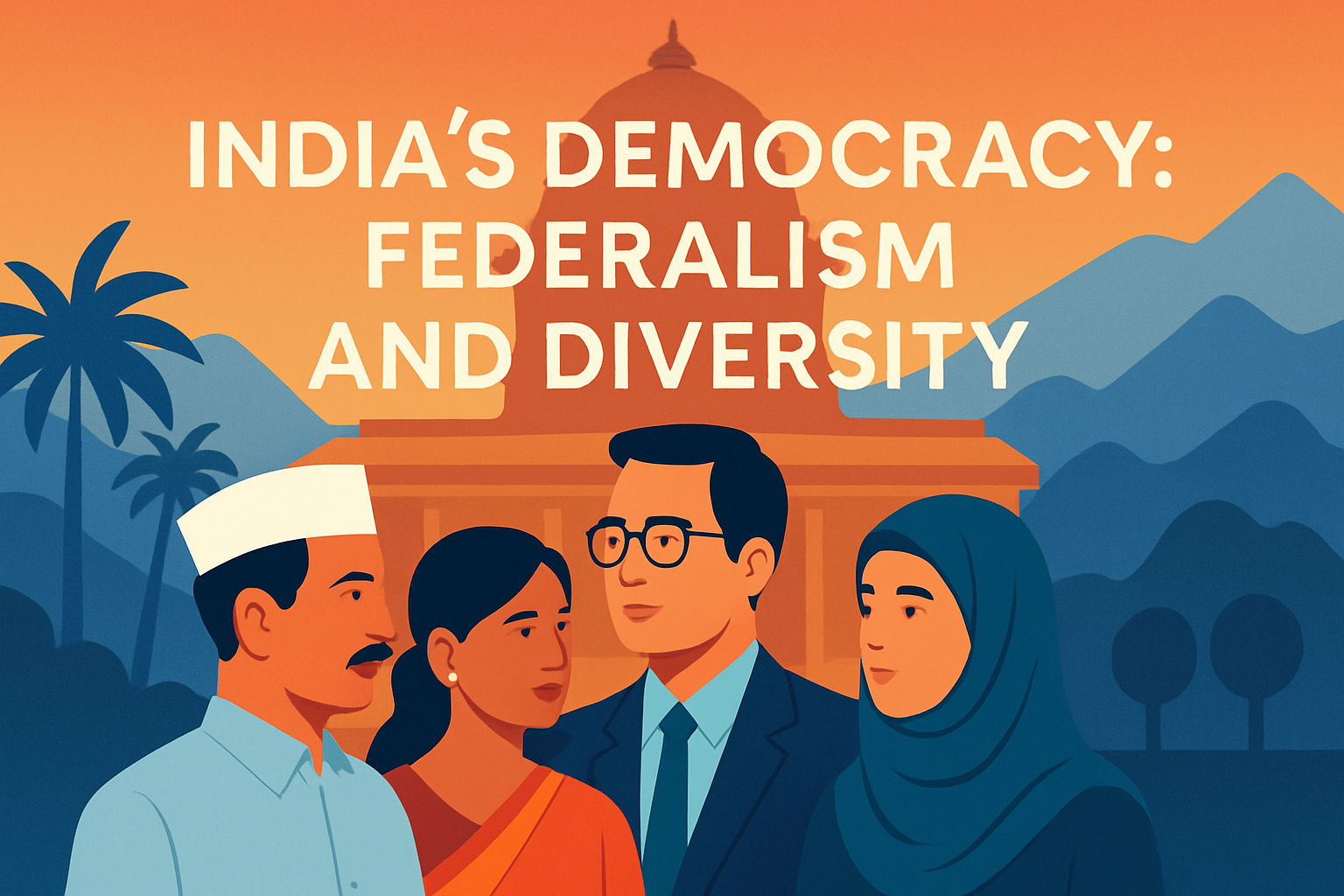
The tapestry of human governance is woven with varied threads of political systems, each representing the unique fabric of its society. Among these, democracy stands tall as a symbol of freedom, equality, and representation. When we explore democratic systems around the world, India’s democracy deserves a special mention due to its complexity and depth. But what makes India’s democracy intriguing and significant in the global context? It is the marriage of federalism and diversity that defines the essence of India’s democratic framework.
Federalism refers to a political system where power is divided between a central authority and several regional entities. It’s a constitutional dynamic enabling different regions to coexist within a single political entity while maintaining their individuality. Diversity, on the other hand, is a defining characteristic of India, a land where a multitude of cultures, languages, and religions coexist, reflecting an unbroken thread of civilization. India’s democracy thrives on federalism to manage this remarkable diversity.
The relevance of federalism and diversity in India’s democracy cannot be overstated. They form the twin pillars upon which the world’s largest democracy operates. With a population of over 1.4 billion, comprising hundreds of ethnic groups and thousands of languages and dialects, the challenge is to ensure unity while respecting the multiplicity. This complexity necessitates a robust federal structure to empower regional identities within the larger national framework.
The Framework of Indian Federalism
India’s federal system is outlined in its Constitution, which came into effect on January 26, 1950. The framers of the Constitution designed a quasi-federal structure, blending features of both federal and unitary systems. This dual nature allows the Union Government to exercise strong central powers while the states have significant autonomy. This design aims to prevent regional conflicts and promote balanced development across diverse regions.
One real-world example of India’s federal structure at work is its response to natural disasters. In times of crisis, such as the devastating Kerala floods in 2018, the central government collaborates with state governments to ensure swift relief and rehabilitation efforts. The Centre’s role in providing resources and support complements the state governments’ intimate understanding of local needs, illustrating the synergy inherent in India’s federalism.
Managing Linguistic Diversity
India is home to 22 officially recognized languages and hundreds more spoken across its breadth. Managing linguistic diversity is vital to maintaining national unity. The Indian Constitution recognizes the importance of this aspect and allows each state the power to adopt its own official language. This flexibility ensures that linguistic preferences do not become a bone of contention, as seen in the case of Tamil Nadu, which uses Tamil as its primary language for official communication instead of Hindi, the country’s most widely spoken language.
Such measures help placate regional sentiments and ensure that language, a powerful cultural identity marker, fosters diversity rather than division. Other countries with lesser linguistic diversity have faced challenges when attempting to impose a monolingual policy, unlike India, where federalism accommodates this diversity.
Religious Tolerance and Secularism
An integral component of India’s diversity is its religious multiplicity. India is home to major religions such as Hinduism, Islam, Christianity, Sikhism, Buddhism, and Jainism. The principle of secularism in India is not just about the separation of religion from politics; it is more about equal respect and protection for all religions.
The Indian state’s role in ensuring religious harmony is evident in its celebration of diverse festivals such as Diwali, Eid, Christmas, and Gurpurab at a national level, promoting a sense of inclusive celebration. This approach prevents majoritarianism and respects minority rights, an ongoing challenge for many democracies around the world.
Economic Federalism and Development
Economic federalism plays a crucial role in managing India’s vast and diverse development needs. States have the power to make decisions on economic policies that best suit their resource endowments and socio-economic conditions. This autonomy is observed in how different states attract industries and boost local employment through specific incentives and policies.
For instance, Maharashtra’s thriving film industry benefits from state-specific policies promoting media and entertainment sectors, enabling it to become the Bollywood hub, drawing talents and investments nationally and internationally. Such tailored policy-making supports regional economies while contributing to the national GDP, showcasing the symbiosis of federalism and economic progress.
Cultural Unity Amidst Diversity
Cultural diversity in India is as wide as it is deep, with each region boasting unique traditions, cuisines, art forms, and customs. Rather than being a source of division, this cultural plethora enriches the global public sphere, inviting dialogue and engagement across borders.
The Indian federal structure supports cultural festivals like the Hornbill Festival in Nagaland, which sees participation from all states, enhancing cross-cultural bonding. Such platforms enable shared cultural experiences, fostering national integration while celebrating distinct cultural identities.
Political Stability Through Decentralization
Decentralization is another strength of India’s federalism. The Panchayati Raj system, introduced in 1992, empowers local self-governments in rural areas, enabling grassroots democratic participation. This system brings governance closer to the people, ensuring transparency and accountability.
A testament to this is the significant role played by Gram Panchayats (village councils) in Kerala during the COVID-19 pandemic. They ensured efficient delivery of health services and disseminated crucial information, underlining how localized governance contributes to overall political stability and crisis management.
| Aspect | Description |
|---|---|
| Federal System | Division of powers between central and state governments. |
| Linguistic Diversity | 22 official languages, with state-level language policies. |
| Religious Tolerance | Secular state with equal respect for all religions. |
| Economic Policies | State-specific economic strategies foster regional development. |
| Local Governance | Panchayati Raj institutions enable grassroots democracy. |
Challenges and the Path Forward
Despite its successes, India’s federalism and diversity present ongoing challenges. Inter-state water disputes, regional inequalities, and cultural clashes can generate friction. Political parties sometimes exploit ethnic and religious divisions for electoral gains, undermining national unity.
The path forward calls for a committed dialogue among stakeholders at all levels. It requires strengthening institutions that mediate regional interests and fostering an environment of inclusive growth. Technology can play a crucial part here, allowing for better resource management and policymaking that reflects the ground realities of India’s diverse landscape.
Conclusion
In conclusion, India’s unique brand of democracy, characterized by federalism and diversity, is both a model and a lesson for the world. This system not only accommodates but celebrates the differences, giving each region the freedom to maintain its distinct identity while working together for national cohesion. The key takeaways for better understanding this dynamic are that it requires constant vigilance, cooperative governance, and an ongoing commitment to equitable development across all sectors.
As a global citizen or policy enthusiast, the challenge is not merely to observe but to engage with these concepts actively. Understanding India’s federal democracy offers insights into managing complexity and diversity on a large scale. Encouraged by this knowledge, the next step could be to explore how such a system can be adapted or appreciated within different global contexts, fostering worldwide cooperation and unity in diversity.
Frequently Asked Questions
1. What is India’s federal structure and how does it support its democracy?
India’s federal structure is a foundational aspect of its democracy because it balances power between the central and state governments. Unlike a unitary system where a central authority holds the primary power, India’s federalism allows for power to be distributed more widely, accommodating its vast and diverse population. The Indian Constitution outlines the division of responsibilities, drafting lists of subjects that fall under the jurisdiction of the central government, state government, and those shared by both. This tiered governance helps manage a vast country with diverse languages, cultures, and religions by allowing regions to have autonomy over issues that resonate most with their local needs, thus supporting democratic principles by fostering inclusion and representation.
This system ensures that local and regional governments have significant say in matters that directly affect their communities, such as health, education, and infrastructure. Decentralization through federalism guarantees that government actions remain relevant to constituent needs, enhancing accountability and democratic engagement. Moreover, the Indian federal structure accommodates societal diversity by enabling states to adopt policies that best suit their unique social and cultural contexts, thus proving robust enough to address disparities in a nation as diverse as India.
2. How did diversity shape India’s democracy?
Diversity is central to India’s identity and has been a crucial factor in shaping its democratic processes. With a population exceeding 1.4 billion and over 2,000 distinct ethnic groups, India’s government system had to evolve to address the intricate mosaic of languages, religions, and traditions. The aspirational element of India’s democracy thrives on making sure every voice, no matter how small, is heard on the national stage. Diversity enriches India’s democratic framework by encouraging policies that are inclusive and thoughtfully constructed.
Moreover, India’s diversity contributes to vibrant debate and dialogue, leading to more reflective decision-making. The multi-party system is an offshoot of this diversity, where regional parties often play pivotal roles in coalition governments, representing varied interests and concerns. Through its democratic processes, India sets an example of how a country with immense cultural multiplicity can work harmoniously to strengthen its democratic ethos. The creation of linguistic states is another example where diversity has been used to decentralize governance further, accommodating linguistic differences as a measure to empower people to legislate in their mother tongue, promoting greater participation in democracy.
3. What challenges does India’s democracy face due to its federal structure and diversity?
While India’s federal structure and diversity are sources of strength, they also present unique challenges to governance. One significant challenge arises from the constant negotiation between central and state powers, especially when political parties in power differ across levels. This can sometimes lead to gridlocks, policy misalignments, and tensions over authority and jurisdiction. The Sarkaria Commission and, subsequently, the Punchhi Commission were established to analyze these issues and recommend solutions to improve center-state relations, thereby enhancing cooperative federalism.
Diversity, on the other hand, can sometimes fuel regionalism or sectarianism, potentially leading to political unrest or demand for separate statehood, which can strain national unity. The need to balance competing interests from various cultural groups and ensuring every community feels fairly represented is an ongoing challenge. Moreover, linguistic and cultural diversity can impact administrative efficiency; however, a strong commitment to dialogue, negotiation, and constitutional frameworks remain crucial in weathering these challenges, ensuring that India’s democracy remains resilient and adaptable.
4. How does India’s Constitution ensure minority representation in its democracy?
India’s Constitution is a testament to its commitment to ensuring minority representation and safeguarding the rights of diverse communities. This is achieved using several mechanisms and provisions. One of the most significant is the reservation system, which ensures representation in education, jobs, and legislative bodies for Scheduled Castes, Scheduled Tribes, and Other Backward Classes. These provisions allow marginalized groups greater access to opportunities previously denied due to historical social hierarchies.
Furthermore, the Constitution provides for the rights of minorities to establish educational institutions of their choice, commonly referred to as minority institutions, under Article 30. This promotes the preservation of their cultural identity and helps bridge educational disparities. Additionally, the existence of councils and commissions, like the National Commission for Minorities, and linguistic safeguards ensure that minority issues are highlighted and addressed in the halls of power. Provisions like Article 29 also protect cultural and educational rights, reinforcing the understanding that India’s democracy is not just majority-driven but is inclusive of all voices.
5. In what ways do regional parties influence India’s democratic and federal system?
Regional parties play a crucial role in the democratic landscape of India by ensuring that local and regional interests are effectively represented in the national discourse. They often cater to specific state issues, including development projects, cultural preservation, and local grievances, that might otherwise be overlooked by major national parties. This brings diverse voices into the legislative process, influencing national policy to become more inclusive and region-sensitive.
In terms of federalism, regional parties act as a counterbalance to the centralizing tendencies sometimes exhibited by strong central governments. This is particularly evident in coalition governments where regional parties hold significant sway; they negotiate terms that reflect their constituency’s needs and push for policies beneficial to their regions. Regional parties contribute to a more multi-layered, decentralized approach to governance, fostering stronger center-state cooperation and ensuring that federal principles are respected in decision-making processes. By allowing regional issues to influence the broader national agenda, regional parties underscore the importance of diversity, reinforcing the pluralistic nature of India’s democracy.