
Introduction
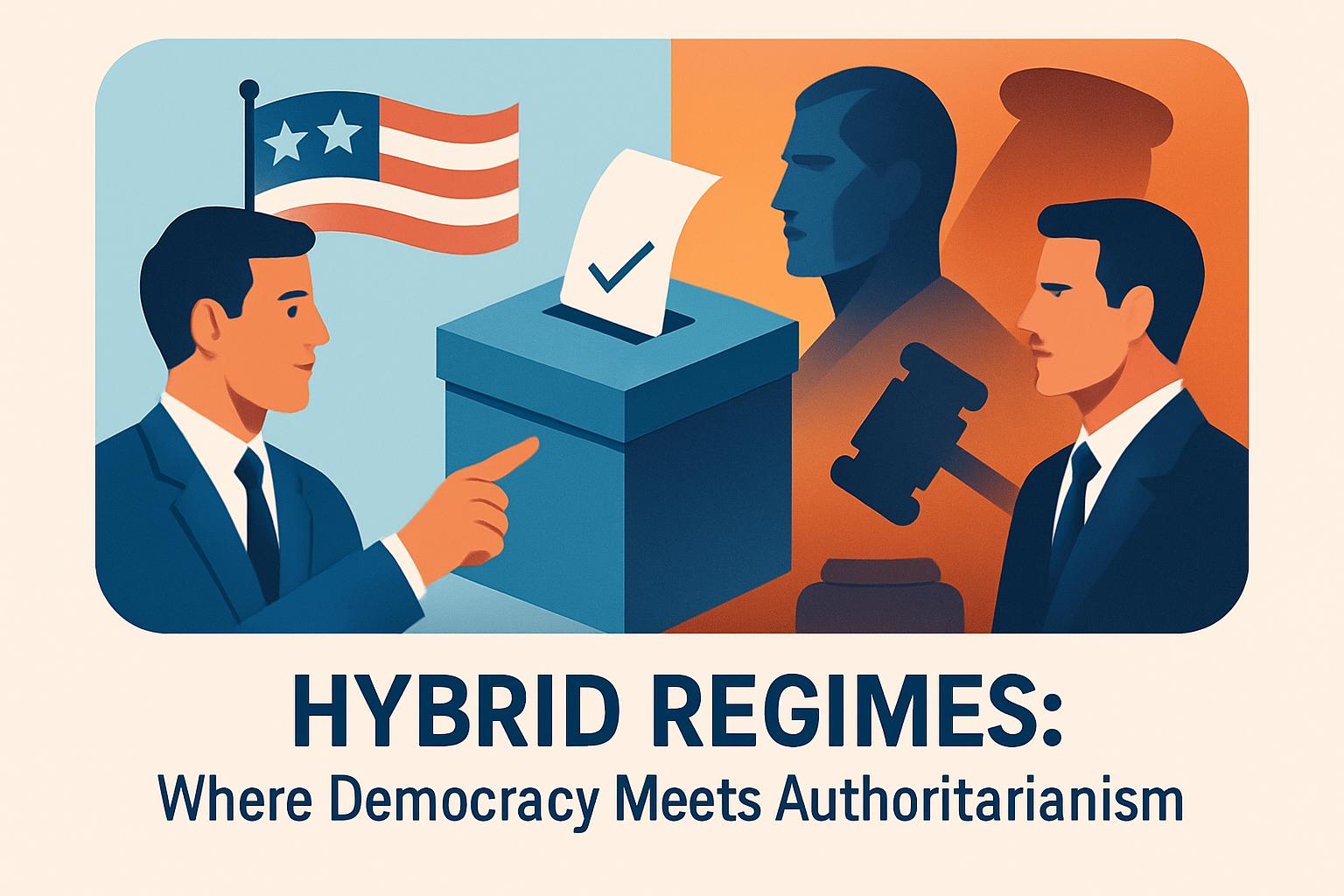
In the modern geopolitical landscape, political systems do not always fit neatly into the categories of democracy or authoritarianism. Instead, we are witnessing the rise of hybrid regimes, political structures that blend characteristics of both democracy and authoritarianism. This juxtaposition leads to a unique form of governance that plays a crucial role in contemporary international politics. Hybrid regimes have become increasingly prevalent, making it important for political analysts, scholars, and everyday citizens to understand their dynamics. By examining hybrid regimes, we can better comprehend how they influence global stability, human rights, and international relations. As democratic ideals face challenges worldwide, identifying and understanding hybrid regimes becomes pivotal. This article will delve into hybrid regimes by examining their characteristics, real-world examples, and implications to provide a thorough understanding of their significance in today’s world.
Defining Hybrid Regimes
Hybrid regimes are political systems characterized by a combination of democratic and authoritarian elements. While they may hold elections, these elections often lack competitiveness or fairness, failing to meet the standards of full democracies. Additionally, hybrid regimes typically maintain some democratic institutions, such as parliaments or constitutions, yet exercise control over these institutions to hinder genuine political dissent. This blend of democratic and authoritarian traits allows governments to maintain legitimacy, while restricting fundamental rights and freedoms.
Characteristics of Hybrid Regimes
Hybrid regimes often illustrate several key characteristics which differentiate them from democratic or authoritarian states. Typically, they manifest political pluralism on the surface, yet the ruling party or leader holds substantial power behind the scenes. Freedom of expression may be tolerated, but media outlets often experience censorship or government interference. Moreover, while elections are held, opposition parties frequently encounter legal and practical obstacles that hinder their competitive presence.
Civil society organizations in hybrid regimes may operate, but often under restrictive regulations that limit their reach and effectiveness. Simultaneously, these regimes frequently showcase a strong executive branch with limited checks and balances from other government institutions. Corruption tends to be prevalent as well, enabled by the concentration of power in a single leadership.
Case Study: Russia
Post-Soviet Russia exemplifies a hybrid regime. Following the dissolution of the Soviet Union, Russia embarked on the path of democratization but soon fell into a political system best classified as a hybrid regime. Elections occur regularly, yet factors such as media control and the strategic sidelining of political opponents often ensure predetermined outcomes. Although the legislative framework exists for checks and balances, in practice, authority remains concentrated within the executive branch under the leadership of Vladimir Putin.
Russia’s hybrid regime also demonstrates restricted civil liberties. Media organizations frequently face intimidation, while protest activities encounter widespread crackdowns. Although political pluralism is theoretically acknowledged, it is not genuinely operationalized in practice, exemplifying the nuances common to a hybrid regime.
Impacts of Hybrid Regimes
Hybrid regimes impact various facets of the global political landscape, including influencing global democratic trends, contributing to international instability, and affecting economic development. Understanding the impact of hybrid regimes is crucial for policymakers and scholars alike who seek to navigate these complex political environments effectively.
- Democratic Trends: Hybrid regimes contribute to the global backsliding of democracy. They present a paradox where democratic institutions exist, yet true democracy is undermined systematically. This diluted form of governance often draws scrutiny from human rights organizations and democratic watchdogs.
- International Instability: Hybrid regimes may contribute to geopolitical instability. For instance, regional conflicts can be exacerbated when hybrid regimes manipulate tensions to consolidate power. Their unpredictable nature and interior political struggles can propagate regional uncertainty.
- Economic Development: The economic impacts of hybrid regimes vary. In some instances, economic growth can occur, but often at the expense of equitable wealth distribution. Corruption and a lack of transparent governance may create conducive environments for business monopolies, restricting fair economic opportunities.
Case Study: Turkey
Turkey provides a significant example of a hybrid regime within a democratic framework. The Justice and Development Party (AKP) and President Recep Tayyip Erdoğan have played influential roles in shaping Turkey’s political landscape. Initially, praised for increasing democratic reforms and expanding Turkey’s economy, the AKP has gradually shifted the country towards a hybrid regime.
The weakening of rule of law and the press, the erosion of judicial independence, and constitutional changes enhancing presidential powers characterize Turkey’s hybrid regime. Kurdish political movements and journalists face repression, exemplifying the selective application of democratic principles. Nevertheless, Turkey remains an incredibly influential regional player both politically and economically.
The Role of Technology in Hybrid Regimes
Modern technology plays a significant role in the functioning of hybrid regimes. Governments can harness digital technology to both maintain control and keep up appearances of democratic engagement. The amplification of societal control through “digital authoritarianism” refers to the manipulation of digital platforms to control and surveil citizens.
Hybrid regimes may utilize social media platforms for propaganda while curtailing opposition voices. Internet censorship and surveillance programs also serve to limit the free exchange of ideas. As access to technology expands, its potential dual use in influencing both the empowerment and oppression of societies remains a critical factor in understanding hybrid regimes.
Case Study: Venezuela
The political trajectory of Venezuela showcases hybrid regime characteristics. Under President Hugo Chávez and later Nicolás Maduro, Venezuela transitioned from a struggling democracy into a hybrid regime. Secure in electoral support due to changes in Constitutional rules granting the Executive prolonged terms and dominion over media broadcasting, the Maduro regime epitomizes hybrid governance.
The use of state resources to maintain power, contested election processes, and human rights abuses characterize Venezuela’s hybrid regime. The Venezuelan government utilizes technology to limit free expression, while retaining a guise of democratic processes through heavily manipulated elections. The ongoing social and economic crises further illustrate challenges faced within hybrid regimes.
The Future of Hybrid Regimes
The trajectory of hybrid regimes is multifaceted and contingent on numerous political, social, and economic parameters. As democracy faces scrutiny globally, an understanding of hybrid regimes and their capabilities becomes essential. Their prevalence requires reassessment of traditional foreign policy approaches and long-term strategies to foster genuinely democratic institutions within affected nations.
Observers predict continued challenges for hybrid regimes, with public dissent and international pressure arising as significant hurdles. Economic constraints and corruption can also destabilize hybrid regimes, further emphasizing the dynamic nature of these political entities. Emphasizing civic education, strengthening democratic institutions, and prioritizing international cooperation are crucial strategies for addressing the future challenges posed by hybrid regimes.
Conclusion and Call to Action
Hybrid regimes inhabit an intriguing space within the political spectrum where democratic and authoritarian features intertwine. Examining their characteristics, exploring real-world examples, and understanding the ramifications equips us with a nuanced perspective. By recognizing the intricacies of hybrid regimes, we enhance our capacity to promote effective, just governance.
As global political dynamics evolve, the need for increased awareness, proactive policymaking, and civic engagement becomes paramount. Acknowledging hybrid regimes can bolster efforts to preserve and expand democratic freedoms worldwide.
Readers are encouraged to engage with literature on hybrid regimes and support efforts underscoring transparency and democratic principles in governance. A call-to-action lies in advocating for informed dialogue surrounding hybrid regimes, ultimately contributing to broader efforts that support democracy’s resilience in a continually evolving political world.
Frequently Asked Questions
1. What exactly is a hybrid regime, and how does it differ from pure democracies or authoritarian states?
A hybrid regime is a type of political system that incorporates elements of both democracy and authoritarianism. Unlike pure democracies, which are characterized by open and competitive elections, civil liberties, and political pluralism, hybrid regimes may present the facade of democratic processes while maintaining authoritarian control. Similarly, they differ from pure authoritarian states, where power is concentrated, and liberties are severely restricted, by often allowing limited political freedoms and controlled multiparty elections. These regimes may uphold certain democratic features like constitutions or parliaments but often manipulate them to maintain ruling elite authority. The blending of these two governance styles can lead to a complex and sometimes contradictory political landscape.
2. What are some characteristics of hybrid regimes?
Hybrid regimes exhibit a mix of democratic and authoritarian characteristics. Common features include: – Competitive elections: Elections exist but are often marred by irregularities, manipulation, or lack of fair competition. – Restricted freedom: While certain civil liberties may be upheld, others such as freedom of the press, speech, or assembly could be limited. – Relative stability: These regimes often achieve a certain stability through controlled political opposition and managed electoral processes. – Institutional duality: They typically maintain democratic institutions like parliaments and courts, which may be influenced or controlled by dominant parties or leaders. – Populist rhetoric: Leaders in hybrid regimes might use democratic rhetoric to legitimize authority, despite undemocratic practices. This blend allows the regime to balance between presenting an image of democracy while retaining control akin to authoritarianism.
3. Why have hybrid regimes become more prevalent in recent years?
The rise of hybrid regimes can be attributed to several global factors. Firstly, the end of the Cold War removed the dichotomous political influence of the US and Soviet Union, allowing for more varied governance models. Secondly, globalization and the spread of information have pressured authoritarian regimes to adopt some democratic elements to gain international legitimacy and economic benefits. Thirdly, as the world becomes more interconnected, maintaining a facade of democracy helps gain foreign investments, aid, and diplomatic relations. Additionally, internal pressures such as demands for reform and a desire to maintain control without full repression can lead governments to adopt hybrid characteristics. This adaptability and strategic balancing have contributed significantly to their prevalence.
4. What role do hybrid regimes play in international politics?
Hybrid regimes play a critical and often complex role in international politics. Their existence challenges the binary understanding of political systems, compelling democratic nations and international organizations to navigate relationships more carefully. They stand as middle-ground forces that can act as crucial allies or points of contention in international diplomacy and negotiations. Hybrid regimes often exert regional influence, affecting neighboring countries politically and economically. Furthermore, they contribute to debates on democracy promotion and human rights, pressing international organizations to reconsider engagement strategies. Their capability to attract foreign investment due to economic liberalization, while simultaneously maintaining political control, adds another layer to global economic dynamics. Thus, hybrid regimes shape the international political landscape significantly, demanding nuanced and informed policy responses.
5. How might the rise of hybrid regimes impact global democratization efforts?
The increase in hybrid regimes presents both challenges and opportunities for global democratization efforts. On one hand, these regimes can undermine democratization by establishing models that seemingly balance authoritarian control with democratic procedures, potentially inspiring established and emerging democracies to backslide. This complicates international advocacy for democracy as hybrid regimes can claim legitimacy through their limited democratic processes. On the other hand, the presence of elements typical of democracy provides a foundation for potential political evolution towards fuller democratization. International actors can leverage these democratic elements to support civil society, press for electoral reforms, and encourage open discourse. Thus, while hybrid regimes complicate democratization narratives, they also open channels for gradual democratic advancement if strategically addressed.