
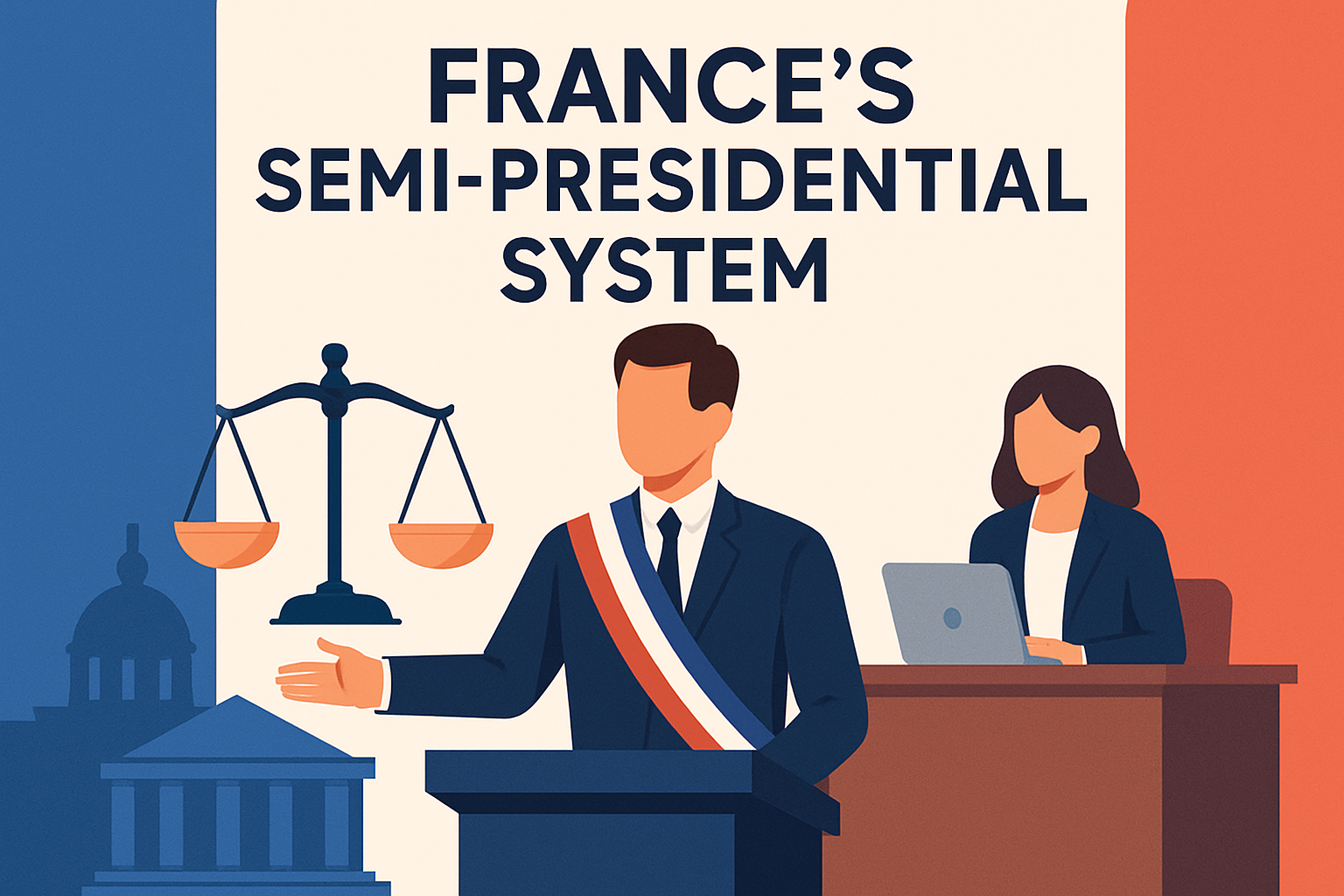
France’s political framework stands out due to its unique blend of presidential and parliamentary features, known as the semi-presidential system. This model has attracted global interest for its hybrid nature, combining elements of both strong executive leadership and parliamentary representation. Introduced with the inception of the Fifth Republic in 1958, France’s semi-presidential system is a cornerstone of the nation’s governance, allowing for a power dynamic where responsibilities are shared between a President and a Prime Minister, supported by parliament. Understanding this system is crucial for those studying political science and international relations, as it showcases a model striving to balance authority and democratic representation in complex political environments. The significance of this system lies in its ability to manage internal and external politics through a dual mechanism that, ideally, leverages both stability and adaptability.
Defining Semi-Presidentialism
Semi-presidentialism is a government structure where the head of state, the President, coexists alongside a head of government, the Prime Minister, both of whom play significant roles in policy-making and governance. In France, the President is directly elected by the people and wields substantial powers, including foreign policy leadership and defense oversight. Meanwhile, the Prime Minister, appointed by the President, handles the day-to-day affairs of running the government, primarily focusing on domestic policy.
This system was institutionalized under Charles de Gaulle’s leadership, fundamentally changing the French political landscape. It was seen as a solution to the instability experienced under the Fourth Republic, characterized by frequent government changes and ineffective parliamentary procedures. By offering a central role to the President, semi-presidentialism aims to ensure strong, unified leadership while retaining the parliamentary mechanics necessary for legislative oversight and policy diversity.
Presidential Powers in Practice
The President of France wields significant authority, particularly in areas such as national defense and foreign policy. They also play a crucial role in appointing key officials, including the Prime Minister, and have the power to dissolve the National Assembly, call for referendums, and influence the legislative agenda. This concentration of power allows for rapid decision-making, particularly in international affairs, illustrating the system’s flexibility and leadership efficiency.
- Presidents such as Charles de Gaulle and François Mitterrand have maximized these executive powers to pursue both national reforms and international treaties.
- The influence over foreign policy allows France to play a pivotal role in global politics. For instance, Emmanuel Macron has used this role to champion climate change initiatives and revitalize the European Union.
The real-world implications of these powers are evident in how Presidents negotiate international agreements and navigate global challenges—demonstrating the practical effectiveness of centralized leadership in certain contexts. However, this control also requires careful political negotiation to align with domestic interests and Assembly priorities, ensuring that Presidential ambitions do not alienate parliamentary cooperation.
The Role of the Prime Minister
In contrast to the President’s more prominent international focus, the Prime Minister is responsible for implementing government policy on domestic fronts. This role involves coordinating with ministers to enforce laws and managing the day-to-day operations of government—ensuring that elected mandates are translated into actionable programs within domestic governance.
The Prime Minister also acts as a liaison between the President and the National Assembly, maintaining a balance that is vital for political coherence. Consider the tenure of Prime Ministers such as Édouard Philippe and Jean Castex; both have navigated complex socio-economic conditions, balancing Presidential directives with parliamentary expectations.
France’s domestic policies, such as healthcare reforms and economic measures, showcase the Prime Minister’s influence in practical governance. This role provides operational stability, enabling pragmatic policy development in response to citizens’ needs, while concurrently supporting the broader visionary policies directed by the President. This diarchy demands effective communication and strategic negotiation skills from the Prime Minister to maintain harmonious relations across the government.
The Dynamic of Cohabitation
A distinct feature of France’s system is cohabitation—occurring when the President and Prime Minister hail from opposed political parties. This situation requires careful negotiation and compromises on governance priorities but also serves as a testament to the flexibility and adaptability of the system.
Cohabitations such as those between François Mitterrand with Prime Ministers Jacques Chirac and Édouard Balladur, as well as Jacques Chirac with Lionel Jospin, highlight a phase where bipartisan efforts become central. Here, the President continues to influence defense and foreign policies, while the Prime Minister takes charge of domestic programs, often aligning with the parliamentary majority’s agenda.
These periods demand heightened negotiation skills and political diplomacy, showcasing how power-sharing can result in collaborative governance that aligns with the broader spectrum of public opinion. Such experiences enrich France’s semi-presidential system, providing case studies in effective governance amidst divergent political ideologies.
Challenges and Criticisms
Despite its strengths, France’s semi-presidential system is not without criticisms. Critics point to the potential for conflict between the President and Prime Minister, particularly during cohabitation, which can lead to legislative gridlock. Moreover, the power of the President in shaping national policy can overshadow parliamentary input, leading some to argue for a reevaluation of executive dominance to ensure balanced democratic processes.
Another challenge relates to public perception and electoral influences, where the dual executive structure may confuse voters regarding accountability and responsibility. The blurred lines of accountability can lead to decreased trust in governmental efficacy, particularly if misalignments occur between presidential policies and parliamentary support.
However, these criticisms underscore the need for ongoing adaptation within the system to ensure it meets modern democratic standards and effectively addresses the needs of its citizenry. Adjustments and reforms could enhance transparency and strengthen the synergy between legislative and executive branches, fostering a more integrated approach to governance.
In evaluating these challenges, it’s noteworthy that such institutional frameworks, like the semi-presidential system, are constantly evolving, responding to societal demands and international pressures. This adaptability is vital for ensuring its relevancy and effectiveness in a global environment marked by rapid political and technological changes.
Strengths and Implications
France’s semi-presidential system offers a unique balance, combining centralized executive strength with parliamentary checks to ensure responsible governance. This dual system provides a robust mechanism for addressing both international and domestic issues, aimed at fostering a stable yet dynamic political environment.
| Aspect | Strength | Implication |
|---|---|---|
| President’s Executive Powers | Rapid decision-making in emergencies | Effective international leadership and crisis management |
| Prime Minister’s Role | Focused domestic governance | Enhanced policy design and implementation |
| Cohabitation | Bipartisan cooperation | Broader representation across political lines |
The implications of this system stretch beyond national borders. Other nations examining governance reforms can glean insights from France’s experiences in balancing power distribution and achieving political cohesion. The system’s resilience amidst changing political climates offers lessons in adaptability and inclusiveness—key elements for nations crafting their governance frameworks.
Conclusion: France’s Semi-Presidential System and Its Future
France’s semi-presidential system represents a potent blend of leadership efficiency and parliamentary involvement, designed to address both immediate national challenges and long-term strategic goals. By integrating strong executive capabilities with comprehensive legislative oversight, this system seeks to harmonize governance with democratic ideals, ensuring both accountability and effectiveness.
The potential adjustments to the system, addressed through reforms and policy alignments, provide pathways for enhancing governance quality and bolstering public trust. The lessons drawn from France’s experiences offer valuable perspectives for other nations navigating their political landscape constraints.
Ultimately, investigating France’s semi-presidential system underscores the importance of adaptable governance structures capable of responding to evolving political landscapes, paving the way for sustainable national and international progress. Embrace insights from this framework by exploring how adaptable strategies in governance can enhance organizational effectiveness in today’s complex political ecosystems.
Frequently Asked Questions
What is France’s semi-presidential system?
France’s semi-presidential system is a distinctive political structure that was established with the introduction of the Fifth Republic in 1958. This system is characterized by a unique combination of presidential and parliamentary elements that function in tandem. It’s neither purely presidential nor parliamentary, but rather a hybrid model that incorporates the strengths of both systems. In this setup, the President and the Prime Minister share executive powers. The President, elected by the public, holds significant authority over national policy, defense, and foreign affairs, whereas the Prime Minister, appointed by the President, manages domestic policies and must maintain the confidence of the National Assembly. This dual-leadership model ensures a separation of powers while fostering collaboration between branches, providing a dynamic balance between a single strong executive leader and a responsive parliamentary system.
How does power distribution work in this semi-presidential setup?
The power distribution in France’s semi-presidential system is meticulously designed to balance authority between the President and the Prime Minister, mitigating the potential for excessive power consolidation in either branch. The President, as the head of state, focuses on overarching policies, foreign diplomacy, and defense matters. Meanwhile, the Prime Minister acts as the head of government and is responsible for domestic issues, economic strategies, and implementing laws that pass through the National Assembly. However, during periods of “cohabitation”—when the President and the parliamentary majority come from opposing parties—the power dynamics shift. In such situations, the Prime Minister gains prominence in steering national policies, reflecting the democratic principle of maintaining parliamentary majority influence. This flexible exchange ensures adaptability and prevents stagnation in governance, aligning executive functions with the political climate of the parliament.
Why was the semi-presidential system introduced in France?
The semi-presidential system in France was introduced under the leadership of Charles de Gaulle, who sought a governmental structure that could provide stability and avoid the pitfalls of the previous Fourth Republic, which was marked by political fragmentation and governmental instability. By 1958, it was clear that France needed a change to enhance executive clarity while still preserving democratic representation. The semi-presidential system allowed for a strong executive branch to lead during national crises without sidelining the parliamentary influence essential to democracy. The dualistic nature of the system aimed to harness the strengths of both presidential and parliamentary frameworks—strong leadership and representative pluralism—without succumbing to either extreme. This innovation was vital for modernizing France’s political framework, ensuring governmental efficiency and resilience in a rapidly changing post-war world.
What are the benefits of having a semi-presidential system?
The semi-presidential system of France offers a range of benefits that contribute to its enduring appeal. Chief among them is the system’s flexibility, which allows for quick response and decisive leadership during crises. The President can act autonomously in the realm of foreign affairs and national security, enhancing France’s strategic standing on the global stage. Meanwhile, the parliamentary component ensures that domestic policies reflect the public’s current political sentiments, fostering accountability and democratic engagement. Another advantage is the potential for dynamic power shifts during cohabitation, where the parliament’s influence can increase, promoting political balance and preventing any one party from monopolizing control. This balance ensures that both executive dominance and parliamentary oversight remain integral to the governance system, preventing authoritarian tendencies while ensuring responsible and effective policy-making.
How does the French semi-presidential system differ from other global systems?
The French semi-presidential system is distinct from both purely presidential and purely parliamentary systems. In a clearly presidential system, like that of the United States, the President is both the head of state and government, wielding expansive powers particularly in foreign policy and military matters, without a Prime Minister. Conversely, in a parliamentary system, such as that of the United Kingdom, the Prime Minister is the head of government and exercises executive functions, while a monarch or ceremonial president acts as the head of state with limited powers. France’s system is hybrid, granting significant executive power to both a President and a Prime Minister. The unique feature of cohabitation further differentiates it, as this arises when the President and parliamentary majority belong to different political parties, leading to a shift in power where the Prime Minister assumes greater command over domestic policy. This dual leadership structure provides a checks and balances mechanism, strengthening both governance efficacy and political stability.