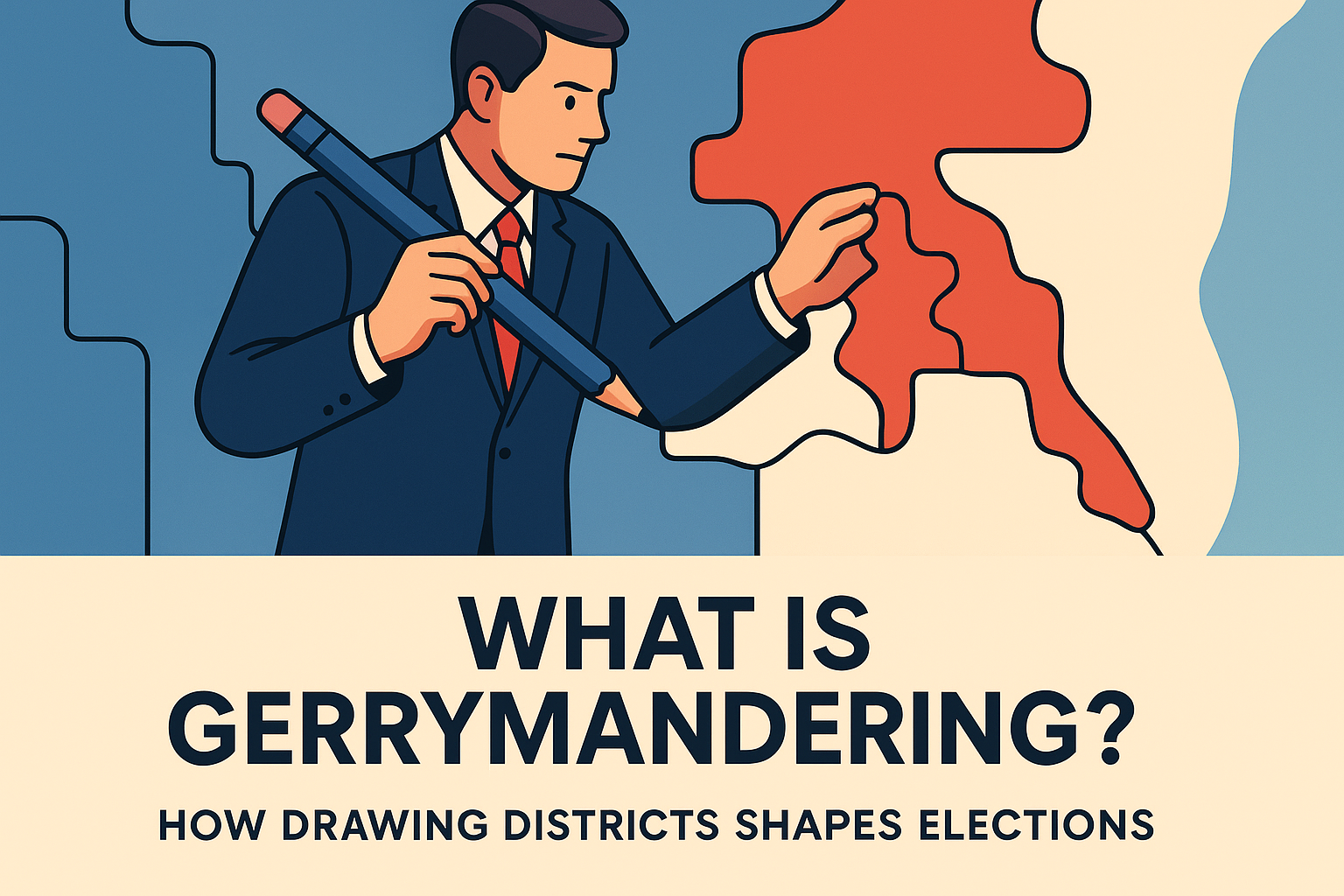
Gerrymandering is a term often encountered in political discussions, especially during election seasons, but what exactly does it mean? At its core, gerrymandering refers to the process of manipulating the boundaries of electoral districts in a way that favors a particular political party or group. Coined in the early 19th century, the term is named after Elbridge Gerry, a Massachusetts politician whose redistricting plans resembled a salamander, hence the name “Gerrymander.”
The practice of gerrymandering is significant because it can severely impact the democratic process by skewing electoral results, thus affecting which parties hold power in legislative bodies. It challenges the notion of fair representation by rigging the system in favor of the party in power, often leading to uncompetitive districts and voter disenfranchisement. Understanding gerrymandering is crucial for any engaged citizen, as it has direct implications on policy decisions, governmental representation, and the health of democracy itself.
The Mechanics of Gerrymandering
Gerrymandering is executed through two primary tactics: “cracking” and “packing.” Cracking involves dispersing a political group’s voters across many districts to dilute their electoral influence. Conversely, packing concentrates these voters into a few districts to reduce their impact elsewhere. This manipulation can distort electoral outcomes by ensuring that the controlling party retains a disproportionate share of seats, even if they do not receive a majority of the votes.
Types of Gerrymandering
Gerrymandering can be divided into several types based on the groups targeted. Partisan gerrymandering aims to advantage a specific political party; racial gerrymandering manipulates boundaries to weaken the influence of racial or ethnic minorities. Incumbent gerrymandering protects current elected representatives by reshaping districts to include a majority of their previous supporters.
For example, in North Carolina, recent district maps were deemed unconstitutional due to excessive partisan bias. The maps were drawn to maintain a Republican majority by strategically placing Democratic voters in fewer districts. Such actions illustrate the extent to which those in power can utilize gerrymandering to entrench themselves against changes in voter preferences, ultimately undermining democratic principles.
Legal Challenges and Judicial Involvement
The legality of gerrymandering, particularly partisan gerrymandering, has been challenged in various courts. The role of the judiciary in addressing such issues remains complex and inconsistent. While racial gerrymandering has been prohibited under the Voting Rights Act of 1965, partisan gerrymandering is often more difficult to prove and judge, largely due to the lack of clear standards defining illegal partisan gerrymandering.
A notable case is Gill v. Whitford, a landmark decision by the United States Supreme Court involving challenges to Wisconsin’s legislative districts. Although the Court did not definitively rule on the constitutionality of partisan gerrymandering, it highlighted the need for concrete standards to assess such claims. This case exemplifies the evolving judicial landscape surrounding gerrymandering and the ongoing debate over the courts’ role in election fairness.
The Impact of Gerrymandering on Elections
Gerrymandering can significantly influence elections by ensuring that a particular party has a greater chance of winning more seats than they would under fair conditions. This distorts the political landscape, making it challenging for opposing parties to compete effectively. It can lead to political polarization by creating “safe seats,” where incumbents have little incentive to appeal to the electorate broadly since the district is skewed in their favor.
A clear manifestation of this can be seen in Maryland, where Democrats have been accused of gerrymandering to maintain control. The state has a significant Democratic majority in its congressional delegation, which doesn’t completely align with the voter registration percentages. This discrepancy highlights how gerrymandering can create imbalances that don’t reflect the electorate’s true political leanings.
Technological Advances and Gerrymandering
In today’s era, technology plays a crucial role in enabling and enhancing gerrymandering practices. Mapping software and voter data have become instrumental in drawing district boundaries with precision, allowing map-makers to predict electoral outcomes with astounding accuracy. This technological sophistication means gerrymanders have become more resilient to change, posing a significant challenge to electoral equity.
Politicians can now utilize detailed voter files and complex algorithms to craft districts that are nearly impervious to shifts in voting trends. This technical empowerment of gerrymandering was evident in Texas, where sophisticated mapping tools were employed to bolster Republican advantages across state legislative districts.
Efforts and Movements to Combat Gerrymandering
There has been a rise in movements aimed at combating gerrymandering and advocating for fairer representation. These include efforts to implement independent redistricting commissions, using non-partisan organizations to establish district boundaries. Some states, like California and Arizona, have already adopted this model, which has sparked a broader conversation about its feasibility nationwide.
The effectiveness of these commissions is often debated, but proponents argue that they provide an equitable alternative that limits partisan bias. Colorado is an example of a state that has successfully implemented such reforms, resulting in district maps that more closely reflect the state’s political diversity.
| State | Gerrymandering Type | Recent Reform |
|---|---|---|
| North Carolina | Partisan | Judicial Review |
| California | Racial/Partisan | Independent Commission |
| Wisconsin | Partisan | Pending Legal Action |
| Texas | Partisan | No Major Reform |
The Future of Gerrymandering
There are ongoing debates about the future of gerrymandering and how it may evolve. While reforms and legal challenges present opportunities for change, persistent political incentives to control districting suggest that gerrymandering will remain a contentious issue. Future battles may be fought not just in courtrooms but in public opinion, as voters become more aware of the implications of unfair districting.
One potential avenue for reform is through the adoption of nationwide legislative standards. The idea is to create consistent criteria for district boundaries that minimize partisan advantage. If implemented effectively, such measures could dramatically reduce the influence of gerrymandering on elections, but must also navigate the complex intersection of state and federal oversight.
Conclusion
Gerrymandering remains a pressing concern for democratic governance, affecting the fairness and competitiveness of elections. By understanding its mechanisms, types, and impacts, citizens and policymakers alike are better equipped to advocate for reforms that promote equitable representation in legislative bodies. This leads to healthier and more authentic democratic practices.
The importance of vigilance in confronting gerrymandering cannot be overstated; it directly influences the fabric of political power and policymakers’ responsiveness to their constituents. As awareness grows, so does the potential for meaningful change. By engaging with local and national initiatives aimed at electoral reform, individuals can contribute to a more representative and just political system.
For those eager to make a difference, consider supporting organizations that work to promote fair district mapping. Engaging with local representatives about the importance of independent redistricting commissions or participating in awareness campaigns can help push the conversation forward. Democracy thrives when the people have a fair voice; addressing gerrymandering is one crucial step toward achieving that goal.
Frequently Asked Questions
1. What is Gerrymandering and How Did It Get Its Name?
Gerrymandering is a political strategy used to manipulate electoral district boundaries to favor a particular political party or group. The term “gerrymandering” can sound quite mysterious at first, but its origins are actually quite interesting. It all began in the early 19th century with Elbridge Gerry, a Massachusetts politician. Gerry’s redistricting plan in 1812 was so creatively contorted that some thought it resembled a salamander. And with that observation, “gerrymander” was born – a combination of Gerry’s name and the word “salamander.” This colorful history provides insight into the insidious nature of gerrymandering, as it suggests sneaky, almost artistic manipulation of electoral maps.
2. How Does Gerrymandering Affect Election Outcomes?
Gerrymandering impacts elections by essentially stacking the deck in favor of one party. By manipulating district boundaries, a political party can ensure that their voters have the majority in as many districts as possible, thus maximizing their chances of winning more seats. This process can lead to a lack of fair representation, as the proportion of seats won by a party may not reflect the actual distribution of voters. In effect, gerrymandering allows politicians to choose their voters, rather than allowing voters to choose their representatives. The consequences of gerrymandering can be long-lasting, sometimes affecting multiple election cycles until maps are redrawn again.
3. What Are the Different Types of Gerrymandering?
Gerrymandering can take several forms, each with its own method of skewing election results. Predominantly, it manifests as partisan gerrymandering, racial gerrymandering, and incumbent gerrymandering. Partisan gerrymandering is aimed at giving one political party an advantage over others. Racial gerrymandering involves manipulating district lines to weaken the voting power of racial minorities, often violating the Voting Rights Act. Incumbent gerrymandering is designed to protect current politicians by altering districts to ensure they remain electable. Each type of gerrymandering employs different techniques such as “cracking,” which dilutes the voting power of the opposition by spreading their voters across multiple districts, and “packing,” which concentrates the opposition’s voters into a few districts to reduce their influence elsewhere.
4. How Is Gerrymandering Legal? Are There Any Laws or Regulations?
While gerrymandering is widely criticized, it is, in many cases, not illegal. The legality often depends on the type of gerrymandering and specific state laws. The U.S. Supreme Court has ruled on several cases, distinguishing between partisan gerrymandering, which is difficult to regulate, and racial gerrymandering, which is illegal. The Court says strict scrutiny is applied to racial gerrymandering cases under the Fourteenth Amendment. However, the lack of a clear, manageable standard to address partisan gerrymandering makes it a persistent issue. Some states have taken measures into their own hands, establishing independent commissions tasked with drawing fairer electoral maps to reduce partisan bias. Yet, the effectiveness of these safeguards varies across states.
5. Has Technology Made Gerrymandering Easier or More Difficult?
In the digital age, technology has greatly influenced the practice of gerrymandering, making it more precise and arguably more pernicious. Powerful computer algorithms and data analytics tools enable politicians to draw district maps with unprecedented accuracy, using detailed demographic data to predict and manipulate voting outcomes. This technology allows for highly strategic district layouts that can maximize a party’s electoral advantage. However, technology also offers tools for reform. Public mapping software provides transparency, enabling citizens and advocacy groups to analyze and challenge gerrymandered districts. In this way, technology is a double-edged sword, complicating gerrymandering while also providing a means to combat it through greater public participation and oversight.