
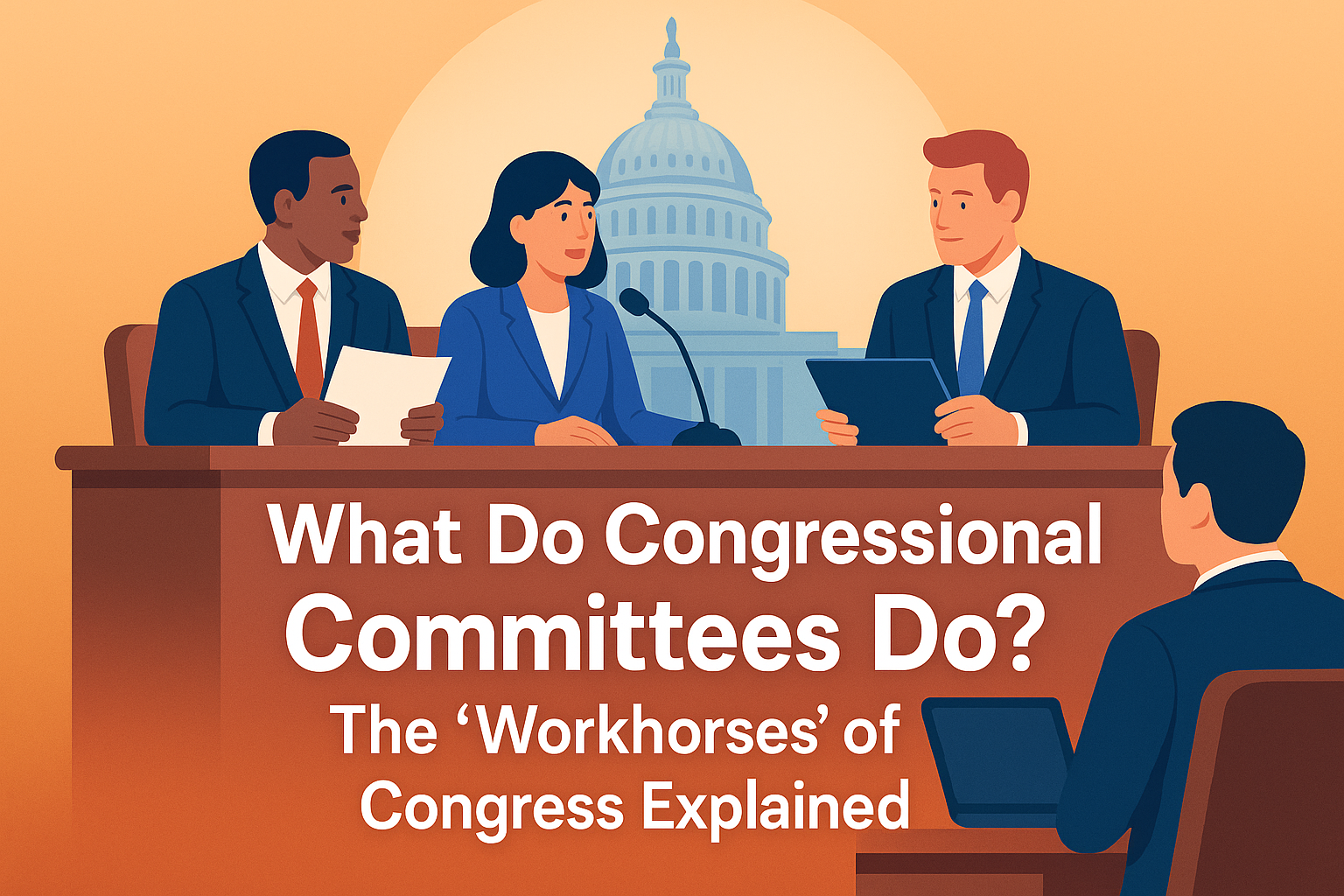
Congressional committees play a pivotal role in the legislative process of the United States Congress, often referred to as the “workhorses” of Congress. These committees are integral in shaping legislation and ensuring that all aspects of proposed laws are thoroughly examined. But what exactly do these committees do, and why are they so crucial to the workings of Congress?
Committees are specialized groups within Congress tasked with specific duties, primarily centered around the development, analysis, and revision of legislation. Once a bill is introduced in either the House of Representatives or the Senate, it is typically referred to a relevant committee. Committees take on the bulk of legislative work by investigating details, holding hearings, amending drafts, and reporting on the proposed bills. This division of labor is essential, given the immense volume of legislative proposals that Congress deals with during a session.
The influence and breadth of committees extend beyond simply vetting legislation. They also engage in oversight of federal agencies, conduct investigations, and provide a platform for public discussions on critical national issues. As such, congressional committees function as both the investigative body and expertise hub within Congress, providing insights, recommendations, and amendments that help shape comprehensive, effective policies. Understanding the role and significance of these committees is crucial for grasping how democracy functions at the legislative level and how it impacts everyday lives.
The Structure and Types of Committees
Congress is divided into two houses: The House of Representatives and the Senate, each with its own set of committees. These committees are further divided into three main types: standing committees, select (or special) committees, and joint committees.
- Standing Committees: These are permanent panels with legislative jurisdiction. They consider bills and issues and recommend measures for consideration by their respective chambers. Examples include the House Committee on Armed Services and the Senate Committee on Finance.
- Select or Special Committees: These are often created for a specific purpose and are not always permanent. They focus on particular issues that don’t fit neatly into the jurisdiction of existing committees. An example is the Senate Select Committee on Intelligence.
- Joint Committees: Comprised of members from both the House and the Senate, these committees focus on specific subject areas. They are usually permanent, with respective committees such as the Joint Committee on Taxation.
Each committee has a defined scope of responsibility, which allows for specialized attention to complex topics ranging from national defense to agricultural policy. As real-world testimony to their influence, consider the role of the House Ways and Means Committee in shaping tax policy; it serves as the primary body through which all revenue-raising bills must pass, underscoring the deep impact committees can have on everyday economic policy.
How Committees Shape Legislation
One of the primary responsibilities of congressional committees is to examine and refine proposed legislation before it reaches the broader congressional floor. Committees have the power to draft and revise bills, hold public hearings, and conduct investigations into relevant issues. Through these processes, committees carefully analyze proposed laws to ensure they are just and effective.
Consider the example of the Senate Judiciary Committee, which plays a critical role in the process of confirming judicial appointments, including justices to the Supreme Court. This committee scrutinizes nominees to ensure their suitability and fairness, which has profound implications for the legal landscape of the entire nation. Similarly, the House Committee on Energy and Commerce garners significant attention for its influence over the nation’s economic policies, scrutinizing matters like energy policy and public health.

The Role of Subcommittees
To further delve into specific areas of policy, many committees are subdivided into smaller groups known as subcommittees. These subcommittees allow for even more detailed scrutiny and specialization in areas that require concentrated expertise. For instance, the House Committee on Education and Labor has multiple subcommittees, each focusing on critical aspects like Higher Education and Health, Employment, Labor, and Pensions.
By addressing concentrated topics and achieving a focused legislative analysis, subcommittees act as invaluable extensions of their parent committees. They gather in-depth information, solicit expert testimonials, and recommend legislation to the full committee. Their targeted focus enables quicker responses to pressing issues, fostering timely and effective policy solutions. An example of the efficacy of subcommittees is the Subcommittee on Civil Rights and Civil Liberties, which plays an instrumental role in addressing and advancing issues relating to civil rights across the United States.
Committees and Public Policy Influence
The impact of congressional committees extends beyond legislation to significantly shape public policy and opinion. Committees like the Senate Foreign Relations Committee and the House Oversight Committee wield substantial influence by engaging in high-profile investigations, questioning executive actions, and examining critical national topics.
One notable case is the investigation by the House Select Committee on Benghazi, which conducted exhaustive analyses and hearings on the 2012 attack on the US embassy in Libya, drawing national and international attention. Such investigations not only shape public perception but also guide legislative action by pinpointing failures and recommending necessary changes to policies.
Additionally, committees often serve as a direct channel for public and interest group concerns, allowing citizens to interact with their government representatives through testimonies, consultations, and public hearings. Through these channels, committees not only gather public sentiment but also educate their constituents on ongoing legislative processes and developments.
The Committees’ Role in Checks and Balances
Congressional committees also uphold the foundational democratic principle of checks and balances by overseeing federal agencies and scrutinizing the actions of the executive branch. This oversight ensures that government actions adhere to public interest and lawful governance.
For instance, the House Judiciary Committee actively monitors the conduct of federal agencies responsible for enforcing laws and administers oversight on matters like civil liberties and law enforcement misconduct. Similarly, the Senate Intelligence Committee regularly examines intelligence activities and safeguards U.S. national security, ensuring transparency and accountability in intelligence operations.
Such oversight is crucial to maintaining democratic integrity and offers corrective measures when government actions deviate from ethical or legal standards. By safeguarding against overreach and jurisdictional abuse, committees reinforce the independence and interdependence of government branches, thus maintaining a balance that is critical for a functioning democracy.
| Committee | Key Responsibility | Example of Oversight |
|---|---|---|
| Senate Judiciary Committee | Judicial Appointments | Supreme Court Nominee Hearings |
| House Committee on Energy and Commerce | Economic Policies | Oversight of Energy Policy |
| Senate Intelligence Committee | National Security | Examination of Intelligence Operations |
Real-World Impact: Legislation and Beyond
Committees not only craft and vet legislation but also impact a wide range of policy areas affecting everyday American lives. Their role in the legislative process can have immediate and long-term consequences. For example, the comprehensive COVID-19 relief packages developed and refined through committee work have provided critical support to individuals and businesses amid the pandemic. These efforts were crucial in managing public health and economic stability.
Moreover, committees are responsible for ensuring the execution of existing laws, a task that involves attention to detail and persistent oversight. The power to subpoena, investigate, and report on matters of public concern equips committees with a unique potential to enact change and drive policy reform.
Conclusion: The Integral Role of Committees in Shaping America
Congressional committees serve as the backbone of the U.S. legislative process, functioning as the meticulous architects of policy development and legislative refinement. Through specialized labor, they enable comprehensive scrutiny, discussion, and enhancement of emerging laws, orchestrating a rigorous process that ensures laws cater to public welfare, economic growth, and social justice.
The extensive work these committees perform extends far beyond legislation, encapsulating oversight, investigation, and public policy influence. As watchdogs and visionaries, they continually adapt and respond to evolving national and international landscapes, maintaining an accountable, transparent, and efficient governance system.
Engaging with the vital work of congressional committees and staying informed about their activities is essential for anyone invested in democracy and governance. As these “workhorses” of Congress carry the legislative mantle forward, an informed citizenry stands empowered to contribute to the democratic process. Let us pledge to stay informed, and by doing so, help mold a future where our legislative system is dynamic, inclusive, and responsive to the needs of all Americans.
Frequently Asked Questions
1. What is the main purpose of congressional committees?
Congressional committees are the backbone of the United States Congress, serving as the primary mechanism for managing and refining the legislative process. They exist to transform broad legislative concepts into detailed actionable laws. The committees prioritize specific policy areas, allowing for focused discussions and thorough examination of pending legislation. This specialization helps Congress handle its vast array of responsibilities and manage complex issues efficiently. By dividing tasks among various committees, Congress ensures that each area receives the necessary attention and expertise, which aids in crafting well-informed and effective legislation.
2. How do congressional committees affect the legislative process?
Committees play a critical role in the legislative process by reviewing, amending, and crafting legislation before it reaches the broader congressional floor. They are responsible for initial hearings and debates on proposed bills, providing a platform for expert testimonials and public input. This detailed scrutiny ensures that the legislation is examined from multiple angles, addressing potential concerns and unintended consequences. Committees have the power to alter, approve, or reject legislation during this stage. Only after a thorough evaluation will a bill proceed from committee discussions to the full House or Senate, ensuring that only the most viable and well-developed proposals advance.
3. What types of committees exist within Congress, and how do they differ?
Various types of congressional committees exist, each with a specific role within the legislative framework. The main types are standing committees, select or special committees, joint committees, and conference committees. Standing committees are permanent and focus on specific legislative areas, such as finance or agriculture, providing oversight and guidance on corresponding government policies. Select or special committees are generally temporary, formed to address specific issues outside the realm of existing committees, like investigations or unique national matters. Joint committees include members from both the House and Senate, usually focused on bipartisan issues to streamline legislative decision-making. Conference committees are temporary and convene to resolve disagreements on particular bills, ensuring mutually agreeable solutions between both congressional chambers.
4. How are congressional committee members selected?
Members of congressional committees are chosen based on party representation and leadership priorities within each congressional chamber. The selection process is influenced by the respective party leadership and generally depends on the balance of power within Congress. Majority and minority party leaders appoint committee members proportionate to their parties’ overall representation in the House or Senate. Expertise and seniority often play a part in these appointments, allowing experienced lawmakers to guide the legislative process in their areas of specialization. This selection ensures that committees are composed of individuals with varied insights and backgrounds, promoting a comprehensive approach to legislative efforts.
5. How do congressional committees ensure effective oversight of government operations?
Congressional committees are fundamental in monitoring and ensuring that government operations align with legislative intent and public interest. They conduct regular oversight activities, including investigations, hearings, and reviews, to evaluate governmental function and accountability. Committees have the authority to subpoena witnesses, demand documentation, and scrutinize executive actions through detailed evaluations. This oversight not only checks and balances government power but also provides transparency and encourages responsible governance. Through these processes, committees play a vital role in upholding democratic principles and ensuring that government activities meet the expectations and needs of the American public.