
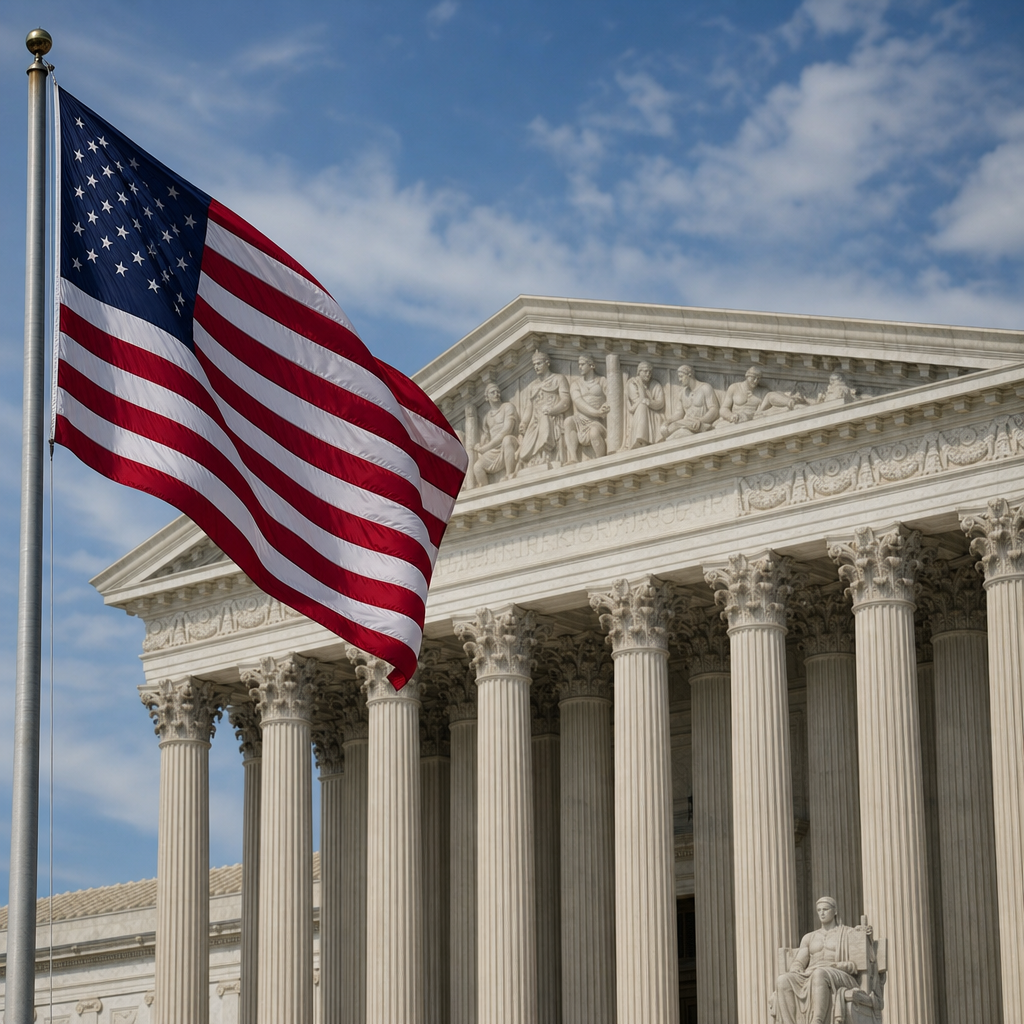
United States v. Lopez is the modern Supreme Court case most often used to explain that Congress does not possess unlimited power under the Commerce Clause. Decided in 1995, the case marked the first time in nearly sixty years that the Court struck down a federal law because it exceeded Congress’s authority to regulate interstate commerce. For AP Government and Politics students, Lopez matters because it clarifies federalism, the balance of power between national and state governments, and the constitutional limits that still shape criminal law, education policy, and debates over national authority.
The Commerce Clause appears in Article I, Section 8 of the Constitution and gives Congress power to regulate commerce with foreign nations, among the several states, and with Native American tribes. In plain terms, it allows the national government to address economic activity that crosses state lines or substantially affects the national economy. Over time, however, the meaning of that power expanded. During the New Deal and after, the Supreme Court often upheld broad federal regulations, reasoning that even local activity could be reached when its cumulative effect influenced interstate markets.
Lopez forced the Court to answer a basic question: is there any judicially enforceable stopping point? I have taught this case as the cleanest illustration of constitutional line drawing because the underlying law was not about buying, selling, shipping, or producing goods. It was the Gun-Free School Zones Act of 1990, which made it a federal crime to knowingly possess a firearm in a school zone. Congress argued that guns near schools lead to crime, crime raises costs, and those costs affect the national economy. The Court rejected that chain of reasoning and held the statute unconstitutional.
Understanding Lopez helps students connect a wide set of recurring topics in AP Government and Politics: enumerated powers, implied powers, judicial review, federalism, the Necessary and Proper Clause, and the role of precedent. It also serves as a hub case for related decisions such as McCulloch v. Maryland, Gibbons v. Ogden, Wickard v. Filburn, Heart of Atlanta Motel v. United States, United States v. Morrison, and Gonzales v. Raich. Once you understand how Lopez fits among those cases, you can evaluate when Congress may regulate local conduct and when the Constitution reserves authority primarily to the states.
Case Background and Constitutional Question
The case began when Alfonso Lopez Jr., a twelfth-grade student in San Antonio, Texas, carried a handgun and bullets into his high school. State authorities initially charged him under Texas law, but federal prosecutors soon charged him under the Gun-Free School Zones Act. Lopez argued that the federal law exceeded Congress’s power under the Commerce Clause. Lower courts split on the issue, and the Supreme Court agreed to decide whether simple gun possession in a local school zone could be treated as interstate commerce.
The constitutional question was narrow but significant: may Congress criminalize the possession of a gun in a school zone solely because the activity, through a chain of social and economic effects, might influence interstate commerce? That wording matters. The statute did not require that the gun had moved across state lines at the time of the offense, that the possession was economic, or that the school itself engaged in commercial activity. Unlike many federal laws, it also lacked a jurisdictional element tying each prosecution to interstate commerce.
That absence became central. In my experience, students understand Lopez much faster when they compare it with a law saying, for example, “It is illegal to possess a firearm in a school zone if that firearm has traveled in interstate commerce.” Such language does not guarantee constitutionality, but it gives courts a concrete connection to national commerce. The Gun-Free School Zones Act as written offered no such limit, which made it look like a general police power measure. General police power, however, belongs primarily to the states, not Congress.
The Supreme Court’s Holding and the Three Commerce Categories
Chief Justice William Rehnquist wrote the majority opinion for a five-justice Court. The Court identified three broad categories of activity that Congress may regulate under the Commerce Clause. First, Congress may regulate the channels of interstate commerce, such as highways, waterways, air routes, and the instrumental pathways through which goods and people move. Second, Congress may regulate the instrumentalities of interstate commerce, and persons or things in interstate commerce, even when a threat comes from intrastate activity. Third, Congress may regulate activities that substantially affect interstate commerce.
Lopez fell into the third category, and that is where the federal government lost. The Court said possession of a gun in a local school zone is not itself an economic activity. Because the conduct was noneconomic, the government’s argument depended on inference piled upon inference: guns near schools may lead to violent crime; violent crime may increase insurance and security costs; those costs may affect the national economy; guns may impair education; weaker education may reduce productivity; reduced productivity may affect interstate commerce. The majority said that if such reasoning were accepted, Congress could regulate almost anything.
The decision did not erase decades of Commerce Clause doctrine. The Court did not overrule Wickard v. Filburn, where Congress could regulate wheat grown for personal consumption because aggregate production affected a national commodity market. Nor did it disturb cases sustaining federal civil rights laws against businesses serving interstate travelers. Instead, Lopez insisted on a meaningful distinction between economic regulation and ordinary criminal law. If a law regulates commerce, markets, or economic transactions, Congress usually has stronger footing. If it regulates noneconomic local conduct, constitutional scrutiny becomes much stricter.
| Commerce Clause category | Meaning | Example | Lopez result |
|---|---|---|---|
| Channels of interstate commerce | Routes through which commerce moves | Regulating goods shipped on interstate highways | Not applicable |
| Instrumentalities of interstate commerce | People, vehicles, or goods moving in commerce | Protecting airplanes or trains from harm | Not applicable |
| Activities substantially affecting interstate commerce | Conduct with major economic impact on national markets | Production limits in a national agricultural market | School-zone gun possession did not qualify |
Why the Majority Drew a Constitutional Limit
The majority’s concern was structural, not merely semantic. The Constitution creates a national government of limited and enumerated powers. If Congress could regulate any activity that might, in the aggregate, influence the economy, there would be little left of the states’ independent authority. Rehnquist wrote that the Court must preserve the distinction between what is truly national and what is truly local. That sentence captures the federalism principle at the center of the case.
I often explain this point by comparing two kinds of laws. A federal law setting wage rules for workers engaged in interstate production addresses an economic system spread across state lines. A federal law banning gun possession near every local school addresses public safety in neighborhoods, a subject traditionally handled by states and localities. The fact that public safety has economic consequences does not automatically convert it into commerce. By enforcing that distinction, the Court sought to prevent the Commerce Clause from becoming a blank check.
Another important feature of the majority opinion was its treatment of congressional findings. Congress had not included detailed findings in the statute, although the government offered policy arguments about crime and education. The Court did not say findings are irrelevant, but it signaled that findings alone cannot transform noneconomic conduct into commerce. Courts still require a constitutionally significant connection. That lesson reappears in later cases and is especially useful for students analyzing whether evidence of broad social effects is enough to support national legislation.
The Dissents and the Case for Broader Federal Power
Justice Stephen Breyer’s dissent argued that the Court should defer more heavily to Congress. He emphasized that education affects the workforce, the workforce affects productivity, and productivity affects the national economy. In his view, Congress could rationally conclude that guns in schools threaten educational quality and therefore substantially affect interstate commerce. The dissent relied on the Court’s long tradition of allowing regulation of local activity when Congress had a rational basis for seeing a substantial aggregate economic effect.
That position was not frivolous. In a highly integrated national economy, local harms often produce national costs. School violence can increase medical expenses, property losses, security spending, teacher turnover, and lower graduation rates. Those outcomes do influence economic performance. The dissent feared that the majority’s distinction between economic and noneconomic activity would prove unstable and subjective. It also worried that the Court was reviving limits that had been largely abandoned after the New Deal settlement.
For students, the dissent is useful because it frames the enduring constitutional debate. Should judges impose firm boundaries to protect state authority, or should they largely trust Congress to assess national economic realities? Lopez did not settle that debate completely. It reset the conversation by saying there are real limits, but later cases showed that the Court would still uphold broad federal laws when they regulate markets directly. That mixed pattern is exactly why Lopez is best understood as a limiting principle, not a complete rollback.
Relationship to Wickard, Morrison, and Raich
Lopez makes the most sense when placed beside the leading Commerce Clause cases around it. In Wickard v. Filburn, decided in 1942, the Court allowed Congress to penalize a farmer who grew extra wheat for personal use. Although the wheat never entered commerce, the Court reasoned that many farmers doing the same thing would affect the national wheat market. Wickard is the high-water mark of expansive federal power because it treats local production as part of a larger economic class of activities.
Five years after Lopez, the Court decided United States v. Morrison and struck down part of the Violence Against Women Act. The reasoning looked familiar. Gender-motivated violence was serious, but it was noneconomic criminal conduct, and Congress could not reach it merely by pointing to aggregate economic consequences. Morrison confirmed that Lopez was not a one-off symbolic decision. It established that noneconomic violent crime, even when supported by extensive congressional findings, may still fall outside the Commerce Clause.
Then came Gonzales v. Raich in 2005, where the Court upheld federal regulation of locally grown medical marijuana allowed by California law. At first glance, Raich looks inconsistent with Lopez, but the difference is market regulation. Marijuana cultivation and possession were part of a comprehensive federal scheme controlling a national drug market. The Court concluded that exempting local production could undercut the broader regime. The practical rule students should remember is simple: Congress has more power when regulating an economic market comprehensively, and less power when targeting isolated noneconomic conduct.
Why Lopez Matters for AP Government and Politics
For AP Government and Politics, Lopez appears repeatedly because it sits at the intersection of constitutional design and public policy. It is a foundational case for understanding enumerated powers, reserved powers, and the way the Supreme Court polices institutional boundaries. It also illustrates how a single phrase in the Constitution can expand or contract over time depending on judicial interpretation. That makes it ideal for free-response questions asking students to connect constitutional principles to landmark cases.
Lopez also helps students distinguish commerce power from other sources of federal authority. Congress may sometimes pursue similar goals through the spending power, conditional grants, or civil rights enforcement under the Fourteenth Amendment. That means a policy objective can be constitutionally limited under one clause yet achievable under another route if drafted differently. In class discussions, this is where students begin to see constitutional law not as abstract theory but as an exercise in choosing the right governmental tool.
As a hub topic, Lopez should also send students to adjacent concepts that often appear together: federalism, the Tenth Amendment, selective incorporation, the Necessary and Proper Clause, judicial restraint versus judicial activism, and the structure of the Rehnquist Court. If you are building study notes, pair Lopez with McCulloch for implied powers, Gibbons for early commerce interpretation, Wickard for expansion, Morrison for limits, and Raich for the modern qualification. That group gives you a reliable framework for most exam questions on national power.
Lasting Impact and Practical Takeaways
The long-term significance of United States v. Lopez is that it restored the idea that the Commerce Clause has judicially enforceable boundaries. It did not dismantle the modern regulatory state, but it required Congress to show a closer fit between the regulated activity and interstate commerce when the conduct is local and noneconomic. For lawyers, legislators, and students, the case provides a practical test: ask whether the law targets economic activity, whether it contains a jurisdictional hook, whether it is part of a broader regulatory scheme, and whether accepting the government’s theory would leave any principled limit at all.
The core takeaway is straightforward. Lopez says Congress cannot rely on remote economic effects to regulate every social problem. States retain primary authority over ordinary criminal law, school safety, and other local police-power matters unless the Constitution clearly gives the national government a stronger basis to act. That insight remains essential far beyond one gun-possession statute because it explains how American federalism still functions in a powerful national system.
If you are studying AP Government and Politics, use Lopez as your anchor case for Commerce Clause limits, then compare it to Wickard, Morrison, and Raich until the pattern becomes automatic. Master that sequence, and you will understand not only what the Court decided in 1995, but why the decision still shapes debates over constitutional power today.
Frequently Asked Questions
What was United States v. Lopez, and why is it considered such an important Supreme Court case?
United States v. Lopez, decided in 1995, is a landmark Supreme Court case that redefined the limits of congressional power under the Commerce Clause. The case began when Alfonso Lopez Jr., a high school student in San Antonio, Texas, was charged under the federal Gun-Free School Zones Act of 1990 for bringing a handgun to school. Congress had made it a federal crime to knowingly possess a firearm in a school zone, but the law did not require any connection between the gun possession and interstate commerce. Lopez challenged the law, arguing that Congress had gone beyond its constitutional authority.
The Supreme Court agreed. In a 5–4 decision, the Court held that the Gun-Free School Zones Act exceeded Congress’s power to regulate commerce among the states. This was a major moment in constitutional law because it was the first time in nearly six decades that the Court struck down a federal law on the ground that it went beyond the Commerce Clause. For much of the twentieth century, the Court had interpreted Congress’s commerce power very broadly, allowing regulation of activities that had even an indirect effect on the national economy. Lopez signaled that there were still meaningful constitutional boundaries.
The case is especially important for students of AP Government and Politics because it highlights core themes of federalism and separation of powers. It shows that the national government is one of enumerated powers, meaning Congress can act only where the Constitution gives it authority. It also reminds students that the states retain broad police powers over local matters such as health, safety, and education. In that sense, Lopez is not just a case about guns or schools. It is a case about who gets to govern which issues in the American system and how the Court polices the line between national and state authority.
What did the Supreme Court actually say about the Commerce Clause in United States v. Lopez?
In United States v. Lopez, the Supreme Court explained that Congress’s power under the Commerce Clause is broad, but not unlimited. The Court identified three general categories of activity that Congress may regulate under its commerce power. First, Congress may regulate the channels of interstate commerce, such as highways, waterways, air traffic, and other routes through which commerce moves. Second, Congress may regulate the instrumentalities of interstate commerce, as well as persons or things in interstate commerce, even if the threat comes from intrastate activity. Third, Congress may regulate activities that substantially affect interstate commerce.
The dispute in Lopez centered on that third category. The government argued that possessing a gun in a school zone could, in the aggregate, affect education, which in turn could affect economic productivity and ultimately interstate commerce. The Supreme Court rejected that reasoning as too attenuated. Chief Justice William Rehnquist, writing for the majority, said that if Congress could regulate gun possession near schools on the basis of such indirect economic effects, then it would be difficult to identify any meaningful limit on federal authority. Almost any activity could be linked to the economy through a chain of inferences.
The Court emphasized several points in reaching its conclusion. The regulated activity here was non-economic, criminal conduct: simple possession of a gun in a local school zone. The statute did not contain a jurisdictional element requiring proof that the firearm had moved in interstate commerce in the particular case. Congress also had not made detailed legislative findings showing a substantial effect on interstate commerce. Together, those factors helped the Court conclude that the law fell outside the commerce power.
The key takeaway is that Lopez did not eliminate broad federal commerce authority, but it did insist on limits. Congress cannot simply invoke the Commerce Clause whenever it wants to address a social problem. There must be a closer, more direct connection between the regulated activity and interstate commerce, especially when the activity is non-economic and traditionally governed by state law.
Why did the Gun-Free School Zones Act fail under the Commerce Clause?
The Gun-Free School Zones Act failed because the Supreme Court concluded that it regulated conduct that was too far removed from interstate commerce. The law made it a federal offense to possess a firearm within a school zone, but it did not tie that prohibition to any commercial transaction or interstate movement. In other words, the statute was aimed at local gun possession, not buying, selling, shipping, or transporting goods across state lines. That distinction mattered a great deal to the Court.
The federal government argued that guns in schools can lead to violent crime, violent crime can raise insurance costs and discourage travel, and disruptions in education can reduce the quality of the national workforce. All of those effects, the government said, ultimately influence the national economy. The Court found this logic unpersuasive because it depended on a long chain of indirect reasoning. If accepted, that argument would allow Congress to regulate virtually any local behavior by claiming that it might eventually affect economic conditions. The majority warned that this would convert the Commerce Clause into a general police power, something the Constitution does not give Congress.
Another reason the law failed was that it lacked what courts often call a jurisdictional hook. The statute did not require the government to prove, in an individual prosecution, that the gun had traveled in interstate commerce or that the possession had a concrete connection to interstate economic activity. Congress later revised the law to include language tying the firearm to interstate commerce, but the original version struck down in Lopez lacked that limiting feature.
The decision also reflected the Court’s concern for federalism. Education and ordinary criminal law enforcement are classic areas of state and local responsibility. By attempting to regulate gun possession near schools through a federal criminal statute without a sufficiently strong commerce connection, Congress had intruded into an area usually left to the states. That is why Lopez is often taught as a case about constitutional structure as much as constitutional doctrine.
How did United States v. Lopez affect federalism and the balance of power between the national and state governments?
United States v. Lopez had a major symbolic and practical impact on federalism because it reasserted that the Constitution creates a national government of limited, enumerated powers. Before Lopez, many observers believed that the Commerce Clause had become so expansive that almost any federal law could be justified if Congress connected it to the economy in some way. The Court’s decision challenged that assumption and reminded lawmakers that there are judicially enforceable limits on federal power.
From a federalism perspective, Lopez reinforced the idea that states retain primary authority over local matters, especially those involving public safety, education, and general criminal law. These subjects have traditionally fallen within the states’ police powers. By invalidating the Gun-Free School Zones Act, the Court signaled that Congress cannot simply nationalize every issue of public concern by arguing that it has downstream economic effects. This helped preserve a meaningful role for the states as independent sovereigns in the constitutional system.
The case also influenced how later federal laws were drafted and defended. After Lopez, Congress became more careful about including findings, jurisdictional language, and clearer economic connections when legislating under the Commerce Clause. The decision laid the groundwork for later cases, including United States v. Morrison in 2000, where the Court again struck down a federal law that regulated non-economic conduct with only an indirect connection to interstate commerce. At the same time, the Court did not abandon broad national authority altogether. In Gonzales v. Raich in 2005, for example, the Court upheld federal regulation of locally grown marijuana because it was part of a broader regulatory scheme aimed at controlling an interstate market.
So the long-term lesson of Lopez is not that federal power became weak, but that it became more clearly bounded. The case revived the principle that there is a constitutional line between truly national economic regulation and local activity better handled by the states. For students, that makes Lopez one of the clearest examples of how the Supreme Court can shape the balance between national supremacy and state autonomy.
What should AP Government students remember most about United States v. Lopez?
AP Government students should remember United States v. Lopez as the leading modern example of the Supreme Court placing a limit on Congress’s Commerce Clause authority. If you need the simplest exam-ready takeaway, it is this: the Court said Congress may not regulate a non-economic, local activity under the Commerce Clause when the connection to interstate commerce is too indirect. That core principle helps explain why the case is repeatedly included in discussions of federalism, enumerated powers, and the constitutional boundaries of national authority.
Students should also remember the three categories of commerce power described in the case: Congress can regulate the channels of interstate commerce, the instrumentalities of interstate commerce, and activities that substantially affect interstate commerce. Lopez is about the third category. The Court decided that mere possession of a gun in a school zone was not an economic activity with a substantial enough relation to interstate commerce to justify federal regulation. That doctrinal framework often shows up in class discussions, multiple-choice questions, and free-response essays.
It is also useful to connect Lopez to broader themes. The case demonstrates that the Supreme Court can act as an umpire in disputes over constitutional power. It shows that the Tenth Amendment and the idea of reserved powers still matter in practice. It also helps students understand that constitutional interpretation changes over time. For decades, the Court had been highly deferential to Congress in Commerce Clause cases. Lopez marked a shift toward greater scrutiny, even if only in certain contexts.
Finally, students should be able to compare