
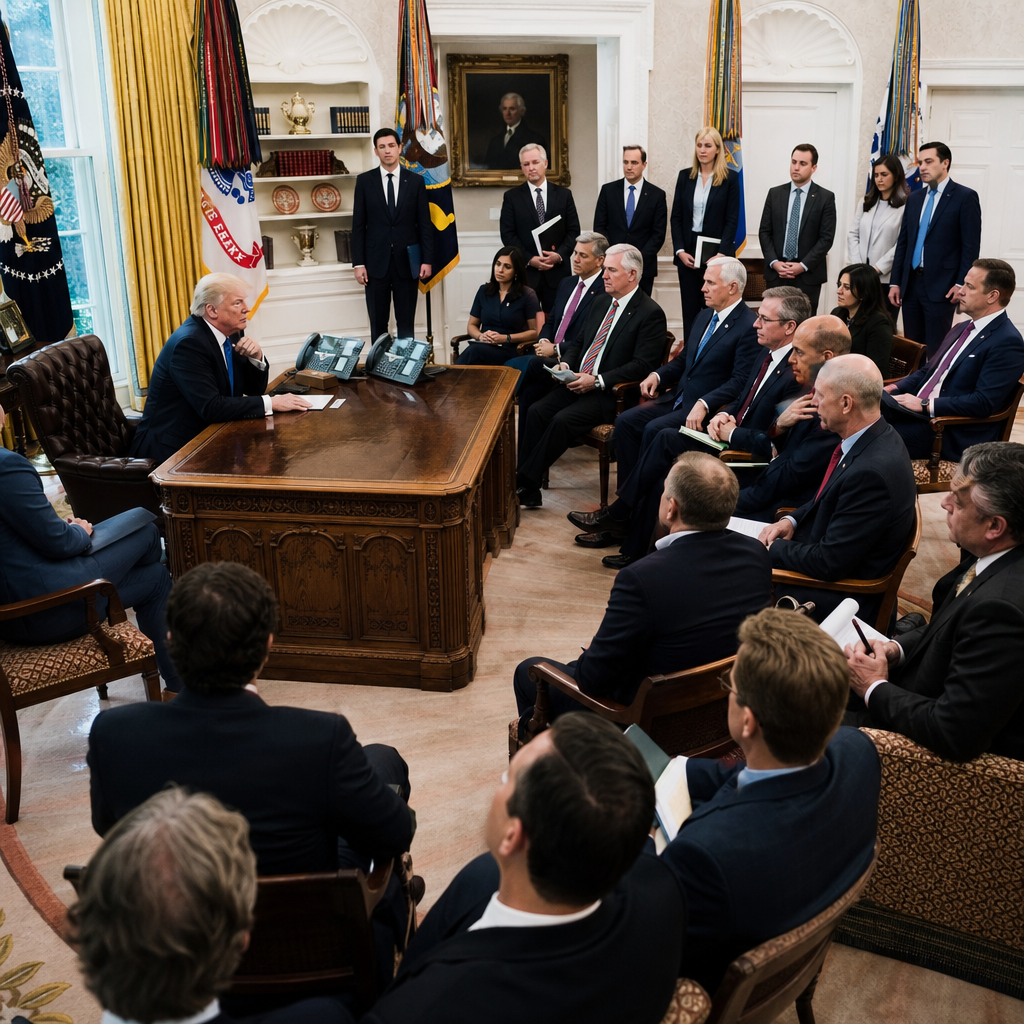
The White House Office and the Cabinet both advise the president, but they do so in different ways, from different locations in the executive branch, and with very different institutional strengths. In AP Government and Politics, this distinction matters because it explains how presidential power actually works beyond the Constitution’s short description of the executive branch. Students often hear that the Cabinet advises the president and then assume it is the president’s main decision-making team. In practice, after years of watching administrations operate, the White House Office is usually the president’s closest circle, while the Cabinet manages departments and brings policy, administrative, and political expertise from across the federal government.
To understand the difference, start with definitions. The White House Office is a group of senior presidential aides who work in the Executive Office of the President and are selected to serve the president directly. These advisers usually include the chief of staff, press secretary, communications staff, policy advisers, and other assistants who help shape strategy, scheduling, messaging, and day-to-day decisions. The Cabinet is made up of the heads of the major executive departments, such as State, Treasury, Defense, Justice, and Education, along with a few Cabinet-level officials. Cabinet secretaries lead large bureaucracies, oversee policy implementation, and advise the president based on their department’s responsibilities.
This topic matters because the relationship between the White House Office and the Cabinet reveals the balance between personal loyalty and institutional expertise. A president needs immediate advisers who understand political timing, public opinion, legislative strategy, and media pressure. A president also needs department leaders who know how to run agencies, enforce laws, manage budgets, and respond to crises. When these systems work together, the executive branch can act quickly while staying informed by specialized knowledge. When they clash, presidents can become isolated, departments can be sidelined, and policy can suffer. For AP Government, this is also a gateway topic for understanding the Executive Office of the President, the federal bureaucracy, presidential leadership, and informal powers.
At the broadest level, the White House Office helps the president think and act politically and strategically, while the Cabinet helps the president govern administratively and substantively. That distinction is not absolute, and every administration organizes advice differently. Still, if you want the shortest accurate answer to who advises the president most directly, it is usually the White House Office. If you want the fullest answer to who provides formal executive branch advice across major policy areas, it includes the Cabinet. Understanding both is essential for mastering how modern presidents make decisions.
What the White House Office Does
The White House Office is the president’s inner advisory team. Its members are chosen for proximity, trust, and responsiveness. Unlike Cabinet secretaries, many White House advisers do not lead huge departments. Their central job is to help the president decide, coordinate, and communicate. In practical terms, they manage information flow. That means deciding which memos reach the president, which meetings happen, what priorities dominate the schedule, and how policy choices are framed before a final decision is made.
In every modern presidency, the chief of staff is usually the most important gatekeeper in the White House Office. The chief of staff controls access, organizes staff work, and ensures that competing ideas are narrowed into choices the president can act on. Other officials, such as the national security adviser, domestic policy advisers, communications director, and counsel to the president, shape policy and politics from within the West Wing. These advisers are often with the president daily. Because of that physical and organizational closeness, they frequently have more influence than Cabinet members, even when they have less subject-matter expertise than a department secretary.
One reason the White House Office matters so much is speed. A president facing a breaking foreign policy crisis, a Supreme Court ruling, or a budget showdown cannot always wait for a full interdepartmental process. White House aides can gather instantly, assess political consequences, and recommend an immediate course of action. I have seen this dynamic in how administrations respond to major news events: the initial response is almost always shaped inside the White House first, with departments then adjusting implementation. That pattern shows why modern presidents rely heavily on advisers who sit steps away from the Oval Office.
What the Cabinet Does
The Cabinet is the president’s formal advisory body made up primarily of department heads. These officials are nominated by the president and confirmed by the Senate, which gives them a constitutional and political standing that White House aides usually do not have. Each secretary runs a major executive department with thousands of employees, defined statutory powers, and a specific policy mission. The secretary of State oversees diplomacy, the secretary of Defense leads the Department of Defense, the attorney general heads the Department of Justice, and the secretary of the Treasury manages core financial and fiscal functions.
Because Cabinet secretaries lead large bureaucracies, they advise the president from an operational vantage point. They know what a department can realistically do, how long implementation may take, what legal limits exist, and where resistance inside the bureaucracy may arise. That perspective is invaluable. For example, a White House team may want a rapid regulatory change or a highly visible enforcement initiative, but a Cabinet secretary can explain whether existing law permits it, whether rulemaking procedures will delay action, and whether the department has the personnel and funding to carry it out effectively.
Cabinet meetings, however, are not usually the core arena of presidential decision-making. In many administrations, full Cabinet meetings are infrequent and often more ceremonial than decisive. The real influence of Cabinet members tends to come through one-on-one meetings, policy memoranda, crisis briefings, and interagency processes rather than around a single conference table. In AP Government terms, that means the Cabinet is important, but not always central. It supplies expertise, legitimacy, and administrative reach, yet it often competes with White House staff for presidential attention.
Key Differences Between the White House Office and the Cabinet
The simplest comparison is this: White House advisers are personal presidential staff, while Cabinet secretaries are institutional leaders of executive departments. That difference affects appointment, accountability, influence, and daily function. White House Office staff generally serve because the president personally trusts them. Cabinet secretaries serve because the president wants both trust and governing capacity, but they also must navigate Senate confirmation, congressional oversight, and the internal demands of the departments they lead.
| Feature | White House Office | Cabinet |
|---|---|---|
| Primary role | Advise the president directly on strategy, policy, messaging, and scheduling | Lead executive departments and advise based on subject expertise and administration needs |
| Proximity to president | Very close, often daily contact | Less frequent direct contact in most administrations |
| Senate confirmation | Usually not required | Usually required |
| Main source of influence | Personal trust and control of information flow | Departmental expertise, legal authority, and bureaucratic capacity |
| Typical focus | Immediate decisions and political coordination | Implementation and policy administration |
These differences explain why presidents often prefer White House advisers for sensitive choices. A White House aide is there to advance the president’s agenda as defined by the president. A Cabinet secretary has a broader institutional role. The secretary must consider legal constraints, departmental morale, relations with Congress, inspector general scrutiny, and long-term program management. That can make Cabinet advice more cautious, but also more grounded. Presidents who ignore Cabinet realities often announce goals that later run into administrative or legal barriers.
For students, a useful rule is that the White House Office usually dominates agenda setting, while the Cabinet is more influential in implementation and specialized policy areas. That is not always true. Secretaries of State, Defense, Treasury, and the attorney general can be major power centers, especially during war, economic instability, or major legal disputes. Still, in the modern presidency, the gravitational center of advice is usually inside the White House.
Why Presidents Often Rely More on White House Staff
Modern presidents tend to trust the White House Office more because its members are selected for loyalty, ideological alignment, and willingness to operate within the president’s political timetable. This pattern expanded significantly in the twentieth century as the presidency became more complex. Since Franklin D. Roosevelt and especially after the creation and growth of the Executive Office of the President, presidents have built stronger in-house advisory systems to manage legislation, media, national security, and domestic policy. The White House Office became the command center of modern presidential leadership.
Another reason is message discipline. Cabinet secretaries often have independent reputations and ties to Congress, interest groups, governors, and the press. That can be an advantage, but it can also produce mixed signals. White House aides usually have a narrower mission: make sure the president’s priorities are delivered consistently. In contentious moments, presidents often prefer advice from aides who think first about the president’s coalition, the next legislative vote, or the next news cycle. That may sound overly political, but presidents operate in a constant political environment, and strategy cannot be separated from governance.
There is also a structural reason. White House staff can coordinate across departments in ways individual Cabinet secretaries cannot. If an immigration decision involves Homeland Security, Justice, State, Health and Human Services, and the Domestic Policy Council, someone near the president has to reconcile competing recommendations. White House offices are built for that coordinating role. The Cabinet, by contrast, is divided into departmental jurisdictions. As a result, a president usually turns to the White House Office to integrate advice and to the Cabinet to supply the specialized information underneath it.
When the Cabinet Matters Most
The Cabinet matters most when policy success depends on technical expertise, departmental execution, and credibility with outside institutions. During military operations, the secretary of Defense and the secretary of State bring perspectives no communications aide can replace. During a financial crisis, Treasury and related economic officials can explain market reactions, debt management, and banking system risks in ways that directly affect presidential choices. During public health emergencies, agencies and department leaders become indispensable because implementation depends on scientific guidance, procurement systems, and state-federal coordination.
Cabinet members can also matter when they bring political stature of their own. Some presidents appoint rivals, former governors, senators, military leaders, or respected policy experts to strengthen the administration’s reach. Those officials may influence policy not only because of their formal position but because Congress, foreign governments, or the public take them seriously. A secretary with deep credibility can reassure allies, calm markets, or negotiate with lawmakers in ways White House aides cannot easily match.
Still, Cabinet influence depends heavily on the president’s management style. Some presidents encourage open disagreement and hear from multiple secretaries directly. Others centralize decision-making tightly in the White House. If the chief of staff controls access and policy clearance, even a talented Cabinet secretary may struggle to shape outcomes. That is why no single chart tells the full story. The formal structure matters, but the president’s personal habits matter just as much.
Examples in Modern Presidencies
Modern history repeatedly shows the White House Office’s dominance. Presidents from John F. Kennedy onward relied heavily on close in-house advisers for fast, confidential decision-making. National security advisers such as Henry Kissinger and later Brent Scowcroft demonstrated how a White House-based official could rival or exceed the secretary of State in influence, depending on the president’s trust. Chiefs of staff from James Baker to Rahm Emanuel shaped legislative priorities, staff discipline, and information flow in ways most Cabinet members could not.
At the same time, Cabinet officials have been pivotal in specific moments. Secretaries of Defense and State often become central during wars and treaty negotiations. Attorneys general can shape the administration’s legal posture on civil rights, executive power, and federal enforcement. Treasury secretaries are critical during recessions, debt ceiling confrontations, and inflationary periods. In these situations, the president still hears from White House staff, but the secretary’s command of the department and policy field becomes impossible to ignore.
The broader lesson is that influence is relational, not automatic. A Cabinet title does not guarantee closeness, and a White House title does not guarantee wisdom. Strong presidents know they need both immediate loyal advisers and experienced administrators. Weak information systems produce policy failure. The best presidencies build a process where White House staff frame choices clearly and Cabinet officials test those choices against law, evidence, and operational reality.
What AP Government Students Should Remember
For AP Government and Politics, remember four core points. First, the White House Office is usually the president’s closest advisory network. Second, the Cabinet is the formal group of department heads that offers expertise and oversees implementation. Third, White House staff often have more day-to-day influence because they control access and work near the president. Fourth, Cabinet officials matter most when departmental knowledge, legal authority, and administrative capacity are central to the issue at hand.
This topic also connects to related AP Government concepts. It helps explain the growth of the Executive Office of the President, the limits of the Cabinet as a collective body, the importance of the federal bureaucracy, and the way informal presidential powers shape formal institutions. If you are building a broader study map for this miscellaneous executive branch area, connect this article to topics such as the Executive Office of the President, the bureaucracy, Senate confirmation, presidential leadership styles, and checks on executive power. Those links turn a simple comparison into a full understanding of how the executive branch really functions.
The White House Office versus the Cabinet is ultimately a question of proximity versus portfolio. Presidents usually listen first to those closest to them, but governing requires the reach of the departments. If you remember that the White House Office drives immediate presidential advising while the Cabinet supplies formal expertise and execution, you have the core answer. Review how each body is structured, look at modern examples, and use this hub as your starting point for the wider AP Government and Politics miscellaneous subtopic.
Frequently Asked Questions
1. What is the main difference between the White House Office and the Cabinet?
The main difference is that the White House Office is made up of the president’s closest personal and political advisers, while the Cabinet is a group of department heads who lead major executive departments such as State, Defense, Treasury, and Education. Both can advise the president, but they do not play the same role in practice. The White House Office is located inside the Executive Office of the President and is designed to serve the president directly, often on a daily basis. Its staff focuses on political strategy, communications, scheduling, policy coordination, and immediate decision-making support. These advisers are chosen because the president trusts them personally and wants them close at hand.
The Cabinet, by contrast, is made up of officials who manage large bureaucratic organizations. Cabinet secretaries are responsible not only for advising the president but also for administering federal law, overseeing agencies, managing budgets, and supervising thousands of employees. That means their perspective is often shaped by the policy area they run and by the institutional responsibilities of their department. In AP Government terms, this distinction matters because it shows that formal constitutional structures do not always reveal where power actually operates. Even though students often hear that the Cabinet advises the president, the president usually relies more heavily on White House Office staff for immediate counsel because those advisers are physically closer, politically loyal, and focused entirely on the president’s agenda.
2. Why does the president usually rely more on the White House Office than on the Cabinet for day-to-day advice?
Presidents usually rely more on the White House Office because it is built for constant, direct access. White House Office staff work in close proximity to the president and are involved in the daily flow of information, meetings, messaging, and political calculations. They can respond quickly to breaking events, prepare decision memos, coordinate across agencies, and help the president manage both governing and public relations. This makes them especially valuable in a presidency where speed, message discipline, and political strategy matter every day.
Cabinet members are important, but they are not usually part of the president’s inner circle in the same way. A secretary of State or secretary of Homeland Security may have tremendous expertise and legal authority, but that person is also busy running a massive department. Cabinet secretaries often bring broader administrative and policy knowledge, yet they may not have the same level of personal closeness or regular access to the president as White House advisers do. In addition, White House Office staff are often selected for loyalty and ideological alignment, which gives presidents confidence that their advice will reflect presidential priorities rather than the interests of a department. For AP Government students, this helps explain why the real center of presidential advising is often informal and personal rather than purely constitutional or ceremonial.
3. Does the Cabinet still matter if the White House Office is usually more influential?
Yes, the Cabinet still matters a great deal, but its importance is different from the influence exercised by the White House Office. Cabinet secretaries matter because they lead the executive departments that actually carry out federal policy. A president can announce goals, but departments and agencies must implement those goals through rules, enforcement, administration, diplomacy, defense planning, and program management. Cabinet officials therefore provide expertise, institutional memory, and operational capacity that White House staff often do not have. They can explain what is practical, what legal limits exist, how policies will affect agencies and the public, and what resources implementation will require.
The Cabinet also matters because department heads connect the president to the broader executive branch. The White House Office is relatively small compared with the enormous bureaucracy the president oversees. Cabinet secretaries help translate presidential priorities into administrative action. They also represent important policy constituencies and often testify before Congress, defend administration policy in public, and negotiate with lawmakers and stakeholders. So while the White House Office may dominate immediate access and strategic influence, the Cabinet remains essential for governance, subject expertise, and execution. In other words, the White House Office often shapes what the president wants to do, while the Cabinet plays a major role in determining how those goals are carried out in practice.
4. How does this distinction help explain presidential power in AP Government and Politics?
This distinction is important in AP Government because it shows that presidential power depends on more than the Constitution’s short description of executive authority. The Constitution says relatively little about the internal structure of presidential advising. Over time, however, presidents have built an institutional presidency that includes the White House Office, the Executive Office of the President, and the Cabinet. Understanding the difference between these components helps students see that modern presidential leadership is shaped by organization, access, and control over information as much as by formal constitutional text.
In practical terms, the White House Office gives the president a set of personal advisers who can help centralize power and coordinate decision-making from the center of the executive branch. The Cabinet, meanwhile, reflects the more decentralized and administrative side of the presidency, since each secretary runs a department with its own mission, personnel, and traditions. This can create tension. Presidents want responsiveness and loyalty, which White House staff can provide. But they also need expertise and implementation capacity, which Cabinet departments provide. For students, this is a key lesson: the presidency is not just one person making decisions alone. It is a complex institution, and where advisers sit within that institution often determines how much influence they have. That is why the difference between the White House Office and the Cabinet is so useful for explaining how modern executive power actually works.
5. If both advise the president, why do students often misunderstand the Cabinet’s role?
Students often misunderstand the Cabinet’s role because introductory descriptions of the executive branch usually emphasize that Cabinet secretaries advise the president, which is true but incomplete. That basic description can make it sound as though the Cabinet functions like the president’s main governing team in the way a board of advisers might in a simple organizational chart. In reality, the Cabinet is not usually the president’s primary source of day-to-day political and strategic advice. Much of that comes from the White House Office and other parts of the Executive Office of the President, where staff members are specifically hired to focus on the president’s priorities, public image, legislative strategy, and immediate policy choices.
The misunderstanding also happens because the Cabinet is highly visible. Cabinet secretaries are well known, often Senate-confirmed, and associated with major national issues. That visibility can make them seem more central to the president’s inner decision-making than they sometimes are. But influence in the presidency is not just about title or prestige; it is often about access, trust, proximity, and control over information. White House advisers may have lower public profiles but greater ability to shape what the president hears and how choices are framed. For AP Government students, the key takeaway is that the Cabinet is important, but it is not usually the president’s only or even primary advisory body. To understand presidential power accurately, students need to distinguish between formal departmental leadership and the president’s personal advisory network inside the White House.