
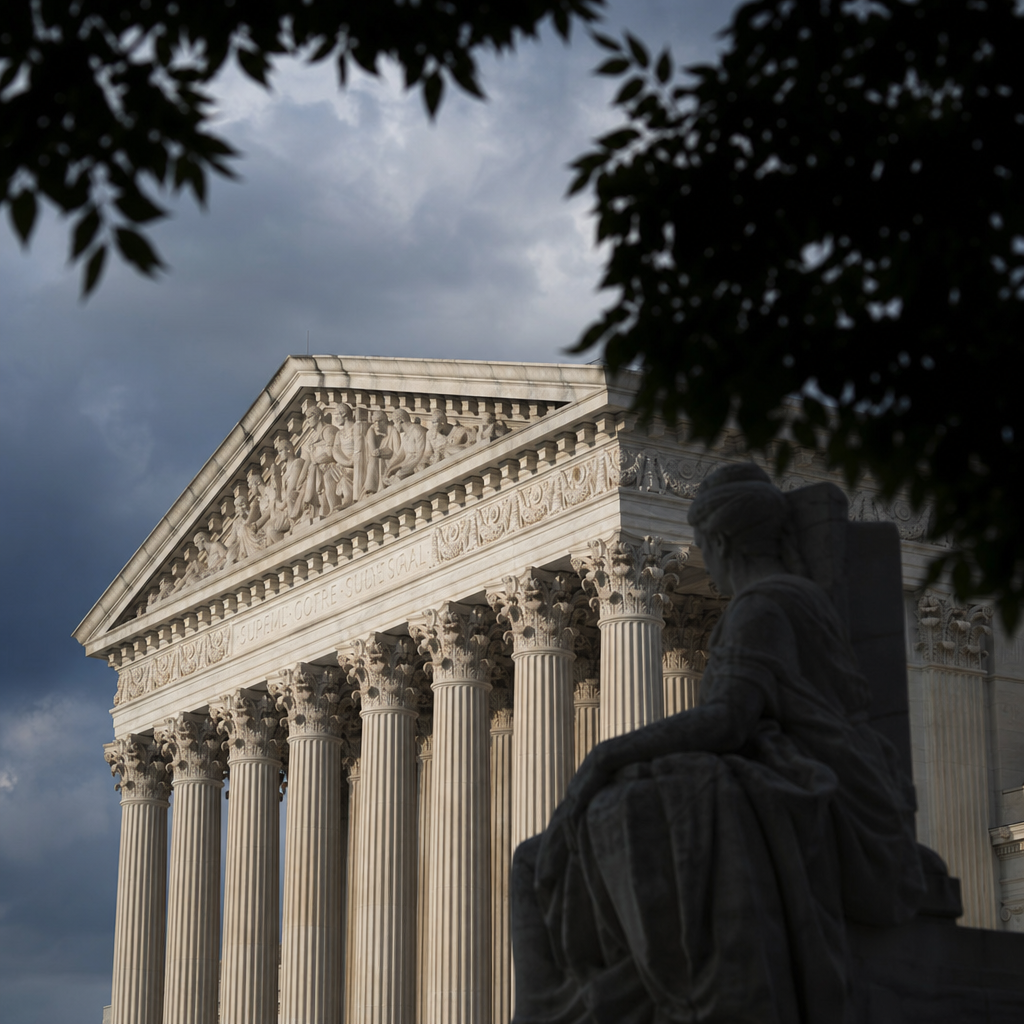
The Supreme Court’s shadow docket refers to orders and summary decisions issued outside the Court’s regular merits process, often without full briefing, oral argument, or a signed opinion explaining the result. In AP Government and Politics, the term matters because it sits at the intersection of judicial power, separation of powers, transparency, and democratic accountability. Students usually learn the Court through landmark opinions like Brown v. Board of Education or Roe v. Wade, but much of the Court’s practical influence also comes through emergency orders, stays, injunctions, and procedural rulings that receive less public attention while still shaping national policy.
In plain terms, the shadow docket is not a separate court or a formal docket with different rules. It is a label scholars and journalists use to describe the stream of unsigned, expedited orders that resolve urgent disputes. These orders can decide whether a law takes effect, whether an execution proceeds, whether election rules change close to voting, or whether a lower court ruling is paused. Because these actions often happen quickly and with limited explanation, critics argue that they can obscure reasoning and reduce accountability. Defenders respond that emergency circumstances require speed and that the Court has always needed a way to handle urgent requests.
For anyone studying AP Government and Politics, this topic is essential because it shows how institutions operate beyond textbook diagrams. The Court is not only a body that writes lengthy constitutional opinions after months of deliberation. It is also an actor that can intervene overnight in disputes involving immigration, public health, religion, reproductive rights, capital punishment, and elections. Understanding the shadow docket helps explain why the Supreme Court can affect policy immediately, why lower courts and litigants race to seek emergency relief, and why debates over legitimacy now focus as much on procedure as on ideology. This hub article maps the core concepts, major controversies, and practical examples that define the issue.
What the shadow docket includes
The shadow docket includes emergency applications and routine orders that the Court resolves without the full process used in argued cases. Common forms include stays of lower court rulings, injunctions pending appeal, vacating stays, administrative stays, and summary dispositions. A stay temporarily pauses a lower court decision. An injunction pending appeal preserves or blocks government action while litigation continues. An administrative stay is often a short-term pause used while the justices consider a request. Summary reversals occur when the Court overturns a lower court without full argument because it believes the law is clear enough to act immediately.
When I have taught this topic, the most useful distinction is between the merits docket and emergency orders. On the merits docket, the Court grants certiorari, receives extensive briefs, hears oral argument, and usually issues signed opinions with concurrences and dissents. On the shadow docket, timing is compressed. Applications can arrive within hours. Responses may be due the same day. Orders are sometimes only a paragraph long. The legal effect, however, can be enormous. If the Court allows a policy to take effect during litigation, that temporary decision can govern real people for months or years.
The term became widely known after legal scholar William Baude used it to describe the Court’s less visible orders work. The phrase caught on because it captured a real transparency gap. The public can read high-profile opinions and follow arguments, but emergency orders often emerge with little warning and less explanation. That makes the shadow docket especially important for a hub page in AP Government and Politics: it connects to civil liberties, federalism, executive power, interest groups, and the media’s role in interpreting institutions.
Why the Court uses it
The Supreme Court uses expedited orders because some disputes cannot wait for the normal pace of appellate review. Executions are scheduled for specific dates. Election deadlines arrive quickly. Immigration rules may affect thousands of people immediately. A nationwide injunction can halt federal policy at once. In these situations, parties ask the Court to preserve the status quo or stop a change before irreversible consequences occur. The justices therefore need procedures that let them act fast, even when the factual record is incomplete and legal questions remain unsettled.
There is also an institutional reason. The Court receives thousands of filings each term and cannot hear full argument in more than a small fraction of cases. Emergency applications serve as a pressure valve. Individual justices are assigned to geographic circuits and can handle certain preliminary matters, but major requests are usually referred to the full Court. This process is longstanding. What has changed is the scale, visibility, and policy significance of emergency intervention. Especially in recent years, administrations, advocacy groups, and state governments have become more aggressive about seeking emergency relief from the justices.
That rise reflects changes in litigation strategy. Lower courts more frequently issue nationwide injunctions. Federal policy now moves through executive action more often, which invites immediate legal challenges. Polarization increases incentives to seek fast judicial wins. As a result, the shadow docket has become a central tool in high-stakes governance rather than a quiet back-office function. Understanding that shift is crucial to understanding modern judicial politics.
Why critics care
Critics care about the shadow docket for three main reasons: limited explanation, major policy impact, and inconsistency in standards. First, unsigned orders often do not explain why the Court acted. A one-paragraph order can change the legal landscape while offering little guidance to lower courts, litigants, or the public. That lack of reasoning makes it harder to evaluate whether the Court applied settled law, changed doctrine indirectly, or acted on ideological preference. In constitutional government, explanation matters because it is a basic mechanism of accountability.
Second, emergency orders can produce consequences that look temporary in theory but function as near-final judgments in practice. If the Court allows a state abortion restriction to remain in force, or permits an immigration policy to operate during litigation, the immediate real-world effects may be irreversible. Patients miss windows of care. Families are separated. Voters follow changed rules. Even if a later merits opinion revises the law, the temporary order may have already shaped behavior, costs, and outcomes. Critics therefore argue that “temporary” decisions can act like substantive rulings without the safeguards of full merits review.
Third, critics question whether the Court applies emergency standards consistently. Traditional factors for a stay include likelihood of success on the merits, irreparable harm, balance of equities, and the public interest. Yet in practice, the Court’s emergency orders do not always clearly walk through those elements. That creates the impression that some applicants, especially governments, receive more favorable treatment than others. The concern is not simply speed. It is whether speed is paired with principled, transparent reasoning.
How defenders respond
Defenders of the Court’s emergency practices make several strong arguments. The first is necessity. A court that cannot act quickly in emergencies would fail at one of its basic jobs. If a lower court issues an order hours before an election or blocks an execution after years of litigation, the Supreme Court must have a mechanism for immediate review. Waiting months for full briefing could make effective judicial review impossible. In that sense, emergency orders are not exceptional; they are part of how appellate courts preserve orderly process.
Defenders also argue that the criticism sometimes ignores history. The Court has long resolved many matters through unsigned orders, and not every emergency ruling should carry a long opinion. Short orders can reflect settled law rather than secrecy. The justices may believe a lower court clearly erred, that the equities are obvious, or that explanation would risk prejudging issues still being litigated below. They also note that some emergency orders include noted dissents or concurring statements that reveal substantial debate.
A further defense is that lower-court innovation has forced the justices into a larger emergency role. When district courts issue broad injunctions affecting national policy, the Supreme Court faces pressure to step in quickly because the consequences are immediate and widespread. From this view, the shadow docket is partly a response to changes elsewhere in the judiciary and political system, not simply a power grab by the Court itself.
Major examples students should know
Several cases explain why the shadow docket became a major public controversy. In Whole Woman’s Health v. Jackson in 2021, the Court declined to block Texas Senate Bill 8, a restrictive abortion law enforced through private civil suits. The unsigned order emphasized procedural complexity, but critics saw the decision as allowing a significant constitutional restriction to operate without full merits review. Because the law remained in effect, the practical impact was immediate even though the order was technically interlocutory.
During the COVID-19 pandemic, emergency orders on religious liberty drew national attention. In Roman Catholic Diocese of Brooklyn v. Cuomo, the Court blocked New York attendance limits on religious services, signaling a stronger protection for free exercise claims against public health regulations. The order was brief, but its implications were broad. It indicated that even under emergency public health conditions, restrictions on worship would face close scrutiny when comparable secular activities were treated more favorably.
Immigration cases under multiple administrations also highlight the pattern. Litigation over the Trump administration’s travel restrictions, the “Remain in Mexico” policy, public charge rules, and later Biden administration policies generated repeated emergency applications. In these disputes, the Court often decided whether policies would remain in force while lower courts considered legality. Those temporary choices shaped border administration and federal-state relations in real time.
Capital punishment is another area where the shadow docket has long mattered. Execution cases regularly arrive at the Court on compressed timelines, sometimes late at night. Orders may determine whether a prisoner is executed before claims receive full review. Questions involving ineffective assistance of counsel, intellectual disability, method of execution, or religious advisers in the execution chamber have all reached the justices through emergency applications. For critics, these cases are the starkest example of why explanation and consistency are essential.
| Issue area | Typical emergency question | Why critics focus on it |
|---|---|---|
| Elections | Should voting rules change close to Election Day? | Last-minute orders can affect turnout, ballot access, and public confidence. |
| Immigration | Can a federal policy take effect while litigation continues? | Temporary orders influence detention, removal, and border management immediately. |
| Abortion | Should a restriction be blocked before full review? | Delay can effectively decide access because time-sensitive care cannot be restored later. |
| Religion | Do emergency public rules burden free exercise? | Brief orders can shift constitutional doctrine for broad categories of disputes. |
| Death penalty | Should an execution be stayed? | The consequence is irreversible, making procedural fairness especially important. |
Why it matters in AP Government and Politics
This topic belongs at the center of AP Government and Politics because it illustrates how formal constitutional design interacts with actual governing practice. Separation of powers is not only about Congress passing laws and courts interpreting them through famous opinions. It is also about whether the judiciary can alter executive and state policy through emergency process. Federalism appears when state officials and federal agencies seek rapid relief from nationwide rulings. Civil liberties and civil rights appear when expedited orders affect speech, religion, due process, equal protection, or reproductive freedom.
The shadow docket also helps students analyze legitimacy. The Supreme Court has no army and limited direct enforcement power. Its authority depends heavily on public acceptance that its decisions are lawful and reasoned. When major disputes are resolved through brief, unsigned orders, people naturally ask whether the Court is exercising judgment or simply asserting power. That question is central to political science. It links to public opinion, media framing, interest-group mobilization, and confirmation politics.
For exam preparation, students should be able to define the term, distinguish it from merits cases, identify why emergency relief exists, and explain the central criticism: major legal and policy change can occur without the transparency of full review. They should also note the strongest defense: emergencies are real, and a high court must be able to act quickly when delay would defeat justice or create chaos. That balanced explanation demonstrates strong command of the concept and mirrors how the issue appears in modern constitutional debate.
Key debates and likely reforms
The current debate is not simply whether the shadow docket should exist. It will exist because emergencies are unavoidable. The real debate is how the Court should use it. Reform proposals include requiring more written explanations for consequential orders, clarifying the standards for stays and injunctions, publishing votes more consistently, and limiting broad relief unless the legal basis is clearly established. Some scholars also support faster merits scheduling after major emergency interventions so that temporary rulings do not function as prolonged substitutes for final judgment.
There are tradeoffs. More explanation can improve transparency, but it can also consume time when hours matter. Clearer standards can promote consistency, but emergency cases often involve incomplete records and unusual procedural postures. Mandatory signed opinions might increase accountability, yet they could also encourage strategic writing that hardens positions before full review. The best reforms therefore aim for practical gains: explain more when policy stakes are high, identify the legal test being applied, and resolve the merits quickly whenever possible.
The shadow docket matters because procedure is power. When the Supreme Court acts quickly and quietly, its orders can shape national life as much as famous opinions do. For students, voters, and anyone following AP Government and Politics, understanding this process makes the Court easier to analyze honestly. Watch not only the blockbuster cases on the merits docket, but also the emergency orders that decide what happens right now. If you want a clearer picture of American government, start tracking both.
Frequently Asked Questions
What is the Supreme Court’s “shadow docket”?
The Supreme Court’s “shadow docket” is a shorthand term for the Court’s orders and summary decisions that happen outside its regular, highly visible merits process. In the merits process, the Court typically agrees to hear a case, receives full written briefs from both sides and often from outside groups, holds oral argument, and later issues a signed or attributed opinion explaining its reasoning. By contrast, shadow docket actions often come in the form of short orders on emergency requests, stays, injunctions, or procedural disputes. These decisions can be issued quickly, sometimes late at night, and sometimes without a detailed explanation of why the Court ruled as it did.
The term does not mean these decisions are secret in the literal sense; the orders are usually public. What makes the docket “shadowy” is the limited transparency compared with the Court’s ordinary process. Many orders are unsigned, brief, and do not reveal much about the legal reasoning behind them. Some may note dissents or concurrences, but others provide little more than the result. That can make it harder for lawyers, lower courts, journalists, students, and the public to understand what legal principle the Court is applying.
For AP Government and Politics, the shadow docket matters because it shows that judicial power is not exercised only through famous constitutional opinions. The Court also shapes policy and law through emergency rulings and procedural orders. In practice, those orders can have immediate nationwide consequences, affecting immigration policy, elections, public health rules, abortion access, and the balance of power between federal and state governments. So while students often focus on landmark cases, the shadow docket highlights a different but highly important way the Supreme Court influences American government.
Why do critics care so much about the shadow docket?
Critics care because shadow docket decisions can have enormous real-world effects without the level of transparency, deliberation, and public explanation that many people expect from the nation’s highest court. When the Court acts through its regular merits docket, the public can follow the development of a case: which legal questions are presented, what arguments each side makes, what the justices ask at oral argument, and how the majority and dissenters justify their positions. That process helps support legitimacy because people can see how the Court reached its decision, even if they disagree with the outcome.
On the shadow docket, however, major disputes may be resolved on an emergency basis with limited briefing and little or no written reasoning. Critics argue that this creates a democratic accountability problem. The Supreme Court is unelected and largely insulated from political pressure, so one of the main checks on its authority is public justification through reasoned opinions. If the Court changes the practical status quo through short, unexplained orders, critics say it becomes harder to evaluate whether the justices are applying consistent legal principles or simply reaching preferred outcomes.
Another reason critics care is that emergency orders can affect separation of powers. For example, when the Court quickly allows or blocks an executive policy, it is not merely settling a technical procedural issue; it may be influencing how much power presidents, governors, legislatures, and lower courts can exercise. Critics worry that if these interventions become more frequent, the Court may be shaping national policy without the careful procedural safeguards associated with ordinary judicial review. Supporters sometimes respond that emergencies require speed and that the Court must be able to act quickly to prevent irreparable harm. But the criticism remains powerful because speed and limited explanation can come at the cost of transparency and predictability.
How is the shadow docket different from the Supreme Court’s regular merits docket?
The regular merits docket is the traditional process most students learn first. A party asks the Supreme Court to hear a case through a petition for certiorari, the justices decide whether to grant review, both sides submit extensive briefs, interested groups may file amicus briefs, and the Court hears oral argument. After deliberation, the justices issue one or more written opinions explaining the legal reasoning behind the result. This process is slower, more formal, and usually better suited for resolving major constitutional questions in a way that creates clear precedent.
The shadow docket works differently. It usually involves emergency applications or procedural matters that arise before a full hearing on the merits. A party may ask the Court to pause a lower-court ruling, allow a law to take effect temporarily, block enforcement of a policy, or intervene because time is short. In these situations, the Court may act within days or even hours. The briefing may be limited, oral argument often does not happen, and the order may be only a paragraph or two long. Sometimes there is no signed opinion, and sometimes the justices do not fully explain the legal standard they are applying.
That difference matters because procedure affects substance. A decision issued after months of briefing and argument can look very different from one made under severe time pressure. On the merits docket, the Court typically aims to settle legal questions in a durable and reasoned way. On the shadow docket, the Court is often deciding whether to preserve or change the status quo while litigation continues. Even so, those temporary orders can be enormously important. In practical terms, a supposedly temporary ruling may determine what happens during an election, whether a government policy remains in force for months, or whether constitutional rights can be exercised immediately. That is why many scholars and commentators say the distinction between “procedural” and “substantive” is not always as sharp as it sounds.
Does the shadow docket let the Supreme Court make major policy decisions without full explanation?
In some cases, yes, and that is a central source of controversy. Formally, shadow docket rulings are often framed as temporary or procedural decisions rather than final judgments on the merits. The Court may say it is only deciding whether to grant a stay, lift an injunction, or respond to an emergency application. But in reality, those decisions can have sweeping policy consequences. If the Court allows a law to take effect while litigation continues, that law may govern people’s lives for a long period before the underlying legal challenge is fully resolved. If the Court blocks a policy, the opposite can happen.
Critics argue that this means the Court can effectively reshape national policy without producing the kind of detailed opinion that would normally accompany such a significant move. Because many shadow docket orders are brief and unsigned, it may be unclear how broad the ruling is supposed to be, what legal rule lower courts should extract from it, or whether the justices are signaling a change in doctrine. This uncertainty can ripple outward, leaving lower courts and government officials unsure how to apply the Court’s action in related disputes.
At the same time, defenders of the Court’s emergency authority note that not every shadow docket order is a hidden policy decision. Some are routine and necessary. Courts must manage litigation, respond to urgent deadlines, and prevent immediate harm when waiting for the full merits process would make relief meaningless. The real debate is not whether emergency orders should exist at all, but how often they should be used in high-stakes cases and how much explanation the Court should provide. For students of government, this debate is a great example of the tension between efficiency and legitimacy: the judiciary must be able to act quickly when needed, but the public also expects major exercises of judicial power to be reasoned and visible.
Why is the shadow docket important for AP Government and Politics students?
The shadow docket is important for AP Government and Politics because it connects several core ideas from the course in one topic. First, it illustrates judicial power beyond the famous cases usually highlighted in textbooks. Students often learn about constitutional change through landmark rulings with lengthy opinions, but the shadow docket shows that the Supreme Court also exercises power through emergency orders, procedural interventions, and short rulings that may still alter policy in major ways. Understanding that broader reality gives students a more accurate picture of how the federal judiciary functions.
Second, the shadow docket is a concrete example of separation of powers in action. When the Court grants or denies emergency relief, it can immediately affect what presidents, agencies, Congress, state governments, and lower federal courts are able to do. A single order may allow an executive policy to proceed, stop a state law from being enforced, or change the legal environment surrounding elections, civil liberties, or administrative action. That makes the shadow docket highly relevant to questions about checks and balances and the proper role of the judiciary in the American constitutional system.
Third, it raises issues of transparency and democratic accountability that are central to AP Government. The judiciary does not answer to voters in the same way elected branches do, so its legitimacy depends heavily on public confidence in principled, consistent decision-making. When the Court acts with minimal explanation, critics say that confidence can weaken. Students can use the shadow docket to think critically about what makes institutions legitimate: Is it enough for the Court to be lawful and constitutionally authorized, or should it also explain itself fully when its actions have broad public consequences?
Finally, the topic helps students connect abstract constitutional principles to current events. The shadow docket is not just a theory; it is an ongoing part of how the Supreme Court influences national life. For exam purposes and for civic understanding more broadly, knowing what the shadow docket is and why critics care helps students discuss federalism, civil liberties, judicial review, institutional legitimacy, and public trust in government with more sophistication and accuracy.