
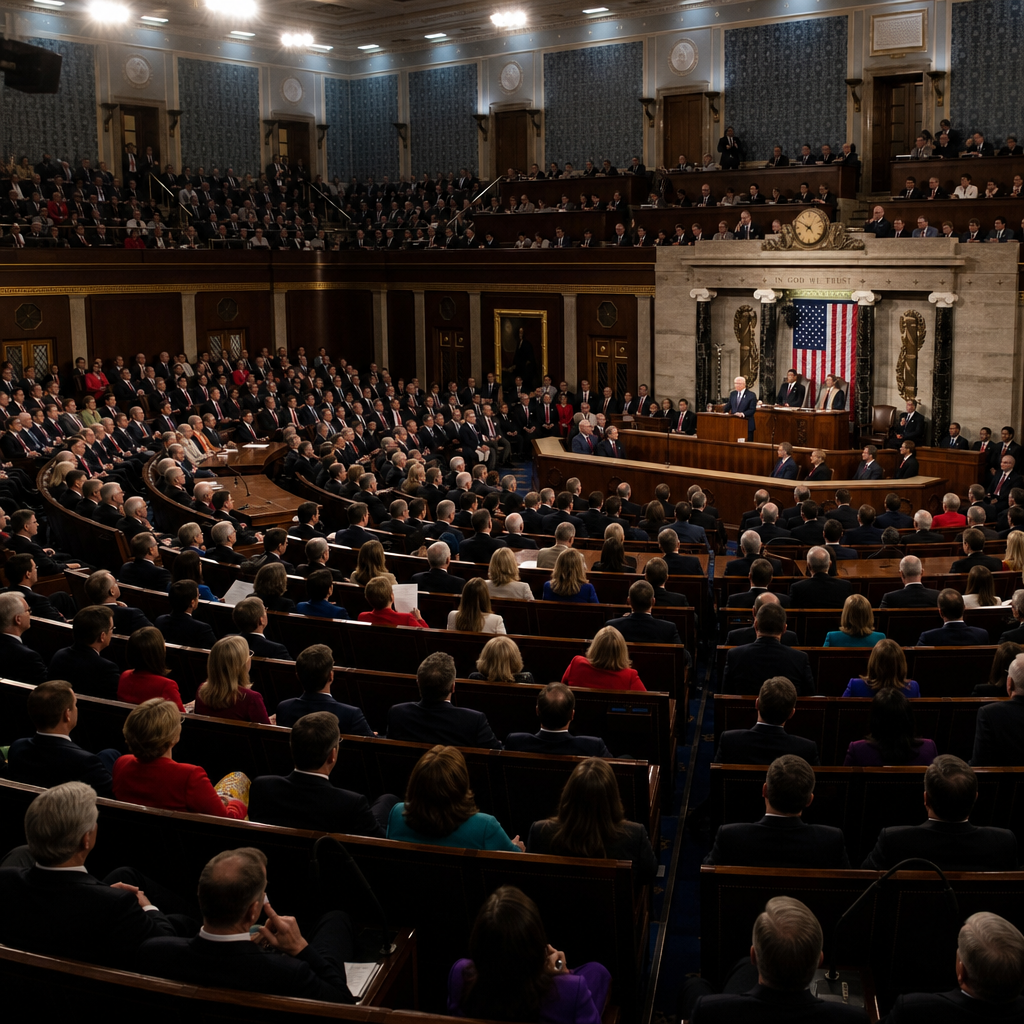
The State of the Union Address sits at the intersection of constitutional duty, legislative strategy, media spectacle, and electoral politics. For students of AP Government and Politics, it is one of the clearest examples of how formal institutions and informal political behavior operate at the same time. The president is required by the Constitution to give Congress information on the state of the union and recommend measures deemed necessary and expedient. Yet the modern State of the Union is far more than a report. It is a nationally televised message, a policy rollout, a partisan signaling event, and a carefully staged performance aimed at multiple audiences at once.
Understanding the State of the Union matters because it connects core course themes: separation of powers, checks and balances, presidential leadership, agenda setting, public opinion, media, and political parties. When I have taught students how to analyze presidential power, this address is often where abstract ideas become concrete. You can see the president acting as chief legislator by asking Congress for specific bills, as head of state through ceremonial language, as chief executive by defending administrative priorities, and as party leader by framing issues to help allies and pressure opponents. At the same time, congressional reactions, opposition responses, and press coverage reveal the limits of presidential influence.
In plain terms, the main question is this: is the State of the Union primarily a policy agenda or political theater? The accurate answer is both, but not in equal measure every year. Some addresses have genuinely shaped legislative priorities, especially during periods of unified government or national crisis. Others have functioned mostly as symbolic performances designed to rally supporters, define an election-year message, or create viral moments for television and social media. To evaluate the event well, students need historical context, constitutional grounding, and a clear framework for judging what presidents say against what they can actually accomplish.
This hub article explains how the State of the Union evolved, what constitutional role it serves, how presidents use it to advance policy, why it often becomes political theater, and how to analyze it as an AP Government and Politics topic. It also points toward the broader “Misc” category by linking themes that connect to presidential communication, congressional behavior, media strategy, and civic interpretation. If you can read a State of the Union critically, you can better understand modern American government itself.
Constitutional foundation and historical evolution
The Constitution gives the president a modest instruction in Article II, Section 3: from time to time, the president shall give Congress information on the state of the union and recommend measures for consideration. That wording is important. It does not require an annual speech, does not require an in-person appearance, and does not prescribe a theatrical national event. Early presidents interpreted the duty differently. George Washington and John Adams delivered speeches in person, but Thomas Jefferson considered that style too monarchical and returned to a written message. For more than a century, presidents generally sent written annual messages to Congress.
The modern televised State of the Union emerged gradually in the twentieth century. Woodrow Wilson revived the in-person address in 1913 because he believed direct communication with Congress would strengthen presidential leadership. Franklin D. Roosevelt popularized the phrase “State of the Union,” and the growth of radio gave presidents a wider public audience. Harry Truman’s 1947 address was the first televised one, and television transformed the event from a congressional communication into a national political broadcast. By the late twentieth century, the speech had become a major media production with rehearsed applause lines, guest galleries, and instant analysis.
This evolution reflects a broader expansion of the modern presidency. Presidents no longer speak only to lawmakers in the chamber. They speak over Congress to the public, to interest groups, to party activists, to donors, to markets, and to foreign audiences. The annual message became a platform for what political scientist Richard Neustadt described as presidential power rooted in persuasion. It is also an example of the rhetorical presidency, a concept associated with Jeffrey Tulis, in which presidents increasingly govern through public appeals. That shift helps explain why the address now blends constitutional obligation with campaign-style messaging.
The State of the Union as a policy agenda
At its strongest, the State of the Union is a policy agenda-setting tool. Presidents use it to identify priorities, define problems, claim urgency, and ask Congress for action. A successful address does not pass laws by itself, but it can coordinate the governing coalition by putting items in sequence and attaching presidential attention to them. In practice, I have seen analysts treat the speech as a roadmap for the coming legislative session: what proposals get top billing, what language is repeated, and which issues are framed as nonnegotiable reveal what the White House wants Congress and the public to focus on.
There are clear examples of policy impact. Lyndon Johnson used major addresses to press civil rights, voting rights, and Great Society programs during a period when Democratic majorities made legislative follow-through possible. Bill Clinton’s 1996 declaration that “the era of big government is over” signaled an adaptation to divided government and helped define a centrist governing approach after the Republican Revolution. George W. Bush’s post-9/11 addresses reinforced homeland security priorities and built support for broader executive action. Barack Obama used State of the Union speeches to defend economic recovery measures, health care implementation, and immigration reform, even when congressional conditions limited outcomes.
Still, agenda setting is not the same as agenda achieving. Political scientists have consistently found that presidential success depends heavily on partisan control, issue salience, and congressional incentives. A proposal highlighted in the State of the Union may gain attention yet still fail because committee chairs resist it, interest groups mobilize against it, or members fear electoral backlash. The speech matters most when it clarifies priorities within a realistic governing window. It matters less when it becomes a wish list disconnected from legislative arithmetic. Students should therefore distinguish between message power and institutional power.
Why the address often becomes political theater
The theatrical side of the State of the Union is not accidental. It is built into the incentives of modern politics. Television rewards visuals, emotional stories, and conflict. Presidents invite guests in the gallery to embody policy themes: a small-business owner, a military family, a crime victim, a medical researcher, or a worker whose experience illustrates a broader claim. Members of Congress stand, clap, remain seated, or visibly dissent. Camera shots turn chamber behavior into a national performance of party alignment. Every element is designed for persuasion, and often for clips that can circulate well beyond the speech itself.
Political theater also appears in the ritual itself. The procession into the chamber, the announcement of “Mr. Speaker, the President of the United States,” the applause interruptions, and the opposition response all dramatize the separation of powers while softening it with ceremony. Yet behind that ceremony is partisan contest. One side wants to project command, empathy, and momentum. The other wants to deny consensus, challenge claims, and expose vulnerabilities. During polarized eras, even moments once treated as bipartisan, such as praising troops or honoring guests, can become coded signals in a wider struggle over narrative control.
The rise of digital media intensified this pattern. Speechwriters now craft lines not just for the room but for searchable headlines, short video clips, and rapid-response graphics. Fact-checkers publish near real time. Campaign arms raise money off applause lines or gaffes within minutes. In effect, the State of the Union has become both a governing address and a content event. That does not make it meaningless. It means students must evaluate form as well as substance. If a proposal gets thirty seconds while a symbolic anecdote gets two minutes, that imbalance tells you something important about the president’s strategic goals.
How to analyze a State of the Union in AP Government and Politics
For AP Government and Politics, the best way to evaluate a State of the Union is to ask targeted questions about institutions, incentives, and outcomes. Start with constitutional role: what is the president formally doing under Article II? Then move to political context: is government unified or divided, is it an election year, are approval ratings strong or weak, and what major crises shape the address? Next, identify the policy asks and separate realistic proposals from symbolic messaging. Finally, compare the speech to what happens afterward. Did Congress hold hearings, draft bills, appropriate funds, or ignore the request?
Students should also watch for recurring course concepts. Agenda setting is central because the president tries to direct national attention. Checks and balances matter because Congress decides whether recommendations become law. Informal powers matter because the address relies on persuasion rather than command. Public opinion matters because presidents often frame policies in terms designed to move median voters, activate the base, or reassure independents. Media effects matter because coverage often reduces a complex speech to a few dominant themes. Federalism can appear when presidents ask states to implement or cooperate with national initiatives.
| Analytical lens | What to look for in the speech | Why it matters |
|---|---|---|
| Constitutional duty | Assessment of national conditions and recommendations to Congress | Shows the formal basis of the address |
| Presidential leadership | Specific legislative priorities, executive actions, and crisis framing | Reveals how the president defines governing goals |
| Partisanship | Audience reactions, attacks on opponents, and opposition response | Demonstrates polarization and coalition politics |
| Media strategy | Memorable lines, guest stories, visuals, and social media moments | Explains how the message reaches mass audiences |
| Policy follow-through | Subsequent bills, hearings, negotiations, or executive implementation | Separates rhetoric from actual governing results |
This approach helps with essays and multiple-choice questions because it moves beyond simple summary. A strong analysis does not just say the president proposed education reform or tax changes. It explains whether the proposal fit the institutional context, whether it was aimed at Congress or the public, and whether it had a plausible path to enactment. That is the difference between describing political communication and analyzing political power.
Real-world examples, limits, and why this hub matters
Several recent addresses show the balance between governing and performance. Donald Trump’s speeches emphasized immigration, trade, and border security, using sharp contrasts and emotionally loaded examples to energize supporters while pressuring congressional opponents. Joe Biden’s addresses have highlighted infrastructure, industrial policy, health costs, support for allies abroad, and the defense of democratic institutions, often pairing legislative achievements with appeals to middle-class voters. In both cases, the speeches included actual policy priorities, but their presentation clearly served electoral positioning as well. That is typical of the modern presidency, not an exception.
The limits are just as important as the ambitions. A president can command national attention for an evening, but cannot force Congress to adopt a program. Divided government sharply reduces the odds of sweeping legislative success. Even under unified government, internal party factions can block major priorities. Public approval can boost leverage, yet it does not erase Senate rules, House coalitions, budget constraints, judicial review, or bureaucratic implementation challenges. In my experience, students often overestimate what a powerful speech can do. The better lesson is that rhetoric opens opportunities; institutions determine how many of them remain open.
As a hub article for the AP Government and Politics “Misc” subtopic, this page connects themes that branch into many related articles: presidential communication, the bully pulpit, executive power, congressional leadership, party polarization, media framing, public opinion, political socialization, and civic literacy. The State of the Union is useful precisely because it gathers all of those threads into one event. If you want to understand whether it is policy agenda or political theater, the answer is not either-or. It is a constitutional message transformed by modern media into a strategic political performance. Watch it closely, compare words to outcomes, and use that habit of analysis across every topic in American government.
Frequently Asked Questions
What is the constitutional purpose of the State of the Union Address?
The constitutional foundation of the State of the Union comes from Article II, Section 3, which requires the president to periodically give Congress information on the state of the union and recommend measures considered necessary and expedient. At its core, that makes the address a formal governing responsibility, not just a political speech. The president is expected to assess national conditions, identify major challenges, and outline policy priorities for the legislative branch. For students of AP Government and Politics, this is a useful example of how the Constitution creates broad duties rather than highly specific procedures. The Constitution does not require a televised prime-time event, applause lines, or a nationally broadcast policy rollout. It simply establishes a communication duty between the executive and legislative branches.
Over time, however, that constitutional obligation evolved into a major public event. Early presidents often delivered the message in writing, while modern presidents usually present it in person before a joint session of Congress. That shift reflects the growth of the presidency, the rise of mass media, and the expectation that presidents must lead not only through formal powers but also through persuasion. So the constitutional purpose remains informing Congress and recommending policy, but the practical purpose has expanded. Today, the State of the Union helps presidents frame the national agenda, influence public opinion, pressure Congress, reassure allies, and present themselves as active leaders. In that sense, it is both a constitutional duty and a strategic instrument of modern governance.
Why is the State of the Union considered both a policy agenda and a political performance?
The State of the Union is considered both a policy agenda and a political performance because it operates on two levels at the same time. On one level, it is a serious governing document delivered as a speech. Presidents use it to announce legislative priorities, explain their policy philosophy, and signal what they want Congress to work on in the coming year. Issues such as the economy, foreign policy, health care, immigration, education, or national security are often framed in ways meant to generate momentum for specific proposals. Members of Congress, interest groups, journalists, and voters all listen for cues about where the administration plans to spend political capital.
On another level, the event is carefully staged political theater. The setting itself is symbolic: the president stands in the House chamber before members of Congress, cabinet officials, military leaders, Supreme Court justices, and invited guests. Every visual element communicates something about presidential leadership and national unity, even when the room is deeply divided. The applause, standing ovations, camera shots, guest recognitions, and rhetorical contrasts are all designed to shape how audiences interpret the message. Presidents often include emotionally powerful stories about ordinary citizens to humanize policy goals and create memorable moments for television and social media.
This dual character is especially important in AP Government because it shows how formal institutions and informal behavior intersect. The speech is rooted in constitutional structure, but its impact depends heavily on public relations, party strategy, media coverage, and electoral incentives. A president may present a bold legislative plan, but that plan is also crafted to energize supporters, appeal to independents, and draw contrasts with the opposition. In short, the State of the Union is never just one thing. It is policymaking communication wrapped in symbolism, strategy, and spectacle.
How does the State of the Union influence Congress and the legislative process?
The State of the Union can influence Congress by setting the agenda, shaping public expectations, and signaling which issues the president considers most important. Presidents do not control Congress, but they do have a powerful platform. When a president highlights certain proposals in the address, those proposals often receive increased attention from congressional leaders, committee chairs, advocacy groups, and the press. The speech can create momentum by making it politically costly for lawmakers to ignore issues that have just been elevated before a national audience. It can also help unify the president’s own party around a shared message and a ranked list of priorities.
That said, the address does not guarantee legislative success. Congress is an independent branch with its own incentives, procedures, and partisan divisions. If the president faces a chamber controlled by the opposing party, the speech may do more to frame conflict than to produce compromise. Lawmakers may applaud popular themes but resist the details, especially when policy proposals carry budgetary costs, ideological disagreements, or electoral risks. In periods of divided government, the State of the Union often becomes a way for presidents to appeal over the heads of Congress directly to the public, hoping that public pressure will force some response.
The speech also matters because of timing and framing. It often arrives early enough in the year to influence committee hearings, budget debates, legislative calendars, and media narratives. Even when proposals do not pass exactly as presented, the address can define the terms of debate. For example, if a president repeatedly emphasizes affordability, border security, or industrial policy, those concepts can become the language through which Congress discusses the issue. So while the State of the Union is not a lawmaking mechanism by itself, it is a major agenda-setting tool within the broader legislative process.
What role does media coverage play in shaping the meaning of the State of the Union Address?
Media coverage is central to the modern meaning of the State of the Union because most Americans do not experience the event as members of Congress do. They experience it through television, live streams, clips, headlines, commentary, and social media reactions. That means the speech is not only delivered in the House chamber; it is also reconstructed through media framing. Journalists decide which policy proposals receive the most attention, which exchanges in the chamber become defining images, and whether the speech is interpreted as bold, partisan, optimistic, defensive, or ineffective. In many cases, the post-speech analysis shapes public opinion as much as the speech itself.
The modern State of the Union is designed with this media environment in mind. Presidents write lines that will become sound bites, use guest stories that generate emotional visuals, and emphasize themes that can be repeated across platforms. The opposition response also reflects media logic, since it offers another party a chance to contest the president’s framing immediately after the speech. Fact-checkers, partisan commentators, and online audiences then add additional layers of interpretation. By the next day, many people remember a few key moments rather than the speech as a whole.
For AP Government students, this highlights the difference between formal constitutional processes and modern political communication. The Constitution created a reporting function to Congress, but media development transformed that function into a mass audience event. As a result, success is often measured not only by legislative outcomes but also by approval ratings, viral clips, fundraising boosts, and message discipline. Media coverage can amplify a president’s agenda, but it can also reduce complex policy arguments to symbolic moments or partisan conflict. In that way, the media does not merely report on the State of the Union; it helps define what the address means in political life.
Why is the State of the Union especially important for students studying AP Government and Politics?
The State of the Union is especially valuable in AP Government and Politics because it brings together many major course concepts in a single event. It illustrates separation of powers because the president addresses Congress while trying to influence another branch without controlling it. It demonstrates checks and balances because lawmakers may support, revise, or reject the president’s recommendations. It shows the importance of informal powers, especially the president’s role as agenda setter, party leader, and chief communicator. It also reveals how political institutions operate within a larger environment shaped by public opinion, interest groups, elections, and media.
The address is also a strong example of how constitutional duties evolve over time. Students can compare the brief constitutional requirement with the highly choreographed modern spectacle and see how political development changes the practical meaning of institutions. The State of the Union helps explain why the presidency is often described as both an office defined by law and an institution expanded by expectations. Americans now expect presidents to perform leadership publicly, offer policy solutions, persuade the nation, and project confidence, even though many of those expectations are not spelled out in the Constitution.
Finally, the State of the Union teaches students to think critically rather than passively. Instead of asking whether the speech is “real policy” or “just theater,” students should ask how those dimensions work together. A moving anecdote may serve a strategic purpose. A policy proposal may be sincere but also politically timed. Bipartisan applause may signal shared values, while visible silence may reveal party polarization. In other words, the State of the Union is important not because it gives simple answers about American government, but because it reveals how power, persuasion, institutions, and political behavior interact in a democratic system.