
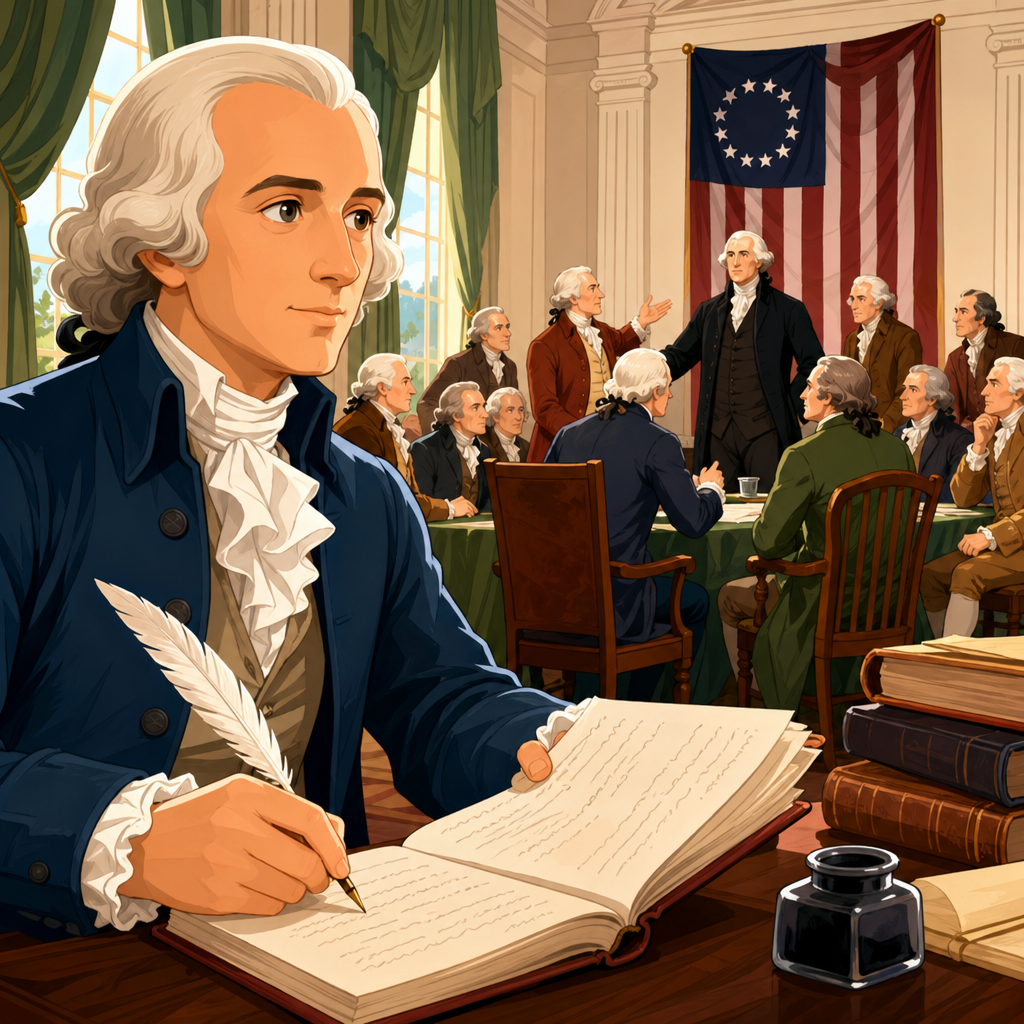
James Madison’s Notes of Debates in the Federal Convention of 1787 remain the most detailed record of how the United States Constitution was argued, revised, and finally framed, making them indispensable for any serious study of AP Government and Politics. Madison attended nearly every session in Philadelphia, sat near the presiding officer, and wrote extensive summaries of motions, objections, compromises, and private tensions. When students read “The Constitutional Convention Through Madison’s Notes,” they are not reading a polished textbook narrative; they are encountering the closest thing to a working transcript of the founding era’s central political meeting. That matters because the Constitution did not emerge as a finished blueprint. It was negotiated under pressure, shaped by disagreement over representation, executive power, federalism, slavery, and ratification. Madison’s record shows those conflicts in real time.
For AP Government and Politics, Madison’s notes help connect abstract constitutional principles to the people and debates that produced them. Terms such as republicanism, separation of powers, checks and balances, enumerated powers, and federalism become easier to understand when seen as contested solutions rather than fixed doctrines. In my experience teaching and reviewing this material, students remember the Constitution more accurately when they follow the arguments delegate by delegate: large states pushing population-based representation, small states defending equal voting power, nationalists seeking a stronger central government, and skeptics warning against concentrated authority. Madison’s notes also matter as a hub for broader “miscellaneous” convention topics because they capture the details often left out of summaries, from committee work to procedural maneuvering. They reveal what the framers prioritized, what they postponed, and what they left ambiguous for future generations, courts, and political parties to fight over.
Why Madison’s Notes Matter as a Historical Source
Madison’s notes are the foundational primary source for understanding the Constitutional Convention because the official journal is thin and procedural, while most delegates left either limited records or retrospective recollections. Madison prepared seriously for the convention, studied ancient and modern confederacies, and developed a disciplined note-taking method. He usually wrote during the session and expanded entries afterward, preserving speeches by figures such as James Wilson, Gouverneur Morris, Roger Sherman, Alexander Hamilton, Benjamin Franklin, and George Mason. Although he was not a neutral stenographer, no other source matches his consistency or scope. Historians rely on his notes not because they are perfect, but because they capture the sequence of debate, the alternatives considered, and the reasoning behind key compromises.
Students should also understand the limits of the source. Madison revised portions later in life, and his own preferences shaped what he emphasized. He favored a stronger national government and sometimes gave fuller treatment to arguments aligned with that goal. Delegates spoke behind closed doors under a secrecy rule, which encouraged candor but left the public dependent on insider records. That means Madison’s notes must be read critically, compared where possible with the Convention Journal, Robert Yates’s notes, Luther Martin’s later account, and the finished Constitution itself. Still, if the question is how the convention actually unfolded day by day, Madison is the starting point. He lets readers see constitution-making as a process of drafting, bargaining, coalition building, and strategic retreat.
The Convention’s Original Problem: Why the Articles Failed
Madison’s notes make clear that the convention did not begin with a narrow plan to tweak the Articles of Confederation. Delegates arrived knowing the existing system had major structural defects. Under the Articles, Congress lacked independent taxing power, struggled to regulate interstate and foreign commerce, and depended on states for compliance. There was no separate executive to enforce national laws and no national judiciary with broad authority to resolve disputes. Events such as Shays’s Rebellion in 1786–1787 sharpened fears that weak central institutions could not protect property, maintain order, or preserve the union. Madison repeatedly framed these weaknesses as proof that a mere league of states was insufficient.
The practical issue was sovereignty. Were the states the primary political units, merely cooperating for limited common purposes, or did the people of the United States need a government acting directly upon individuals? Madison’s notes show delegates wrestling with that question from the opening days. Edmund Randolph introduced the Virginia Plan, largely shaped by Madison’s preparatory work, and it moved well beyond amendment. It proposed a national government with separate branches, a bicameral legislature, and representation tied to population or financial contribution. That proposal set the convention’s direction. Once delegates debated the Virginia Plan, they were no longer just repairing the Articles; they were designing a new constitutional order.
Representation and the Great Compromise
The most explosive dispute recorded in Madison’s notes concerned representation. Large states argued that republican government should reflect population. Small states feared domination if voting power were redistributed by size. Madison preserves the intensity of the clash. Delegates from populous states insisted that citizens, not states as corporate entities, should be represented. Small-state delegates replied that the states entered the union as political communities and required institutional protection. This conflict threatened to break the convention.
The Virginia Plan favored proportional representation in both houses of the national legislature. In response, William Paterson presented the New Jersey Plan, which kept a unicameral legislature with equal state voting, while modestly strengthening Congress under the existing confederal principle. Madison’s notes show that the debate was not simply large versus small; it also involved competing theories of union. Nationalists argued that equal voting among unequal states violated political justice. Defenders of state equality argued that without it, smaller states would never consent to the new frame.
| Plan or Compromise | Main Feature | Who Supported It | Constitutional Result |
|---|---|---|---|
| Virginia Plan | Representation based on population in a bicameral legislature | Large-state nationalists such as Madison and Randolph | Shaped the House of Representatives |
| New Jersey Plan | Equal state voting in a strengthened unicameral Congress | Small-state delegates such as Paterson | Preserved the principle later used in the Senate |
| Connecticut Compromise | Population-based House and equal-state Senate | Brokered by Roger Sherman and Oliver Ellsworth | Resolved the convention’s central representation dispute |
The Connecticut, or Great, Compromise fused both principles: representation by population in the House and equal representation for states in the Senate. Madison disliked the Senate portion because it gave small states disproportionate power, yet the notes show that necessity overruled theory. For AP Government students, this episode explains why Congress has two chambers with different constitutional identities. The House reflects the people directly through apportioned representation, while the Senate protects state equality. Madison’s notes capture the uncomfortable truth that this arrangement was not the product of pure principle. It was a bargain required to keep the convention alive.
Designing the Presidency and the Separation of Powers
Madison’s record is especially valuable on the presidency because the executive branch was one of the least settled questions in 1787. Many delegates feared monarchy, yet they also knew the Articles had failed partly because the national government lacked energy and accountability. Madison’s notes trace debates over whether the executive should be singular or plural, how long the term should be, whether reelection should be allowed, and who should choose the president. Delegates considered selection by Congress, by state executives, by electors, and even by the people directly, though direct national election appeared impractical in an era of limited communication and uneven political information.
The final design was a compromise layered with safeguards. The president would be a single executive, chosen through the Electoral College, serving a four-year term, eligible for reelection, commander in chief of the military, and subject to impeachment. Madison’s notes show why these features were linked. A single executive promised decisiveness. An indirect election method was meant to buffer the office from immediate factional control. Shared powers, including the veto and Senate advice and consent, reflected the larger constitutional commitment to separated institutions sharing power. Students often memorize these features as isolated facts. Madison’s notes reveal their purpose: to create enough executive vigor to govern, but not enough to become kinglike.
The notes also illuminate the judiciary. Delegates agreed more quickly on the need for a national supreme court than on lower federal courts, but they debated judicial tenure, jurisdiction, and the proposed council of revision. Madison favored giving judges, alongside the executive, a role in reviewing legislation before enactment. The convention rejected that plan, but the debate shows the framers thinking carefully about constitutional review and legislative excess. Even where Madison lost, his notes preserve ideas that later shaped constitutional interpretation.
Slavery, Commerce, and Federalism at the Convention
Madison’s notes are essential because they do not allow readers to romanticize the convention. They show slavery embedded in constitutional bargaining. Delegates debated how enslaved people would count for representation and taxation, whether Congress could regulate the slave trade, and how to handle fugitive persons “held to service.” The resulting Three-Fifths Compromise counted three-fifths of the enslaved population for apportionment and direct taxation, increasing the political power of slaveholding states without granting rights to the enslaved themselves. Madison’s notes make plain that this was a political transaction, not a moral resolution.
Commerce created another major divide. Northern delegates wanted stronger national power over trade, including simple-majority navigation acts. Some southern delegates feared export taxes and commercial regulations that might injure plantation interests. The convention ultimately barred taxes on exports and delayed any congressional ban on the international slave trade until 1808, though Congress could impose a tax on importation. These decisions reflected a broader federal balance. The new government gained substantial powers over commerce, taxation, war, and diplomacy, yet states retained a large sphere over local law, elections administration, and internal governance.
Madison’s notes are particularly useful here because they show federalism as a negotiated architecture, not a single clause. The Supremacy Clause, the enumerated powers of Congress, the Necessary and Proper Clause, and limits on the states all grew from the same concern: national laws needed real authority. At the same time, the convention did not create a fully consolidated regime. The states survived as powerful institutions. That tension, visible in Madison’s pages, explains later conflicts over nullification, civil rights, economic regulation, and the scope of national power.
Ratification, Omission, and the Convention’s Lasting Legacy
One of the most revealing lessons from Madison’s notes is that the convention solved some problems by postponing others. Delegates created an amendment process in Article V because they knew the Constitution would need revision. They also chose ratification by special state conventions rather than state legislatures, a crucial move that appealed directly to the people and sidestepped institutions that might defend the Articles. Madison’s notes show broad awareness that legitimacy required more than delegate agreement in Philadelphia. The Constitution had to survive a national argument.
Just as important are the omissions. A bill of rights was not included in the final document, despite concerns raised by George Mason and Elbridge Gerry. Madison’s notes show that many delegates thought the federal government’s powers were limited enough to make a rights declaration unnecessary, while others feared listing some rights might endanger unlisted ones. The omission became a central Anti-Federalist attack during ratification and led to the first ten amendments in 1791. This is a key AP Government connection: constitutional meaning did not stop at the convention. It continued through Federalist and Anti-Federalist debate, ratifying conventions, the Bill of Rights, judicial interpretation, and later amendments.
As a hub for miscellaneous convention topics, Madison’s notes reward close reading because they preserve the human dimension of constitution-making. Franklin appealed for compromise despite age and illness. Gouverneur Morris argued with sharp, memorable force for a stronger national framework. Mason objected to the slave trade and later refused to sign. Hamilton, absent much of the convention, returned to defend energetic government. Washington spoke little, but his presence as presiding officer lent authority to the proceedings. Through Madison, the convention appears as a room full of talented, divided politicians working under heat, secrecy, and uncertainty. For students, the greatest benefit of reading the convention through Madison’s notes is clarity. The Constitution becomes understandable not as sacred text dropped from above, but as a durable framework built through argument, concession, and deliberate design. Read the notes alongside the Constitution itself, then trace how each major debate still shapes American government today.
Frequently Asked Questions
What are Madison’s Notes, and why are they so important for understanding the Constitutional Convention?
James Madison’s Notes of Debates in the Federal Convention of 1787 are the single most important firsthand record of what happened inside the Constitutional Convention. Although the Convention met in secrecy, Madison attended nearly every session and carefully documented the arguments, proposals, compromises, and disagreements that shaped the final Constitution. His notes allow readers to move beyond the finished constitutional text and see the actual process of constitution-making: who supported which ideas, why delegates disagreed, and how major issues were revised over time.
For students of AP Government and Politics, that makes the notes especially valuable. The Constitution can sometimes appear fixed and inevitable when read on its own, but Madison’s record shows that it emerged from intense debate over representation, executive power, federalism, slavery, and the structure of Congress. His account helps explain not only what the framers decided, but also what alternatives they considered and rejected. In other words, the notes turn the Convention from a static historical event into a living political argument, which is exactly what makes them so useful for serious constitutional study.
How did Madison take his notes, and can they be trusted as an accurate source?
Madison was unusually well positioned to create a detailed account. He sat near the presiding officer, attended sessions consistently, and made a deliberate effort to record speeches and proceedings as fully as possible. He often wrote during the sessions themselves and then refined or expanded his notes afterward while the discussions were still fresh in his mind. That method helps explain why his record is so much more complete than any other surviving account of the Convention.
At the same time, students should understand that Madison’s Notes are not a perfect transcript. The Convention had no modern recording equipment, and Madison could not capture every word exactly as spoken. He summarized, paraphrased, and organized material through his own judgment. In some places, he revised wording later, and as a participant in the debates, he had his own constitutional preferences. Even so, historians regard the notes as highly reliable because of their scope, consistency, and closeness to the events. The best way to use them is as an indispensable primary source that reveals the substance and flow of debate, while remembering that they remain the work of an observer-participant rather than a verbatim stenographer.
What major constitutional issues become clearer when reading the Convention through Madison’s Notes?
Madison’s Notes make several foundational issues far easier to understand. One of the clearest is representation. Readers can follow the conflict between large and small states as delegates argued over whether representation in the national legislature should be based on population or state equality. The notes show how this dispute threatened the Convention and how compromise eventually produced a bicameral Congress with a House of Representatives based on population and a Senate giving equal representation to each state.
The notes also illuminate the framers’ struggle to balance power among the branches of government. Delegates debated whether the executive should be a single president or a plural body, how long the president should serve, whether the president should be re-eligible, and how the executive should be chosen. Similarly, the Convention wrestled with the role of the judiciary and with how much power Congress should have over taxation, commerce, and national defense. Madison’s account reveals that none of these structures was obvious from the start; each resulted from repeated revisions and competing theories about liberty and effective government.
Another major area clarified by the notes is the tension between national and state power. Delegates disagreed sharply over how strong the central government should be and how much independence states should retain. Madison’s record shows how these disputes helped shape federalism, the Supremacy Clause, and the distribution of powers between the national and state governments. It also brings into focus the moral and political conflicts surrounding slavery, including representation and the slave trade, reminding readers that the Constitution was both a remarkable political achievement and a document marked by profound compromises.
Why did the delegates keep the Convention secret, and how do Madison’s Notes help us understand that decision?
The delegates conducted the Convention in secrecy because they believed candid debate required privacy. If every speech, proposal, and reversal had been immediately published, many delegates might have felt pressured to defend rigid positions rather than openly reconsider them. Secrecy gave them room to test ideas, change their minds, negotiate, and form compromises without constant public scrutiny. In a setting where the existing Articles of Confederation were failing and the future of the union was uncertain, the delegates believed that confidentiality was necessary for serious institutional design.
Madison’s Notes are especially helpful here because they reveal exactly the kind of intense, fragile, and sometimes contentious exchanges that secrecy made possible. The notes show delegates floating controversial plans, objecting sharply to one another, and revising positions in response to practical concerns. Without Madison’s record, historians would know much less about how deeply divided the Convention often was and how uncertain the outcome remained. His account demonstrates that secrecy did not mean the delegates lacked disagreement; rather, it created the conditions under which disagreement could be worked through. For modern readers, that is one of the most important lessons of the notes: the Constitution was not simply announced by consensus, but built through negotiation under extraordinary political pressure.
How should AP Government students use Madison’s Notes when studying the Constitution today?
AP Government students should use Madison’s Notes to connect constitutional principles to the debates that produced them. Instead of memorizing clauses in isolation, students can ask why a particular provision was written the way it was, what problem it was designed to solve, and what competing options were on the table. For example, studying the notes alongside topics such as checks and balances, separation of powers, federalism, republicanism, and representation helps students see those concepts as contested solutions rather than abstract vocabulary terms. That approach leads to stronger historical understanding and more sophisticated political analysis.
The notes are also useful because they train students to read primary sources critically. Madison provides evidence of intention, disagreement, compromise, and constitutional design, all of which are central to AP-style argumentation. Students can use the notes to support claims about framers’ concerns over majority rule, minority rights, executive power, faction, and the dangers of weak government under the Articles of Confederation. Just as importantly, they should compare Madison’s observations with the final Constitution and with later developments such as the Bill of Rights, judicial interpretation, and changing democratic practices. Doing so shows that constitutional meaning begins at the Convention but does not end there.
In practical terms, students will benefit most by treating Madison’s Notes as a guide to constitutional formation rather than as a list of isolated quotations. Read them to follow the evolution of major debates, identify key compromises, and understand the political realities behind the text. That method makes the Constitution more intelligible, more human, and far more memorable—exactly the kind of understanding that strengthens both exam performance and long-term civic literacy.