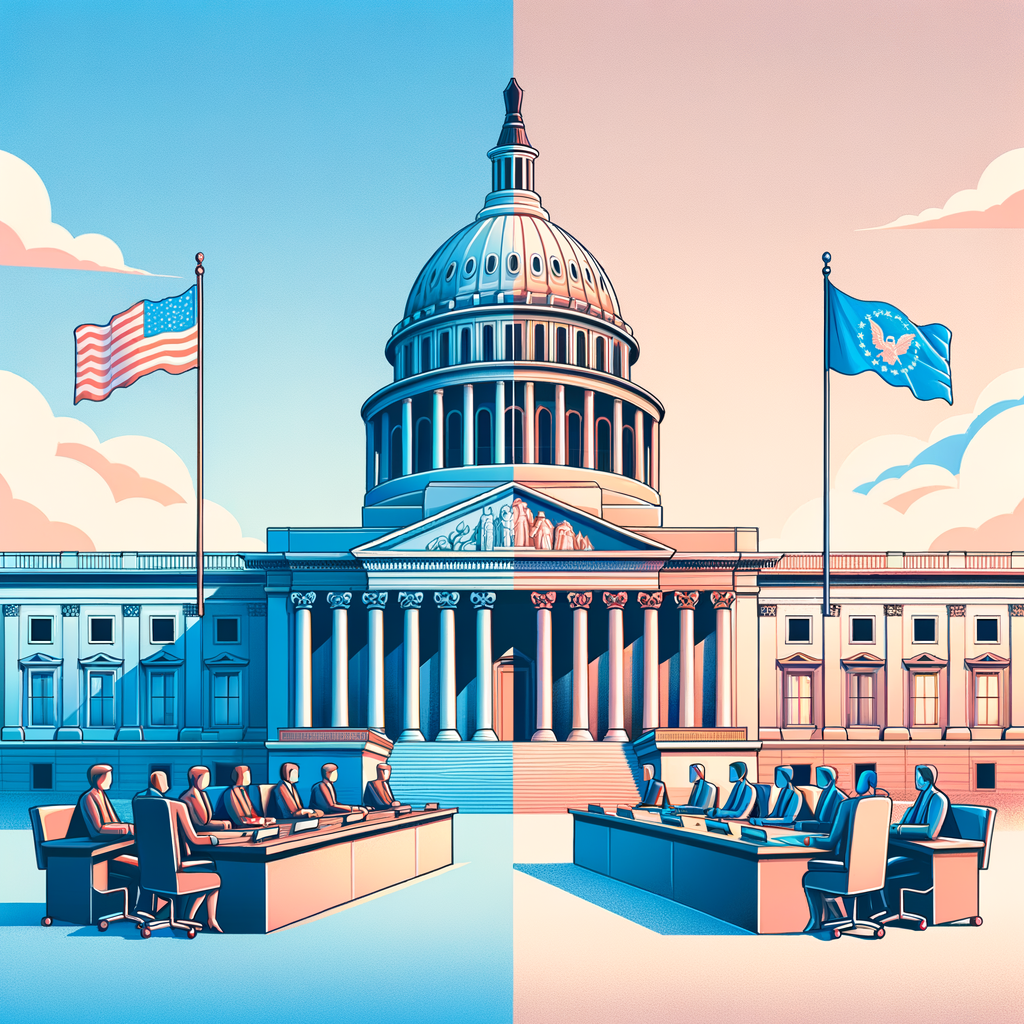
In the United States, legislative bodies play a crucial role in shaping policies, governing laws, and representing the interests of citizens. Among these legislative bodies, state legislatures and the United States Congress stand out as principal entities. Although these bodies share the primary function of lawmaking, there are distinct nuances and differences in their structure, processes, powers, and functions. Understanding the key differences between state legislatures and Congress is vital for recognizing how governance, representation, and law-making function across different levels of government. These differences reflect tailored needs and operational scopes shaped by historical contexts, political doctrines, and the constitutional framework.
State legislatures derive their authority from the U.S. Constitution and their respective state constitutions. They focus on issues significant to the state’s welfare, budget, and local governance. Comprising two chambers—except for Nebraska’s unicameral legislature—state legislatures are decentralized entities allowing for localized governance.
In contrast, the United States Congress, consisting of the House of Representatives and the Senate, is a central legislative body with broad powers outlined in the U.S. Constitution. Congress is tasked with addressing national and international issues, enacting federal laws, and providing checks and balances to the executive branch. Despite similar foundational purposes, differences abound in their historical evolution, policy impacts, and citizen engagement. This exploration highlights structural variations, procedural dynamics, and legislative powers that differentiate state legislatures from Congress, emphasizing their unique contributions to the federal system.
Structural Differences between State Legislatures and Congress
The structural differences between state legislatures and Congress play a significant role in how these bodies function and serve their constituents. State legislatures generally consist of two chambers: an upper chamber, often referred to as the Senate, and a lower chamber, usually called the House of Representatives or Assembly. Nebraska is the exception, with a unicameral legislature known simply as the Legislature. In bicameral legislatures, the Senate typically has fewer members with longer terms, ensuring stability and thorough deliberation. Conversely, the House, with more members and shorter terms, is more responsive to shifts in public opinion. The size and constituency of state legislatures vary widely, reflecting population and specific state needs.
Congress, the federal legislature, is similarly bicameral, comprising the House of Representatives and the Senate. The House has 435 members, with representation based on a state’s population, serving two-year terms. The Senate has 100 members, with two senators from each state serving six-year terms. This structure is designed to balance representation between populous and less populous states, ensuring both detailed population-based representation and equal state representation at the federal level.
While both legislatures have upper and lower chambers, their scales of operation introduce significant differences. State legislatures tend to focus on more localized policies, whereas Congress handles comprehensive national legislation. Furthermore, congressional sessions are convened regularly and can be prolonged, whereas state legislatures may convene annually or biennially with shorter sessions, underscoring their emphasis on regional governance and efficiency.
Operational and Procedural Variances
The processes and procedures in state legislatures and Congress reflect their distinct roles within the American political system. In state legislatures, procedures may vary widely from one state to another, allowing flexibility to accommodate unique political cultures and constituent needs. State legislatures tend to be more innovative in procedures, experimenting with different approaches to committee systems, bill passage requirements, and debate rules to craft policies that resonate with their distinct local landscapes.
By contrast, Congress operates under standardized procedures that are comprehensive and designed to manage the complexities of federal legislation. Committees in both bodies play essential roles, but congressional committees hold significant influence, with specialized subcommittees focusing on diverse national issues, from telecommunications to foreign policy. Committee hierarchies and extensive bureaucratic procedures in Congress lead to more robust oversight and detailed scrutiny of bills, facilitating informed decision-making on multifaceted national legislation.
The law-making processes themselves reflect distinctive approaches. In state legislatures, the process might be expedited to address urgent state-specific issues, leveraging shorter sessions to pass essential local legislation swiftly. By contrast, the congressional process can be protracted, involving multiple readings, committee reports, and revisions. Filibustering and cloture motions in the Senate, for instance, add another dimension to legislative maneuvering, offering minority voices some mechanism to delay or alter legislation while ensuring thorough debate.
Legislative Powers and Responsibilities
The scope of legislative powers in state legislatures and Congress exhibits notable contrasts alongside some similarities. State legislatures primarily address laws affecting education, health, transportation, local taxes, and law enforcement within their states. These legislatures possess the power to approve state budgets, tax proposals, and various policies that directly impact citizens’ day-to-day lives. They retain authority over much of the “reserved” powers under the Tenth Amendment, enabling them to address issues not expressly delegated to the federal government.
In contrast, Congress wields extensive powers that encompass the entire nation. Its legislative purview includes interstate commerce, immigration, national defense, and monetary policy, among others. Congress holds the “power of the purse,” significantly impacting national budgets, taxation, and fiscal oversight. Additionally, it possesses foreign policy powers such as ratifying treaties, declaring war, and regulating international trade. Alongside creating laws, Congress also performs oversight of the executive branch, influencing policy through hearings, investigations, and various checks.
Despite these differences, state legislatures and Congress share common legislative responsibilities, such as representing constituents, deliberating on proposed laws, and working to resolve policy disputes. Both bodies have evolved legislative powers reflective of their governmental levels, embodying principles of federalism, whereby powers are shared and distributed efficiently to maintain the balance between state and national governance.
Representation and Accountability
Representation within state legislatures and Congress is a cornerstone of their existent political raison d’être. State legislators are elected representatives tasked with voicing their constituents’ local interests. Given the smaller size and frequent turnover of state assemblies, legislators have closer ties with their constituents, often living in the communities they serve, fostering direct political engagement. This direct connection allows state legislators to more readily address voter concerns, resulting in responsive, listener-oriented policymaking that reflects local opinion and character.
In comparison, members of Congress have broader responsibility and often represent vast constituencies comprising diverse and multifaceted interests. While members of the House similarly focus on constituency services, the complexity of national issues requires a delicate balance between addressing local concerns and national policy agendas. Senators, with their longer terms, often serve broader interests with more strategic visions concerning national and international matters.
The accountability mechanisms also vary. State legislators frequently deliver through prompt responses to local matters and partial oversight through state-level initiatives like referendums and resources like ‘sine die’ legislative sessions. Meanwhile, Congressional accountability integrates federal oversight mechanisms, public exposure through media, and detailed legislative transparency protocols, facilitating in-depth scrutiny from citizens and advocacy groups.
Historical Evolution and Contextualization
The historical contexts leading to the establishment of state legislatures and Congress offer insights into their modern roles and differences. State legislatures have origins tracing back to colonial assemblies that were designed to adapt British governance models to new realities in America. With independence and the gradual formation of the United States, state legislatures began to reflect distinctive democratic ideals, expanding their autonomy and tailoring legislative scopes to suit regional demands.
Congress emerged from the need for a unified legislative body capable of addressing national concerns and mediating state-driven interests. The Constitutional Convention deliberations instituted Congress as a bicameral legislature to balance disparate political ideals, ensuring fair representation while concentrating power to safeguard the union’s cohesion. Such historical foundations imbue Congress with a role to act as a stabilizing force across contrasting state politics, harmonizing as an arbitrator of federal principles and enactor of comprehensive legislation.
This historical evolution, with state legislatures functioning as laboratories for democracy and Congress serving as the nation’s conscience and architect, informs the broader understanding of these legislative powers within a complex federal governmental structure.
Conclusion: Harmonizing Differences in Legislative Roles
The key differences between state legislatures and Congress are shaped by their historical origins, structural necessities, and functional objectives within America’s federal system. Both bodies, through their divergent focuses, reinforce the robust mechanisms of democracy by ensuring representation, accountability, and innovation across various government levels.
State legislatures, efficient in their locally informed approaches, address immediate regional concerns, offering swift legislative action on issues affecting citizens’ everyday lives. Concurrently, Congress, with its national lens, crafts policies that balance state interests within a broader national framework, ensuring the nation’s welfare and security.
This dual system epitomizes federalism’s strength—preserving states’ rightful autonomy while ensuring cohesive national governance, facilitating a dynamic political culture capable of responding to localized and national needs respectively. By leveraging their unique strengths, state legislatures and Congress continue to influence and respond to the evolving political and social landscapes they are designed to serve.
Frequently Asked Questions
1. What are the main structural differences between state legislatures and Congress?
When we talk about structure, we’re essentially discussing how these bodies are organized. In Congress, which is the federal legislative body of the United States, there are two houses: the House of Representatives and the Senate. This bicameral structure is mirrored in nearly every state legislature. However, Nebraska bucks the trend with its unicameral (single-chamber) body. The size of these legislative bodies varies dramatically. For example, the U.S. Congress is made up of 535 members—435 Representatives and 100 Senators. In contrast, state legislatures can have significant variations in size. California’s state legislature has 120 members, while New Hampshire’s is composed of 400 representatives and 24 senators, showing a wide range of how states configure their governance bodies.
2. How do the powers of state legislatures compare to those of Congress?
Here’s where we observe truly notable differences. The U.S. Congress wields powers granted explicitly by the Constitution, making federal laws that are binding across the entire nation. These powers are broad and include areas like national defense, currency regulation, and commerce between states and with foreign nations. State legislatures, on the other hand, have authority over matters not expressly delegated to the federal government. This encompasses a broad swath of issues that directly affect the lives of citizens, such as education, local law enforcement, healthcare provisions, and transportation. Moreover, state laws generally do not extend beyond a state’s border, focusing instead on local matters.
3. How do legislative processes differ between state legislatures and Congress?
The legislative process in both Congress and state legislatures involves several similar steps: introduction of a bill, committee review, debate, voting, and, eventually, the approval or rejection by the executive (the President at the federal level and governors at the state level). However, the intricacies can differ considerably. For instance, the relationship in committee actions within these bodies can vary; state legislatures might allow for more rapid movement through the legislative stages due to fewer procedural hurdles and shorter sessions. Conversely, Congress has more extensive committee networks and staff support, which allows for a more thorough and potentially slow approach due to the complexity and scale of federal issues.
4. Are there differences in how members are elected to state legislatures and Congress?
Yes, significant differences exist in the election process. Members of the U.S. House of Representatives serve two-year terms and are typically elected from single-member districts, re-evaluated every decade following the census. U.S. Senators, on the other hand, serve six-year terms, with elections staggered so that approximately one-third of the seats are up for grabs every two years. In state legislatures, the exact term lengths can vary greatly, with most state senators serving four-year terms and representatives serving two-year terms, although this differs by state. Election cycles in state legislatures can also be influenced by state-specific laws and the political leanings of the electorate.
5. How do constituent services compare between members of Congress and state legislatures?
The varying scope of responsibility leads to some clear differences in constituent services. Members of Congress, accountable to a broader and often more diverse set of constituents, tend to focus on larger, more general issues that might affect their entire state or, in the case of representatives, particular districts. They have larger staffs to assist with casework that often involves federal agencies (e.g., immigration issues, veterans’ affairs). On the state level, legislators are generally more accessible to their constituents, focusing on local issues such as roads, schools, and state-level welfare services. Their offices are usually smaller, which means they must efficiently handle constituent concerns within a more limited scope and range of resources.