
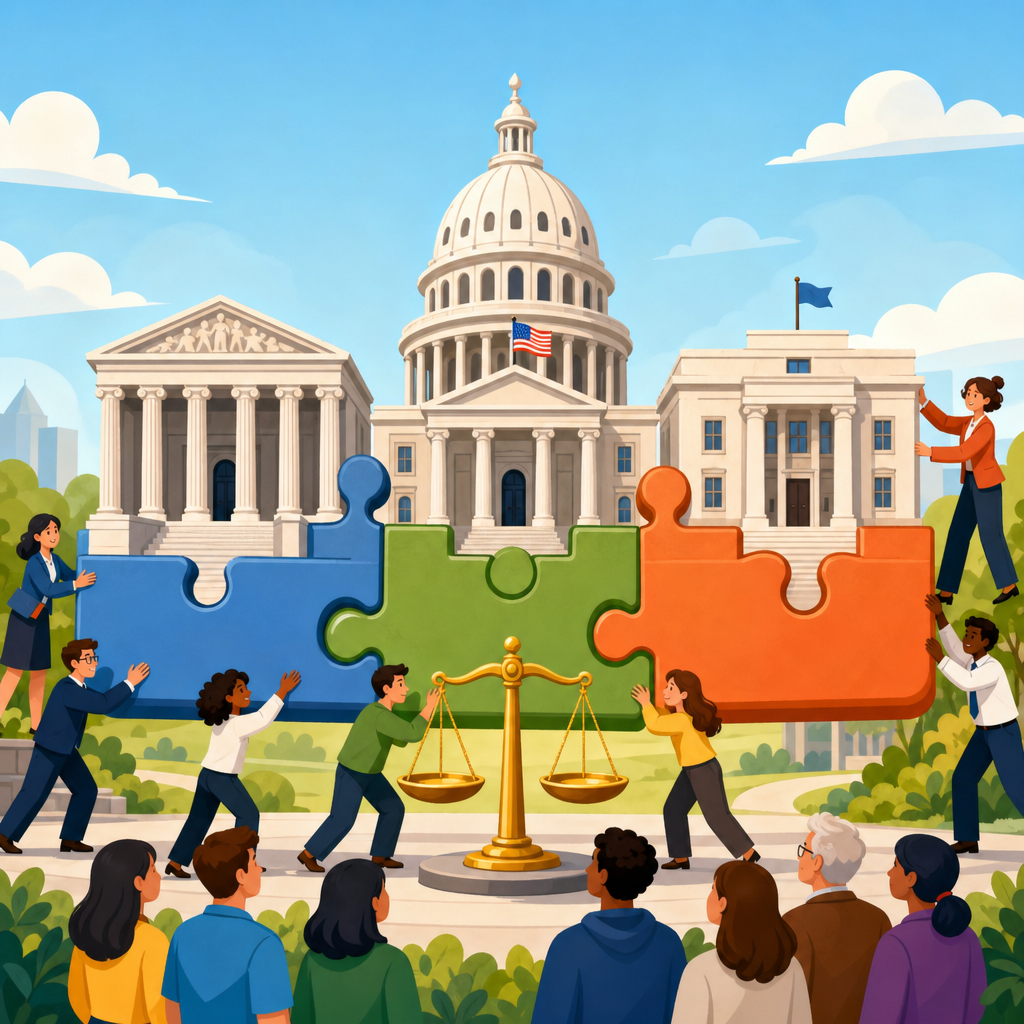
Separation of institutions sharing powers is the constitutional design that prevents any single office, branch, or level of government from exercising unchecked authority. In AP Government and Politics, this idea sits at the center of how the Constitution organizes power, limits abuse, and channels conflict into lawful decision-making. Students often hear three related terms together: separation of powers, checks and balances, and federalism. They are not identical. Separation of powers divides national authority among Congress, the presidency, and the judiciary. Checks and balances gives each institution tools to restrain the others, such as the veto, judicial review, impeachment, and Senate confirmation. Federalism divides authority between the national government and the states. The phrase separation of institutions sharing powers captures the deeper point: the institutions are distinct, but they must cooperate because many powers overlap in practice.
This constitutional logic matters because the framers did not simply want efficient government. They wanted limited government strong enough to govern but constrained enough to protect liberty. Having worked through constitutional debates and Supreme Court doctrine with students, I have found that confusion usually starts when power is treated as neatly divided. It is not. Congress writes laws, but the executive implements them through departments and agencies. Courts interpret statutes, but they depend on the executive to enforce judgments. The president negotiates treaties, but the Senate must consent. Congress can declare war, but presidents command military operations. Institutions therefore share powers while remaining separate, and that tension is deliberate rather than accidental.
The Constitution was written against the backdrop of colonial experience with concentrated power, state constitutional experiments, and the weakness of the Articles of Confederation. James Madison argued in Federalist No. 51 that ambition must be made to counteract ambition. In practical terms, this means constitutional order does not rely on virtue alone. It relies on incentives, procedures, and rival centers of authority. That design has shaped every major American political conflict, from disputes over the national bank to battles over executive orders, administrative rulemaking, civil rights enforcement, and war powers. To understand AP Government and Politics, students need a hub that ties these threads together. This article does that by explaining the constitutional structure, the major institutions, the role of federalism, key doctrines, and the recurring debates that make this topic essential.
Why the Constitution Separates Institutions but Forces Shared Power
The framers separated institutions because they feared tyranny, but they also rejected paralysis. Under the Articles of Confederation, the national government lacked taxing power, struggled to raise troops, and depended on state cooperation. Shays’s Rebellion underscored how weak national institutions could threaten public order and economic stability. The Constitution answered that weakness by creating stronger national institutions, yet it did not consolidate power into one body. Instead, it assigned legislative power to Congress, executive power to the president, and judicial power to the courts, while giving each branch constitutional weapons against the others.
This design reflects both political theory and institutional realism. Montesquieu influenced the framers by arguing that liberty is threatened when legislative, executive, and judicial powers are united. Madison extended that insight by recognizing that pure separation was impossible. Government requires interaction. Lawmaking involves execution and interpretation. Foreign policy involves legislative funding and executive initiative. Appointments require nomination and confirmation. For that reason, the Constitution creates partial agency across branches. The president can veto legislation, but Congress can override. The Senate confirms judges and cabinet officers, but the president chooses nominees. Courts can invalidate laws and executive actions, but judges are appointed through political institutions.
In AP Government, one of the most testable ideas is that the Constitution slows action on purpose. Delay is not always dysfunction. Bicameralism, presentment, judicial review, staggered elections, and federalism all make policy change harder. In stable periods, that can frustrate reformers. In crisis periods, it can prevent rash action. The point is not that slow government is always good. The point is that the constitutional system assumes concentrated power is a greater long-term danger than inefficiency.
Congress, the President, and the Courts: Distinct Roles, Shared Authority
Congress is the lawmaking branch, but its authority goes far beyond passing bills. Article I grants enumerated powers including taxation, spending, regulation of interstate commerce, declaring war, raising armies, and making all laws necessary and proper for carrying out federal authority. In practice, Congress also shapes administration through appropriations, oversight hearings, reporting requirements, and statutory design. A well-drafted statute can tightly constrain agencies, while a broad delegation can give the executive significant discretion.
The presidency is often described as the branch of energy, speed, and implementation. Article II vests executive power in the president, who enforces federal law, commands the military, negotiates with foreign governments, and supervises the executive branch. But presidents do not operate as elected monarchs. Their power depends heavily on statutory authority, appropriated funds, bureaucratic capacity, judicial tolerance, and public support. Executive orders, for example, are real governing tools, but they must rest on constitutional or statutory foundations. When presidents act without those foundations, courts can intervene and Congress can respond.
The judiciary interprets law and resolves cases and controversies. Since Marbury v. Madison in 1803, judicial review has been a foundational practice, even though the Constitution does not explicitly use that phrase. Federal courts determine whether acts of Congress or executive actions conflict with the Constitution. That authority makes courts central to the separation of institutions sharing powers, but courts are not omnipotent. They cannot appropriate money, command troops on their own, or initiate prosecutions. Their influence depends on doctrine, legitimacy, and institutional compliance.
| Institution | Core Constitutional Function | Key Shared Powers | Common AP Government Example |
|---|---|---|---|
| Congress | Lawmaking, taxation, spending, oversight | Confirms appointments, impeaches officials, overrides vetoes | War Powers Resolution funding limits |
| President | Execution of laws, commander in chief, appointments | Vetoes bills, negotiates treaties, issues executive orders | Use of signing statements and emergency declarations |
| Judiciary | Interprets law, resolves constitutional disputes | Judicial review of statutes and executive actions | United States v. Nixon limiting executive privilege |
Real-world politics shows how these functions overlap. Consider immigration policy. Congress writes the statutory framework, appropriates enforcement resources, and can revise visa categories or asylum standards. The executive branch sets enforcement priorities, administers border policy through agencies such as the Department of Homeland Security, and issues regulations. Courts then review whether those regulations and executive actions comply with statute and the Constitution. No single institution controls the field from start to finish.
Checks and Balances in Action
Checks and balances are the operational side of separated institutions. They are the mechanisms that turn constitutional design into daily governance. Some checks are explicit, such as the presidential veto, Senate advice and consent, impeachment, and judicial review. Others are structural, including control of appropriations, control over jurisdiction in certain contexts, and staggered election cycles that prevent one election from instantly remaking the entire government.
One clear example is impeachment. The House has the sole power to impeach, which is functionally similar to indictment, while the Senate conducts the trial and may convict by a two-thirds vote. This makes removal difficult by design. Another example is appointments. Presidents nominate ambassadors, judges, and senior executive officials, but the Senate confirms them. That requirement forces bargaining and often moderates nominations. In my experience teaching this topic, students understand the concept fastest when they track one nomination fight from nomination to floor vote because the shared power becomes visible.
Judicial review provides another major check. In Youngstown Sheet & Tube Co. v. Sawyer, the Supreme Court blocked President Truman’s attempt to seize steel mills during the Korean War. The case remains vital because it showed that emergency claims do not erase constitutional limits. Justice Jackson’s concurrence offered a framework still used today: presidential power is strongest with congressional authorization, weaker in the zone of congressional silence, and weakest when the president acts against congressional will. That framework is indispensable for understanding modern disputes over immigration, sanctions, surveillance, and emergency powers.
United States v. Nixon is equally important. The Court unanimously required President Nixon to comply with a subpoena during the Watergate investigation, rejecting an absolute claim of executive privilege. The decision confirmed that presidents have confidentiality interests but are not above judicial process. That single case captures the entire constitutional logic of shared power: separate institutions, overlapping authority, and no final unchecked actor.
Federalism: Shared Power Across Levels of Government
Separation of institutions sharing powers is not limited to the three branches. The Constitution also divides authority vertically between the national government and the states. Federalism is essential because many policy areas involve concurrent authority. States possess police powers over health, safety, welfare, and morals, while the national government exercises enumerated powers such as regulating interstate commerce, taxing, spending, and enforcing constitutional rights. The Supremacy Clause ensures that valid federal law prevails when state and federal law conflict, but that does not mean states are mere administrative units.
Modern federalism often works through grants, mandates, and cooperative administration. Medicaid is a classic example. Congress sets broad statutory terms and offers funding. Federal agencies issue rules and guidance. States administer the program within federal parameters, making choices about eligibility, delivery systems, and optional benefits. This layered arrangement is efficient in some respects because it uses state capacity, but it also generates litigation and political conflict when priorities diverge.
Key cases clarify these boundaries. McCulloch v. Maryland affirmed implied national powers under the Necessary and Proper Clause and denied states the power to tax federal institutions. United States v. Lopez imposed limits on the Commerce Clause by striking down the Gun-Free School Zones Act. NFIB v. Sebelius upheld the Affordable Care Act’s individual mandate as a tax but limited Congress’s ability to coerce states through Medicaid expansion conditions. Each case shows that federalism is not static. It is a continuing argument about national power, state autonomy, and constitutional text.
For AP Government, federalism explains why the same issue can produce different policies across states while still operating inside a national constitutional framework. Marijuana regulation, election administration, abortion policy after Dobbs, and environmental enforcement all illustrate this point. Shared power across levels of government can create innovation, conflict, duplication, or delay. Those outcomes are features of the constitutional order, not deviations from it.
The Administrative State and the Modern Constitution
No hub article on this topic is complete without the administrative state. The Constitution names Congress, the president, and the courts, but modern governance depends heavily on agencies such as the Environmental Protection Agency, Securities and Exchange Commission, Department of Labor, and Federal Communications Commission. Agencies write rules, adjudicate disputes, investigate violations, and enforce statutes. Critics argue this concentrates legislative, executive, and judicial functions in one place. Defenders respond that complex industrial society requires expertise, continuity, and technical regulation that Congress cannot supply in detail on its own.
The constitutional question is not whether agencies exist. They do, and Congress has created them by statute for more than a century. The real question is how they are controlled. Congress uses authorizing statutes, appropriations, oversight, inspector general structures, and the Congressional Review Act. Presidents influence agencies through appointments, budget proposals, executive orders, and centralized review, especially through the Office of Information and Regulatory Affairs. Courts review agency action under statutes such as the Administrative Procedure Act, asking whether agencies exceeded statutory authority, acted arbitrarily, or failed required procedures.
Recent doctrine has sharpened these debates. Questions about the nondelegation doctrine, the major questions doctrine, and deference to agency interpretations all concern how much policymaking discretion unelected administrators may exercise. These are not abstract disputes. They affect student loan policy, environmental regulation, workplace safety rules, telecommunications, and financial oversight. If students want to understand modern constitutional conflict, they must understand that many of the most consequential fights occur at the intersection of Congress, the presidency, the courts, and agencies.
How to Study This Misc Hub in AP Government and Politics
As a sub-pillar hub for miscellaneous constitutional structure topics, this page should anchor related articles on war powers, executive privilege, judicial review, impeachment, federalism disputes, bureaucracy, independent agencies, delegated authority, and landmark separation-of-powers cases. The best study method is comparative rather than isolated. Do not memorize each concept as a separate definition. Ask who has the power, where the power comes from, what institution can check it, and what case or example defines the boundary.
A practical study sequence works well. Start with Articles I, II, and III. Then connect Federalist No. 51, Marbury, McCulloch, Youngstown, United States v. Nixon, and one modern federalism case such as Lopez or NFIB. After that, apply the framework to current events. If a president issues an executive order, ask whether Congress authorized it, whether agencies can implement it, and whether courts are likely to uphold it. If Congress investigates an administration, ask whether the dispute concerns oversight, privilege, appropriations, or removal. When students use this sequence, the Constitution stops looking like a list of disconnected clauses and starts functioning as an integrated system.
The core logic of the Constitution is not a clean division of isolated powers. It is a durable framework in which separate institutions must share authority, contest one another, and still govern. That design protects liberty by making domination difficult, and it promotes stability by requiring coalitions, procedures, and legal justification. Congress, the president, the courts, the states, and the administrative state all operate inside this structure. For AP Government and Politics, mastering this hub means recognizing patterns across many topics rather than memorizing fragments. Use this page as your starting point, then move outward to the linked cases, doctrines, and institutions that give the Constitution its everyday meaning.
Frequently Asked Questions
What does “separation of institutions sharing powers” mean in constitutional government?
“Separation of institutions sharing powers” refers to the Constitution’s basic strategy for preventing concentrated political power. Instead of placing all authority in one office or one governing body, the Constitution divides power among separate institutions that must work with, restrain, and respond to one another. In the American system, that means the legislative branch makes laws, the executive branch enforces laws, and the judicial branch interprets laws. But the idea goes further than simple division. These institutions do not operate in total isolation. They share important responsibilities, which forces negotiation, accountability, and compromise.
This design reflects the framers’ belief that power is necessary for government to function, but dangerous if left unchecked. By separating institutions while also giving them overlapping roles, the Constitution makes it harder for any single branch to dominate the system. Congress can pass legislation, but the president can veto it. The president can appoint officials and judges, but the Senate must confirm many of those appointments. Courts can interpret laws and executive actions, but judges themselves are appointed through a political process. This interdependence is deliberate. It channels conflict into constitutional procedures rather than personal rule or arbitrary power.
For students of AP Government and Politics, this phrase captures the core logic of the Constitution: power is divided not to create weakness, but to preserve liberty and encourage responsible governance. The system assumes disagreement will happen. Instead of treating conflict as a flaw, the Constitution structures institutions so that disagreement becomes part of lawful decision-making. That is one of the most important foundations of American constitutionalism.
How is separation of powers different from checks and balances and federalism?
These three concepts are closely related, but they are not the same. Separation of powers is the broad principle that government authority should be divided among distinct branches. In the U.S. Constitution, that means legislative power is primarily assigned to Congress, executive power to the president, and judicial power to the courts. The goal is to prevent the accumulation of all governing authority in one place.
Checks and balances are the specific tools that allow each branch to limit or influence the others. In other words, if separation of powers is the structure, checks and balances are the operating mechanisms inside that structure. A presidential veto, Senate confirmation of appointments, congressional oversight, impeachment, judicial review, and the power of the purse are all examples of checks and balances. These powers ensure that the branches are separate, but not independent in the sense of being beyond review.
Federalism is different because it concerns the division of power between levels of government rather than among branches of the national government. Federalism allocates authority between the national government and the states. The Constitution gives certain enumerated powers to the national government, reserves other powers to the states, and allows some powers to be shared. So while separation of powers divides power horizontally across institutions at the same level of government, federalism divides power vertically across national and state governments.
Understanding the distinction matters because AP Government questions often test whether students can tell these principles apart. A conflict between Congress and the president usually involves separation of powers or checks and balances. A conflict between the federal government and a state government usually involves federalism. All three are part of the constitutional effort to restrain power, but they operate in different ways and at different points in the system.
Why did the framers believe separating power among institutions was necessary?
The framers believed that human nature and political history both showed the danger of concentrated power. They had studied governments in which kings, legislatures, or ruling elites accumulated authority and used it abusively. They also had direct experience with British rule and were deeply suspicious of arbitrary government. At the same time, they knew a republic could not survive without an effective national government. Their challenge was to create a system strong enough to govern but limited enough to protect liberty.
Separation of institutions sharing powers was their answer to that challenge. The framers assumed that officials, like all people, would have ambitions, loyalties, and competing interests. Rather than relying only on civic virtue, they designed institutions so that power would check power. This is the logic behind James Madison’s argument in Federalist No. 51 that government must first control the governed and then oblige itself to control itself. The Constitution does not assume that leaders will always act nobly. It assumes incentives and rival institutions are necessary to prevent abuse.
The framers also wanted to avoid the opposite problem: legislative supremacy. Under some early state constitutions and under the Articles of Confederation, legislatures had enormous influence, and the national government was too weak to act effectively. The Constitution therefore did not merely restrain executives; it restrained all centers of power. Congress was given major lawmaking authority, but it was divided internally into two chambers. The presidency was made energetic enough to execute the law, but still limited by elections, oversight, and other checks. Courts were granted independence, but not unlimited control.
In this sense, the framers saw institutional separation not as a technical detail, but as a safeguard for republican government itself. Their constitutional design recognized that liberty is threatened both by tyranny and by disorder. Separating powers among institutions was meant to reduce both risks at once.
Can you give examples of how separate institutions share powers in practice?
Yes. One of the clearest examples is the lawmaking process. Congress writes and passes bills, but the president can sign or veto them. If the president vetoes a bill, Congress can still enact it with a two-thirds vote in both houses. That means legislation is not controlled by just one branch. Instead, it emerges through a shared process that requires coordination and, often, compromise.
Appointments provide another strong example. The president nominates cabinet secretaries, ambassadors, and federal judges, including Supreme Court justices. But many of those nominations must be confirmed by the Senate. This means executive staffing and judicial selection are not solely executive decisions. The Senate’s advice-and-consent role gives the legislative branch a meaningful voice in shaping the personnel of other parts of government.
Treaty-making also shows shared power. The president negotiates treaties with foreign nations, but the Senate must approve them by a two-thirds vote. Similarly, Congress holds the power to declare war and fund the military, while the president serves as commander in chief. Foreign policy and national security therefore involve both independent authority and institutional overlap.
The budget process is another major example. The executive branch may propose spending priorities, but Congress controls appropriations. Even when presidents have strong policy agendas, they generally need legislative cooperation to fund them. Oversight hearings, subpoenas, and investigations also illustrate shared power because Congress can monitor executive action and demand accountability from administrative agencies and officials.
Finally, the judiciary shares power through interpretation. Courts do not write laws in the formal sense, but judicial rulings can define how laws apply and whether government actions are constitutional. Through judicial review, courts can invalidate laws passed by Congress or actions taken by the president. Yet judges are appointed through the political branches, and courts depend on the broader system to enforce judgments. All of these examples show the same constitutional pattern: powers are separated, but institutions remain connected through formal checks and overlapping responsibilities.
How does this constitutional design affect modern politics and public policy today?
The separation of institutions sharing powers continues to shape nearly every major political conflict in the United States. It affects how quickly policy can be made, how disputes are resolved, and why government often appears slow or contentious. Because power is divided, major change usually requires support across multiple institutions. A president may campaign on a bold agenda, but without congressional action many goals cannot become law. Congress may pass legislation, but implementation often depends on executive agencies. Courts may then be asked to decide whether those laws or agency actions are constitutional.
This design can frustrate people who want swift action, especially during crises. Gridlock, delay, and institutional conflict are common features of American politics precisely because the Constitution makes unilateral action difficult. But that difficulty is not always a defect. It is also a protective feature. The same system that slows government can prevent hasty decisions, expose abuses, and force broader consensus before major policies take effect.
Modern examples appear everywhere: disputes over executive orders, battles over judicial appointments, congressional investigations of presidential conduct, and court challenges to federal regulations. Even divided government—when different parties control different branches or chambers—shows the continuing importance of the constitutional structure. Political actors must use constitutional tools, not just public opinion, to advance their goals.
For students, the key takeaway is that the Constitution does not merely describe institutions; it creates a process for governing through competition, cooperation, and restraint. Modern politics often feels chaotic because the branches are designed to be partially independent and partially interdependent. That tension is not accidental. It is the central logic of a constitutional system built to prevent unchecked power while still allowing democratic government to function.