
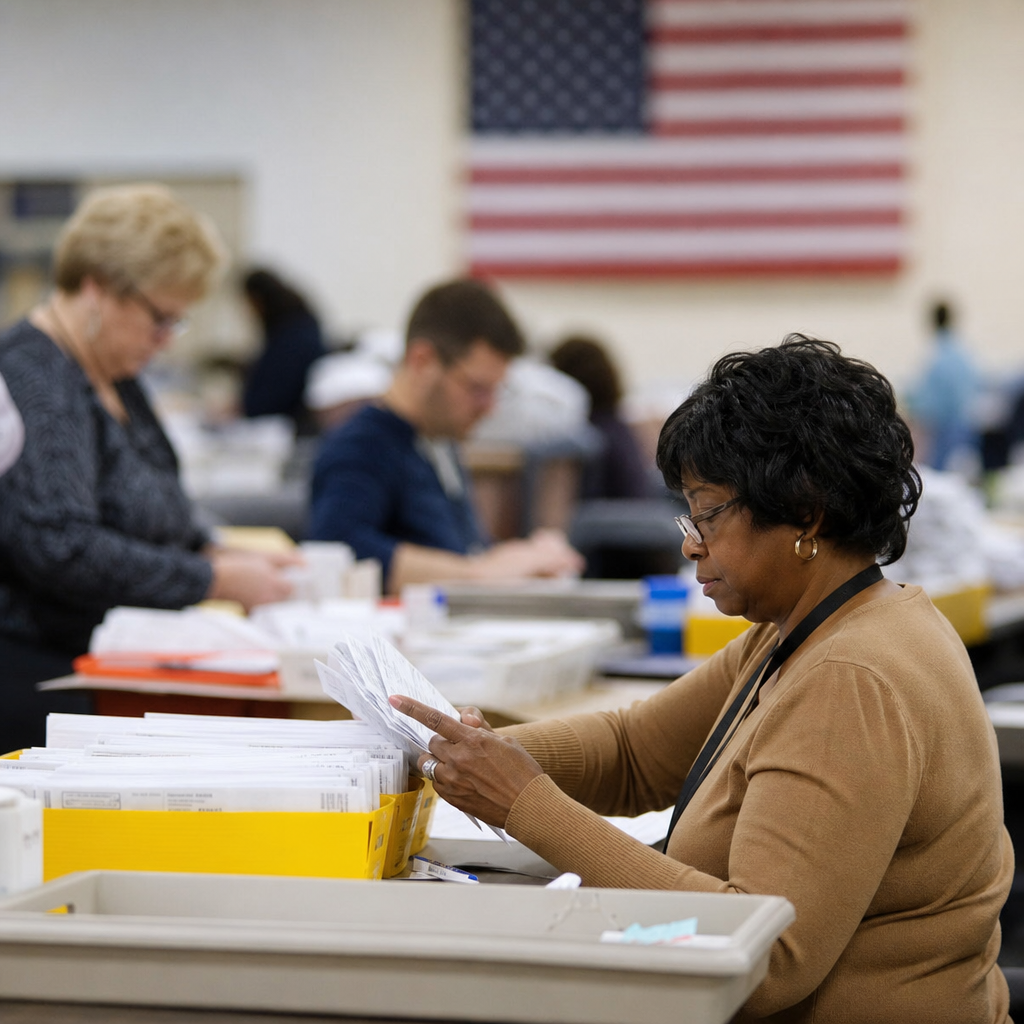
Secretaries of state sit at a critical junction in American election administration because they often oversee voter registration systems, certify ballot access, publish rules for local officials, and validate final statewide results. Election certification is the formal process of confirming that votes were counted according to law and that the reported outcome is the legally recognized outcome. In AP Government and Politics, this topic matters because it connects federalism, separation of powers, administrative law, political parties, civil rights, and democratic legitimacy. Students usually hear about elections through presidential campaigns and the Electoral College, but the quieter administrative steps after ballots are cast are just as important. In practice, I have found that many misconceptions begin with the assumption that a secretary of state can simply refuse to certify results for partisan reasons. In most states, that is not how the law works. Certification is generally a ministerial duty guided by statutes, deadlines, canvassing procedures, and judicial review.
The title secretary of state can be misleading because the office varies by state. In many states, the secretary is the chief election official, while in others election authority is shared with boards of elections, county canvassing boards, or bipartisan commissions. Some secretaries are elected statewide, creating an obvious political dimension, while others are appointed. Election certification also does not mean recounting every ballot personally. Instead, it usually means receiving local returns, checking that statutory procedures were followed, resolving certain disputes through established channels, and issuing an official determination. That determination can affect recount rights, litigation timing, presidential elector appointment, and the seating of candidates in state and federal office. Understanding these mechanics helps explain why post-election disputes often focus on process instead of raw vote totals and why state-level officials become national figures during close contests.
For this hub within AP Government and Politics, the goal is to treat secretaries of state and election certification as a gateway topic. It links naturally to voting rights, state constitutions, political participation, campaign law, judicial review, federal election statutes, and the balance between local autonomy and statewide uniformity. It also raises a foundational question in democratic governance: who decides when an election is final, and under what legal standard? A strong answer requires more than naming one officeholder. It requires understanding how canvassing, certification, recounts, audits, court orders, and legislative rules fit together. Once those parts are clear, students can analyze controversies with more precision and less rhetoric.
What secretaries of state actually do in election administration
In most states, the secretary of state is the senior statewide official responsible for election administration, but the exact portfolio is defined by state law rather than a single national model. Typical duties include maintaining statewide voter registration databases required by the Help America Vote Act of 2002, issuing election guidance to county clerks, approving ballot form standards, certifying candidates and ballot measures for placement on the ballot, training local officials, and publishing official returns. In some states, the office also handles business filings, administrative rules, archives, and notary regulation, which means elections are only one part of a broader administrative agency. That broader role matters because it shows why the office is structured as a legal bureaucracy rather than a campaign war room. The public may see a partisan elected official, but the election division beneath that official is usually staffed by career administrators, lawyers, database specialists, and compliance personnel.
Authority is also fragmented by design. Counties usually run polling places, recruit election judges, print ballots, and tabulate precinct returns. Bipartisan canvassing boards may verify local totals before sending them to the state. State courts interpret election statutes, and legislatures write the rules those officials must follow. Governors may issue writs of election or fill vacancies. That means no secretary of state can lawfully invent a statewide outcome alone. Even in states where the secretary signs the final certificate, the office typically acts after receiving county canvass reports and after any mandatory reconciliation steps. This division of labor reflects federalism inside the states themselves: local administration, state supervision, and judicial correction when conflicts arise.
How election certification works from local canvass to statewide result
Election certification follows a sequence. First, local officials report unofficial election night results. Those numbers are fast but incomplete because they may exclude late-arriving absentee ballots allowed by law, provisional ballots awaiting eligibility review, cured signatures, military and overseas ballots, and duplicated damaged ballots. Second, local canvassing occurs. During canvass, officials reconcile poll books with ballots cast, review provisional ballot determinations, tally accepted absentee ballots, resolve tabulation discrepancies, and prepare a formal abstract of votes. Third, counties submit certified local returns to the state. Fourth, the state canvasses and certifies the statewide totals. Fifth, recounts or contests may proceed if triggered by statute or requested by candidates. The precise order varies, but the key principle does not: certification follows verification, not intuition.
One reason certification generates confusion is that the word sounds discretionary. In actual administration, most certification tasks are ministerial, meaning the official must carry out a legal duty once prerequisites are met. There can be judgment at the margins, especially when returns are incomplete, inconsistent, or the subject of a court order. But a secretary of state does not usually get to reject lawful votes because of policy preferences. If county returns comply with statutory requirements and no court blocks them, the state generally must include them. This distinction between ministerial and discretionary authority appears repeatedly in election litigation. Courts are more likely to compel action through mandamus when an official refuses a ministerial duty than when the statute grants real discretion.
| Stage | Main actors | What happens | Why it matters |
|---|---|---|---|
| Unofficial reporting | Precincts and counties | Election night totals are posted quickly | Informs the public but does not finalize outcomes |
| Local canvass | County clerks and canvassing boards | Absentee, provisional, and reconciliation work is completed | Produces the legally reviewable local record |
| State canvass | Secretary of state or state board | County abstracts are aggregated and checked | Creates the official statewide totals |
| Certification | State official or canvassing board | Formal declaration of result is issued | Triggers recount deadlines and officeholder recognition |
| Contest or recount | Candidates, courts, election officials | Margins or legal claims are reviewed under statute | Provides a structured remedy without suspending democracy |
Why certification became politically visible
Certification was historically low visibility because the process is technical, deadline driven, and usually routine. That changed as polarization increased, mail voting expanded, and close elections attracted national litigation and media scrutiny. The 2000 presidential election elevated public awareness of canvassing, recounts, and judicial intervention. The 2020 election pushed certification into mainstream political debate, especially in states where officials faced intense pressure to delay or deny final results. From my perspective working through election law materials and administrative guidance, the core lesson from these episodes is simple: the legal architecture held because most officials followed statutes even when partisan audiences wanted a different outcome.
Recent controversies also showed that certification disputes can arise at multiple levels. County canvassing boards have deadlocked or threatened not to certify local results. State officials have been asked to reject county submissions. Legislatures have debated whether executive election guidance exceeded statutory authority. Courts have been pulled in to determine whether deadlines are mandatory, whether ballots were lawfully cured, and whether procedural defects justify exclusion. These conflicts matter for AP Government because they illustrate how institutions convert political conflict into legal process. They also demonstrate that administrative bottlenecks can become democratic stress points if officials misunderstand or misstate their authority.
Law, standards, and limits on the secretary of state’s power
Several legal frameworks constrain election certification. State constitutions define the offices and often protect the right to vote. State statutes set canvassing timelines, recount thresholds, contest procedures, and certification duties. Federal law matters too. The Elections Clause gives state legislatures primary authority over the times, places, and manner of congressional elections, while Congress can alter those regulations. The Electors Clause shapes presidential elector appointment. The Voting Rights Act bars certain discriminatory practices, and the National Voter Registration Act and Help America Vote Act impose administrative requirements. None of these laws creates unlimited room for a single statewide official to improvise.
Standards used during certification are procedural rather than partisan. Officials ask whether returns were timely filed, whether county boards completed required canvass steps, whether discrepancies were documented, whether challenged ballots were processed under law, and whether any court order changes the count. Recognized tools and methods include risk-limiting audits in some states, post-election logic and accuracy review, chain-of-custody documentation, ballot adjudication logs, and statewide election management systems. Those mechanisms do not guarantee perfection, but they create an evidentiary record. When a losing campaign alleges fraud or error, the decisive question is usually whether the claim can overcome that documented record in court, not whether the allegation is politically resonant.
There are limits, however. Election administration is not mechanically uniform across the country. Some states use boards of state canvassers instead of unilateral certification by the secretary of state. Some give county officials more autonomy. Some deadlines are strict, while others permit curing or judicial extension. Close races can expose gaps in old statutes written before mass mail voting or modern data systems. Administrative guidance can also become controversial if it appears to interpret rather than merely implement the law. That is why careful analysts distinguish ordinary certification disputes from broader constitutional crises.
Major controversies and what students should learn from them
Three recurring controversies dominate this topic. First is refusal to certify. When officials refuse certification despite completed lawful returns, courts often treat the duty as ministerial and order certification. Second is disputed ballots, especially absentee and provisional ballots. Here the issue is whether voter intent and eligibility were determined under statutory standards. Third is timing. Campaigns may seek injunctions before certification, after certification, or during recount windows, and timing can shape remedies. For example, courts are generally reluctant to rewrite election rules after voting has begun, a principle associated with concerns about voter confusion and unequal treatment.
Students should also learn the difference between an audit, a recount, and a contest. An audit checks whether the tabulation process performed as expected, often by sampling paper ballots against reported totals. A recount retabulates ballots, usually in close races and under detailed statutory rules. An election contest is a legal challenge to the validity of the result itself, often involving claims about misconduct, ineligible ballots, or procedural violations. These are not interchangeable remedies. In practical administration, they serve different purposes and require different evidence. Confusing them leads to poor analysis and exaggerated claims about what certification can fix.
Another key lesson is that decentralization is both a strength and a weakness. It is a strength because no single point of failure controls the whole system. It is a weakness because uneven local capacity can create delays, inconsistent voter experience, and public suspicion. I have seen students grasp this best when comparing counties within the same state. One county may have sophisticated ballot tracking, abundant staff, and rapid adjudication. Another may struggle with outdated equipment or fewer trained workers. The secretary of state’s role is often to standardize enough process to preserve equality while respecting local administration.
How this topic connects across AP Government and Politics
Secretaries of state and election certification tie directly to major course themes. Under institutions, the topic shows how state executives operate within statutory limits and alongside courts and legislatures. Under political behavior, it affects turnout, confidence, and acceptance of outcomes. Under civil rights and liberties, it intersects with equal protection, ballot access, disability accommodation, language assistance, and redistricting spillover effects. Under public policy, it raises questions about funding, administrative capacity, and implementation. Under political parties, it reveals how parties litigate rules strategically while still depending on neutral administration to make victory meaningful.
As a hub page, this subject should lead readers toward related articles on voting rights, the Electoral College, primary elections, recounts, campaign finance, federalism, judicial review, and state election law. Those topics are not separate silos. They are parts of one system that determines who can vote, how ballots are counted, who resolves disputes, and when power changes hands. If students master certification, they gain a framework for interpreting election news with constitutional literacy rather than guesswork. That is the main payoff: better analysis of democracy when it is under stress.
Secretaries of state and election certification are best understood as the legal machinery that turns millions of individual ballots into an authoritative public result. The office may be political, but the certification duty is usually bounded by statutes, documented procedures, local canvasses, and judicial oversight. That is why most certification fights are really arguments about evidence, timelines, and legal authority rather than simple partisan choice. For AP Government and Politics, this topic is valuable because it joins abstract principles to concrete administration. Federalism explains why states run elections differently. Separation of powers explains why courts, legislatures, and executive officials share responsibility. Civil rights principles explain why access, equal treatment, and lawful counting remain central.
The practical takeaway is clear. Do not treat certification as a ceremonial formality, and do not treat it as a free-floating veto. It is a structured process with defined actors, deadlines, records, and remedies. When controversy appears, ask basic questions first: Who has statutory authority? What stage of canvass or recount is underway? What evidence supports the claim? What remedy does the law provide? Those questions cut through noise quickly. They also prepare students to connect this hub topic to broader study of elections and democratic institutions. Continue by exploring the linked AP Government and Politics articles on voting rights, recounts, federalism, and election disputes so you can see how certification fits into the full constitutional system.
Frequently Asked Questions
What does a secretary of state do in election administration?
In many states, the secretary of state is the chief elections official, meaning the office plays a central role in how elections are organized, regulated, and finalized. Although duties vary by state, secretaries of state often oversee statewide voter registration systems, issue guidance to county and local election officials, certify which candidates and ballot measures qualify for the ballot, and help ensure that election procedures follow state and federal law. They may also publish election calendars, provide training materials, approve forms, and communicate official rules about voting, recounts, and post-election procedures.
This position matters because American elections are highly decentralized. Local governments usually run polling places and count ballots, but the secretary of state helps create statewide consistency. That means the office sits at an important intersection of federalism and administrative law: elections are conducted locally, but they must still meet statewide standards and legal requirements. In AP Government and Politics, this is a useful example of how state institutions shape the practical functioning of democracy.
What is election certification, and why is it so important?
Election certification is the formal legal process of confirming that the vote totals have been reviewed, tabulated, and accepted according to the rules established by law. It is not simply a ceremonial announcement of who appears to have won on election night. Instead, certification is the official act that makes the results legally recognized by the state. Before certification, election officials typically complete steps such as canvassing returns, checking provisional ballots, incorporating late-arriving eligible ballots where allowed by law, and verifying that counties submitted accurate and complete totals.
Certification is important because it turns raw election data into an official result with legal force. That official result can determine who takes office, whether a recount proceeds, whether a ballot measure passes, and how a state fulfills federal obligations, such as appointing presidential electors. Certification also supports legitimacy. In a democratic system, voters need confidence that results are not based on rumor, projection, or partisan preference, but on a structured legal process. For students of government, certification shows how procedural rules protect constitutional order by ensuring that power changes hands according to law rather than political pressure.
Do secretaries of state have the power to decide election winners on their own?
No. A secretary of state does not have the lawful authority to simply choose a winner based on personal preference or partisan loyalty. Election outcomes are determined by votes cast and counted under state law. The secretary of state’s role is usually to administer the certification process, verify compliance with legal procedures, and recognize the official totals produced through the canvass and reporting system. In other words, the office helps confirm the outcome; it does not invent it.
That distinction is extremely important. In public debate, certification is sometimes misunderstood as if it gives a single official unlimited discretion. In reality, secretaries of state operate within a legal framework that includes statutes, court rulings, deadlines, bipartisan or multi-member canvassing boards in some states, and oversight by other institutions. If disputes arise, courts may intervene, recounts may be triggered, and legislatures may shape the governing rules prospectively through lawmaking. This reflects separation of powers in action: no one official is supposed to stand above the legal process.
How does election certification connect to federalism and separation of powers?
This topic is a strong example of federalism because elections in the United States are administered primarily by the states, with substantial responsibility often delegated further to counties and municipalities. The federal government sets certain constitutional and statutory requirements, such as protections against discrimination in voting and rules for federal elections, but the day-to-day administration of registration, ballot design, counting procedures, and certification is usually handled at the state and local levels. Secretaries of state therefore illustrate how states serve as major governing institutions within the federal system.
Election certification also highlights separation of powers because multiple institutions influence the process. State legislatures write election laws, executive officials like secretaries of state carry them out, and courts interpret those laws and resolve disputes. Local election boards may conduct the initial canvass, while statewide officials finalize or transmit results. This division of authority is designed to prevent unilateral control and create legal checks. In AP Government and Politics, this makes election certification a practical case study in how constitutional principles operate beyond the national level, shaping the real mechanics of democratic governance.
Why has election certification become such a visible issue in recent American politics?
Election certification has received more public attention because recent elections have produced intense scrutiny, misinformation, and political pressure surrounding vote counting and final results. As more people follow election night coverage and post-election litigation, they have become more aware that results are not officially complete the moment media organizations make projections. Certification is the final stage that confirms the lawful outcome, so it naturally becomes a focal point when elections are close, contested, or politically polarized.
The visibility of certification also reflects broader concerns about democratic legitimacy and institutional trust. When elected officials, candidates, or members of the public question results without evidence or misunderstand the role of election administrators, certification can become a test of whether legal procedures will be followed despite partisan conflict. That is why the role of secretaries of state matters so much: they are often expected to apply rules consistently, communicate clearly with the public, and resist efforts to substitute political preference for verified vote totals. For students, this issue demonstrates how institutions, norms, and law all work together to sustain peaceful transfers of power.