
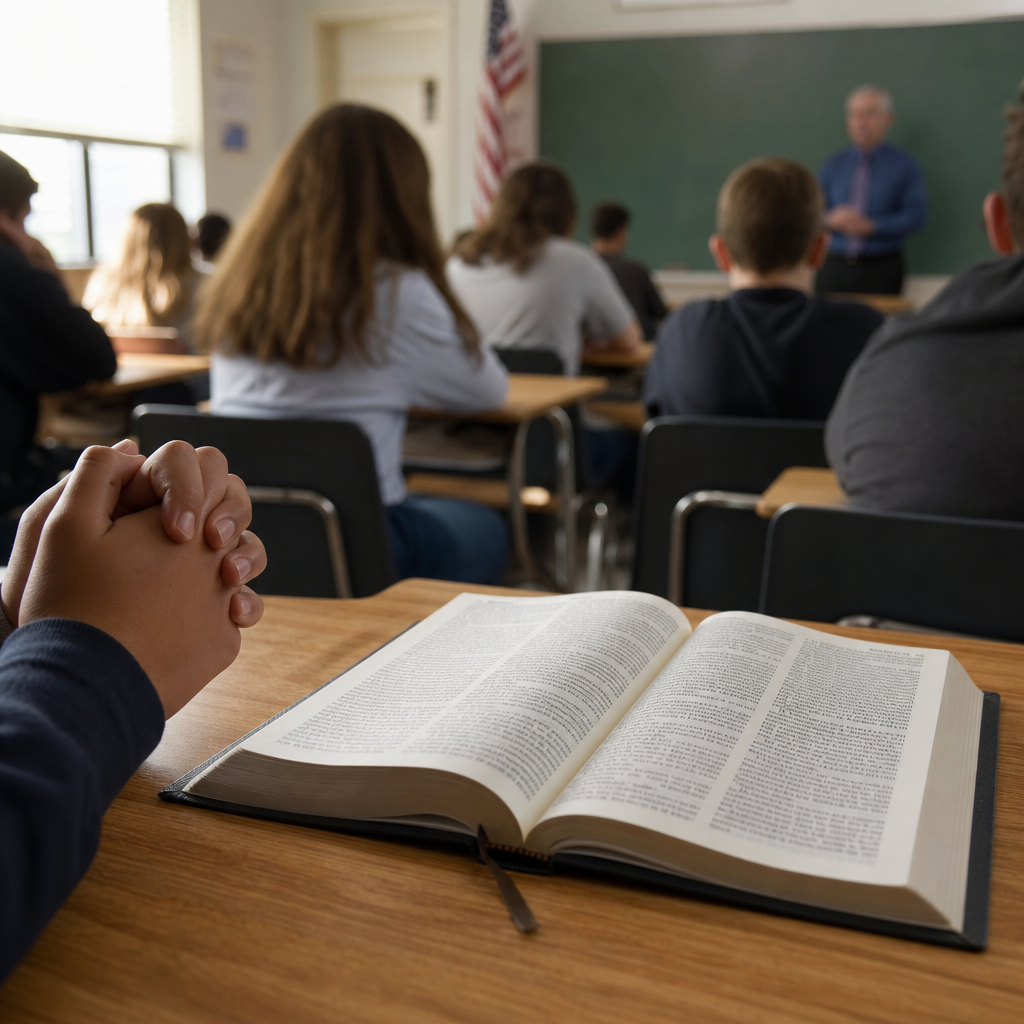
Religion in public schools sits at the center of one of the most persistent constitutional debates in American government: how to protect individual faith while keeping the state neutral. In AP Government and Politics, this topic usually appears through cases about school prayer, Bible reading, student religious expression, and the meaning of the Establishment Clause and Free Exercise Clause of the First Amendment. The core question is simple to state but difficult to apply: when a public school permits, sponsors, limits, or discourages religious activity, is it protecting liberty or violating neutrality? Because public schools are government institutions, their choices carry constitutional weight in a way that private schools, churches, and families do not.
The key terms matter. School prayer can mean a private student silently praying before a test, a football coach leading players in prayer, or a principal scheduling an official invocation at graduation. Bible reading can refer to devotional readings selected by school officials or the academic study of the Bible in a literature or history course. Government neutrality means the state may not favor religion over nonreligion, one faith over another, or irreligion over religion. That standard sounds balanced, but in practice schools must make daily judgment calls about curriculum, ceremonies, clubs, holidays, dress, and speech. I have worked through these disputes with students by using one basic rule: in public schools, private religious choice is generally protected, while school-sponsored religious exercise is generally unconstitutional.
This issue matters far beyond a single unit test. Public schools educate children from many traditions, including Protestant, Catholic, Jewish, Muslim, Hindu, Sikh, Buddhist, secular, atheist, and unaffiliated families. A practice that seems harmless to a majority can feel coercive to a minority when it is tied to attendance, authority, grades, or school rituals. The Supreme Court has repeatedly recognized that children are especially vulnerable to social pressure in school settings. At the same time, the Court has also warned that schools cannot treat religious viewpoints as second-class speech. Understanding religion in public schools, then, requires holding two constitutional commitments together: no establishment of religion by the state, and no unnecessary suppression of private religious expression by students or staff acting in a private capacity.
As a hub topic within AP Government and Politics, this area connects to civil liberties, incorporation, judicial review, selective application of constitutional rights to the states through the Fourteenth Amendment, and the broader tension between majority rule and minority rights. It also links to related articles on the First Amendment, landmark Supreme Court cases, student speech, federalism, equal protection, and the role of public institutions in a pluralistic democracy. If students understand how prayer, Bible reading, and neutrality are analyzed, they can decode most school-religion controversies with confidence.
Constitutional foundations and why schools are different
The First Amendment begins, “Congress shall make no law respecting an establishment of religion, or prohibiting the free exercise thereof.” Through incorporation, these limits apply to state and local governments, including school districts. Public schools are not private associations; they are state actors funded by taxpayers, governed by public officials, and entrusted with compulsory education. That status changes everything. A student may pray at home, at church, or with friends without constitutional concern. A public school principal who organizes a prayer over the loudspeaker is different because the government is now involved in religious exercise.
In practice, courts ask several recurring questions. Who is speaking: the government, a school employee, or a private student? Is participation voluntary in theory but coercive in reality because attendance or social pressure is built in? Is the activity devotional, such as reciting a prayer or reading scripture for worship, or academic, such as studying religion as part of history? Is the school opening a forum for many viewpoints, or selectively permitting religious speech while excluding others? These questions matter more than labels. Calling a prayer “nonsectarian” or “voluntary” does not save it if the school itself sponsors the event.
Schools are different from legislatures, town councils, and public parks because students are young, attendance is often mandatory, and educators hold formal authority. A teacher’s invitation can feel like a directive. A coach’s prayer before a game can affect playing time, team belonging, or perceived loyalty. Courts have treated these realities seriously. They do not assume children can easily separate state pressure from personal choice. That concern explains why the constitutional line in schools is often stricter than in other public settings.
School prayer and Bible reading: the landmark rule
The modern doctrine was shaped by two foundational Supreme Court decisions. In Engel v. Vitale (1962), the Court struck down a state-composed prayer recited in New York public schools, even though students could remain silent or be excused. The problem was not only coercion; it was government authorship and sponsorship of prayer. One year later, in Abington School District v. Schempp (1963), the Court invalidated school-sponsored Bible reading and recitation of the Lord’s Prayer. The Court drew a durable distinction: public schools may teach about religion, but they may not conduct religious exercises.
These cases are often misunderstood. The Court did not ban religion from schools. It banned official devotional practices organized by the school. Students may still pray privately, read religious texts during free time, discuss religion with friends, and express religious viewpoints in assignments when relevant to the prompt. Teachers may teach the Bible as literature, religion in world history, or the role of faith in social movements if the instruction is secular, objective, and educational. What schools may not do is turn a class, assembly, or ceremony into an act of worship.
Later cases extended the same principle. In Lee v. Weisman (1992), clergy-led prayer at a public school graduation was unconstitutional because graduation is a major school event and students face subtle but real pressure to participate. In Santa Fe Independent School District v. Doe (2000), student-led prayer over the public-address system before football games also failed because the school’s policy effectively authorized a religious message at a school-sponsored event. The lesson for AP Government students is straightforward: if the school controls the platform, audience, and event, courts are likely to treat religious speech there as government-endorsed.
Protected student religious expression and equal access
While official prayer is prohibited, private student religious expression is strongly protected. Students may pray alone or in groups during noninstructional time, as long as they do not disrupt school operations or infringe on others’ rights. They may bring a Bible to school, read it during free reading periods if class rules allow similar materials, and include religious viewpoints in homework, speeches, or artwork when those viewpoints are relevant and evaluated by the same academic standards applied to all students. A school cannot censor a student solely because the speech is religious.
Congress reinforced this principle through the Equal Access Act of 1984. Under that law, if a federally funded secondary school creates a limited open forum by allowing noncurriculum-related student groups to meet, it generally cannot deny equal access to a student religious club based on the religious content of its speech. In practical terms, if a high school allows clubs such as chess, environmental action, or community service, it usually must also allow a Bible club or prayer group to meet during noninstructional time, with the same rules that apply to other clubs. Faculty may be present for custodial purposes, but they may not direct the club’s religious activities.
This balance often confuses students because it seems to permit religion in one setting and forbid it in another. The distinction is consistent. When students initiate and lead the activity on equal terms with other student speech, the Constitution protects it. When school officials organize, endorse, or pressure participation, the Constitution restrains it. I have found that using the phrase “equal access, not official sponsorship” helps students remember the rule quickly and apply it accurately.
| School scenario | Likely constitutional result | Main reason |
|---|---|---|
| Student silently prays before an exam | Permitted | Private religious exercise, no disruption |
| Teacher leads class in a morning prayer | Unconstitutional | Government-sponsored religious activity |
| Student Bible club meets after school like other clubs | Permitted | Equal access for student-led groups |
| School schedules Bible reading over announcements | Unconstitutional | Official devotional practice |
| History teacher assigns a unit on religion in abolitionism | Permitted | Academic study of religion, not worship |
| Coach pressures players to join team prayer | Usually unconstitutional | Authority and coercive context |
Teachers, coaches, curriculum, and the problem of coercion
Employees create the hardest cases because they are both citizens and agents of the state. Teachers and coaches do not lose all religious rights at work, but when they speak in their official roles to captive student audiences, schools may limit religious activity to avoid constitutional violations. A science teacher cannot pause class for devotional Bible reading. A principal cannot encourage students to attend a revival. A coach cannot make team prayer a condition of belonging. Even without explicit orders, students may reasonably interpret these acts as endorsed by the school and risky to decline.
The coercion idea became central in school cases because pressure in education is often subtle. A student at graduation may technically be free to stay seated during a prayer, but refusing marks that student as different at a milestone event. A player may technically be free to walk away from midfield prayer, yet still fear reduced trust from teammates or a coach. Courts therefore look beyond formal voluntariness. They consider age, setting, power imbalance, peer dynamics, and whether the school has structured the event in a way that encourages conformity.
Curriculum requires a separate analysis. Public schools may teach about religion because religion is part of history, literature, art, music, law, and politics. The First Amendment does not require schools to sanitize the curriculum of religious content. It requires schools to handle that content with a secular educational purpose and neutrality among viewpoints. A unit on the Protestant Reformation, Islamic empires, the Black church in the civil rights movement, or biblical allusions in English literature is constitutionally sound when taught objectively. The line is crossed when the teacher uses coursework to promote belief, denigrate belief, or conduct devotional exercises under an academic label.
Holiday observances show the same pattern. Schools may teach about Christmas, Hanukkah, Ramadan, Diwali, or Easter as cultural and historical subjects. Music programs may include sacred pieces when selected for legitimate educational reasons and presented in a broader pedagogical context. Problems arise when celebrations become worship services or when one tradition is repeatedly elevated as the school’s preferred faith. Neutrality does not mean hostility to religion; it means schools neither advance nor inhibit religious practice.
Standards, recent disputes, and how to analyze exam questions
The Supreme Court has used multiple tests over time, which is why this topic can feel messy. Older opinions often referred to secular purpose, primary effect, and excessive entanglement, drawn from Lemon v. Kurtzman (1971). Later cases emphasized endorsement, coercion, history, and tradition. Students do not need to memorize every doctrinal shift to answer most AP-style questions well. They should focus on source of speech, degree of school involvement, coercive pressure, and whether the activity is devotional or educational. Those factors explain outcomes more reliably than slogans.
Recent disputes have kept the topic active. Controversies over coach prayer, religious displays, released-time programs, and parental rights show that the line is still contested. Courts have sometimes become more protective of personal religious expression by public employees when they are not acting within official instructional duties. That nuance matters. A teacher quietly bowing her head during lunch is different from inviting students to join her in prayer during class. A coach engaging in a private act after a game may be treated differently from one who gathers players for a team devotional. Facts determine the constitutional result.
For exam analysis, start with a short framework. First, identify the actor: student, teacher, coach, administrator, clergy, or outside group. Second, identify the forum: classroom, graduation, football field, club meeting, announcements, or curriculum. Third, ask whether participation is genuinely private and voluntary or shaped by school authority and peer pressure. Fourth, separate teaching about religion from practicing religion. Finally, connect the facts to leading cases such as Engel, Schempp, Lee, and Santa Fe. This method consistently produces clear, defensible answers in free-response and multiple-choice settings.
As a hub within the broader AP Government and Politics curriculum, religion in public schools links outward to the First Amendment, incorporation, civil liberties, freedom of speech, student rights, and Supreme Court case analysis. Students studying this page should next review core religion-clause cases, school speech precedents, and the constitutional standards governing public institutions. The big picture is stable even when doctrine evolves: public schools must protect private religious liberty without turning state power into religious endorsement.
The most important takeaway is that the Constitution does not require public schools to be religion-free zones, and it does not allow them to become instruments of worship. That middle position is the principle of government neutrality. Students may express faith privately, organize religious clubs on equal terms, and study religion as part of a serious curriculum. Schools, however, may not compose prayers, sponsor Bible reading, or pressure students to join religious exercises. When authority, setting, and coercion point to government involvement, the practice is likely unconstitutional.
For AP Government and Politics, mastering this topic means learning to spot distinctions that courts treat as decisive: private versus official speech, education versus devotion, voluntary choice versus coercive pressure, and equal access versus endorsement. Those distinctions explain why a student may read scripture during free time while a teacher may not lead scripture reading in class, and why a Bible club may meet after school while a graduation prayer may be struck down. Constitutional analysis here is rarely about being pro-religion or anti-religion. It is about preserving liberty for everyone in a diverse public system.
If you are building out this subtopic, use this article as your starting point and then move to the related case-specific pages, First Amendment doctrine guides, and student rights resources in the AP Government and Politics hub. Review the landmark holdings, practice applying the actor-forum-coercion framework, and compare fact patterns carefully. That approach will help you answer exam questions accurately and understand one of the clearest examples of how constitutional principles shape everyday life in American public schools.
Frequently Asked Questions
1. What does the Constitution say about religion in public schools?
The Constitution does not mention public schools by name, but the First Amendment sets the basic rules that govern religion in public education. It says that government may not establish religion and may not prohibit the free exercise of religion. In school settings, those two commands work together. Public schools are government institutions, so they cannot sponsor, promote, or pressure students to participate in religious activity. At the same time, students and staff do not lose all religious freedom when they walk into a school building. The challenge is drawing the line between private religious expression, which is generally protected, and school-sponsored religious activity, which is generally unconstitutional.
In AP Government and Politics, this issue is usually framed through the Establishment Clause and the Free Exercise Clause. The Establishment Clause limits government involvement with religion. That is why official school prayer, school-directed Bible reading, or policies that favor one faith tradition can raise serious constitutional problems. The Free Exercise Clause protects the right of individuals to hold religious beliefs and engage in personal religious practices, as long as those practices do not disrupt the school or violate neutral rules. Courts have spent decades trying to balance these principles, which is why religion in public schools remains such a central constitutional debate.
2. Why did the Supreme Court rule against school-sponsored prayer and Bible reading?
The Supreme Court ruled against school-sponsored prayer and Bible reading because public schools are state actors, and the state may not compose, endorse, or organize religious exercises for students. Even if participation is described as voluntary, the Court has recognized that schools are unique environments where students can feel strong social pressure to conform. A prayer read over the loudspeaker, a Bible passage selected by school officials, or a devotional exercise led by teachers carries the weight of government approval. That creates an Establishment Clause problem because it suggests that the school is taking a position on religion.
Two landmark cases are especially important. In Engel v. Vitale (1962), the Court struck down a state-composed prayer that was recited in public schools, even though students could technically opt out. The Court concluded that government-written prayer in public schools violated the constitutional ban on establishment of religion. In School District of Abington Township v. Schempp (1963), the Court invalidated mandatory Bible reading and recitation of the Lord’s Prayer in public schools. The reasoning was not that prayer or Bible reading are improper in themselves, but that the government cannot organize those practices in a public school setting. These decisions did not outlaw religion in schools. They limited government-sponsored religious exercises while leaving room for private belief and personal religious practice.
3. Can students pray, read the Bible, or talk about religion at school on their own?
Yes. Students generally have the right to pray privately, read religious texts, discuss religion with classmates, and express religious viewpoints, as long as they are doing so on the same terms as other forms of personal expression and are not disrupting school operations. The key distinction is that the activity must be genuinely student-initiated and not directed, encouraged, or officially endorsed by the school. A student silently praying before a test, gathering with friends for voluntary prayer during free time, or reading the Bible during noninstructional time is typically protected by the Free Exercise Clause and free speech principles.
Students may also include religious themes in assignments when relevant to the topic and consistent with academic requirements. In many cases, religious clubs can meet on school grounds if the school allows other noncurricular student groups to do the same. What schools cannot do is favor religious expression over nonreligious expression or suppress religious viewpoints simply because they are religious. At the same time, schools may enforce neutral rules about time, place, and manner. So student religious expression is protected, but it is not unlimited. The constitutional rule is neutrality: schools may not sponsor religion, and they may not discriminate against students because of religion either.
4. What is the difference between government neutrality and hostility toward religion in public schools?
Government neutrality means the school neither promotes religion nor opposes it. That distinction matters because some people mistakenly assume that removing school-sponsored prayer is the same thing as banning religion from public life. Constitutionally, neutrality does not require schools to treat religion as something improper or unwelcome. Instead, it requires public schools to avoid using state authority to advance or inhibit religious belief. In practical terms, that means a school cannot lead students in prayer, but it also cannot punish students for engaging in private, voluntary religious expression that follows ordinary school rules.
The Supreme Court has repeatedly emphasized that the Constitution protects both religious liberty and government nonalignment. A school acts non-neutrally when it endorses religion, such as by organizing devotional exercises or giving special preference to one faith. It may also act non-neutrally if it singles out religion for unfavorable treatment when comparable secular expression is allowed. That is why modern First Amendment analysis often focuses on equal treatment. Public schools should not coerce students into religious participation, but they also should not treat religious students as second-class participants in school life. Neutrality is best understood as fairness backed by constitutional limits, not as public hostility to faith.
5. Why is religion in public schools such an important topic in AP Government and Politics?
This topic is important in AP Government and Politics because it brings together several foundational ideas in one area of law and public policy. It involves the First Amendment, judicial review, civil liberties, the role of the Supreme Court, and the difficulty of applying broad constitutional principles to everyday government action. Public schools are especially useful for studying these issues because they are government-run institutions that affect millions of students from many different religious and nonreligious backgrounds. That makes them one of the clearest settings for examining how constitutional protections work in practice.
It also matters because religion in public schools shows how constitutional interpretation evolves through cases. Students often study disputes involving school prayer, Bible reading, graduation ceremonies, student clubs, and religious expression by teachers and students. These controversies force courts to answer hard questions about coercion, endorsement, equality, and liberty. They also reveal that constitutional law is rarely just about abstract doctrine. It shapes real decisions about what schools may do, what students may say, and how government respects diversity in a pluralistic society. For AP Gov students, understanding this subject helps explain not only religion clause cases, but also the broader American commitment to protecting individual rights while limiting government power.