
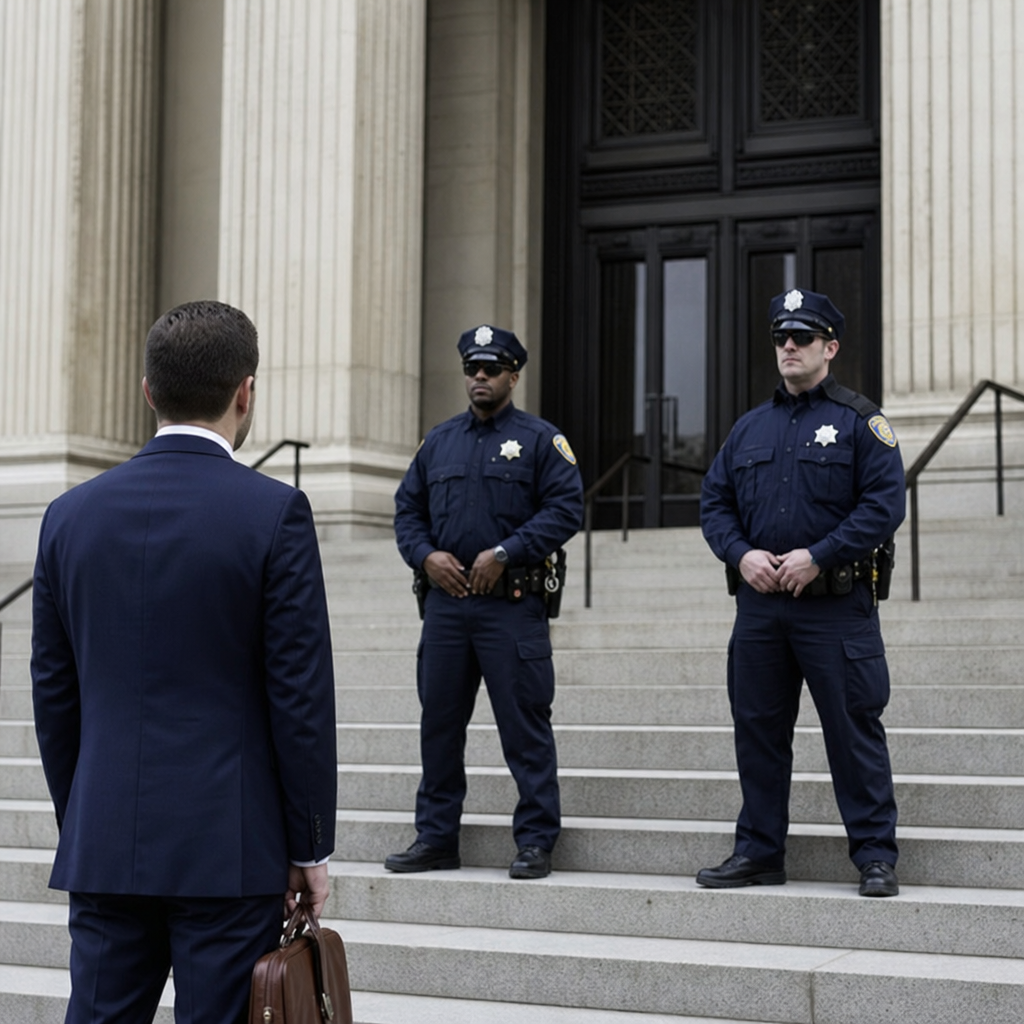
Qualified immunity is one of the most consequential and misunderstood doctrines in American public law, especially for students studying AP Government and Politics. In civil rights litigation, it often determines whether a person harmed by a government official can obtain damages at all. The basic idea sounds narrow: officials are shielded from personal liability unless they violated “clearly established” law. In practice, that rule has made many constitutional lawsuits extraordinarily difficult to win, even when courts acknowledge troubling conduct.
For AP Government and Politics, qualified immunity sits at the intersection of constitutional rights, federalism, judicial interpretation, public accountability, and the daily operation of state power. It most commonly appears in lawsuits under 42 U.S.C. Section 1983, the Reconstruction-era federal statute that allows individuals to sue state and local officials for violating federal rights. Students often encounter the doctrine when studying police use of force, unlawful searches, school discipline, prison conditions, or municipal accountability. The concept matters because rights on paper are only meaningful if there is a workable remedy when officials break the law.
I have worked through many Section 1983 cases, and the pattern is consistent: plaintiffs rarely lose because a judge says rights do not matter. They lose because the legal standard is stacked around prior case law, procedural hurdles, and judicial caution. To understand why civil rights lawsuits are so hard to win, you need to understand where qualified immunity came from, how courts apply it, and what obstacles exist beyond the doctrine itself. This article serves as a hub for the broader “Misc” subtopic by connecting civil rights litigation to policing, federal courts, constitutional remedies, and ongoing reform debates.
What qualified immunity means in plain terms
Qualified immunity is a judge-made doctrine that protects government officials, usually state or local officers sued in their individual capacities, from paying damages unless their conduct violated clearly established constitutional or statutory rights. The modern test usually asks two questions: was there a rights violation, and was that right clearly established at the time? Courts may answer either question first. If the law was not clearly established, the official generally wins, even if the court believes the conduct was unconstitutional.
The phrase “clearly established” is the doctrine’s center of gravity. In real litigation, it means a plaintiff usually must point to earlier precedent with closely similar facts from the Supreme Court, the relevant federal circuit, or occasionally a robust consensus of persuasive cases. General statements such as “excessive force is unconstitutional” are often not enough. Judges frequently require a high level of factual specificity. That turns the inquiry into a search for a prior case where another court already condemned nearly the same conduct.
For a student, the easiest way to think about qualified immunity is this: the doctrine can block recovery not because the plaintiff was treated lawfully, but because prior opinions did not give officials sufficiently specific notice. Critics argue this creates a catch-22. If courts dismiss cases for lack of clearly established law without deciding whether the Constitution was violated, then new precedent never develops. The next plaintiff faces the same barrier. Supporters respond that officials should not be personally liable for split-second decisions made in legally uncertain situations.
How the doctrine developed and why courts defend it
Section 1983, enacted in 1871, does not mention qualified immunity. The Supreme Court built the modern doctrine through interpretation, drawing partly on common-law immunities and policy concerns about official decision-making. Early cases were more subjective, asking whether officials acted with good faith. In Harlow v. Fitzgerald, decided in 1982, the Court shifted to an objective standard. That change was significant because it allowed judges to resolve cases earlier, often before trial, by asking legal rather than psychological questions.
Courts defend qualified immunity on several grounds. First, officials need room to perform discretionary functions without constant fear of personal liability. Police officers, school administrators, and regulatory officials make rapid decisions in tense settings. Second, litigation itself is costly. Discovery, depositions, and trial preparation consume time and money, and the Supreme Court has repeatedly called immunity protection from suit, not merely protection from ultimate damages. Third, supporters argue that without some shield, talented public servants might hesitate, overcompensate, or avoid government work altogether.
Those rationales are not imaginary, but they are often overstated in public debate. In practice, governments frequently indemnify officers, meaning the individual official does not personally pay a judgment. Research from Professor Joanna Schwartz found that officers almost never contribute meaningfully to settlements or verdicts. That undermines the idea that qualified immunity is necessary to protect personal finances in most ordinary cases. The stronger institutional argument is about litigation burden and hesitation, not bankruptcy. Even then, the cost falls hardest on plaintiffs whose rights were violated but who cannot clear the doctrine’s demanding precedent requirement.
Why civil rights plaintiffs lose so often
Qualified immunity is only one barrier, but it is a powerful one because it can end a case before a jury hears the facts. Plaintiffs must first identify the right at issue with precision. Then they must match that right to existing precedent. The more novel the fact pattern, the harder the case becomes. This is especially true in excessive force claims, where courts compare small factual differences: whether a suspect was handcuffed, kneeling, fleeing, mentally ill, holding an object, or resisting in a limited way can determine the outcome.
Another reason plaintiffs lose is procedural asymmetry. Government defendants often appeal denials of qualified immunity immediately under the collateral order doctrine. That can delay cases for months or years. Plaintiffs, by contrast, have fewer equivalent procedural advantages. Civil rights lawyers also face practical constraints. Section 1983 cases are expensive, expert-heavy, and risky. Small firms may be unable to finance discovery against a municipality or police department. If damages are uncertain and immunity is likely, many meritorious claims are never filed.
Even strong facts do not guarantee success because constitutional doctrine itself is demanding. Under the Fourth Amendment, courts ask whether force was objectively reasonable from the perspective of a reasonable officer on the scene, following Graham v. Connor. Under the Fourteenth Amendment or Eighth Amendment, standards differ depending on whether the plaintiff was a pretrial detainee, prisoner, student, or noncustodial civilian. Municipal liability is harder still because Monell v. Department of Social Services requires proof that a policy, custom, or failure to train caused the violation. Respondeat superior is not enough.
| Barrier | What it requires | Why it is hard to overcome |
|---|---|---|
| Qualified immunity | Clearly established law on similar facts | Novel misconduct often escapes damages liability |
| Objective reasonableness | Assessment from officer’s viewpoint at the time | Judges defer to tense, uncertain situations |
| Monell liability | Policy, custom, or deliberate indifference by municipality | Single incidents rarely prove institutional fault |
| Causation and damages | Proof of injury linked to the unconstitutional act | Medical evidence, experts, and records are costly |
| Procedure | Survive motions, appeals, and summary judgment | Cases can end before a full factual record develops |
Real-world examples and the importance of precedent
The Supreme Court’s recent qualified immunity cases show how much turns on factual framing. In Kisela v. Hughes, the Court granted immunity to an officer who shot a woman holding a knife near another person, emphasizing uncertainty and the absence of clearly established law on those exact facts. In City of Tahlequah v. Bond and Rivas-Villegas v. Cortesluna, the Court again reversed lower courts for defining the right too generally. The message to lower courts was unmistakable: specificity matters, especially in use-of-force cases.
That emphasis creates odd results. Imagine one case where officers release a police dog on a suspect who has surrendered face down, and another where a suspect is kneeling with hands visible but not fully prone. A court may say the earlier case does not clearly establish the rule for the later one because the posture differs. From a civilian perspective, both situations may look like obvious excessive force. From a qualified immunity perspective, those factual differences can be decisive. The doctrine rewards granular comparison more than moral intuition.
There are exceptions. Some conduct is so egregious that courts say every reasonable officer would know it was unlawful even without a prior case on all fours. The Supreme Court recognized that possibility in Hope v. Pelzer, involving a prisoner handcuffed to a hitching post. But lower courts use that path sparingly. As a result, plaintiffs often need a chain of precedent that is specific enough to deny immunity but broad enough to cover new misconduct. That is one reason civil rights lawyers spend so much effort on precedent research before filing suit.
What qualified immunity means for accountability and reform
The policy debate is not really about whether officials deserve any protection; it is about whether the current balance denies meaningful remedies when the government violates rights. Critics argue that the doctrine weakens deterrence, reduces transparency, and undermines public trust. If damages claims fail repeatedly, unconstitutional practices may persist unless criminal charges, administrative discipline, federal pattern-or-practice investigations, or political pressure intervene. Those alternative forms of accountability exist, but they are uneven and often slower than civil litigation.
Reform proposals vary. Some scholars and legislators favor abolishing qualified immunity entirely for Section 1983 claims because the statute’s text does not include it. Others support a narrower change, such as allowing claims when officials act recklessly, when body-camera footage contradicts officers’ accounts, or when agencies fail to train personnel on settled constitutional rules. State law has become an important testing ground. Colorado and New Mexico created state causes of action that limit or eliminate qualified immunity defenses in certain contexts, offering plaintiffs another route when federal doctrine blocks recovery.
For AP Government and Politics students, the larger lesson is institutional. Rights enforcement depends on Congress, courts, state legislatures, local governments, and administrative systems working together. Qualified immunity shows how judicial interpretation can dramatically shape a statute’s practical effect. It also reveals a recurring tension in American government: protecting official discretion while preserving remedies for abuse. If you are using this article as a hub, the next useful topics to study are Section 1983, Monell liability, Bivens, the exclusionary rule, police reform, and federal court procedure. Understanding those connected subjects makes the doctrine far less mysterious.
Qualified immunity helps explain why civil rights lawsuits are so hard to win, but the full answer is broader than one doctrine. Plaintiffs must navigate constitutional standards that already favor official discretion, procedural rules that permit early dismissal and interlocutory appeal, and a precedent system that demands highly specific prior cases. Even when harmful conduct appears obvious to the public, a court may still hold that the law was not clearly established. That gap between common sense and legal doctrine is the central reason many meritorious claims fail.
The most important takeaway is that remedies define the real strength of rights. A constitutional guarantee without a practical path to damages or institutional correction is often a weak guarantee. Qualified immunity does not erase rights, but it can make enforcement uncertain, expensive, and rare. For students, that makes it a perfect lens for studying how the judiciary, Congress, state governments, and local officials shape liberty in everyday life.
If you want to understand this area deeply, continue from this hub into the connected topics on Section 1983, municipal liability, police powers, and Supreme Court civil rights cases. Those subjects turn a difficult doctrine into a clear map of how government accountability actually works in the United States today.
Frequently Asked Questions
What is qualified immunity, and why does it matter so much in civil rights lawsuits?
Qualified immunity is a legal doctrine that often protects government officials, especially police officers and other executive officials, from being held personally liable for money damages in constitutional lawsuits. Most often, it arises in cases brought under 42 U.S.C. Section 1983, the federal civil rights statute that allows people to sue state and local officials for violating constitutional rights. In theory, qualified immunity is supposed to give officials breathing room to make reasonable mistakes while still allowing lawsuits when they plainly violate the Constitution. In practice, however, it has become one of the biggest barriers to relief for plaintiffs.
The reason it matters so much is that civil rights cases are not just about proving that something unfair or harmful happened. A plaintiff may show serious misconduct and still lose if the court decides the law was not “clearly established” at the time of the incident. That means the lawsuit can be dismissed before a jury ever hears the facts. For students of AP Government and Politics, this is important because it shows how constitutional rights on paper can look very different from rights that can actually be enforced in court. Qualified immunity affects accountability, access to remedies, and the real-world meaning of civil liberties and civil rights.
It is also misunderstood because people often assume it means officials can never be sued. That is not exactly true. Officials can still be sued, and sometimes they lose. But qualified immunity raises the plaintiff’s burden in a very specific way: it is not enough to argue that the official acted badly or even unconstitutionally in a broad sense. The plaintiff usually must point to prior case law that made it sufficiently clear that the conduct was unlawful in a closely comparable situation. That is why the doctrine is so consequential. It can turn a strong moral claim into a weak legal case.
What does “clearly established law” mean, and why is that standard so hard to satisfy?
“Clearly established law” is the core phrase in qualified immunity doctrine. It means that, at the time the official acted, existing legal precedent must have made it clear that the conduct violated the Constitution. Courts often look for decisions from the U.S. Supreme Court, the relevant federal circuit court of appeals, or in some situations a strong consensus of cases from other courts. The key point is that the right cannot be defined at too high a level of generality. It is not enough to say, for example, that the Fourth Amendment forbids unreasonable searches or excessive force in general. Courts often want a prior case with similar facts showing that this particular kind of conduct was already recognized as unconstitutional.
That requirement is hard to satisfy because every incident has its own factual details. Officials may argue that no prior case involved the same sequence of events, the same threat level, the same type of force, or the same setting. Even when prior decisions strongly suggest that the conduct was unconstitutional, courts may still say the precedent was not specific enough. As a result, plaintiffs can lose not because the official’s behavior was acceptable, but because no earlier case had already put the issue beyond debate in a closely analogous context.
This creates a practical catch-22. If courts dismiss new fact patterns because there is no prior case on point, then it becomes harder for future plaintiffs to establish the law as clearly established. Some courts try to address this by deciding the underlying constitutional question before turning to immunity, which can help build precedent. But courts are also allowed to skip that step and grant qualified immunity directly. When that happens, the law does not become clearer, and the same issue can repeat. That is one reason critics say qualified immunity does not just protect officials; it can also slow the development of constitutional law itself.
Why can someone with a strong claim of police misconduct or government abuse still lose a civil rights case?
A person can have a strong factual claim and still lose because civil rights litigation involves multiple legal hurdles. First, the plaintiff must prove that a constitutional right was actually violated. Second, the plaintiff must overcome qualified immunity by showing that the right was clearly established at the time. Those are separate questions. A judge may even assume for the sake of argument that the conduct was unconstitutional and still dismiss the case because the law was not clearly established. That is one of the most frustrating features of the doctrine from a plaintiff’s perspective.
In police misconduct cases, this often appears in excessive force litigation under the Fourth Amendment. Courts evaluate force based on reasonableness, taking into account the facts and circumstances confronting the officer. Because that standard is fact-specific, officials often argue that earlier cases are distinguishable. A plaintiff may show that the force used was severe and unnecessary, but if the court believes prior precedent did not clearly prohibit force under sufficiently similar circumstances, qualified immunity can still apply. In other words, the case may fail even when the facts look deeply troubling.
There are also procedural and strategic realities that make these lawsuits hard to win. Civil rights cases can be expensive, time-consuming, and difficult to investigate, especially when evidence is controlled by the government. Judges often decide immunity issues early in the case, which can limit discovery. Plaintiffs may face motions to dismiss, summary judgment, appeals, and long delays. In addition, juries may give officials the benefit of the doubt in fast-moving or dangerous situations. Qualified immunity is not the only obstacle, but it is a major one because it can block damages before the case fully develops. That is why many civil rights lawsuits are difficult not just morally or politically, but doctrinally and procedurally.
Where did qualified immunity come from, and is it actually written in the Constitution or civil rights statutes?
Qualified immunity is not written in the Constitution, and it does not appear in the text of Section 1983, the main federal statute used to sue state officials for constitutional violations. Section 1983 broadly says that a person who, under color of state law, deprives someone of federal rights can be liable to the injured party. The modern qualified immunity doctrine was largely created by the Supreme Court through interpretation. The Court has said the doctrine reflects common-law principles and policy concerns, including protecting officials from burdensome litigation and allowing them to perform their duties without fear of constant personal liability.
Historically, the doctrine evolved over time. Earlier versions focused more on whether an official acted in good faith. Over the decades, the Supreme Court shifted toward a more objective standard centered on clearly established law. That change was meant in part to avoid intrusive inquiries into an official’s subjective state of mind. But the result was a doctrine that now turns heavily on precedent and legal specificity rather than simply on whether the official acted maliciously or unreasonably. For students, this is a useful example of how constitutional law can be shaped not only by constitutional text and statutes, but also by judicial doctrine.
This history is central to current debates. Critics argue that because qualified immunity is judge-made rather than textually grounded, courts or Congress should narrow it or eliminate it. Supporters argue that officials need protection from hindsight second-guessing and from lawsuits based on unclear legal boundaries. Whether one supports or opposes the doctrine, it is important to understand that qualified immunity is primarily a product of judicial interpretation. That is part of why it remains controversial: many see it as a powerful limitation on civil rights remedies that does not appear in the statute Congress actually enacted.
Can qualified immunity be changed or abolished, and what would happen if it were?
Yes, qualified immunity could be changed, though the path depends on who acts. Because the doctrine has been developed by the Supreme Court, the Court itself could revise or narrow it in future cases. Congress could also attempt to alter the legal landscape by amending Section 1983 or creating a clearer statutory rule limiting or eliminating immunity in certain circumstances. Some states have already taken steps in their own laws to create causes of action or remedies that do not mirror federal qualified immunity rules, although state reforms do not automatically change federal doctrine.
If qualified immunity were narrowed or abolished, government officials would not suddenly become liable every time a plaintiff filed a complaint. Plaintiffs would still have to prove a constitutional violation, establish causation, overcome factual disputes, and persuade a court or jury on the merits. Other legal defenses would remain available. What would change is that officials could no longer rely as easily on the absence of closely matching precedent to end a damages case early. More lawsuits would likely reach discovery, summary judgment, settlement, or trial on the actual constitutional question.
The practical effects would be heavily debated. Supporters of reform say it would improve accountability, strengthen deterrence, and make constitutional rights more meaningful in real life. They argue that when people are injured by official misconduct, there should be a realistic path to compensation. Opponents worry that reducing immunity could make officials overly cautious, increase litigation costs, and discourage decisive action in difficult public jobs. For AP Government students, the larger lesson is that legal rules about remedies matter just as much as rules about rights. A right without an effective remedy may exist in theory, but not always in practice. That is exactly why qualified immunity remains such a powerful and controversial part of American public law.