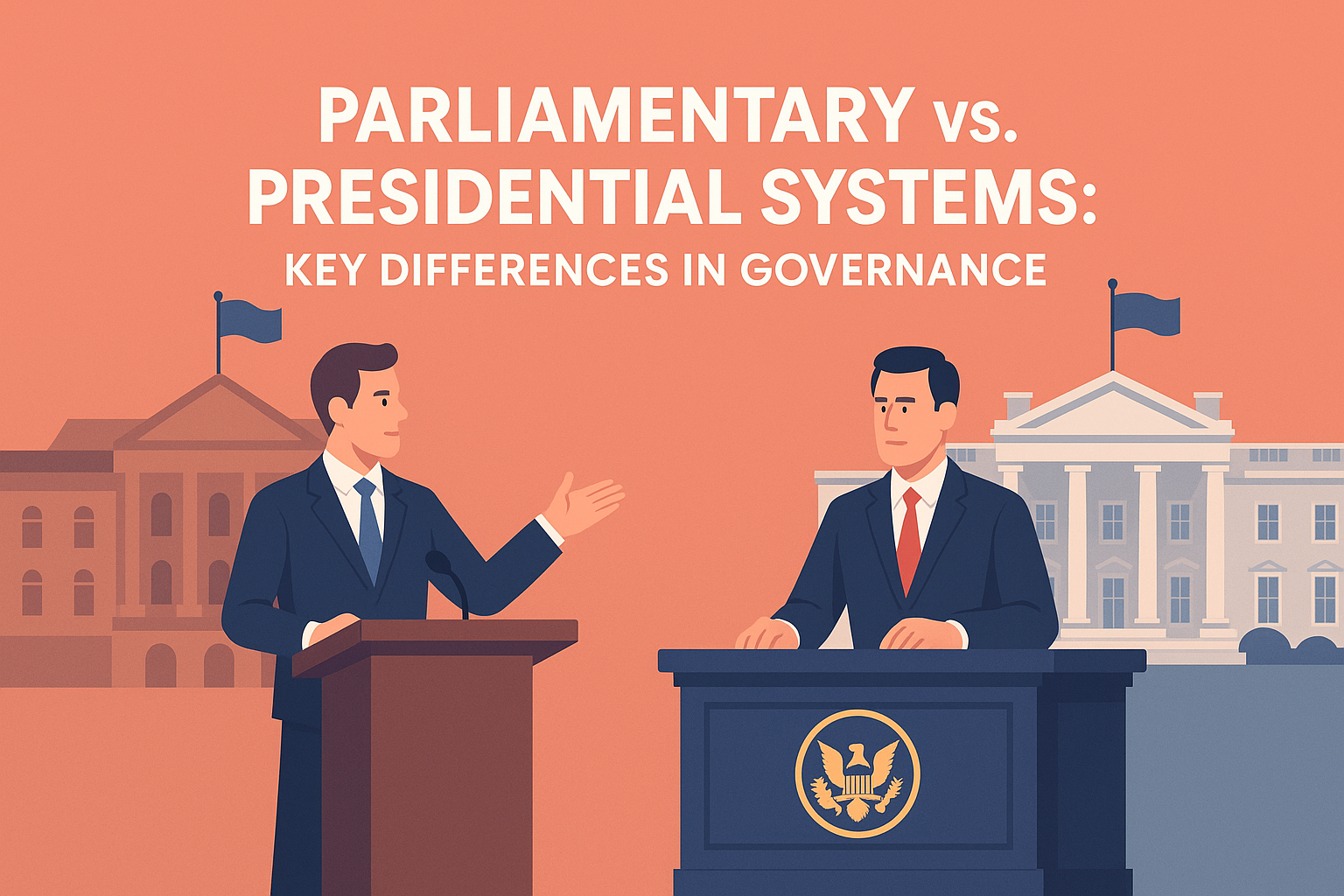
Governance systems play a crucial role in defining how a nation’s government operates and serves its citizens. Among the most prominent forms of governance are the parliamentary and presidential systems. These systems are pivotal in shaping political dynamics, legislative processes, and executive powers within a country. Understanding the differences between these two systems is essential, as they influence political stability, policy-making, and citizen representation. In this article, we will delve into the distinctions between parliamentary and presidential systems, explore their real-world applications, and comprehend their implications on governance.
Structure and Functionality of the Parliamentary System
The parliamentary system is characterized by a close relationship between the legislative and executive branches of government. In this system, the head of state is often a different individual from the head of government, and the executive branch is derived from the legislative branch. The prime minister, who is typically the head of government, is elected by members of the parliament. This relationship fosters a collaborative approach to governance, wherein the executive is accountable to the legislature.
A real-world example of a parliamentary system is found in the United Kingdom. The UK operates under a constitutional monarchy with a parliamentary democracy. The monarch serves as the ceremonial head of state, while the prime minister, elected by the majority party or coalition in the House of Commons, leads the government. This structure ensures that the executive is continuously answerable to parliament, promoting a dynamic governance process where policy-making is directly influenced by legislators.
Parliamentary systems are often praised for their ability to implement policies swiftly, as the executive branch must maintain confidence within the legislative body. This interconnectedness results in more cohesive policy development and less gridlock compared to presidential systems. However, it may also lead to instability if coalition governments struggle to maintain majority support.
Distinctive Features of the Presidential System
The presidential system, in contrast, distinctively separates the branches of government. The head of state and head of government roles are unified under the presidency. This system grants the president significant authority and independence from the legislature, often resulting in a distinct separation of powers. Presidents are typically elected through a national vote, granting them a direct mandate from the populace.
An illustration of the presidential system is the United States. The U.S. government structure embodies a clear division between the legislative, executive, and judicial branches. The president is elected independently of Congress, serving as both the head of state and government. This autonomy allows the president to make significant decisions and enact policies independently, though checks and balances are in place to prevent overreach of power.
Presidential systems are celebrated for their stability and continuity, as fixed terms provide predictability in leadership. Furthermore, the separation of powers facilitates a system of checks and balances that ensures no single branch wields excessive control. However, this separation can also result in political gridlock, particularly when different parties control the executive and legislative branches.
Implications on Political Stability and Governance
The type of governance system significantly impacts political stability and governance efficacy. Parliamentary systems, given their ability to quickly enact policies and adapt to changes, are often perceived as flexible. This adaptability is advantageous in swiftly addressing emerging issues or shifts in public sentiment. However, the necessity of maintaining majority support can result in frequent government changes, potentially leading to instability.
In contrast, presidential systems provide a more stable leadership environment due to fixed electoral terms. This stability facilitates long-term policy planning and continuity in governance. Nonetheless, the separation of powers in presidential systems can sometimes produce conflicts between the executive and legislative branches, particularly in polarized political landscapes, potentially impeding policy implementation.
Policy-Making Processes
Policy-making in parliamentary and presidential systems follows distinct paths shaped by their structural intricacies. In parliamentary systems, the executive’s reliance on legislative support often results in more collaborative policy development. This interdependence ensures that proposed legislation aligns closely with the legislative body’s preferences, expediting policy adoption.
An example of effective policy-making in a parliamentary system is New Zealand’s approach to environmental legislation. Here, the synergy between the executive and legislature facilitated the enactment of robust climate policies, reflecting the electorate’s environmental priorities. Such examples underscore the efficiency of parliamentary systems in translating legislative ambitions into tangible policy outcomes.
Conversely, presidential systems require the executive to negotiate with an often-independent legislative body. This separation introduces negotiation and compromise into the policy-making process, which can both hinder and enhance legislative effectiveness. An illustrative instance is the Affordable Care Act in the United States, where extensive negotiation was necessary to pass the legislation, reflecting the complexities inherent in policy development within a presidential system.
Example of Alignment in Parliamentary Systems
The alignment between policy initiatives and legislative approval is a hallmark of parliamentary systems. To illustrate, consider a typical policy alignment:
| Policy Initiative | Legislative Support | Outcome |
|---|---|---|
| Tax Reform | Majority Support | Legislation Passed |
| Healthcare Expansion | Coalition Agreement | Policy Adopted |
| Environmental Protection | Broad Consensus | New Laws Enacted |
Such alignment exemplifies the capacity of parliamentary systems to efficiently transform policy initiatives into action, underscoring the advantages of legislative-executive cooperation.
Citizen Representation and Influence
Citizen representation and influence are pivotal in both governance systems, albeit manifested differently. In parliamentary systems, citizens exert influence indirectly through party representation. The electorate’s choice translates into parliamentary seats, directly affecting the government’s composition. This mechanism ensures that government policies reflect the populace’s preferences, fostering a responsive political climate.
Conversely, presidential systems offer a direct avenue for citizen influence through separate elections for the executive and legislative branches. Voters independently elect their president, allowing them to express preferences distinct from legislative choices. This arrangement can yield more varied representation, yet it may also disassociate the executive from legislative priorities, potentially leading to policy friction.
Case Studies and Global Perspectives
Examining global applications of these governance systems offers insights into their practical implications. Germany, for instance, combines elements of both systems, operating under a parliamentary system with a federal structure. This hybrid model balances executive accountability with regional autonomy, showcasing the adaptability of governance structures to unique national contexts.
Similarly, France integrates elements of both models in its semi-presidential system, where a president shares power with a prime minister. This arrangement seeks to harness the strengths of both systems, enhancing executive stability while retaining legislative oversight. France’s model exemplifies the potential for innovative governance structures to harmonize diverse political needs.
Conclusion: Choosing the Right Governance System
In conclusion, understanding the fundamental differences between parliamentary and presidential systems reveals their distinct contributions to effective governance. Parliamentary systems prioritize collaboration, swift policy implementation, and responsiveness to legislative preferences. In contrast, presidential systems emphasize stable leadership, independent policy-making, and a robust separation of powers to safeguard against governmental overreach.
The choice between these systems is influenced by historical, cultural, and socio-political contexts, necessitating a tailored approach for each nation. As citizens engage with these systems, recognizing their strengths and limitations empowers informed participation and advocacy for governance reforms aligned with national priorities.
For readers seeking a deeper understanding of governance structures, exploring specific case studies or comparing additional hybrid models can provide valuable insights into the diverse ways nations navigate the complexities of governance. By doing so, individuals can contribute meaningfully to dialogue surrounding governance improvements and their impact on societies worldwide.
Frequently Asked Questions
1. What are the fundamental differences between parliamentary and presidential systems?
At the core, parliamentary and presidential systems differ in how they distribute power between the executive and legislative branches, as well as in their method of selecting leaders. In a parliamentary system, the executive branch derives its mandate from the legislative branch and is directly accountable to it. This typically means that the head of government, often titled the Prime Minister, is drawn from the majority party or coalition in the parliament. Conversely, in a presidential system, the president is elected independently of the legislature, usually through a nation-wide vote, and thus holds a separate mandate. This separation means the president has distinct powers not as directly contingent on the legislative branch’s support.
Another key difference is in how each system deals with power balances and legislative gridlock. Parliamentary systems often enable a more efficient legislative process since the executive is part of, and works hand-in-hand with, the majority party in the legislature. However, this can sometimes lead to less separation between powers. In contrast, presidential systems offer checks and balances, as the executive is independent, leading to a balance of power but sometimes resulting in legislative deadlocks when different parties control the executive and legislative branches.
2. How does the selection process of leaders differ in parliamentary and presidential systems?
In parliamentary systems, the leader of the government is usually the Prime Minister, who becomes the head by commanding the confidence of the majority in parliament. This means the Prime Minister is usually the leader of the party with the most seats or leads a coalition of factions that together form a majority. This leader then selects ministers predominantly from among elected members of the parliament, thereby ensuring that those governing also remain closely accountable to the legislature.
In presidential systems, the president is elected directly by the country’s eligible voters or through an electoral college system, as seen in the United States. This nationwide electoral process means that the executive doesn’t need to secure majority support from the legislature to assume office. Often, this direct election provides the president with a broader national mandate, which theoretically enhances their accountability to the entire electorate rather than just to the legislative majority.
3. How does each system affect policy-making and political stability?
In a parliamentary system, policy-making is typically more streamlined. Because the executive branch is essentially an extension of the legislative majority, it can more swiftly introduce and pass legislation. This ensures that policies backed by the ruling party or coalition can be implemented with fewer obstacles. Furthermore, the threat of a no-confidence vote can act as a deterrent against unpopular decisions, theoretically maintaining stability through constant legislative oversight.
Meanwhile, a presidential system, with its fixed terms and separation of powers, can face more friction in policy-making. The legislature is an independent entity capable of opposing the president’s agenda, which often results in negotiation, compromise, or outright gridlock. This can slow down the policy-making process but also serves to prevent the dominance of any single agenda without broader consensus. As for stability, although presidential systems are less vulnerable to frequent leadership changes than parliaments with shifting coalitions, they can undergo periods of intense legislative-executive conflict if governed by opposing parties.
4. How do parliamentary and presidential systems handle the removal of their leaders?
Parliamentary systems allow for the removal of a head of government via a vote of no confidence. This means, if the majority in the parliament no longer supports the Prime Minister, they can be compelled to resign, making way for a new leadership aligned with current parliamentary sentiments. The relative ease of removing leaders can introduce elements of instability, especially in situations where coalitions are weak or fragmented. Conversely, this also ensures that a government that no longer represents the majority can be swiftly replaced.
In contrast, removing a president in a presidential system is more complicated and typically requires an impeachment process. Impeachment involves legal and political hurdles, requiring solid grounds such as misconduct or a breach of constitutional duties. This process involves both legislative chambers and can be lengthy, which can contribute to prolonged periods of uncertainty or unchanged leadership, even amidst dissatisfaction. However, because impeachment is challenging, it prevents frequent changes in leadership and ensures that presidents have the tenure to implement longer-term policies.
5. How do each system’s structure influence citizen representation and political accountability?
Parliamentary systems often provide representation that is directly tied to party performance in elections. Citizens vote for parties rather than individual leaders, meaning that the Prime Minister lacks a separate mandate. This results in a system where citizen interests are more frequently addressed through party platforms and policies voted on by their parliamentary representatives. The Prime Minister’s dependency on parliamentary confidence ensures accountability, as they must routinely justify their policies and actions to fellow legislators who act as citizen delegates.
On the other hand, presidential systems allow citizens to have a direct say in who the executive leader is by voting for the president in a separate electoral process. This direct election can increase the president’s accountability to the electorate, as they owe their position to the voters rather than legislative materials. However, such a system may also lead to dual accountability issues where the legislature and the president, representing possibly different interests or parties, may both claim to be the legitimate representatives of the people. This can occasionally result in policy gridlocks or conflicts over who better embodies citizen interests, depending on electoral outcomes.