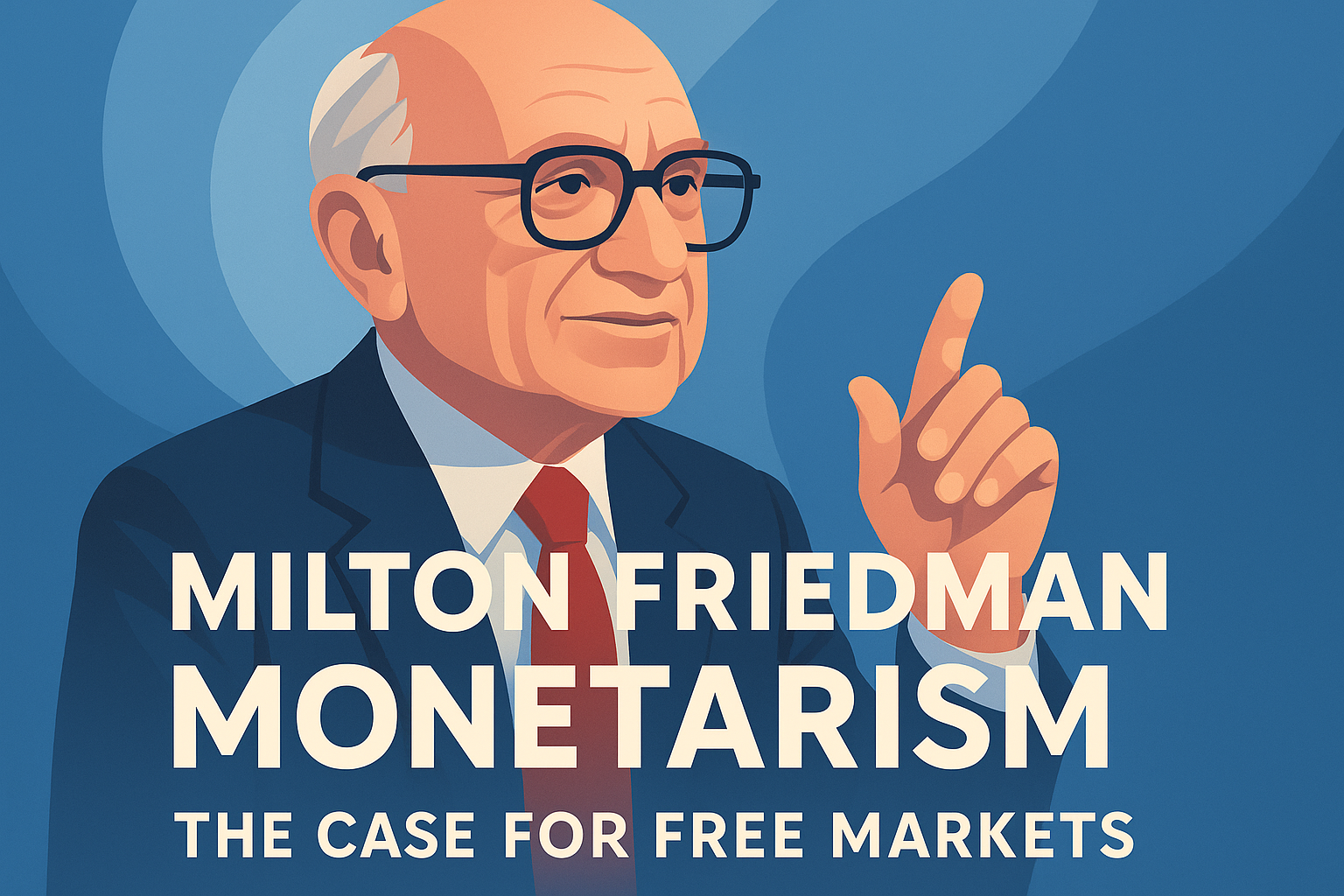
The name Milton Friedman resonates profoundly in the realms of economics and free-market advocacy. As a pivotal figure in the development of monetarism, Friedman has left an indelible mark on economic thought and policy. Monetarism, as championed by Friedman, centers around the importance of controlling the money supply to manage inflation and influence economic stability. Essentially, it suggests that variations in the money supply have major influences on national output in the short run and the price level over longer periods. This theory posits that excessive expansion of the money supply is inherently inflationary, and that monetary authorities should focus primarily on maintaining price stability.
But why does Friedman’s monetarism, and his broader economic philosophy, matter so much? Beyond academic circles, these ideas have informed crucial policy decisions globally, shaping economies and livelihoods. Understanding Friedman’s perspective sheds light on contemporary debates about government regulation, monetary policy, and the role of central banks. As economies worldwide grapple with inflationary pressures and discussions about the merits and pitfalls of free markets and regulation persist, reflecting on Friedman’s work offers valuable insights into these ongoing issues. Examining monetarism and its real-world impact serves as a guide for understanding not only past economic shifts but also potential future trajectories.
Friedman’s Early Work and the Foundations of Monetarism
Milton Friedman’s foray into the theoretical underpinnings of monetarism began with his critique of the prevailing Keynesian orthodoxy. During the mid-20th century, Keynesianism dominated economic policy with its strong emphasis on government intervention and fiscal policy as tools for managing economic cycles. Friedman argued instead for the primacy of monetary policy, suggesting that changes in the money supply were the real culprits behind economic fluctuations. This shift in perspective laid the groundwork for monetarism as not just an economic theory but a policy framework.
An example of monetarism in action can be seen in the Federal Reserve’s policies in the late 20th century. In the 1970s, rampant inflation challenged policymakers, leading to a paradigm shift. During the early 1980s, monetarist policies, influenced by Friedman’s work, were employed to combat inflation by controlling the growth of the money supply. As a result, the inflation rate was reined in, albeit with a temporary rise in unemployment, demonstrating the trade-offs inherent in economic policy.
Real-World Applications of Monetarism
One of the most compelling elements of monetarism is its practical applicability. The theory isn’t just theoretical postulation—it has been instrumental in shaping fiscal and monetary policy across the globe. A quintessential application of monetarism can be observed in the management of inflation through monetary targeting. Monetarists advocate for a fixed annual increase in the money supply, designed to match long-term growth in the productive capacity of the economy.
Consider the case of the UK in the 1980s under Prime Minister Margaret Thatcher. Her administration adopted monetarist principles directly from Friedman, embracing money supply targets as a part of economic policy. While this succeeded in reducing inflation significantly from levels seen in the 1970s, it also led to significant short-term economic pain. The example highlighted the challenging balance between adhering to monetarist principles and managing the social impacts of economic policy.
Understanding the Mechanism: How Monetarism Operates
Monetarism operates through a straightforward, yet profound mechanism: the regulation of the money supply to influence economic outcomes. The foundational belief is that when a central bank controls the supply of money directly, it effectively regulates the economy. Changes in the money supply influence interest rates, investment, consumption, and eventually employment and income levels.
The experience of Germany’s Bundesbank is illustrative. As a central bank, it adopted monetarist policies by using money supply targets to guide its monetary policy. By controlling the growth rate of the money supply, the Bundesbank managed to achieve one of the lowest inflation rates in the developed world during the late 20th century. This approach underscored the effectiveness of monetarism in practical central banking and was often hailed as a model of monetary prudence.
| Country | Period | Monetarist Policy Outcome |
|---|---|---|
| USA | 1980s | Reduced inflation, temporary rise in unemployment |
| UK | 1980s | Lowered inflation, initial economic downturn |
| Germany | Late 20th Century | Low inflation, stability |
Monetarism versus Keynesianism: Different Paths to Economic Stability
At its core, monetarism stands in contrast to Keynesianism concerning how economic stability can best be achieved. While Keynesians emphasize the role of government spending and fiscal policy in managing demand and smoothing out economic cycles, monetarists place monetary policy and control of the money supply at the forefront. This core difference laid the foundation for fierce debates among economists and policymakers about the best approach to managing economies.
The practical differences between these two schools of thought were starkly highlighted during the stagflation crisis of the 1970s. Keynesian policies struggled to address simultaneous inflation and stagnation, leading to the exploration of monetarist perspectives. Ultimately, many governments, notably those in the US and UK, turned to monetarism-inspired policies to control hyperinflation and stabilize their economies, marking a decisive shift away from traditional Keynesian strategies.
Critiques and Challenges of Monetarism
Despite its notable impact, monetarism has not been without its critics. The primary critique revolves around its overly simplified view of the economy. Critics argue that focusing exclusively on money supply ignores other vital factors contributing to economic dynamics, such as fiscal policy, behavioral economics, and the global interconnectedness of financial markets. Furthermore, the monetarist insistence on a mechanical relationship between money supply and economic outcomes has been questioned, particularly regarding its applicability in complex, modern economies subject to rapid technological change.
Moreover, that same mechanistic reliance on money supply targets can lead to adverse social consequences. Critics cite the early 1980s in the US and UK, where the monetarist policies led to high short-term unemployment and economic hardship for many. These instances serve as a reminder of the potential costs associated with strict adherence to monetarist principles.
The Enduring Legacy of Friedman’s Monetarism
Milton Friedman’s legacy in monetarism fundamentally reshaped economic policy-making worldwide. His championing of free-market principles, alongside controlled monetary policy, has influenced generations of economists and policymakers. Despite its challenges, monetarism helped shift the dominant narrative away from an overreliance on government intervention towards a greater emphasis on the efficiency of markets and the importance of inflation control.
The international monetary landscape today continues to reflect Friedman’s influence, with many central banks prioritizing inflation targeting as a primary tool for economic stability. While the debate between monetarism and Keynesianism remains unresolved, Friedman’s work has ensured that considerations of money supply and market efficiency remain central in economic discussions.
The Future of Monetarism in Modern Economics
Looking ahead, monetarism will likely continue to evolve in response to new economic challenges and insights. The fundamental tenets of monetarism—attention to money supply, inflation control, and market-driven efficiency—remain relevant as economies become increasingly interconnected and complex.
As policymakers adapt to innovations in technology, changes in global trade dynamics, and evolving consumer behaviors, the principles of monetarism will continue to guide discussions on monetary policy and market regulation. Those who champion a balance between free markets and regulation must consider the lessons of monetarism, ensuring these insights are adapted to meet contemporary needs.
Ultimately, Friedman’s ideas drive not only ongoing academic debate but also offer practical frameworks that continue to shape modern economic policy.
As we forge ahead in an ever-changing global economy, monetarism provides a lens through which we can evaluate the effectiveness of different economic strategies and adjust our approach accordingly. It calls for a vigilant and nuanced understanding of how monetary policies can foster stability, growth, and prosperity.
For anyone looking to deepen their understanding of economics, exploring Friedman’s contributions to monetarism is an essential step. Researching his work further, watching his debates, and considering his influence on current policies can provide valuable perspectives on both history and future possibilities in economic thought. To truly comprehend the dimensions and impacts of free markets today, engaging with Friedman’s monetarism is indispensable.
In navigating complex economic landscapes, Milton Friedman’s ideas remind us of the power of clear, strategic monetary policy and the enduring importance of trust in free markets. Apply these insights to deepen your economic literacy and engage thoughtfully in discussions about our economic systems.
Frequently Asked Questions
What is monetarism and how did Milton Friedman contribute to its development?
Monetarism is an economic theory that emphasizes the role of governments in controlling the amount of money in circulation. It is predicated on the belief that variations in the money supply are major determinants of national output in the short run and the price level over longer periods. In simpler terms, monetarism argues that managing the money supply is key to achieving economic stability. Milton Friedman, a towering figure in economic thought, invigorated this concept by advocating for a policy rule where governments should increase the money supply at a steady, moderate rate rather than precipitating economic booms and busts through erratic policy-making.
One of Friedman’s major contributions was the challenge he posed to the Keynesian consensus that prevailed in the mid-20th century, which prioritized fiscal policy as a tool for managing the economy. Instead, Friedman argued that monetary policy – through mechanisms like manipulating interest rates and controlling the money supply – should be the primary instrument of economic management. His empirical research and theoretical analysis demonstrated that inflation is always a monetary phenomenon. If the money supply grows faster than real output, prices will rise. This foundational idea helped to shift perspectives and policies during the latter half of the 20th century, leading to central banks across the globe focusing more on money supply management.
How does monetarism propose to combat inflation, and why is this significant?
Monetarism combats inflation by advocating for the control of the money supply. The basic premise is that inflation occurs when there is too much money chasing too few goods. According to monetarists, like Milton Friedman, the key to preventing inflation is to ensure that the growth of money supply is steady and limited, ideally aligning with the growth rate of the nation’s economy. By controlling how much money flows through the economy, it’s possible to maintain stable prices and thus prevent the kind of inflationary spirals that erode purchasing power.
This is significant because uncontrolled inflation can lead to substantial economic instability, reducing consumer and investor confidence, causing distortions in spending and saving, and ultimately deteriorating living standards. By ensuring money supply grows at a predictable, sustainable rate, monetarism aims to create an environment where economic actors can make informed decisions without the fear of unexpected inflation. This is particularly crucial in providing a framework for long-term investments and for maintaining the purchasing power of income earners.
How do free markets fit into Milton Friedman’s economic philosophy?
Free markets are an essential component of Milton Friedman’s economic philosophy. He believed that the best economic outcomes arise when individuals and businesses operate in a market that is free from undue government intervention. According to Friedman, free markets allow for the most efficient allocation of resources. They enable prices to reflect the true value of goods and services, guided by consumer demands and production costs, rather than through centralized control or distortive subsidies and tariffs. This efficiency leads to greater innovation, productivity, and overall economic prosperity.
Friedman was a staunch advocate for minimal government intervention, arguing that when governments try to control economic outcomes directly, they often do more harm than good. Policies such as price controls, excessive regulation, and protectionist measures can create inefficiencies, reduce incentives for businesses, and stifle competition. Instead, free markets empower individuals to make choices based on their preferences and knowledge, which collectively results in a dynamic and adaptable economic system. This principle extended to his support for privatization, competition, and consumer choice across diverse sectors.
What criticisms have been leveled against monetarism and Friedman’s support for free markets?
While Milton Friedman’s ideas have been highly influential, they haven’t been without their share of criticism. One of the main critiques of monetarism is that its focus on controlling the money supply is too simplistic to deal with the complexities of real-world economies. Critics argue that it underestimates the role of other economic variables, such as fiscal policy and external economic shocks. Monetarism’s reliance on stable money supply growth is also considered unreliable by some, because measuring the money supply accurately and predicting its velocity is often fraught with difficulties.
Friedman’s advocacy for free markets has been critiqued from both practical and moral perspectives. Critics point out that completely free markets can lead to market failures, where certain essential goods and services may not be provided effectively. This includes issues like handling public goods, addressing environmental concerns, providing universal healthcare, and ensuring all citizens have access to basic needs. Moreover, the income inequalities and social disparities that can arise in unregulated markets are seen as significant challenges that require targeted intervention. Critics argue that without some level of government regulation and welfare provision, the market alone may not adequately address issues of equity or public welfare.
Why is Milton Friedman considered a pivotal figure in economic thought?
Milton Friedman is considered a pivotal figure in economic thought due to his profound influence on both theoretical economics and practical policy-making. His revitalization of monetarism provided a compelling alternative to the Keynesian economic theory that dominated mid-20th-century economic policy and understanding. By spotlighting the crucial role of the money supply in managing inflation and economic cycles, Friedman significantly shifted the focus of governments and central banks, particularly in terms of monetary policy design.
Furthermore, his broader free-market ideology had a transformative impact on public policy around the world. His insights and arguments provided intellectual support for the deregulation, privatization, and tax reform efforts that characterized late 20th-century economic policy, particularly during the Reagan and Thatcher eras. Friedman’s work, like ‘Capitalism and Freedom’ and ‘Free to Choose’ (the latter co-authored with his wife Rose Friedman), helped popularize and disseminate these ideas beyond academia, demonstrating the real-world implications of economic theory. His ability to effectively communicate complex economic principles to the public further cemented his legacy as an influential economist and public intellectual.