
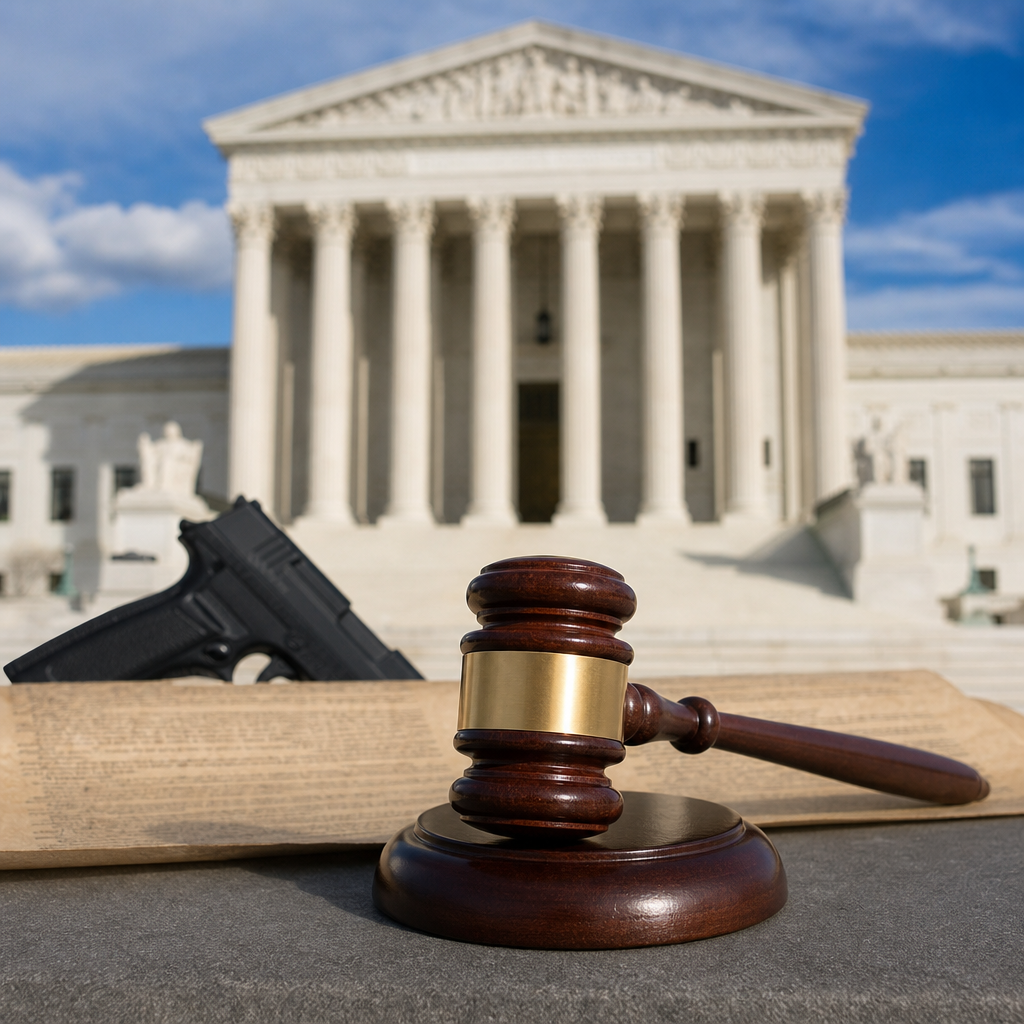
McDonald v. Chicago is the Supreme Court case that made the Second Amendment apply to state and local governments, not just the federal government, and that single holding turned a major constitutional debate into a practical rule for every city, county, school district, and police department in the United States. In AP Government and Politics, the case matters because it sits at the intersection of selective incorporation, federalism, civil liberties, judicial review, and the long argument over how the Bill of Rights limits power at different levels of government. When students ask what “incorporating the Second Amendment” means, the direct answer is simple: the Court held in 2010 that the right to keep and bear arms is protected from infringement by the states through the Fourteenth Amendment. But the case is important for more than a test definition. It explains how constitutional rights travel from the first ten amendments into daily life in states and cities, why the Due Process Clause became the main vehicle for that process, and how precedent builds over time. I have taught this case by pairing it with District of Columbia v. Heller because McDonald makes little sense without Heller’s earlier recognition of an individual right to possess a handgun for self-defense in the home. Together, the two cases form a sequence: first define the right, then decide whether states must respect it. That sequence is central to understanding modern constitutional law.
Before McDonald, Chicago maintained strict handgun regulations that effectively barred many residents from legally possessing handguns in their homes. Otis McDonald, a Chicago resident, challenged the law after arguing that he needed a handgun for self-defense in a neighborhood with serious crime problems. His claim raised a core constitutional question: if the Second Amendment protects an individual right, can a city still block ordinary residents from exercising it? The answer depended on incorporation, the doctrine through which the Supreme Court has made most Bill of Rights protections enforceable against the states. Incorporation is not automatic. Early in American history, the Bill of Rights applied only to the federal government, a principle the Court announced in Barron v. Baltimore in 1833. After the Civil War, the Fourteenth Amendment created new constitutional constraints on states, but the Court did not immediately apply all rights against them. Instead, over decades, the justices selectively incorporated particular rights they considered fundamental to ordered liberty or deeply rooted in the nation’s history and tradition. McDonald belongs in that story. It is not just a gun-rights case; it is a major incorporation case, and that is why it shows up repeatedly in AP Government review materials, constitutional law courses, and debates over state police powers.
Background: From Barron to Heller to McDonald
To understand McDonald v. Chicago, start with the constitutional baseline. In Barron v. Baltimore, Chief Justice John Marshall wrote that the Bill of Rights restricted only the national government. That meant states could violate speech, religion, jury, or arms protections without violating the federal Constitution, unless their own state constitutions said otherwise. The Fourteenth Amendment, ratified in 1868, changed the constitutional structure by prohibiting states from depriving any person of life, liberty, or property without due process of law and from denying equal protection of the laws. Lawyers and scholars have long argued that the amendment was designed in part to protect newly freed African Americans from disarmament and violence in the post-Civil War South. That historical context matters because McDonald relied heavily on the idea that the right to keep and bear arms was understood as fundamental during Reconstruction.
The modern path to McDonald ran through District of Columbia v. Heller in 2008. Heller struck down the District of Columbia’s handgun ban and requirement that lawful firearms in the home be kept inoperable. Justice Antonin Scalia’s majority opinion held that the Second Amendment protects an individual right to possess a firearm for lawful purposes, especially self-defense within the home. Because the District of Columbia is a federal enclave rather than a state, Heller did not resolve whether the same right constrained state and local governments. That gap is exactly where McDonald came in. Chicago and Oak Park had ordinances similar in practical effect to the law invalidated in Heller, and challengers argued that a constitutional right recognized against the federal government should also protect citizens against municipal regulation.
The Facts and Constitutional Question
Otis McDonald was the lead plaintiff, but the case involved several Chicago residents who wanted to keep handguns at home for self-defense. They argued that Chicago’s gun regulations violated the Second and Fourteenth Amendments. The city defended its ordinance as a valid response to urban gun violence, a familiar argument in local government law because municipalities traditionally claim broad police powers to protect health, safety, and welfare. The Supreme Court therefore faced a precise constitutional question: does the Second Amendment right recognized in Heller apply to the states through the Fourteenth Amendment?
That question had two possible doctrinal routes. One was the Due Process Clause, which the Court had used for most modern incorporation decisions. The other was the Privileges or Immunities Clause, which some scholars and litigants have argued should protect substantive rights of national citizenship. The Privileges or Immunities Clause had been largely narrowed by the Slaughter-House Cases in 1873, so reviving it would have reshaped constitutional doctrine. Many court watchers saw McDonald as a possible vehicle for that revival. The Court declined to go that far, but the argument itself is important for AP Government students because it shows that constitutional law often includes debates over which clause does the doctrinal work, not just whether a right exists.
The Supreme Court’s Holding and Reasoning
In a 5-4 decision issued in 2010, the Supreme Court held that the Second Amendment is fully applicable to the states. Justice Samuel Alito wrote the plurality opinion, joined by Chief Justice Roberts and Justices Scalia and Kennedy. Justice Clarence Thomas supplied the fifth vote in the judgment, but on different reasoning. Alito’s opinion used the Court’s established selective incorporation test under the Fourteenth Amendment’s Due Process Clause. The key rule was straightforward: a right is incorporated if it is fundamental to the American scheme of justice or deeply rooted in the nation’s history and tradition. Applying that standard, the plurality concluded that the right to keep and bear arms for self-defense is fundamental.
The opinion relied on several strands of reasoning. First, Heller had already identified self-defense as the central component of the Second Amendment right. Second, historical evidence from the Founding era and Reconstruction showed that the right to possess arms was considered important for personal security. Third, post-Civil War efforts to disarm freedmen supported the view that the Fourteenth Amendment was understood as a protection against state interference with that right. The plurality therefore treated the Second Amendment like most other incorporated rights in the Bill of Rights. Once incorporated, it binds states and their political subdivisions, including cities such as Chicago.
Justice Thomas agreed with the result but rejected the use of substantive due process as the constitutional basis. In his concurrence, he argued that the right to keep and bear arms should be applied to the states through the Privileges or Immunities Clause. That opinion has become especially important for students of constitutional theory because it revived a serious originalist critique of modern incorporation doctrine. Although Thomas did not persuade a majority, his concurrence is widely discussed in law school casebooks and among scholars who believe the Court should reconsider the Slaughter-House Cases.
| Case | Year | Main Holding | Why It Matters |
|---|---|---|---|
| Barron v. Baltimore | 1833 | Bill of Rights applies only to the federal government | Created the original non-incorporation rule |
| District of Columbia v. Heller | 2008 | Second Amendment protects an individual right to possess a handgun for self-defense in the home | Defined the right before incorporation |
| McDonald v. Chicago | 2010 | Second Amendment applies to states and local governments through the Fourteenth Amendment | Extended the right nationwide against state action |
| New York State Rifle & Pistol Association v. Bruen | 2022 | Public carry restrictions must fit the nation’s historical tradition of firearm regulation | Expanded the framework for later Second Amendment cases |
Dissenting Views and the Limits of the Decision
The dissenting justices did not all make the same argument, but they agreed that the Court should not have incorporated the Second Amendment in the way the majority did. Justice Stevens argued that the right recognized in Heller was not the kind of fundamental liberty that should be imposed on the states through the Due Process Clause. Justice Breyer, joined by Justices Ginsburg and Sotomayor, emphasized judicial restraint, federalism, and the practical problem of gun violence. In plain terms, the dissenters believed local officials were better positioned than federal judges to weigh the costs and benefits of gun regulations in dense urban areas. That disagreement highlights a recurring constitutional divide: should courts treat certain rights as so fundamental that local experimentation must give way, or should democratically accountable state and city governments have broader room to regulate?
McDonald also did not create an unlimited right to possess any weapon anywhere for any purpose. Heller itself said that the right is not unlimited, and McDonald repeated that understanding. Longstanding prohibitions on firearm possession by felons and the mentally ill, laws forbidding guns in sensitive places such as schools and government buildings, and conditions on the commercial sale of arms were described in Heller as presumptively lawful. In practice, that meant Chicago lost its broad handgun ban, but governments retained significant regulatory authority. This point is crucial for exam answers: McDonald incorporated the right, but it did not eliminate all gun control.
Why McDonald Matters in AP Government and Politics
For AP Government and Politics, McDonald is a high-value case because it connects multiple required concepts in one decision. It is first a civil liberties case because it concerns an individual right. It is also a federalism case because it determines whether states and municipalities must follow a national constitutional standard. It is a judicial review case because the Supreme Court invalidated local policy choices. And it is a Fourteenth Amendment case because incorporation depends on post-Civil War constitutional change. Students who can explain those links usually understand the case better than those who memorize only the result.
McDonald also serves as a model for how the Court uses precedent. Heller supplied the definition of the right; McDonald supplied the application to the states; later cases debate the scope of that right. That pattern appears across constitutional law. For example, the Court first recognizes a liberty interest, then later decides how broadly it applies, what level of scrutiny or test governs, and what exceptions remain. In my experience, students remember McDonald best when they frame it as the “second step after Heller.” If Heller asks, “What does the Second Amendment protect?” McDonald asks, “Who must obey that protection?” The answer is every level of government subject to the Fourteenth Amendment.
Real-World Effects on State and Local Gun Laws
After McDonald, state and local governments could no longer maintain outright handgun bans like Chicago’s. Many jurisdictions revised their codes to focus instead on licensing systems, background checks, waiting periods, storage rules, concealed-carry requirements, and restrictions on particular locations. Litigation increased because once a right is incorporated, challengers can test a wider range of regulations in federal court. That does not mean every challenge succeeds. Courts for years upheld many regulations under intermediate scrutiny or similar balancing approaches, especially when governments presented evidence linking the law to public safety. But McDonald ensured that such regulations had to be justified under constitutional review rather than accepted as beyond the reach of the Second Amendment.
The longer-term effects became even clearer after New York State Rifle & Pistol Association v. Bruen in 2022. Bruen held that modern firearm regulations must be consistent with the nation’s historical tradition of firearm regulation, rejecting the two-step scrutiny framework many lower courts had used. Bruen would not have been possible in its current form without McDonald, because incorporation made the Second Amendment a nationwide constraint on state licensing regimes. For students following current events, this shows how one major case often sets up the next. McDonald nationalized the right; Bruen reshaped the test for evaluating restrictions.
How to Explain McDonald Clearly on an Exam
A strong exam response should identify the case, the year, the constitutional basis, and the significance in one compact statement. A model sentence is this: In McDonald v. Chicago, the Supreme Court held in 2010 that the Second Amendment right to keep and bear arms for self-defense is incorporated against state and local governments through the Fourteenth Amendment. From there, add one sentence connecting the case to selective incorporation and one sentence explaining that the decision limited local handgun bans but did not invalidate all gun regulations. That combination usually earns full credit because it covers holding, doctrine, and practical effect.
Students should also avoid two common mistakes. First, do not say McDonald created the individual right to bear arms; Heller did that two years earlier. Second, do not say incorporation means every detail of a right becomes absolute. Incorporated rights still have boundaries, exceptions, and ongoing doctrinal fights. The best constitutional analysis is precise. McDonald incorporated the Second Amendment; it did not settle every future dispute over assault weapons, magazine limits, age restrictions, permitting rules, or sensitive-place regulations. Those issues continue to be litigated, often with different outcomes across circuits until the Supreme Court intervenes.
McDonald v. Chicago remains one of the most important Supreme Court decisions for understanding incorporation, the Fourteenth Amendment, and the national reach of civil liberties. Its lasting lesson is that constitutional rights do not matter only in Washington. They shape what cities can ban, what states can regulate, and what individuals can claim in court when local laws go too far. For AP Government and Politics, the case is especially useful because it ties together doctrine, history, institutions, and public policy in a way few decisions do. Remember the sequence: Barron limited the Bill of Rights to the federal government, Heller defined an individual Second Amendment right, and McDonald applied that right to the states. If you can explain that chain clearly, you can explain why incorporation matters across the entire course. Use McDonald as a hub case when reviewing civil liberties, federalism, and the Supreme Court, and then connect it to related cases to deepen your understanding.
Frequently Asked Questions
What was the Supreme Court’s holding in McDonald v. Chicago?
In McDonald v. Chicago (2010), the Supreme Court held that the Second Amendment right to keep and bear arms applies not only to the federal government, but also to state and local governments. That was the key constitutional change created by the case. Before McDonald, the Court had already ruled in District of Columbia v. Heller (2008) that the Second Amendment protects an individual right to possess a firearm for lawful purposes such as self-defense in the home. But Heller involved the District of Columbia, a federal jurisdiction, so it did not answer whether states, cities, and counties were bound by that same rule. McDonald answered that question directly.
The Court struck down Chicago’s handgun restrictions because they violated a right that the justices said is fundamental and therefore enforceable against the states through the Fourteenth Amendment. In practical terms, that meant local governments could no longer treat the Second Amendment as a limit that applied only to Congress or federal officials. Instead, every layer of government in the United States had to recognize that the constitutional right identified in Heller also constrained state legislatures, city councils, police departments, and other local authorities.
For AP Government and Politics, the holding matters because it is a clear example of the Court transforming a constitutional principle into a nationwide rule. The decision took a long-running debate about the Bill of Rights and made it operational in everyday governance. After McDonald, state and local gun laws were open to direct constitutional challenge under the Second Amendment in a way they had not been before.
How does McDonald v. Chicago relate to selective incorporation and the Fourteenth Amendment?
McDonald v. Chicago is one of the most important modern examples of selective incorporation, the process through which the Supreme Court has applied most protections in the Bill of Rights to the states by way of the Fourteenth Amendment. Originally, the Bill of Rights restricted only the federal government. Over time, however, the Court held that certain rights are so fundamental to ordered liberty and the American system of justice that states must respect them as well. That process did not happen all at once. Instead, the Court incorporated rights one by one, selectively, rather than automatically applying the entire Bill of Rights to the states in a single decision.
In McDonald, the Court concluded that the right recognized in Heller—the individual right to keep and bear arms for self-defense—is fundamental enough to be incorporated. The majority relied on the Due Process Clause of the Fourteenth Amendment to do so. That is significant because most incorporation cases use the Due Process Clause, even though some scholars and justices have argued that the Privileges or Immunities Clause would be a more textually natural basis. Justice Clarence Thomas, in a separate opinion, supported incorporation through the Privileges or Immunities Clause instead, which is one reason the case is often discussed in constitutional law courses as well as AP Government classes.
The broader lesson is that McDonald fits into a major constitutional pattern: the Fourteenth Amendment has become the mechanism that makes many national civil liberties enforceable against the states. So when students study freedom of speech, criminal procedure rights, religious liberty, and now the Second Amendment, they are often really studying the larger doctrine of incorporation. McDonald shows that incorporation is not just an abstract legal theory; it changes what state and local governments can actually do.
Why is McDonald v. Chicago so important for federalism and state power?
McDonald v. Chicago is a major federalism case because it defines the balance between national constitutional rights and state or local policymaking authority. Federalism is the division of power between the national government and the states. In many policy areas, states and local governments have broad authority to legislate based on local conditions, preferences, and public safety concerns. Gun regulation has long been one of those contested areas. Before McDonald, supporters of strict local gun laws could argue that states and cities had substantial freedom to regulate firearms without being directly constrained by the Second Amendment as interpreted in Heller.
After McDonald, that autonomy narrowed. The Court did not say states lost all power to regulate guns. In fact, both Heller and later cases made clear that the right is not unlimited. Governments may still regulate firearms in various ways, such as restricting possession by certain categories of people or regulating sensitive places, subject to constitutional review. But McDonald established that state and local governments must exercise that power within constitutional boundaries. They cannot simply ignore the Second Amendment or treat it as irrelevant to local lawmaking.
That is why the case is so important in AP Government. It demonstrates that federalism does not mean states are sovereign in the face of fundamental constitutional rights. The Fourteenth Amendment altered the original state-federal relationship by giving the national judiciary a stronger role in supervising state conduct when civil liberties are at stake. McDonald is a concrete example of that shift. It shows how the Supreme Court can preserve a national baseline of rights while still leaving room for policy variation at the state and local level.
What is the connection between McDonald v. Chicago and District of Columbia v. Heller?
McDonald v. Chicago cannot really be understood without District of Columbia v. Heller. In Heller, decided in 2008, the Supreme Court held that the Second Amendment protects an individual right to possess a handgun for lawful purposes, especially self-defense in the home. That was a landmark ruling because it rejected the narrower view that the Second Amendment protected only a militia-related collective right. However, Heller applied only to the federal government because the District of Columbia is under federal authority.
McDonald, decided two years later, asked the next obvious question: if the Second Amendment protects an individual right, does that right also limit state and local governments? The Court said yes. In that sense, Heller defined the substance of the right, while McDonald extended its reach. Together, the two cases form a constitutional sequence. Heller established what the Second Amendment means in modern constitutional law, and McDonald made that interpretation binding nationwide through incorporation.
This connection is especially important for students because it highlights how Supreme Court doctrine often develops in stages. One case announces a principle; a later case determines who must obey it. Without Heller, there would have been no modern individual-right framework for the Court to incorporate in McDonald. Without McDonald, Heller would have remained far less significant for everyday state and local governance. Together, the two decisions reshaped the legal landscape around gun rights and constitutional litigation.
Why does McDonald v. Chicago matter in AP Government and Politics courses?
McDonald v. Chicago matters in AP Government and Politics because it brings together several core topics in one case: civil liberties, selective incorporation, judicial review, federalism, constitutional interpretation, and the policymaking role of the Supreme Court. It is not just a case about guns. It is a case about how constitutional rights become enforceable against different levels of government and how the Court decides whether a liberty is fundamental enough to receive national protection under the Fourteenth Amendment.
The case also helps students see the practical impact of judicial review. The Supreme Court was not merely discussing theory; it invalidated local laws and changed what governments across the country could do. That makes McDonald a strong example of how the judiciary influences public policy. Once the Court incorporated the Second Amendment, it opened the door for new lawsuits against state and local gun regulations, requiring judges around the country to assess whether those laws were constitutionally permissible.
Just as importantly, the case sits at the center of an enduring American argument over liberty and public safety. AP Government often asks students to think about how rights claims interact with governmental interests. McDonald is a perfect case for that discussion because it does not end the debate; it frames it. After the decision, the question was no longer whether the Second Amendment applies to the states, but how far the right extends and what regulations remain valid. That makes the case both doctrinally important and politically relevant, which is exactly why it continues to appear in classroom discussions of constitutional government.